
Shed Building Permits in Rathdrum
Permit area
Rathdrum
Decision point
Check early
Builder path
Plan the site
Content
Payload editable
Permit planning
Use this Rathdrum permit page before you build
Planning area
Route
FAQ support
- Confirm whether the property is inside city limits or county jurisdiction.
- Check size, foundation, utility, and intended-use rules before ordering materials.
- Use the builder after permit and site constraints are clear enough to shape the shed.
How Rathdrum handles shed permits
The City of Rathdrum Building Department ((208) 687-7242) issues building permits inside city limits. The city's own permitting documentation uses a checklist for accessory structures over 200 square feet, indicating that a shed over 200 square feet needs a building permit while a smaller one is generally exempt. Confirm the precise local cutoff by phone.
Setbacks and placement follow Rathdrum City Code 11-5-2 and apply at any size. In Idaho, electrical, plumbing, and HVAC permits are usually issued by the state Division of Occupational and Professional Licenses (DOPL), separately from any local building permit — and a wired or plumbed shed can need a state trade permit even when the shed itself is small enough to skip a building permit.
Rathdrum shed permit snapshot
Rathdrum shed permit snapshot
- Building-permit threshold
- Accessory structures over 200 sq ft need a city building permit (per the city's accessory-structure checklist). Confirm the exact cutoff with the city.
- Adopted codes
- 2018 IBC and 2018 IRC, as adopted statewide by Idaho.
- Setbacks (RCC 11-5-2)
- An accessory structure up to 300 sq ft must sit at least 5 ft from a side or rear line, or half its wall height, whichever is greater — a 300 sq ft break separate from the 200 sq ft permit trigger.
- Snow load
- High — the University of Idaho study lists Rathdrum near 87 psf ground snow load; Kootenai County is an ASCE 7 case-study area. Confirm the design value.
- Trade permits
- Electrical, plumbing, and HVAC permits are state (DOPL) permits — DOPL: (208) 334-3233.
- Overlays
- Rathdrum sits over the Spokane Valley-Rathdrum Prairie sole-source aquifer; stormwater/grading rules can apply to larger projects.
| Rathdrum shed permit snapshot | |
|---|---|
| Building-permit threshold | Accessory structures over 200 sq ft need a city building permit (per the city's accessory-structure checklist). Confirm the exact cutoff with the city. |
| Adopted codes | 2018 IBC and 2018 IRC, as adopted statewide by Idaho. |
| Setbacks (RCC 11-5-2) | An accessory structure up to 300 sq ft must sit at least 5 ft from a side or rear line, or half its wall height, whichever is greater — a 300 sq ft break separate from the 200 sq ft permit trigger. |
| Snow load | High — the University of Idaho study lists Rathdrum near 87 psf ground snow load; Kootenai County is an ASCE 7 case-study area. Confirm the design value. |
| Trade permits | Electrical, plumbing, and HVAC permits are state (DOPL) permits — DOPL: (208) 334-3233. |
| Overlays | Rathdrum sits over the Spokane Valley-Rathdrum Prairie sole-source aquifer; stormwater/grading rules can apply to larger projects. |
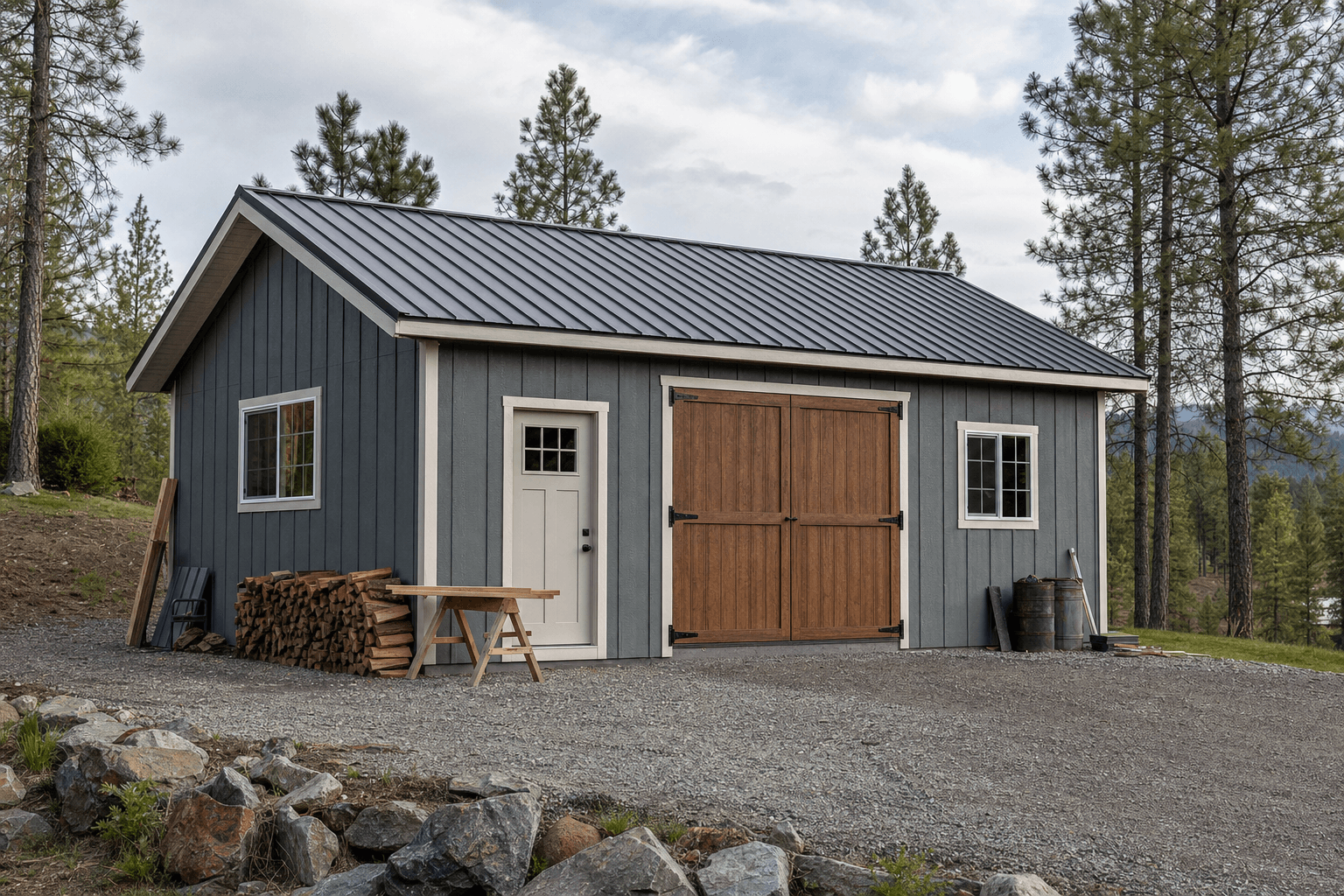
Rathdrum's high ground snow load makes the roof design the first decision — confirm the value before finalizing pitch and framing.
Two different square-foot triggers
Rathdrum has two thresholds that are easy to mix up. The building-permit trigger is 200 square feet — over it, you need a permit. The setback rule, in RCC 11-5-2, uses a 300-square-foot break: an accessory structure up to 300 square feet can sit no closer than 5 feet from a side or rear line, or half its wall height, whichever is greater.
So a shed can be permit-exempt and still fall under the under-300 setback tier. Keep the two numbers separate when you plan placement.
High snow load is the design driver
Rathdrum sits in a notably high-snow-load part of Kootenai County — the University of Idaho study lists it near 87 psf ground snow load, and the county is treated as an ASCE 7 case-study area where site-specific determination is expected. That makes the roof design, pitch, and framing the first decision, not an afterthought.
Design the shed to the actual ground snow load for the parcel rather than a generic minimum.
Trade permits and the aquifer
Electrical, plumbing, and HVAC permits route through the state DOPL, separate from the city building permit. Rathdrum also sits over the Spokane Valley-Rathdrum Prairie sole-source aquifer, so stormwater and grading considerations can apply — usually more to larger projects than to a small shed, but worth checking.
Treat this as planning context, not a permit decision. Thresholds, setbacks, fees, and adopted code editions change, so confirm the current rule for your exact parcel with the authority that has jurisdiction before you order materials.
Rathdrum shed permit FAQs
What size shed needs a permit in Rathdrum?
The city's accessory-structure checklist applies to structures over 200 square feet, indicating a shed over 200 square feet needs a building permit while a smaller one is generally exempt. Confirm the precise cutoff with the Building Department at (208) 687-7242.
Why are there two square-foot numbers?
They do different things. 200 square feet is the building-permit trigger; 300 square feet is a setback break in RCC 11-5-2. A shed can be permit-exempt and still fall under the under-300 setback tier, which requires at least 5 feet from a side or rear line, or half the wall height, whichever is greater.
How much snow load should a Rathdrum shed handle?
A lot — the University of Idaho study puts Rathdrum near 87 psf ground snow load, and the county is an ASCE 7 case-study area. Design the roof to the actual value for the parcel and confirm with the building official.
Who issues electrical permits?
The state (DOPL) at (208) 334-3233. Electrical, plumbing, and HVAC permits are separate from the city building permit.
Plan a Rathdrum shed
Design the roof to the area's snow load and keep the two square-foot triggers straight, then size the shed in the builder — or send the details for an estimate.
Next step