Rathdrum sits at the western edge of Kootenai County, spread across the open ground of the Rathdrum Prairie between Post Falls and the lakes country to the north. For years it was a quiet farm town; now it is one of the fastest-growing cities in North Idaho, with new subdivisions filling in the prairie west of Hayden faster than the storage ever caught up. We build right where you live — storage sheds, detached garages, and finished backyard rooms assembled on your property instead of trucked in finished from a lot somewhere else.
Building on-site is what makes a shed actually work on a Rathdrum lot. The newer prairie subdivisions are platted flat and tight, with the buildable area boxed in by setbacks, drainage swales, and a fence line that often went up before anyone thought about an outbuilding. When the crew builds in place, the shed goes exactly where it fits — through the side gate, into the back corner, onto a pad we level to your grade — instead of wherever a delivery truck happened to be able to reach.
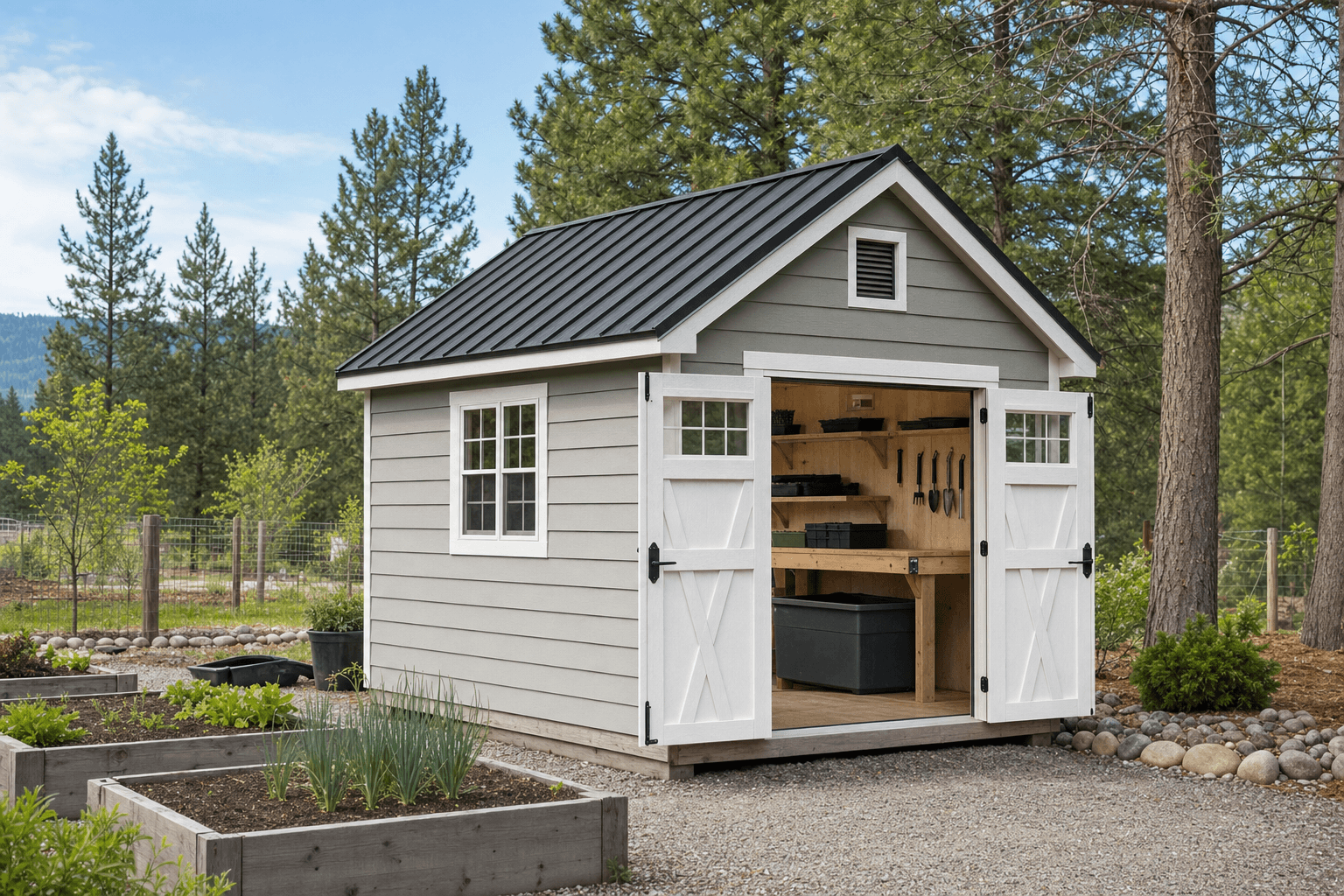
A custom shed built on-site on a Rathdrum Prairie subdivision lot, sized to the fenced backyard and the side gate it had to fit through.
Most Rathdrum customers come to us for reasons that all trace back to fast growth on the prairie. The new house came with a two-car garage that filled up the first winter, the subdivision lot has no basement and nowhere to put the snowblower and the lake gear, or someone needs a quiet place to work now that the spare bedroom is spoken for. We build all of it on your lot. A storage shed clears totes, lawn equipment, and the paddleboards out of the garage; a detached garage or shop adds real bay space for a project car or a side-by-side; a she shed carves out a studio in the backyard; and a backyard office gives remote workers a door that closes between them and the household.
Access and the plat are the first things we sort out. A lot of Rathdrum backyards are reached through a single gate between the house and the fence, and the usable footprint is shaped by the builder's drainage easement and the recorded setbacks on your lot. Building in place means the shed still ends up where you actually want it — no crane, no pulling fence panels, no settling for the front corner because that is as far as a finished building could be dropped. On the older parcels closer to downtown and the larger lots out toward Twin Lakes and Spirit Lake, where there is more room and some slope, we plan the pad and footprint around the grade so the building sits level and drains away from the structure.
New prairie homes rarely have a basement, so the garage fills fast. A storage shed pulls totes, lawn gear, the snowblower, and Twin Lakes equipment back out into a dry, organized building.
Larger prairie and acreage lots often have room for a real shop bay — somewhere for the project car, the side-by-side, the boat, and a heated workbench for winter.
A finished backyard office or she shed for remote work, an art studio, or a quiet retreat — insulated and wired so it stays comfortable through a Rathdrum Prairie winter.
Rathdrum and Kootenai County handle accessory buildings the way most North Idaho jurisdictions do: smaller utility sheds under a set square-footage threshold usually skip a building permit, while larger footprints, anything with power or plumbing, and any building you intend to occupy generally need one. Permits inside city limits run through the City of Rathdrum; lots in the surrounding county go through Kootenai County. Even when no permit is required, setbacks still are — your building has to sit a minimum distance from side and rear property lines, and Rathdrum's newer prairie subdivisions often carry tighter platted setbacks and drainage easements than the older parcels in town. Because nearly all of the prairie sits over the Rathdrum Prairie Aquifer — the sole-source aquifer that supplies drinking water across the region — local rules pay close attention to drainage and anything that could reach groundwater, which is one more reason we set buildings on a clean, well-drained pad.
If your property is in an HOA — newer planned subdivisions like Radiant Lake, Brookshire, and Westwood Pines are common across the prairie — architectural rules usually go beyond county code, dictating siding, roof color, trim, and where an outbuilding may sit relative to the home. Those rules show up often in Rathdrum because so much of the housing here is recent, master-planned construction. Check your CC&Rs and get architectural approval before you finalize anything. Our permits and placement guide covers the county basics and setbacks, and the storage shed planning guide helps you lock in a size before you apply.
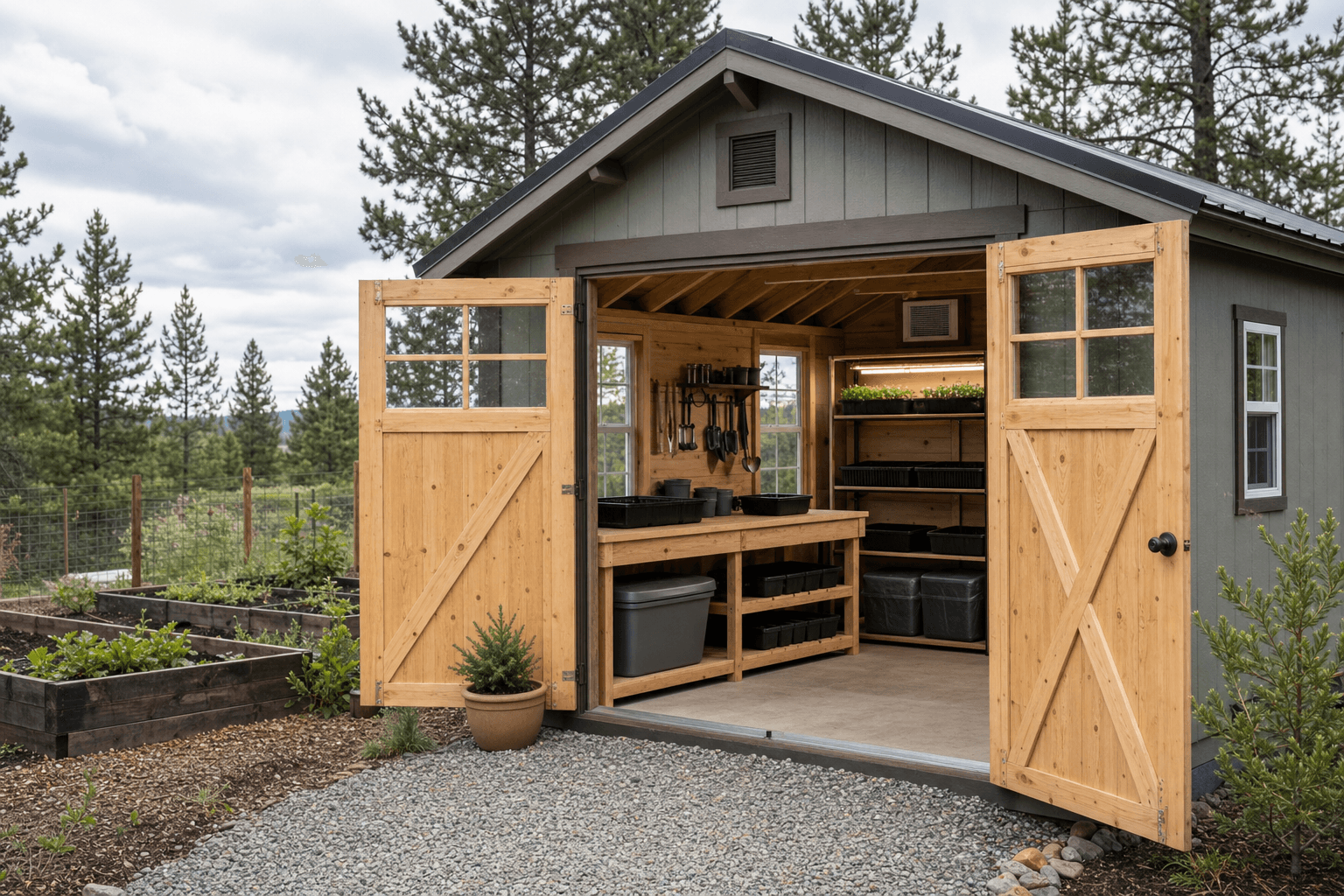
A detached garage built on-site on a larger Rathdrum lot toward Twin Lakes, with a roof pitch and anchoring rated for prairie snow load.
Rathdrum Prairie winters are real North Idaho winters, and the open prairie catches wind and drifting snow that more sheltered lots do not. A shed here has to carry a meaningful snow load on the roof, shrug off freeze-thaw at the foundation, and keep a door that still swings after a storm drifts snow against it overnight. We build to the roof pitch and anchoring the local load calls for, and we set most buildings on a compacted gravel pad that drains snowmelt and keeps the floor up off wet ground — a better fit for the prairie than a slab that traps water against the structure.
Site matters as much as weather. In-town and prairie subdivision lots are usually graded flat but boxed in by drainage swales you do not want a building blocking, while lots toward Twin Lakes, Spirit Lake, and the timbered edges of the prairie pick up slope and tree shade that stays damp into spring. We level and drain the pad so the building stays square and dry for the long haul. A 10x16 or 12x16 covers most Rathdrum storage and shop needs with room to grow, while a compact 8x12 tucks neatly into a tighter subdivision backyard without eating the whole lawn.
Rathdrum, Kootenai County, on the Rathdrum Prairie west of Hayden and north of Post Falls — permits run through the City of Rathdrum or Kootenai County depending on where your lot sits.
Small utility sheds often skip a permit; larger footprints, occupied buildings, and anything with power or plumbing usually need one — and in most prairie subdivisions, HOA approval is required on top of it.
Plan for a meaningful winter snow load on the roof, open-prairie wind and drifting, freeze-thaw at the foundation, and a gravel pad that drains snowmelt away from the building.
We reach all of Rathdrum and the surrounding prairie for the build — tight subdivision gates, narrow side yards, drainage easements, and acreage lots toward Twin Lakes are all handled in place, no crane needed.
It depends on size, use, and where your lot sits. Smaller utility sheds under the local square-footage threshold usually do not need a building permit, but larger buildings, anything you plan to occupy, and any shed with power or plumbing generally do. Permits inside city limits run through the City of Rathdrum, while lots in the surrounding county go through Kootenai County. Setbacks from property lines apply either way, and because the whole area sits over the Rathdrum Prairie Aquifer, drainage and groundwater protection get extra attention. We help you size and place the building to fit, and our permits guide covers the basics.
In most of the newer prairie subdivisions, yes. Planned communities like Radiant Lake, Brookshire, and Westwood Pines have architectural committees and CC&Rs that govern outbuildings — often specifying siding, roof color and pitch, maximum size, and where the building may sit relative to the home. That approval is separate from any city or county permit, so plan for both. Read your covenants and submit for written approval before you finalize anything. We match the building's style, roofline, and placement to what your HOA allows so it fits the neighborhood and clears the architectural review.
Yes — that is a lot of what we build here. Rathdrum's newer prairie subdivisions tend to have flat, fenced lots with a buildable area boxed in by side and rear setbacks plus a builder's drainage swale or easement you cannot block. Because we build on-site, we can work a compact 8x12 or 10x12 through a single side gate and set it in the back corner without a crane or pulling fence panels. We size and place the building to the recorded setbacks on your specific lot so it clears the easements and still leaves you usable yard.
A shed itself is straightforward, but the aquifer is the reason the prairie pays close attention to drainage. The Rathdrum Prairie Aquifer is the sole-source drinking-water supply for much of the region, so local rules care about runoff and anything that could reach groundwater. For a standard storage shed or garage that mostly means setting it on a clean, well-drained gravel pad that moves snowmelt and rainwater away from the structure rather than pooling it. If you are adding plumbing or want the building occupied, that is where permitting and any utility connections come in, and we plan the pad and placement with drainage in mind from the start.
For most Rathdrum yards, a 10x16 or 12x16 hits the sweet spot — enough room for lawn equipment, lake gear, the snowblower, and the garage overflow that piles up in a prairie house with no basement, with space to grow. Tighter subdivision backyards often do well with a compact 8x12 or 10x12, while larger prairie and acreage lots toward Twin Lakes and Spirit Lake frequently step up to a detached garage or shop. We size the building to your lot, your access, and what you actually need to store.
Rathdrum gets real Panhandle winter weather, and the open prairie adds wind and drifting snow that more sheltered lots do not see, so the roof has to carry a meaningful snow load, the foundation has to handle freeze-thaw, and the doors need to keep working after snow drifts against them overnight. We build to the roof pitch and anchoring the local load calls for and set most buildings on a gravel pad that drains snowmelt instead of trapping it against the structure. If you want the shed usable year-round as a shop, office, or studio, we can insulate and wire it to stay comfortable through the cold months.
Tell us about your lot, your subdivision, and what the building is for. We will help you size and place it for Rathdrum Prairie weather, HOA rules, and Kootenai County setbacks — then you can build and price it online.
On-site shed building reaches HOAs and neighborhoods across Rathdrum. Open your community for local access, setback, and HOA-approval notes before you request a quote.
Check local permit, setback, and placement rules before you build on site.
We build on site across North Idaho. Explore other cities and towns we serve.