How Idaho Shed Permits Work: A Statewide Overview
Permit area
North Idaho
Decision point
Check early
Builder path
Plan the site
Content
Payload editable
Permit planning
Use this North Idaho permit page before you build
Planning area
Route
FAQ support
- Confirm whether the property is inside city limits or county jurisdiction.
- Check size, foundation, utility, and intended-use rules before ordering materials.
- Use the builder after permit and site constraints are clear enough to shape the shed.
Idaho sets the codes; the local office issues the permit
Idaho adopts building codes at the state level and lets local governments enforce them. A building permit is issued by whichever city or county has assumed jurisdiction over the parcel — and where no local building department exists, the state's building bureau acts as the authority. That is why two parcels a few miles apart can follow different processes.
The trades are where Idaho is distinctive. Electrical, plumbing, and HVAC permits are commonly issued by the state, not the local building department, through the Division of Occupational and Professional Licenses (DOPL). DOPL absorbed the former Division of Building Safety, so the old dbs.idaho.gov address now redirects to dopl.idaho.gov.
- Building codeIdaho enforces the 2018 I-Codes statewide (2018 IBC, IRC, IECC, IMC, IFGC). A proposed move to the 2024 codes was rejected by the Idaho House committee in February 2026, so the 2018 editions remain current.
- ElectricalThe 2023 National Electrical Code applies statewide. Electrical permits are issued by the state DOPL electrical program in most jurisdictions.
- Plumbing & HVACThe 2017 Idaho State Plumbing Code applies; plumbing and HVAC permits are typically state-issued through DOPL.
- Shed exemptionA one-story detached storage shed of 200 sq ft or less is exempt from a building permit under the 2020 Idaho Residential Code (R105.2) — building permit only, not a zoning or trade-permit exemption.
Idaho shed-permit building blocks
Idaho shed-permit building blocks
- Who issues the building permit
- The local city or county building department where one exists; otherwise the State of Idaho building bureau (under DOPL).
- Residential shed exemption
- One-story detached storage shed 200 sq ft or less (2020 Idaho Residential Code, R105.2). Commercial accessory thresholds are usually smaller (often 120 sq ft).
- Trade permits
- Electrical (2023 NEC), plumbing (2017 ISPC), and HVAC permits are usually issued by the state (DOPL), not locally. DOPL: (208) 334-3233.
- Setbacks & placement
- Set by local zoning, not state code. They apply to a shed of any size — there is no statewide setback number.
- About Idaho Code §39-4116
- This statute is the agricultural-building exemption and the local code-adoption framework. It is not the source of the 200 sq ft residential figure — that comes from the adopted residential code (R105.2).
| Idaho shed-permit building blocks | |
|---|---|
| Who issues the building permit | The local city or county building department where one exists; otherwise the State of Idaho building bureau (under DOPL). |
| Residential shed exemption | One-story detached storage shed 200 sq ft or less (2020 Idaho Residential Code, R105.2). Commercial accessory thresholds are usually smaller (often 120 sq ft). |
| Trade permits | Electrical (2023 NEC), plumbing (2017 ISPC), and HVAC permits are usually issued by the state (DOPL), not locally. DOPL: (208) 334-3233. |
| Setbacks & placement | Set by local zoning, not state code. They apply to a shed of any size — there is no statewide setback number. |
| About Idaho Code §39-4116 | This statute is the agricultural-building exemption and the local code-adoption framework. It is not the source of the 200 sq ft residential figure — that comes from the adopted residential code (R105.2). |
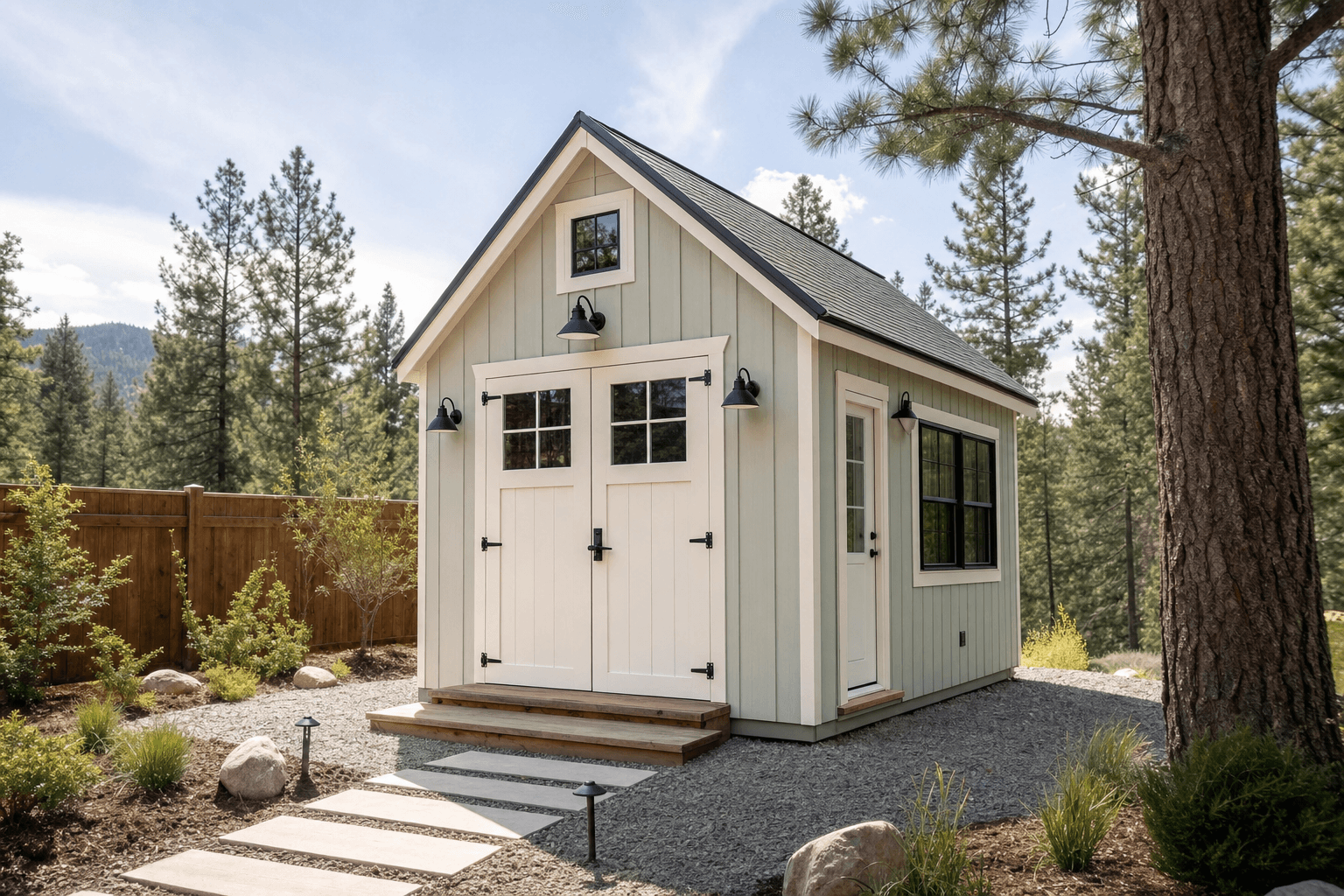
A finished she-shed with power and finishes can cross from 'exempt storage shed' into building- and trade-permit territory — size and utilities decide.
Where the 200-square-foot exemption actually comes from
The widely repeated 200-square-foot figure is a building-permit exemption in the residential code, not a statute. The model 2018 IRC text used 120 square feet; the model 2021 IRC raised it to 200, and Idaho's adopted residential edition uses 200 statewide. Some sources mis-cite Idaho Code §39-4116 as the basis, but that statute covers agricultural buildings and how local governments adopt the I-Codes — it does not set the residential shed number.
Because the figure lives in the adopted code rather than statute, a city that publishes its own number, or a county amendment, can differ. Treat 200 square feet as the Idaho baseline and confirm the operative figure with the office that will issue (or waive) the permit.
Why state trade permits matter even on an exempt shed
A shed can be too small to need a building permit and still need a state electrical or plumbing permit the moment you wire or plumb it. In Idaho those trade permits are issued and inspected by DOPL in most jurisdictions, on a separate track from the building permit. Licensed contractors pull permits in their own name; limited homeowner permits exist for owner-occupied property.
This is the single most common North Idaho shed surprise: the structure is exempt, but the 50-amp subpanel feeding it is not.
From the statewide rules to your parcel
The statewide framework tells you which codes apply and who issues the trades. The parcel-specific answer — the exact threshold, setbacks, snow-load zone, and any floodplain or shoreline overlay — comes from the county or city that governs the lot.
Treat this as planning context, not a permit decision. Thresholds, setbacks, fees, and adopted code editions change, so confirm the current rule for your exact parcel with the authority that has jurisdiction before you order materials.
Idaho statewide shed permit FAQs
Is the shed permit exemption really 200 square feet in Idaho?
Yes, as a statewide baseline: the 2020 Idaho Residential Code (R105.2) exempts a one-story detached storage shed of 200 square feet or less from a building permit. It is a building-permit exemption only, and individual jurisdictions can publish or apply a different figure, so confirm locally.
Does Idaho Code §39-4116 say sheds under 200 square feet are exempt?
No. §39-4116 is the agricultural-building exemption and the statute that governs how local governments adopt and enforce the building codes. The 200-square-foot residential shed figure comes from the adopted residential code (R105.2), not that statute.
Who do I call for an electrical permit on a shed?
In most Idaho jurisdictions, the state Division of Occupational and Professional Licenses (DOPL) at (208) 334-3233. A few cities issue their own electrical permits, so confirm whether the parcel's city has taken over that function.
Which building codes does Idaho currently enforce?
The 2018 I-Codes (IBC, IRC, IECC, IMC, IFGC), the 2023 National Electrical Code, and the 2017 Idaho State Plumbing Code. A proposed move to the 2024 codes was rejected in February 2026, so the 2018 editions remain in force.
Find the rule for your parcel
Pick the county or city that governs your lot from the permit hub, then bring the size and site constraints into the builder.
Next step