
Shed Building Permits in Priest River
Permit area
Priest River
Decision point
Check early
Builder path
Plan the site
Content
Payload editable
Permit planning
Use this Priest River permit page before you build
Planning area
Route
FAQ support
- Confirm whether the property is inside city limits or county jurisdiction.
- Check size, foundation, utility, and intended-use rules before ordering materials.
- Use the builder after permit and site constraints are clear enough to shape the shed.
How Priest River handles shed permits
The City of Priest River Building, Planning and Zoning Department ((208) 448-2123) issues building permits, with plan review support through an outside firm. The city follows Idaho's adopted residential code: a building permit is not required for a one-story detached storage shed when the floor area does not exceed 200 square feet and it has no plumbing, electrical, or mechanical work; at or above that, a permit is required, and pole buildings need plans stamped by an Idaho-licensed engineer or architect.
Electrical, plumbing, mechanical, and gas permits are issued by the state (DOPL), not the city. In Idaho, electrical, plumbing, and HVAC permits are usually issued by the state Division of Occupational and Professional Licenses (DOPL), separately from any local building permit — and a wired or plumbed shed can need a state trade permit even when the shed itself is small enough to skip a building permit.
Priest River shed permit snapshot
Priest River shed permit snapshot
- Building-permit exemption
- One-story detached storage shed 200 sq ft or less with no utilities. Pole buildings need stamped plans.
- Adopted codes
- 2018 IBC, IRC, and IECC with Idaho amendments (effective Jan 1, 2021).
- Setbacks
- R-1: front 25 ft, side 10 ft, flanking 20 ft, rear 20 ft, rear-yard accessory 5 ft. R-2: front 15 ft, side 5 ft, rear 15 ft, accessory 5 ft. Confirm your zone.
- Trade permits
- Electrical, plumbing, mechanical, and gas permits are state (DOPL) permits.
- Stormwater
- A stormwater plan is required if the site is within 300 ft of any surface water.
- Floodplain
- A development permit is required in a floodplain or floodway; a floodway foundation must be engineered.
| Priest River shed permit snapshot | |
|---|---|
| Building-permit exemption | One-story detached storage shed 200 sq ft or less with no utilities. Pole buildings need stamped plans. |
| Adopted codes | 2018 IBC, IRC, and IECC with Idaho amendments (effective Jan 1, 2021). |
| Setbacks | R-1: front 25 ft, side 10 ft, flanking 20 ft, rear 20 ft, rear-yard accessory 5 ft. R-2: front 15 ft, side 5 ft, rear 15 ft, accessory 5 ft. Confirm your zone. |
| Trade permits | Electrical, plumbing, mechanical, and gas permits are state (DOPL) permits. |
| Stormwater | A stormwater plan is required if the site is within 300 ft of any surface water. |
| Floodplain | A development permit is required in a floodplain or floodway; a floodway foundation must be engineered. |
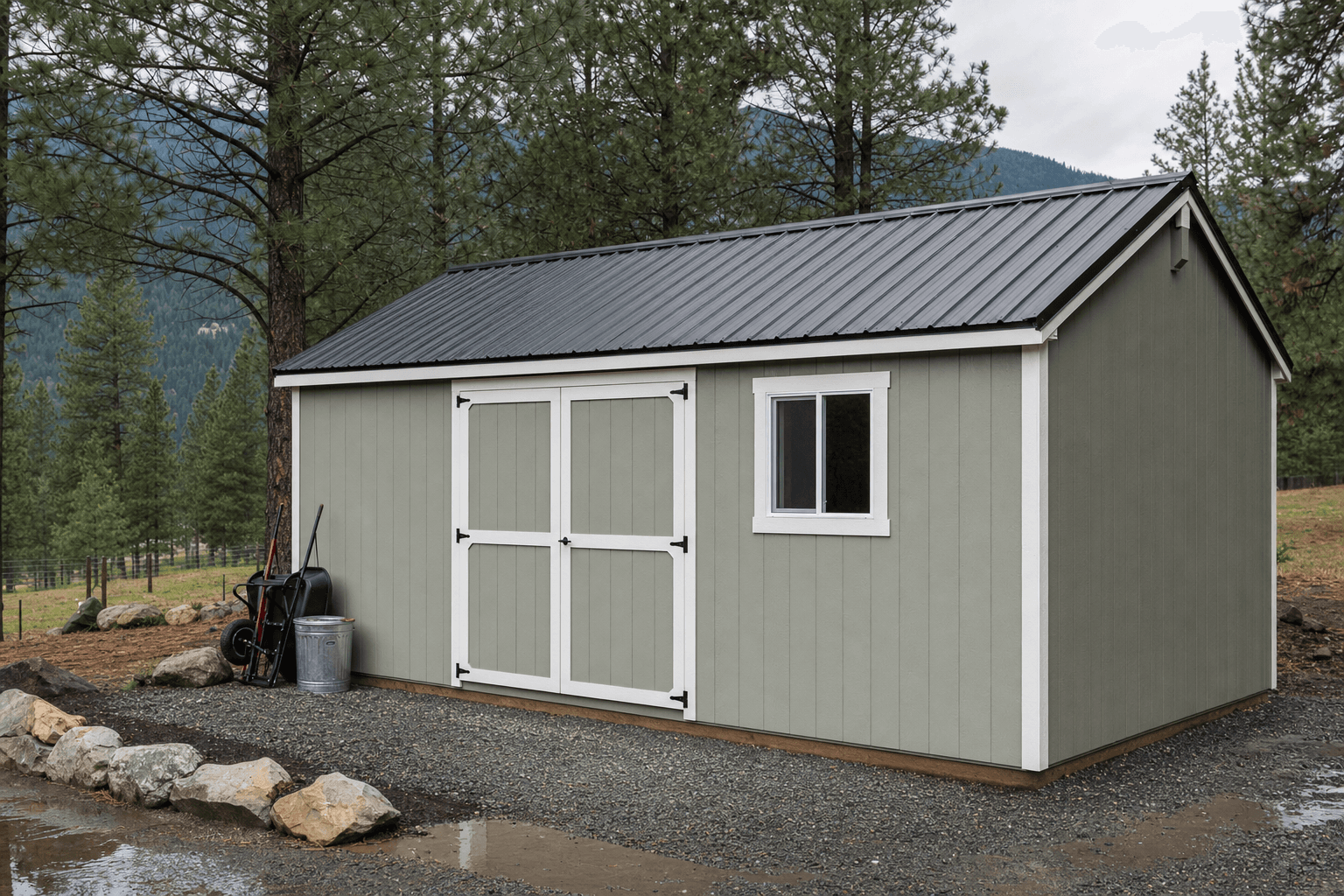
Priest River publishes a 5 ft rear-yard accessory setback and requires a stormwater plan within 300 ft of surface water.
The exemption and the pole-building exception
Priest River applies the standard exemption: a one-story detached storage shed of 200 square feet or less with no utilities skips the building permit. Two things to watch — adding electrical, plumbing, or mechanical work pulls a separate state permit even on a small shed, and a pole building requires plans wet-stamped by an Idaho-licensed engineer or architect regardless.
Above 200 square feet, the city building permit applies on the 2018 code editions.
Published setbacks by zone
The city publishes its setbacks in a handout. In R-1, that's a 25-foot front, 10-foot side, 20-foot flanking street, and 20-foot rear, with a 5-foot rear-yard accessory setback; R-2 uses a 15-foot front, 5-foot side, and 15-foot rear, also with a 5-foot accessory setback. Eaves and other architectural projections count toward the setback.
Confirm the figures for your specific zone before siting the shed.
Stormwater and floodplain near water
Priest River sits at the confluence of the Priest and Pend Oreille Rivers, so water-related rules matter. A stormwater plan is required if the building site is within 300 feet of any surface water, and a development permit is required for a parcel in a floodplain or floodway — with floodway foundations requiring an engineer.
Treat this as planning context, not a permit decision. Thresholds, setbacks, fees, and adopted code editions change, so confirm the current rule for your exact parcel with the authority that has jurisdiction before you order materials.
Priest River shed permit FAQs
Does Priest River require a permit for a small shed?
Not a building permit for a one-story detached storage shed of 200 square feet or less with no utilities. Add electrical, plumbing, or mechanical work and you'll need a separate state permit; build a pole building and you'll need stamped plans. A shed over 200 square feet needs a city permit.
What are the setbacks?
The city publishes them by zone — R-1 is a 25-foot front, 10-foot side, 20-foot flanking, 20-foot rear, with a 5-foot rear-yard accessory setback; R-2 is 15/5/15 with a 5-foot accessory setback. Eaves count. Confirm your zone.
Do I need a stormwater or floodplain permit?
A stormwater plan is required if the site is within 300 feet of any surface water, and a floodplain development permit is required in a floodplain or floodway. Floodway foundations must be engineered.
Who issues electrical and plumbing permits?
The state (DOPL). Electrical, plumbing, mechanical, and gas permits are issued by the state, separate from the city building permit.
Plan a Priest River shed
Check the water setbacks and stormwater rule, then size the shed in the builder — or send the details for an estimate.
Next step