
Shed Building Permits in Bonner County
Permit area
Bonner County
Decision point
Check early
Builder path
Plan the site
Content
Payload editable
Permit planning
Use this Bonner County permit page before you build
Planning area
Route
FAQ support
- Confirm whether the property is inside city limits or county jurisdiction.
- Check size, foundation, utility, and intended-use rules before ordering materials.
- Use the builder after permit and site constraints are clear enough to shape the shed.
Bonner County regulates location, not structure
The Bonner County Planning Department ((208) 265-1458) does not issue an IRC-style structural building permit — the county has not adopted a building code since 1997, so there is no county structural plan review or inspection of sheds. What it issues is a Building Location Permit (BLP) that reviews placement, use, floodplain, and setbacks.
A BLP is required for any structure over 400 square feet, or any habitable structure regardless of size. A one-story detached storage shed of 200 square feet or less is exempt from a BLP; accessory structures between 200 and roughly 1,080 square feet can qualify as a Small Structure. In Idaho, electrical, plumbing, and HVAC permits are usually issued by the state Division of Occupational and Professional Licenses (DOPL), separately from any local building permit — and a wired or plumbed shed can need a state trade permit even when the shed itself is small enough to skip a building permit.
Bonner County shed permit snapshot
Bonner County shed permit snapshot
- Building Location Permit trigger
- Required for any structure over 400 sq ft, or any habitable structure of any size.
- Shed exemption
- A one-story detached storage shed 200 sq ft or less is exempt from the BLP. 200-1,080 sq ft can qualify as a Small Structure.
- Structural code
- None adopted since 1997 — the county does not inspect shed structure. Design responsibility falls to the owner/builder, who should still build to sound engineering.
- Setbacks
- Detached residential accessory structures: about 5 ft side and rear; 15 ft on a side flanking a street. Water-body setbacks of 40 ft (lakes) and 75 ft (rivers/creeks) apply.
- Trade permits
- Electrical, plumbing, and HVAC permits are state (DOPL) permits, not county permits.
- Snow load
- High. Sandpoint's design ground snow load is around 56 psf; confirm the value for the specific elevation.
| Bonner County shed permit snapshot | |
|---|---|
| Building Location Permit trigger | Required for any structure over 400 sq ft, or any habitable structure of any size. |
| Shed exemption | A one-story detached storage shed 200 sq ft or less is exempt from the BLP. 200-1,080 sq ft can qualify as a Small Structure. |
| Structural code | None adopted since 1997 — the county does not inspect shed structure. Design responsibility falls to the owner/builder, who should still build to sound engineering. |
| Setbacks | Detached residential accessory structures: about 5 ft side and rear; 15 ft on a side flanking a street. Water-body setbacks of 40 ft (lakes) and 75 ft (rivers/creeks) apply. |
| Trade permits | Electrical, plumbing, and HVAC permits are state (DOPL) permits, not county permits. |
| Snow load | High. Sandpoint's design ground snow load is around 56 psf; confirm the value for the specific elevation. |
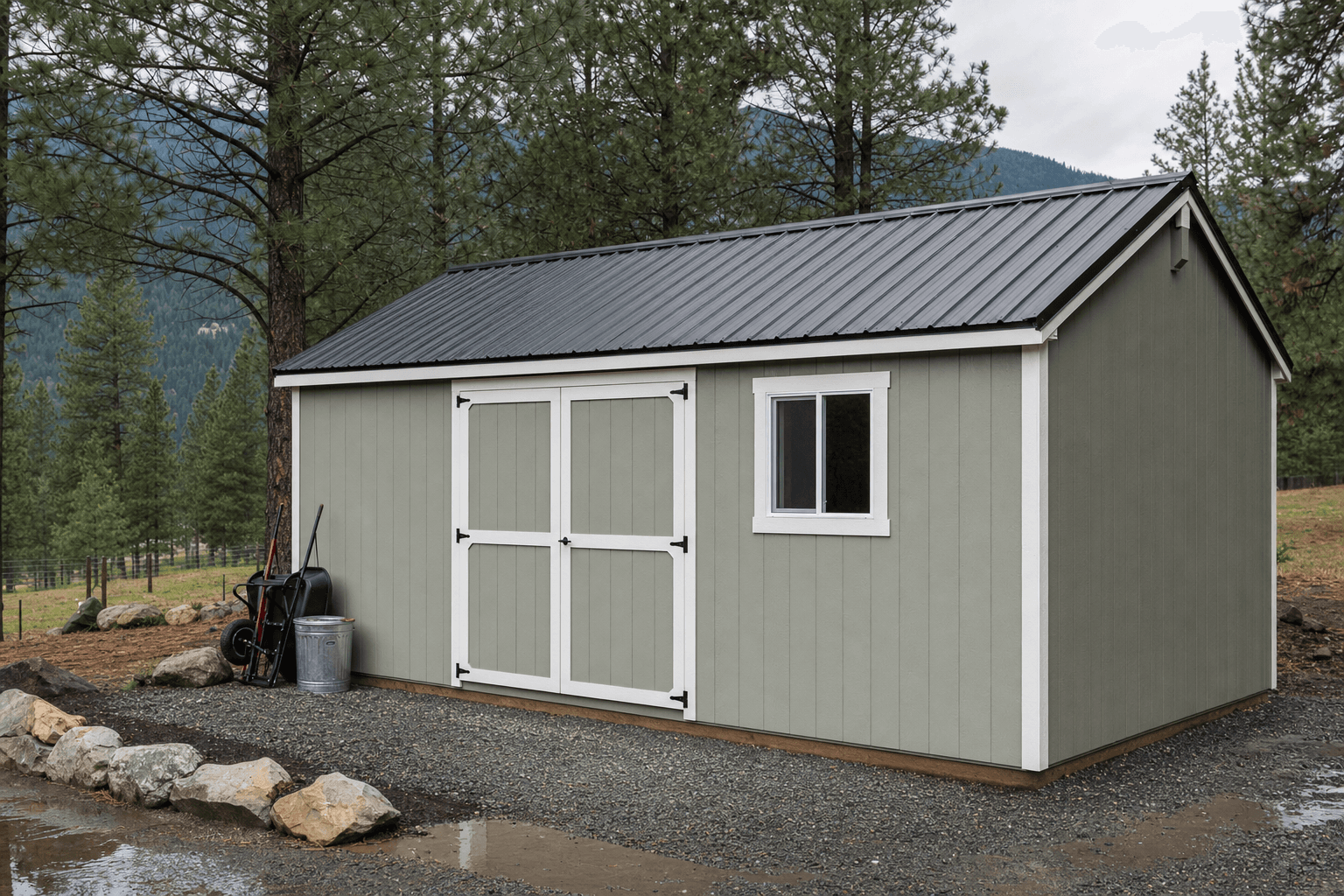
Because Bonner County reviews location rather than structure, the placement plan and water-body setbacks do the heavy lifting on a shed.
The 400-square-foot line, the 200-square-foot exemption, and Small Structures
It is easy to conflate Bonner County's two numbers. The 200-square-foot figure is the exemption — a detached storage shed at or under it needs no Building Location Permit. The 400-square-foot figure is the trigger — at and above it a BLP (or a Small Structure Permit) is required. Between 200 and about 1,080 square feet, accessory shops, carports, and storage buildings can be handled as a Small Structure.
A habitable structure needs a BLP at any size, so the moment a shed becomes living space the exemption disappears.
Placement, setbacks, and shorelines
The Building Location Permit is essentially a placement review. It checks setbacks from property lines, water bodies, easements, the well, and the septic system, and confirms the structure is an allowed use. Detached residential accessory structures generally hold about a 5-foot side and rear setback, with 15 feet when a side flanks a street.
Shorelines are a major factor in Bonner County. Lake Pend Oreille, Priest Lake, and the rivers carry development setbacks — commonly 40 feet from lakes and 75 feet from rivers and creeks — that can override where a shed would otherwise sit.
Structure is the owner's responsibility here
Because the county adopts no structural code, no one inspects the shed's framing or roof. That puts the burden on the owner and builder to design to North Idaho snow loads anyway — Sandpoint's design ground snow load sits around 56 psf, and it climbs with elevation. A shed built to a generic minimum can fail under a real Panhandle winter.
Treat this as planning context, not a permit decision. Thresholds, setbacks, fees, and adopted code editions change, so confirm the current rule for your exact parcel with the authority that has jurisdiction before you order materials.
Bonner County shed permit FAQs
Does Bonner County require a building permit for a shed?
Not a structural building permit — the county has adopted no building code since 1997. It requires a Building Location Permit for structures over 400 square feet (or any habitable structure), and exempts detached storage sheds of 200 square feet or less.
What's the difference between the 200 and 400 square-foot figures?
200 square feet is the exemption: a detached storage shed at or under it needs no Building Location Permit. 400 square feet is the trigger: at and above it, a BLP or Small Structure Permit is required. Between them, an accessory structure can qualify as a Small Structure.
Who handles electrical and plumbing for a Bonner County shed?
The state — the Division of Occupational and Professional Licenses (DOPL). Those trade permits are separate from the county's Building Location Permit and apply even to an otherwise exempt shed if it's wired or plumbed.
Do setbacks apply to a shed under 200 square feet?
Yes. Setbacks and water-body buffers apply to every structure regardless of size. A small exempt shed still has to meet the roughly 5-foot accessory setback and the lake/river shoreline setbacks.
Plan a Bonner County shed
Map the placement and shoreline setbacks first, then design the shed in the builder to a real snow load — or send the details for an estimate.
Next step