Athol sits in the rural north end of Kootenai County, where Highway 95 meets Highway 54 on the way out to Farragut State Park and Lake Pend Oreille. It is one of our home-base areas — close enough that the crew reaches most properties here without it being a haul, and the kind of place where a shed actually has room to be the size you need. Between the acreage parcels off Brunner and Chilco roads, the spreads out toward Bunco and Athol Heights, and the lots within earshot of Silverwood, almost everything we build in Athol is assembled on your property — storage buildings and detached garages put together on your land instead of trucked in finished.
Building on-site is what makes a shed fit an Athol property. Lots out here run large and unpaved, driveways are long gravel pulls that a finished-building trailer cannot always navigate, and the spot you want the shed is often a back corner of the acreage rather than the first flat patch by the road. When the crew builds in place, the gravel drive, the snow berm, and the soft spring ground stop being delivery problems — we work to your grade and set the building exactly where it makes sense for the property.
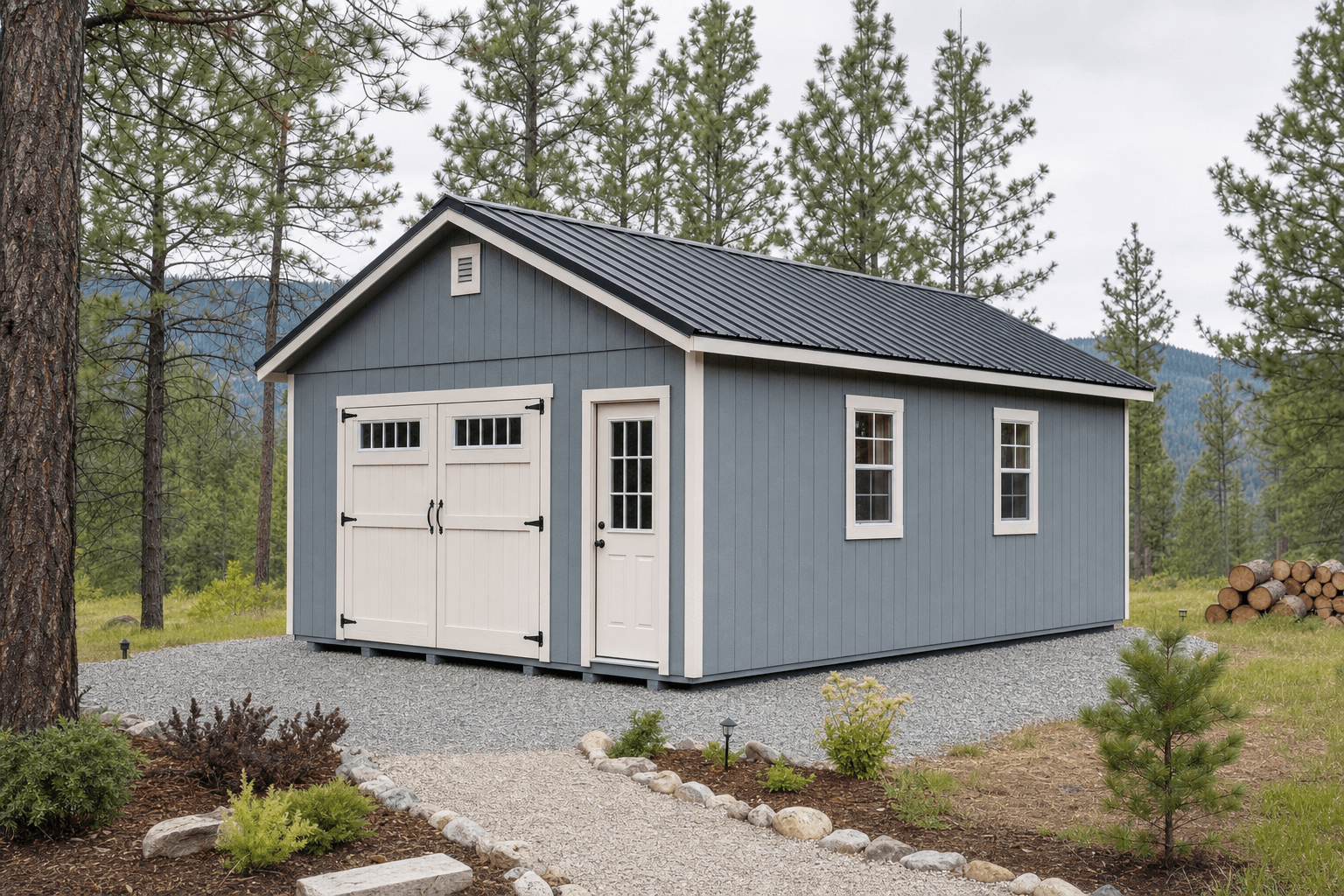
A custom shed built on-site on an Athol acreage, set on a gravel pad well back from the road.
Most Athol customers come to us with a rural list: the equipment is wintering under a tarp, the tractor and the ATV need a roof, hay and feed need to stay dry, or the shop space at the house ran out years ago. We build all of it on your lot. A storage shed gets mowers, seasonal gear, and the overflow out of the weather; a detached garage or shop adds real bay space for a truck, a side-by-side, or a heated workbench; farm storage keeps feed, hay, and implements covered; and a dedicated tool shed keeps hand tools and small equipment organized close to where the work happens.
Access is the first thing we sort out, and on Athol acreage that usually means the drive and the ground rather than a gate. Long gravel approaches, a creek crossing, soft pasture that gives way in spring, and a building site a couple hundred feet off the road are all routine here — and all reasons building in place beats delivery. The crew brings materials in and assembles the shed where you want it, whether that is beside the barn, out by the back fence line, or tucked near the tree line for a windbreak. For properties that flood-irrigate or sit low, we plan the pad and footprint so the building stays up out of standing water.
Hay, feed, fencing supplies, and seasonal implements stay dry and rodent-managed in a building sized for an Athol spread instead of a city backyard.
Acreage out by Bunco and Athol Heights has room for a real shop bay — somewhere for the truck, the tractor, the side-by-side, and a heated workbench through winter.
Mowers, ATVs, snowmobiles, boats headed to Bayview, and the gear that piles up on rural property all come off the tarp and into a dry, organized building.
Athol is unincorporated in most of its surrounding acreage, so accessory buildings here run through Kootenai County rather than a city department. The county handles outbuildings the way most North Idaho jurisdictions do: smaller utility sheds under a set square-footage threshold usually skip a building permit, while larger footprints, anything with power or plumbing, and any building you intend to occupy generally need one. Agricultural buildings on a genuine farm parcel can fall under different rules again. Even when a permit is not required, setbacks still are — the building has to sit a minimum distance from property lines, and parcels near wetlands, the seasonal creeks that run through this area, or a private road can carry extra conditions.
If your property falls under covenants — some of the platted subdivisions and shared-road communities around Athol do have them — architectural rules can go beyond county code and dictate siding, roof color, or where an outbuilding may sit. Check your CC&Rs before you finalize anything. Our permits and placement guide walks through the county basics and setbacks, and the farm storage planning guide helps you lock in a size before you apply.
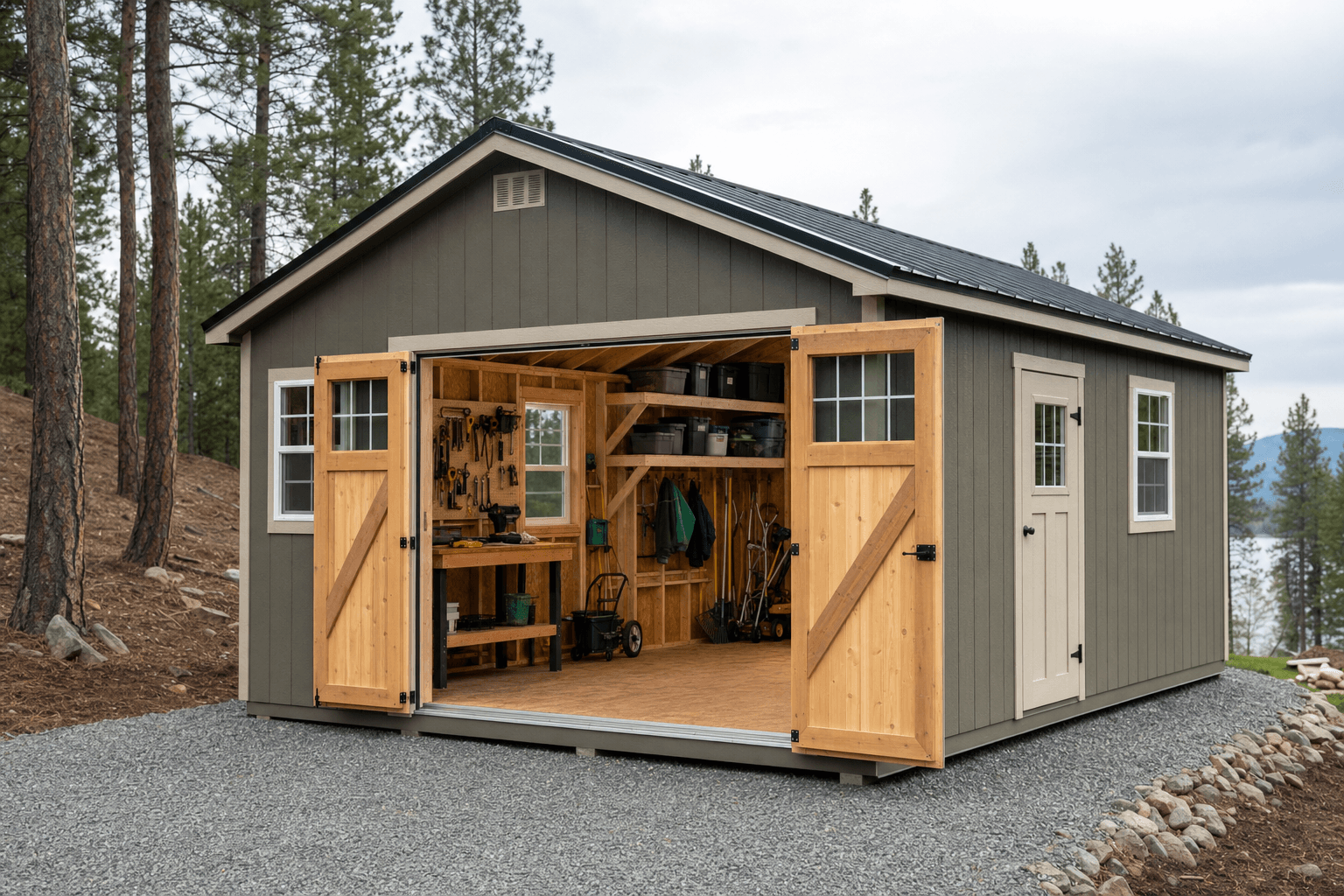
A detached garage built on-site on a Kootenai County acreage near Athol, with a roof pitch and anchoring rated for local snow load.
Athol winters are no joke. The area sits in the snow shadow of the Pend Oreille basin and routinely catches more accumulation than the lakeshore towns to the south, so a shed here has to carry a serious roof snow load, shrug off freeze-thaw at the foundation, and keep a door that still swings after a storm and a plow berm. We build to the roof pitch and anchoring the local load calls for, and we set most buildings on a compacted gravel pad that drains snowmelt and keeps the floor up off wet ground — a better fit for open, wind-exposed, often soggy-in-spring Athol ground than a slab that traps water against the structure.
Site matters as much as weather out here. Pasture and meadow lots hold water when the snow lets go, wind sweeps across open acreage off the Rathdrum Prairie, and tree-shaded parcels stay damp well into spring. We level and drain the pad so the building stays dry and square for the long haul. A 12x16 or 12x20 covers most Athol storage and shop needs with room for equipment, while a 10x16 handles general acreage storage and overflow without crowding the yard.
Athol, northern Kootenai County, near Farragut State Park and the south end of Lake Pend Oreille — most surrounding acreage is unincorporated, so permits run through Kootenai County.
Small utility sheds often skip a permit; larger footprints, occupied buildings, and anything with power or plumbing usually need one. Ag buildings can differ, and setbacks always apply.
Plan for a heavy winter snow load on the roof — Athol catches more than the lakeshore towns — plus freeze-thaw at the foundation and a gravel pad that drains snowmelt away.
We build on-site across Athol — long gravel drives, soft spring ground, creek crossings, and a build site well back on the acreage are all handled in place, no crane needed.
It depends on size, use, and parcel type. Most acreage around Athol is unincorporated, so permits run through Kootenai County. Smaller utility sheds under the local square-footage threshold usually do not need a building permit, but larger buildings, anything you plan to occupy, and any shed with power or plumbing generally do. Genuine agricultural buildings can fall under different rules. Setbacks from property lines apply either way, and parcels near wetlands, seasonal creeks, or a private road can carry extra conditions. We help you size and place the building to fit, and our permits guide covers the basics.
Yes. Athol is one of our home-base areas, and we build across the whole community and the surrounding north end of Kootenai County — from lots near town and Silverwood out to acreage off Brunner, Chilco, and the Bunco and Athol Heights areas. Because we build on-site rather than delivering a finished shed, long gravel drives, soft spring ground, creek crossings, and a build site a couple hundred feet off the road are all things we work around in place. The building goes exactly where you want it on the property, not just as far as a truck could reach.
On Athol acreage, a 12x16 or 12x20 tends to hit the sweet spot — enough room for equipment, feed, seasonal gear, and the overflow that rural property generates, with space to grow. A 10x16 covers general storage without crowding the yard, while properties with a tractor, a side-by-side, and a real project list often step up to a detached garage or shop. We size the building to your lot, your access, and what you actually need to store.
Yes — farm and equipment storage is a big part of what we build around Athol. Hay, feed, fencing supplies, implements, mowers, ATVs, and snowmobiles all do better under a real roof than under a tarp through a North Idaho winter. We build farm storage and equipment buildings on-site, sized and laid out for how you actually use the property, and set on a gravel pad that keeps the floor up out of spring mud. Keep in mind that agricultural buildings on a farm parcel can fall under different county rules than a standard accessory shed, which we factor in from the start.
Yes — long gravel drives and big rural lots are exactly where building on-site pays off. A finished-building trailer cannot always navigate a long unpaved approach, a creek crossing, or soft pasture that gives way in spring, but the crew brings materials in and assembles the shed where you want it — beside the barn, out by the back fence line, or near the tree line for a windbreak. We level and drain a compacted gravel pad so the building sits square and sheds water, even on ground that holds moisture when the snow melts.
Athol catches heavier snow than the lakeshore towns to the south, so the roof has to carry a serious snow load, the foundation has to handle freeze-thaw, and the doors need to keep working after a storm and a plow berm. We build to the roof pitch and anchoring the local load calls for and set most buildings on a gravel pad that drains snowmelt instead of trapping it against the structure. If you want the building usable year-round as a shop or workspace, we can insulate and wire it to stay comfortable through the cold months.
Tell us about your acreage, your access, and what the building is for. We will help you size and place it for Athol snow load and Kootenai County setbacks — then you can build and price it online.
Check local permit, setback, and placement rules before you build on site.
We build on site across North Idaho. Explore other cities and towns we serve.