Shed Building Permits in Post Falls
Permit area
Post Falls
Decision point
Check early
Builder path
Plan the site
Content
Payload editable
Permit planning
Use this Post Falls permit page before you build
Planning area
Route
FAQ support
- Confirm whether the property is inside city limits or county jurisdiction.
- Check size, foundation, utility, and intended-use rules before ordering materials.
- Use the builder after permit and site constraints are clear enough to shape the shed.
How Post Falls handles shed permits
The City of Post Falls Community Development Department, Building Division ((208) 773-8708) issues building permits — and unlike most North Idaho jurisdictions, it also issues its own electrical, plumbing, and mechanical permits (the city took those over from the state in 2015). Idaho's residential code exempts a one-story detached storage shed at or under 200 square feet, but Post Falls does not publish a specific shed square-footage number on its own materials, so confirm the operative threshold with the Building Division before assuming any size is exempt.
Because Post Falls issues its own trade permits, a wired shed needs a city electrical permit rather than a state one.
Post Falls shed permit snapshot
Post Falls shed permit snapshot
- Building-permit threshold
- Idaho's 200 sq ft residential exemption is the reference, but the city doesn't publish a specific shed number — confirm with the Building Division at (208) 773-8708.
- Adopted codes
- 2018 IBC/IRC/IECC/IMC/IFGC, 2017 Idaho State Plumbing Code, and the 2023 NEC.
- Trade permits
- Issued by the city, not the state — Post Falls runs its own electrical, plumbing, and mechanical permitting.
- Setbacks (Table 18.20.040)
- R-1 zone: front 15 ft, rear 10 ft, interior side 5 ft, street side 15 ft. R-1-S: front 30 ft, rear 15 ft, side 15 ft. Confirm your zone.
- Design criteria
- Roof snow load 40 psf, ground snow load 56 psf, wind 115 mph 3-sec gust, Exposure B, Seismic Category C, severe weathering (ice-shield underlayment required).
- Fees
- Valuation-based, from per-square-foot outbuilding values. Confirm the current fee schedule with the city.
| Post Falls shed permit snapshot | |
|---|---|
| Building-permit threshold | Idaho's 200 sq ft residential exemption is the reference, but the city doesn't publish a specific shed number — confirm with the Building Division at (208) 773-8708. |
| Adopted codes | 2018 IBC/IRC/IECC/IMC/IFGC, 2017 Idaho State Plumbing Code, and the 2023 NEC. |
| Trade permits | Issued by the city, not the state — Post Falls runs its own electrical, plumbing, and mechanical permitting. |
| Setbacks (Table 18.20.040) | R-1 zone: front 15 ft, rear 10 ft, interior side 5 ft, street side 15 ft. R-1-S: front 30 ft, rear 15 ft, side 15 ft. Confirm your zone. |
| Design criteria | Roof snow load 40 psf, ground snow load 56 psf, wind 115 mph 3-sec gust, Exposure B, Seismic Category C, severe weathering (ice-shield underlayment required). |
| Fees | Valuation-based, from per-square-foot outbuilding values. Confirm the current fee schedule with the city. |
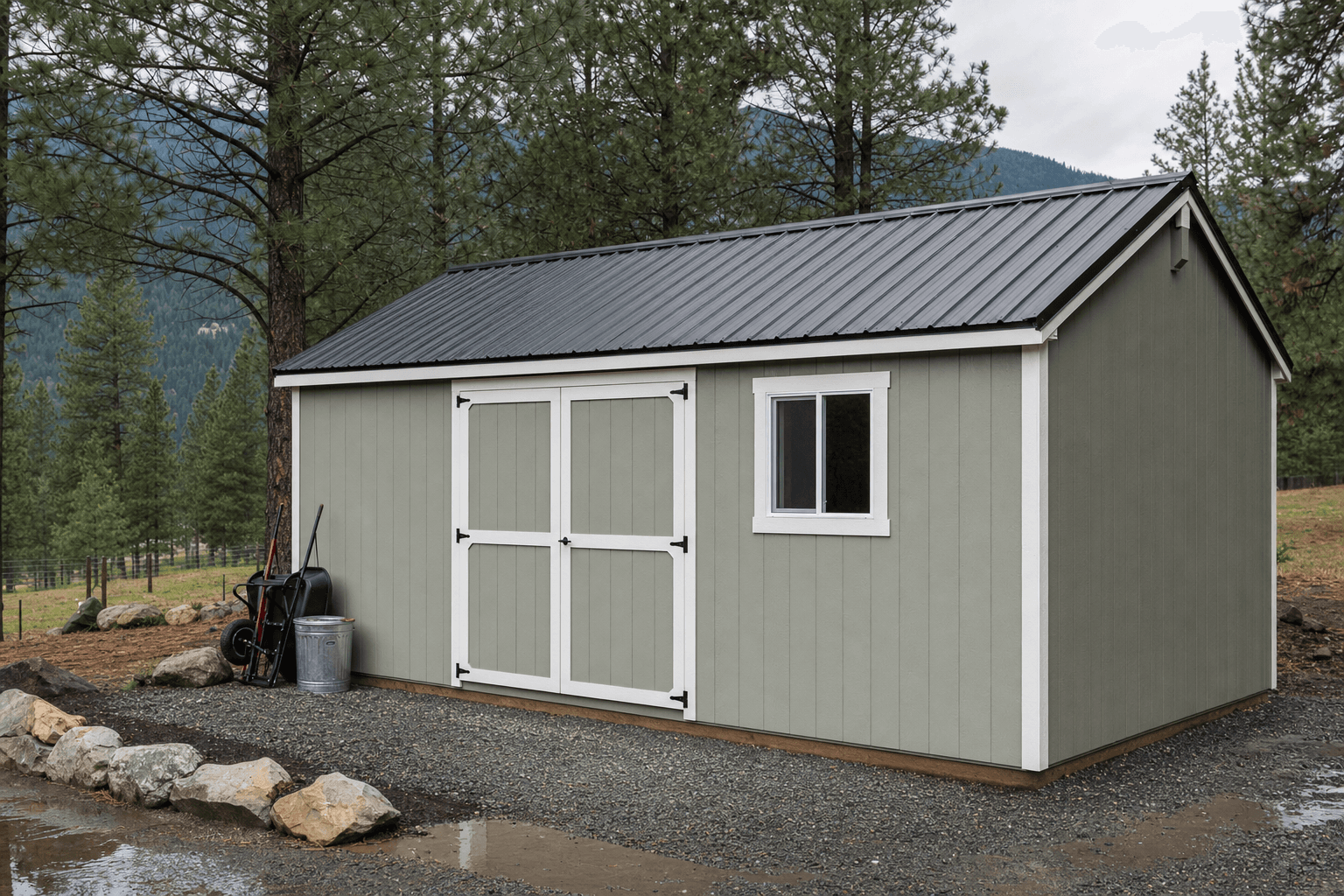
Post Falls publishes its setback table and design criteria — design the shed to the city's 56 psf ground snow load and your zone's setbacks.
Post Falls issues its own trade permits
The defining Post Falls feature is that it took over electrical and plumbing permitting from the state in 2015. So while most North Idaho sheds route trade permits through the state DOPL, a Post Falls shed with wiring or plumbing needs a city electrical, plumbing, or mechanical permit from the same Building Division that handles the building permit. That can actually simplify the process — one office instead of two.
It also means the usual 'call the state for electrical' advice doesn't apply here; confirm trade permits with the city.
A jurisdiction that publishes its numbers
Post Falls is one of the better-documented North Idaho jurisdictions. Its bulk-and-placement table sets clear residential setbacks — an R-1 lot, for example, holds a 15-foot front, 10-foot rear, 5-foot interior side, and 15-foot street side — and its design-criteria sheet publishes a 40 psf roof snow load, 56 psf ground snow load, a 115 mph 3-second-gust wind speed, Exposure B, and Seismic Category C, with severe weathering requiring an ice-shield underlayment.
Designing to those published values up front avoids a redesign later.
The one thing to confirm: the shed threshold
The gap in Post Falls' otherwise detailed materials is an explicit shed square-footage exemption. Idaho's residential code points to 200 square feet, but because the city doesn't post a number, treat the threshold as something to confirm with the Building Division rather than assume — especially if your shed is near the 120-to-200-square-foot range.
Treat this as planning context, not a permit decision. Thresholds, setbacks, fees, and adopted code editions change, so confirm the current rule for your exact parcel with the authority that has jurisdiction before you order materials.
Post Falls shed permit FAQs
Who issues the electrical permit for a Post Falls shed?
The city, not the state. Post Falls took over electrical, plumbing, and mechanical permitting in 2015, so a wired or plumbed shed gets its trade permits from the same city Building Division that handles the building permit.
What size shed needs a building permit in Post Falls?
Idaho's residential code exempts a one-story detached storage shed of 200 square feet or less, but Post Falls doesn't publish a specific shed number on its own materials. Confirm the operative threshold with the Building Division at (208) 773-8708 before assuming any size is exempt.
What snow load should I design for in Post Falls?
The city's design-criteria sheet lists a 40 psf roof snow load and 56 psf ground snow load, with a 115 mph 3-second-gust wind speed and severe weathering requiring an ice-shield underlayment. Design the roof to those published values.
What are the setbacks?
They're published in the city's bulk-and-placement table by zone — for example, an R-1 lot holds a 15-foot front, 10-foot rear, 5-foot interior side, and 15-foot street side. Confirm the numbers for your specific zone.
Plan a Post Falls shed
Design to the city's published setbacks and snow load, then size the shed in the builder — or send the details for an estimate.
Next step