The Silver Valley is the string of old mining towns strung along the South Fork of the Coeur d'Alene River in Shoshone County — Kellogg, Wallace, Pinehurst, Osburn, Smelterville, and the smaller spots in between, all threaded together by Interstate 90 about 40 minutes east of Coeur d'Alene. This is some of the most storied ground in the Idaho Panhandle: the Bunker Hill and Sunshine mines made Wallace a silver capital, and the whole valley still wears that history in its brick downtowns and steep hillside neighborhoods. We build right where you live here — storage sheds, garages and shops, and firewood and gear buildings assembled on your property instead of trucked in finished.
Building on-site is what makes a shed actually work in this valley. Lots in Kellogg and Wallace are narrow and steep, pinched between the river, the railroad grade, and the hills that climb straight up on both sides. Yards are often reached down a single shared alley or up a short pitch off the street, and flat ground is genuinely scarce. When the crew builds in place, none of that has to be solved by a delivery driver — we work to your grade, your access, and the exact corner where the building has to sit.
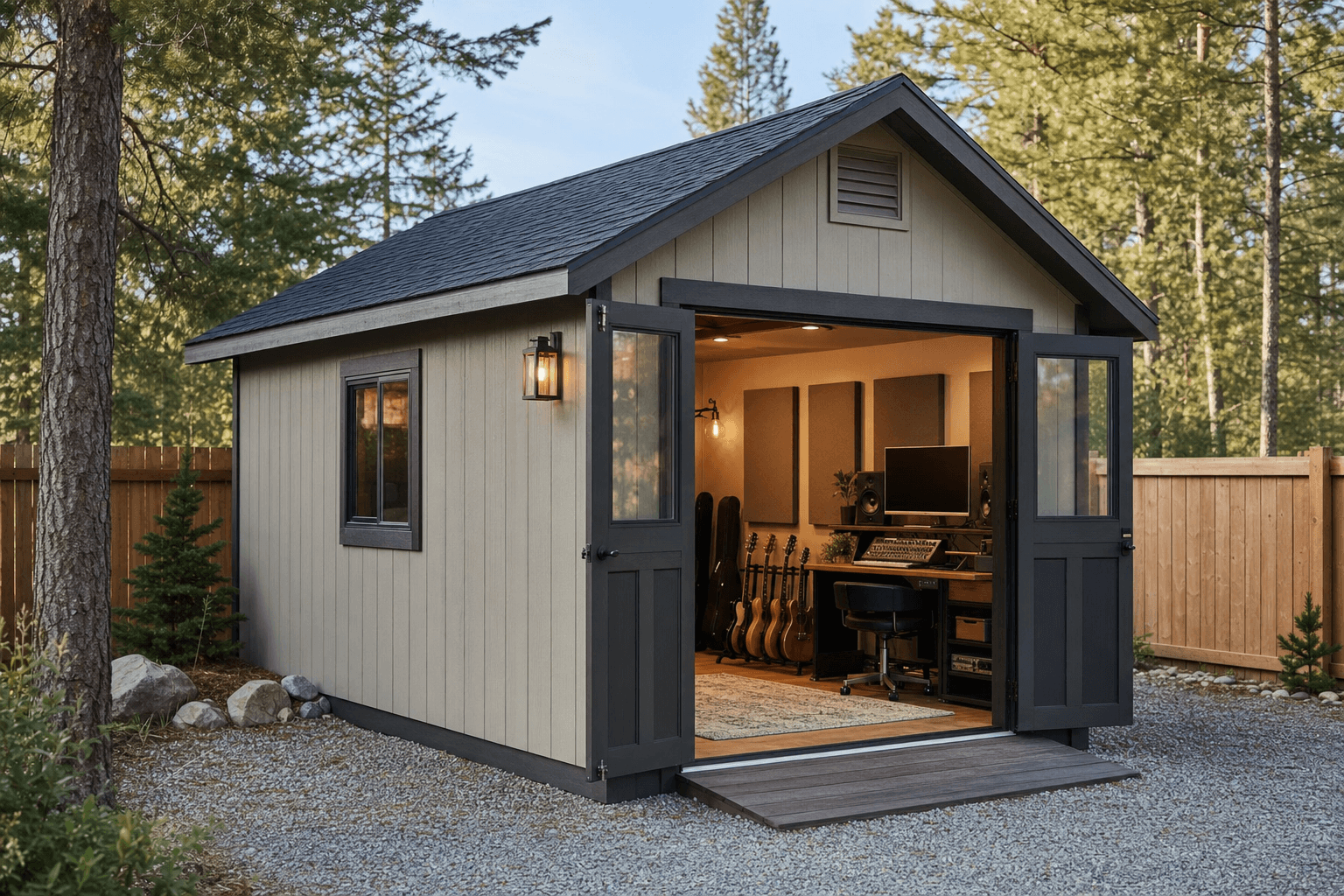
A custom shed built on-site on a steep Silver Valley lot, leveled into the grade between the house and the hillside.
Most Silver Valley customers come to us for one of a few reasons. The garage in an old mining-town house is small and already full, so the snowblower, the tools, and the seasonal gear have nowhere to go. Heating with wood is common up here, and a season's worth of split firewood needs a dry, covered home off the ground. And with Silver Mountain right above Kellogg, a lot of households need somewhere to keep skis, boards, sleds, and bikes sorted between seasons. We build all of it on your lot — a storage shed to clear the garage, a detached garage or shop where there is room for one, a firewood shed to keep next winter's cordwood dry, or a ski tuning shed with a bench and wall storage for gear.
Access is the first thing we sort out, because Silver Valley lots leave little margin. If your backyard is reached through a narrow gate, down a shared alley behind a Wallace block, or up a short steep pitch off a Kellogg side street, building in place means the shed still lands exactly where you want it — no crane, no tearing out fence, no settling for the front corner because that is as far as a finished building could be dropped. On the steep parcels that define this valley, we plan the footprint and the gravel pad around the slope so the building sits level and drains downhill away from the structure and the house.
Old mining-town houses have small garages. A storage shed pulls the snowblower, tools, and seasonal totes out of the way and off the floor.
Wood heat is common in the valley. A covered, ventilated firewood shed keeps a full season of cordwood dry and seasoned, up off wet ground.
With Silver Mountain right above Kellogg, a tuning and gear shed keeps skis, boards, sleds, and bikes organized between seasons.
Shoshone County and the valley's incorporated towns — Kellogg, Wallace, Pinehurst, Smelterville, Osburn — handle accessory buildings the way most North Idaho jurisdictions do: smaller utility sheds under a set square-footage threshold usually skip a building permit, while larger footprints, anything with power or plumbing, and any building you intend to occupy generally need one. Even when a permit is not required, setbacks still apply — your building has to sit a minimum distance from side and rear property lines, which matters a lot on the narrow valley lots here, where the gap between a house and the line can be tight. Some of the historic downtown blocks in Kellogg and Wallace also carry their own placement rules, and parts of the valley fall inside the old Bunker Hill cleanup district, where ground disturbance can require extra steps.
If your property is in an HOA or a newer subdivision up one of the side gulches, architectural rules can go beyond county code, covering siding, roof color, and where an outbuilding may sit. Check your CC&Rs before you finalize anything. Our permits and placement guide walks through the county basics and setbacks, and the storage shed planning guide helps you lock in a size before you apply.
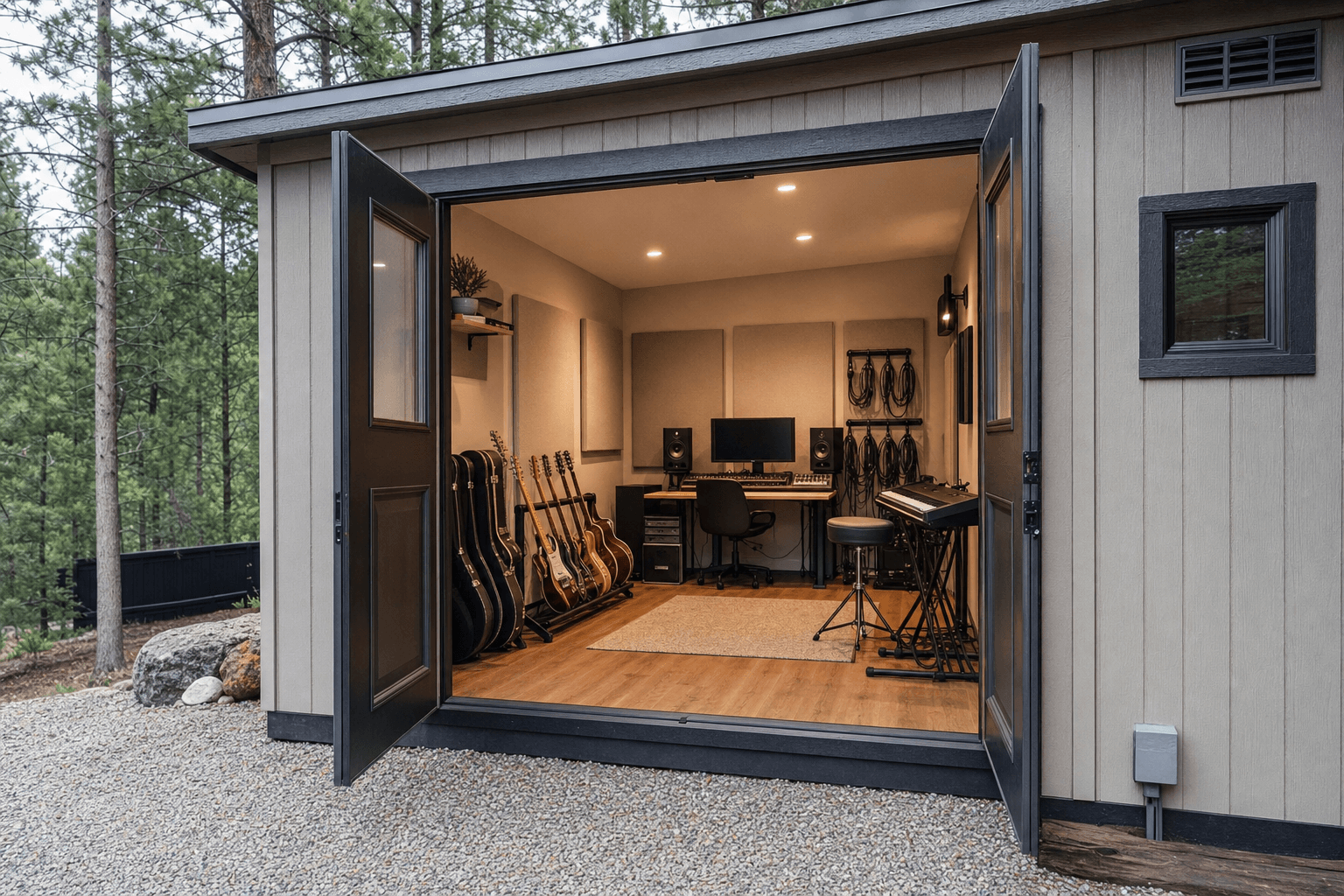
A detached garage built on-site in the Silver Valley, with a steep roof pitch and anchoring rated for deep mountain snow load.
Winter is the real design driver up here. The Silver Valley sits in the mountains, and snow piles up far deeper and stays longer than it does down on the prairie around Coeur d'Alene — Silver Mountain above Kellogg measures its season in hundreds of inches. A shed in this valley has to carry a serious snow load on the roof, so we build to a steeper, snow-shedding pitch and the anchoring that load calls for. Freeze-thaw at the foundation runs hard through a long mountain winter, and a door has to keep swinging after a storm buries the yard. We set most buildings on a compacted gravel pad that drains snowmelt and keeps the floor up off wet ground — a better fit for these sloped, shaded, river-valley lots than a slab that traps water against the structure.
Site matters as much as weather. The valley floor is tight and the hillsides are steep, so almost nothing sits flat, and lots in the bottoms near the South Fork stay damp and can sit near the floodplain. We level and drain the pad so the building stays dry and square for the long haul, and we orient the roof so snow sheds where you want it, not onto the door or the walkway. A 10x16 or 12x16 covers most Silver Valley storage and shop needs with room to grow, while a compact 8x12 tucks neatly onto a tighter Kellogg or Wallace lot.
Shoshone County, along the I-90 corridor on the South Fork of the Coeur d'Alene River — permits run through Shoshone County or the town of Kellogg, Wallace, Pinehurst, Osburn, or Smelterville depending on your address.
Small utility sheds often skip a permit; larger footprints, occupied buildings, and anything with power or plumbing usually need one, and setbacks always apply on these narrow lots.
Plan for a heavy mountain snow load — far deeper than the prairie — a steep snow-shedding roof, hard freeze-thaw at the foundation, and a gravel pad that drains snowmelt away.
We build on-site across the valley, about 40 minutes east of Coeur d'Alene on I-90. Tight gates, shared alleys, and short steep driveways are all handled in place, no crane needed.
It depends on size, use, and where your lot sits. Smaller utility sheds under the local square-footage threshold usually do not need a building permit, but larger buildings, anything you plan to occupy, and any shed with power or plumbing generally do. Setbacks from property lines apply either way, which matters on the narrow valley lots here. Permits run through Shoshone County or the town you are in — Kellogg, Wallace, Pinehurst, Osburn, or Smelterville. Note that parts of the valley fall inside the old Bunker Hill cleanup district, where ground disturbance can carry extra steps, and some historic downtown blocks have their own placement rules. We help you size and place the building to fit, and our permits guide covers the basics.
Yes — steep, narrow lots are exactly where building on-site pays off. Lots in Kellogg and Wallace are pinched between the river, the railroad grade, and hills that climb straight up, so flat ground is scarce and yards are often reached down a shared alley or up a short pitch off the street. Because we build in place instead of delivering a finished shed, we work to your grade and access and set the building level on a compacted gravel pad that drains downhill. The shed lands exactly where you want it, not just as far as a truck could reach.
We build to the heavy mountain snow load this valley actually sees, which is far deeper than what falls on the prairie around Coeur d'Alene — Silver Mountain above Kellogg gets hundreds of inches a season. That means a steeper, snow-shedding roof pitch, stronger framing, and the anchoring a serious load calls for. We also orient the roof so snow sheds away from the door and walkway rather than burying them, and we set the building on a gravel pad that drains snowmelt instead of trapping it against the structure.
Yes. The Silver Valley is about 40 minutes east of Coeur d'Alene straight up Interstate 90, and we build across the whole corridor — Pinehurst, Smelterville, Kellogg, Osburn, and Wallace. It is a longer haul than our in-town Coeur d'Alene work, so we plan the trip and materials accordingly, but because we build on-site rather than trucking in a finished shed, tight gates, shared alleys, and short steep driveways are all things we handle in place once we are there.
Yes, and both are popular here. Wood heat is common in the valley, so a covered, ventilated firewood shed that keeps a full season of cordwood dry and off the ground is a frequent build. And with Silver Mountain right above Kellogg, a ski and gear shed with a tuning bench and wall storage keeps skis, boards, sleds, and bikes sorted between seasons. We build either on your lot, sized to your space and the slope it has to sit on.
For most valley properties, a 10x16 or 12x16 hits the sweet spot — enough room for garage overflow, firewood, and ski or sled gear, with space to grow. Tighter lots in the older parts of Kellogg and Wallace often do well with a compact 8x12 or 10x12 that fits between the house and the hillside. We size the building to your lot, your access, and the snow load up here, so it fits the space and stands up to the winter.
Tell us about your lot, your access, and what the building is for. We will help you size and place it for deep mountain snow and Shoshone County setbacks — then you can build and price it online.
Check local permit, setback, and placement rules before you build on site.
We build on site across North Idaho. Explore other cities and towns we serve.