Stateline sits right on the Idaho line in western Kootenai County, where I-90 crosses from Washington into the Panhandle just past the Pleasant View interchange. It is a small community with an outsized commercial footprint — truck stops, light industrial yards, and the businesses that have long clustered on the Idaho side of the border — wrapped around a scatter of rural homes and acreage off Seltice Way and the frontage roads. We build custom storage sheds, garages, and commercial storage buildings right on your property in Stateline, assembled on the lot rather than trucked in finished, so the building fits the site you actually have.
Because Stateline is split between a working commercial corridor and the rural parcels behind it, the buildings we put up here run the full range. A contractor running a crew off the interstate needs a secure place to lock tools and stage material. A business along the frontage wants dry overflow storage without leasing another unit. A homeowner on a few acres off Seltice wants a shop or a garage with real room to work. Building in place is what lets each of those land where it needs to — at the back of a gravel commercial yard, beside a metal building, or out on an open rural pad.
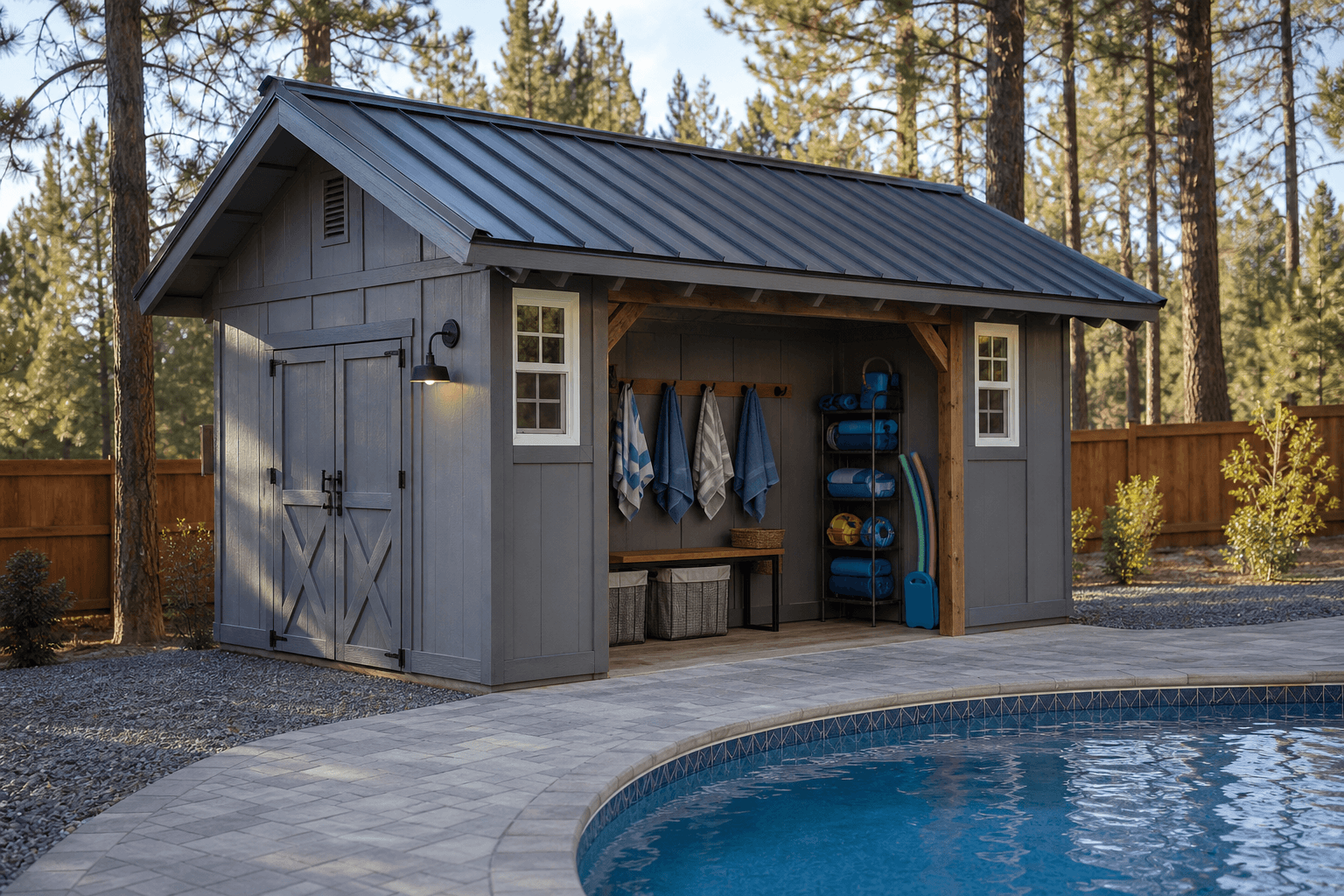
A custom building assembled on-site near the I-90 corridor in Stateline, sized to the lot and built for Panhandle winters.
Stateline customers tend to come to us with a job that mixes work and storage. A commercial storage building gives a business along the corridor dry, lockable space for inventory, equipment, or seasonal overflow without signing another lease. A contractor tool crib keeps saws, fasteners, and small equipment secure and organized for a crew that stages out of the area before heading down I-90. A detached garage or shop on a rural lot adds real bay space for a project, a trailer, or a workbench, and a plain storage shed clears a packed garage or a cluttered yard. We build all of it on your lot.
Access here is usually easier than it is in a tight subdivision, but it comes with its own wrinkles. Commercial yards along Seltice and the frontage roads tend to be open gravel with truck traffic, so we plan the footprint and the pad around how vehicles move through the site and where the building can sit without blocking a lane. Rural parcels off the corridor often have plenty of room but uneven ground, so we level and drain the pad so the building sits square. Building in place means the structure lands exactly where you want it — back corner of the yard, beside an existing metal building, or out on open acreage — with no crane and no finished box to thread onto the property.
Secure, lockable buildings for inventory, equipment, and tools — dry overflow for a business on the corridor or a staging crib for a crew working off I-90.
Real bay space on a rural lot for a project, a trailer, or a workbench — built to the property line setbacks Kootenai County allows on your parcel.
Mowers, equipment, and seasonal gear come off the garage floor or out of the weather and into a dry, organized building that holds up through the winter.
One thing to settle first in Stateline: which state you are building in. The line runs straight through the community, and only parcels on the Idaho side fall under Kootenai County. A building a few hundred feet west is in Washington and answers to Spokane County instead, with different code and a different permit office. If your lot is on the Idaho side, Kootenai County handles accessory buildings the way most of North Idaho does — smaller utility sheds under a set square-footage threshold usually skip a building permit, while larger footprints, anything wired or plumbed, occupied buildings, and most commercial structures generally need one.
Commercial and contractor buildings carry extra considerations beyond a backyard shed — zoning use, fire access, and how the building is classified can all come into play on a commercial parcel, so it is worth confirming with the county before you commit to a size or location. Even when no permit is required, setbacks still are: the building has to sit a minimum distance from property lines. Our permits and placement guide covers the Kootenai County basics and setbacks, and the commercial storage planning guide helps you scope a building before you apply.
A detached garage built on-site on a rural lot near Stateline, set on a leveled gravel pad and matched to the property.
Stateline gets the same real Panhandle winters as the rest of western Kootenai County. A building here has to carry a meaningful snow load on the roof, shrug off freeze-thaw at the foundation, and keep its doors swinging after a storm drops several inches overnight — which matters even more for a commercial or contractor building that has to stay accessible through the work week. We build to the roof pitch and anchoring the local load calls for, and we set most buildings on a compacted gravel pad that drains snowmelt and keeps the floor up off wet ground, a better fit for North Idaho than a slab that traps water against the structure.
Sites along the corridor are often flat, packed gravel that make for a fast, clean pad, while rural parcels off Seltice can run uneven and stay damp into spring. We level and drain the pad either way so the building stays dry and square for the long haul. A 12x16 or 12x20 covers most shop and storage needs with room to work, a 12x24 gives a business or a contractor real footprint for equipment and inventory, and a 10x16 handles straightforward storage without taking over the yard.
Stateline, Kootenai County, on the Idaho/Washington line along I-90 west of Post Falls — Idaho-side lots permit through Kootenai County, while parcels across the line fall under Spokane County, Washington.
Small utility sheds often skip a permit; larger footprints, occupied buildings, anything wired or plumbed, and most commercial structures usually need one — and commercial parcels can add zoning and fire-access review.
Plan for a meaningful winter snow load on the roof, freeze-thaw at the foundation, and a gravel pad that drains snowmelt away from the building so it stays accessible.
We build on-site anywhere in Stateline — open commercial yards along the corridor and rural parcels off Seltice are both handled in place, no crane needed.
It depends on which side of the line your lot sits on. The Idaho/Washington border runs right through Stateline, so a parcel on the Idaho side falls under Kootenai County, while a parcel just across the line is in Washington and goes through Spokane County — two different codes and two different permit offices. Confirm where your property line sits before you plan a build. We work on the Idaho side, so for Kootenai County lots we help you size and place the building to fit county code and setbacks, and our permits guide covers the basics.
For an Idaho-side lot, it depends on size, use, and how the building is classified. Smaller utility sheds under the local square-footage threshold usually do not need a building permit, but larger buildings, anything you plan to occupy, anything wired or plumbed, and most commercial structures generally do. Permits run through Kootenai County, and setbacks from property lines apply either way. Commercial and contractor buildings can also trigger zoning and fire-access review, so confirm with the county before you commit to a size or spot. We help you scope and place the building to fit.
Yes — that is a lot of what we build in this corridor. A commercial storage building gives a business along Seltice or the frontage roads dry, lockable space for inventory, equipment, or seasonal overflow without leasing another unit, and a contractor tool crib keeps tools and small equipment secure for a crew staging off I-90. We build on-site at the back of a gravel yard or beside an existing metal building, and we plan the footprint around how trucks move through the site. Commercial buildings can carry extra permitting on the Idaho side, so we help you size it to fit the parcel and the use.
It splits by use. For shop and general storage, a 12x16 or 12x20 hits the sweet spot — enough room to work with space to grow. Businesses and contractors often step up to a 12x24 for real footprint to hold equipment and inventory, while a 10x16 handles straightforward storage on a smaller lot or yard without taking over the space. We size the building to your parcel, your access, and exactly what you need to store or work on.
Yes. We reach the rural parcels around Stateline and out along Seltice Way and the frontage roads for delivery, and we build in place on open acreage — no crane and no finished box to thread onto the property. Rural lots often have plenty of room but uneven, sometimes damp ground, so we level and drain a gravel pad first so the building sits square and stays dry. Whether it is a shop, a garage, or plain storage, the building goes together exactly where you want it on the lot.
Stateline gets real Panhandle winters, so the roof has to carry a meaningful snow load, the foundation has to handle freeze-thaw, and the doors need to keep working after a heavy storm — which matters even more for a commercial or contractor building that has to stay accessible through the work week. We build to the roof pitch and anchoring the local load calls for and set most buildings on a gravel pad that drains snowmelt instead of trapping it against the structure. If you want the building usable year-round as a shop, we can insulate and wire it to stay comfortable through the cold months.
Tell us about your lot, which side of the line it sits on, and what the building is for. We will help you size and place it for the I-90 corridor, Kootenai County code, and North Idaho winters — then you can build and price it online.
Check local permit, setback, and placement rules before you build on site.
We build on site across North Idaho. Explore other cities and towns we serve.