When a small business outgrows the back room, the closet, and the corner of the shop floor, inventory starts living everywhere it should not. Stock piles up against a wall where it gets damaged, cases of product sit in a hallway that customers walk through, and the equipment you bill for is wedged behind a desk or left in a truck overnight because there is nowhere safe to put it. Then you spend the first half hour of every job digging for the part, the case, or the tool — and twice a year you eat the cost of something that walked off or got crushed. A commercial storage building ends that: one secure, organized building on your own property where inventory, equipment, and supplies live on real shelving, behind a door wide enough to roll a pallet or a loaded handcart straight in, on a floor built to take the weight and the daily traffic.
North Idaho On Site Sheds builds every commercial storage building right on your lot, so the door width, the floor, the shelving, and the locks get sized for the way your business actually moves product. Commercial storage is a different job than a backyard shed — it has to swallow bulk inventory, heavy equipment, and the gear you run a business on, take a loaded cart across the floor every day, and protect assets you cannot afford to lose. Plan it around four things first — capacity, access, security, and durability — and the rest of the build falls into line. Get those four right and the building pays for itself in time saved, product protected, and assets that stay where you left them.
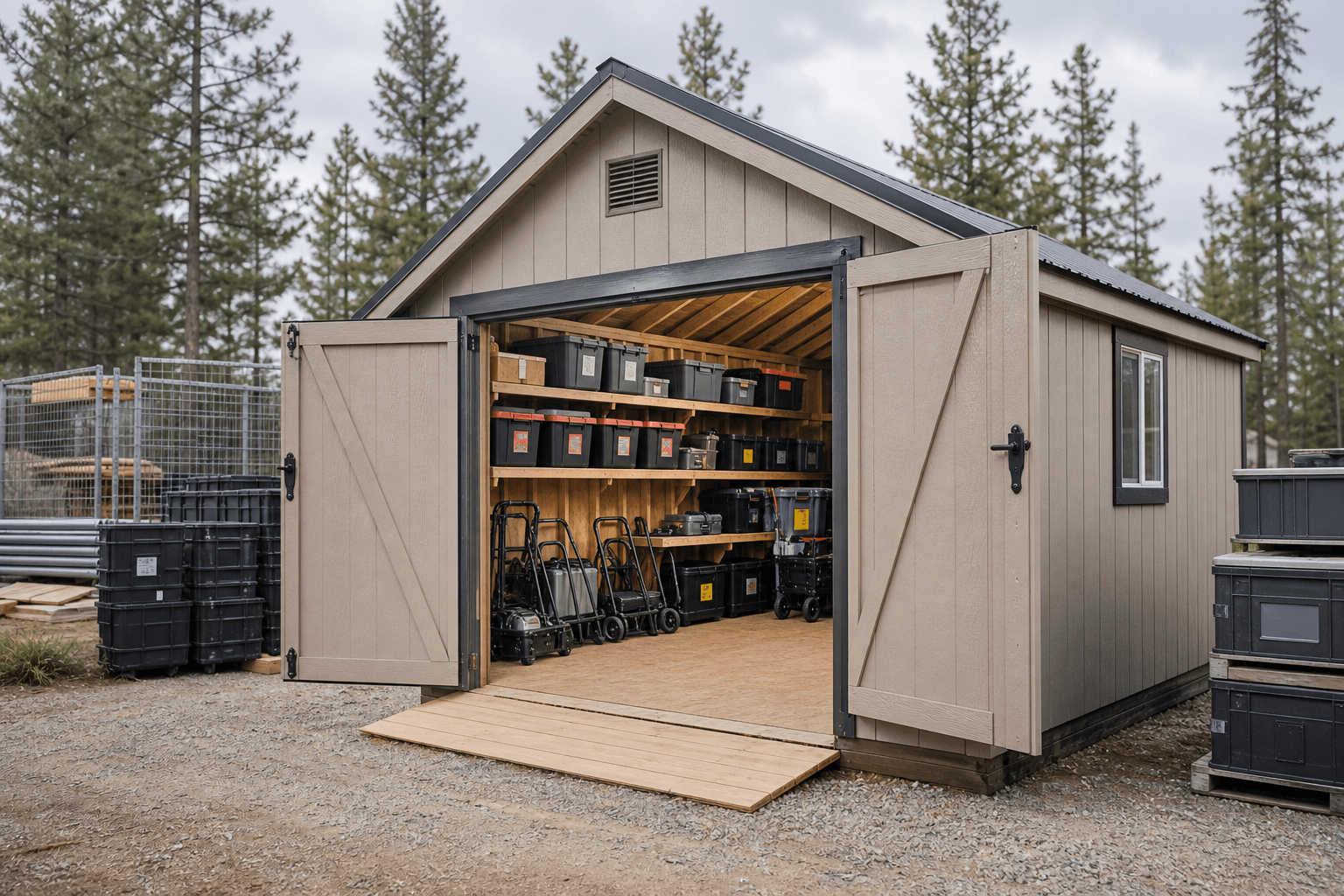
One secure building for the business: inventory on heavy-duty shelving, equipment staged by the door, behind a wide opening you can roll a pallet through.
Commercial storage is defined by how product gets in and how much you can stack once it is inside, so the roofline you choose is really a decision about access and vertical capacity. A standard gable is the workhorse: it frames a tall, wide door on the gable end so a pallet jack, a handcart, or a stacked dolly rolls straight in, and it leaves clean, full-height sidewalls for the deep shelving and pallet racking that hold the inventory. Order a double door or a wide overhead-style opening and 8-foot-plus sidewalls so a loaded pallet clears the frame and the top shelf earns its keep. A lofted barn (gambrel) raises the ridge and builds in a loft — a smart move when you carry slow-moving or seasonal stock, because you keep back-stock and off-season product overhead while the main floor stays clear for the inventory you pick from daily. A lean-to or single-slope sheds North Idaho snow predictably to one side and makes a tidy covered staging spot to back a trailer under or stage outgoing orders alongside the main building.
Whatever the roofline, build for a wide door, real headroom, and a floor that takes the weight, because those three are the things you cannot add after the fact and the things commercial inventory punishes hardest. A commercial storage building sits between a stockroom and a small warehouse, which is why it overlaps with a contractor tool crib when secured, checked-out tools and crew gear drive the plan, and with a rugged farm storage building when equipment and bulk supplies are the real load. Decide early whether the building leans toward stacked inventory or staged equipment, because that one call drives how much wall goes to racking and how much open floor you keep clear for carts and a pick lane.
A 12x20 holds deep shelving or a run of pallet racking down both walls, a staging spot by the door, and a clear lane to push a handcart through — enough for the inventory of a lean, growing operation.
A 12x24 or 16x24 adds the length and width to store inventory on the walls, park equipment and rolling racks on the floor, and keep a staging and order-pull area clear of the racking.
A 20x24 gives you aisles between rows of racking, room for a pallet jack to turn, a receiving and shipping zone, and the floor to add capacity as the business grows into it.
Footprint decides whether you stack inventory deep with a real aisle or shuffle boxes to reach the back row, and whether equipment gets its own staged spot or blocks the pick lane — so compare the actual dimensions against the way you move product before you commit. A 12x20 is a strong starting building for a lean operation: deep shelving or a short run of pallet racking down both long walls, a staging spot by the door, and a clear lane to roll a handcart through, though it tightens up the moment you try to park equipment inside too. A 12x24 buys the length to keep a full inventory wall and still stage rolling racks, totes, and a piece or two of equipment without choking the lane. Step up to a 16x24 and the extra width lets a pallet jack turn, gives you room for back-to-back racking with an aisle, and opens a receiving area clear of the stock. For a genuine small-business warehouse, a 20x24 gives you real aisles between rows, a dedicated shipping-and-receiving zone, and the floor to scale up as volume climbs. Width matters as much as length here — the extra feet are what let a loaded pallet swing through the door and reach the racking without a fight.
These overlap, and the right call comes down to what the building is built around. A commercial storage building leads with inventory and capacity — bulk product, cases, materials, and the equipment you bill for — so it favors deep racking, a wide door for pallets and carts, a durable floor, and a layout you can pick and restock from fast. A contractor tool crib leads with secured, accountable tools — heavy-duty shelving, a lockable cage or room, and gear staged and checked out to crews — which is exactly the instinct you want when shared tools and equipment leave the building every morning and need to come back. A rugged farm storage building leads with implements, feed, and field supplies on a working property, sized to drive equipment in and take mud and weight. The point of a commercial storage building is that it puts business assets first: it holds the inventory, protects the equipment, and keeps both organized and locked.
Plenty of small businesses want one building that does double duty, and that is fine — just name the lead job. If the priority is getting inventory off the shop floor and into sorted, secure capacity, build a commercial storage building and add a locked tool cabinet in one corner. If the priority is controlling tools and equipment that crews sign out, lean toward a tool crib layout with a secured section and build inventory shelving around it. And if a chunk of what you store is ordinary household-scale overflow, a straightforward storage shed may be the simpler answer for that part. Naming the lead use up front locks in your door width, your floor spec, your security level, and how much wall goes to inventory racking versus secured tool storage before the build is ordered.
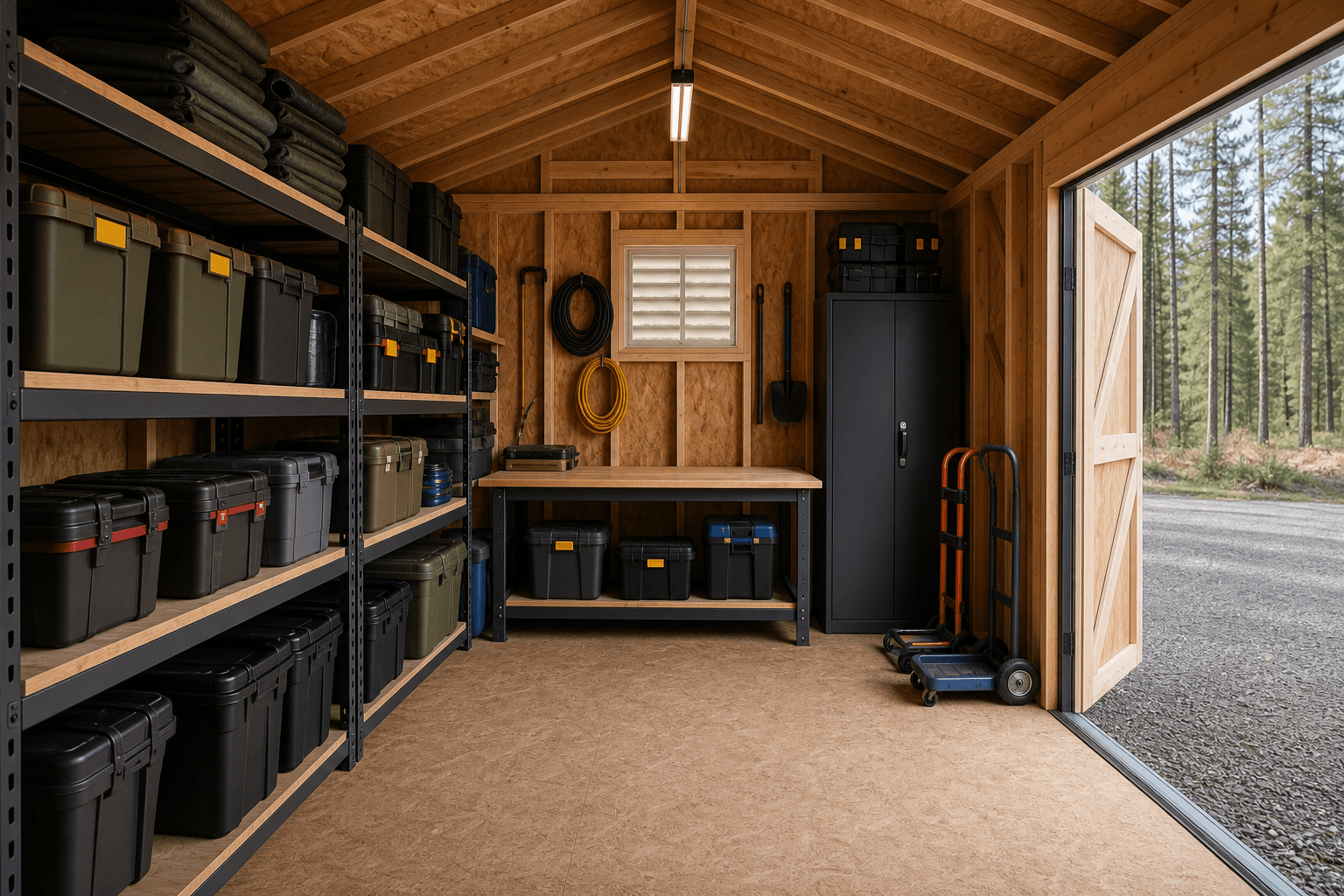
Zone it: racking and shelving on the walls, a clear pick lane down the middle, and a staging area by the door for receiving and order pulls.
Think of the building as four working zones instead of one open box, and lay them out so product flows from the door to the shelf and back out without crossing itself. A receiving and staging zone anchors the area just inside the wide door — a clear stretch of floor and a sturdy bench or table where you break down deliveries, check in stock, and pull and pack outgoing orders — kept right at the threshold so a pallet or handcart rolls in, drops its load, and rolls back out without threading past the racking. An inventory zone runs the long walls with deep shelving or pallet racking, organized so fast-moving product sits at waist height in the easy-to-reach bays and slow stock goes up high or back in a loft. An equipment zone takes a defined patch of floor or a back corner for the gear you stage between jobs — rolling racks, larger tools, cases, and anything on wheels — kept clear of the pick lane. And a secured zone locks away the highest-value items: a cabinet, a cage, or a back section with its own lock for the small, expensive, or theft-prone inventory and tools.
Good zoning means deliveries never pile up in the pick lane, the equipment is not buried behind a pallet, and the valuable stock is locked instead of loose. Leave a clear lane from the door to the racking wide enough to push a loaded handcart or turn a pallet jack, and keep the heaviest, fastest-moving product closest to the door so it travels the shortest distance the most often. Label the bays, keep a running spot for inbound and outbound near the door, and keep the floor under the equipment open so a cart or a jack can get anywhere it needs to. A building you can pick and restock without backtracking is a building that gives you the half hour back on every job.
Industrial steel shelving and rated pallet or cantilever racking on adjustable standards that carry loaded totes, cases, and bulk product without sagging, run floor to near-ceiling to use every cubic foot, and rearrange as the inventory mix changes.
A sturdy receiving-and-pack bench by the door, plus clear labeled bins, a bay-numbering or location scheme, and a simple count or barcode system so you can find, pick, and restock product fast and know what you have on hand.
A loft or overhead racks for slow-moving, seasonal, or back-stock inventory and bulky cases you only touch a few times a year, keeping the main floor and the reachable bays clear for the product you pick from every day.
A floor specced to take loaded pallets, a pallet jack, and handcarts rolling across it all day — a tough framed floor on a solid pad, or a concrete slab you can roll across, sweep, and hose down without it flexing or wearing through.
This is where a bare shell becomes a working business asset, and it is worth naming exactly what lives inside so you size the door, the floor, the racking, and the locks around it. The bulk inventory and stock is the anchor and the reason the shelving runs deep: cases and cartons of product, palletized goods, raw materials and components, packaging and shipping supplies, seasonal and back-stock product, and the totes and bins you pick from. Right beside it lives the equipment and gear you bill for — the larger tools, machines, rolling racks, ladders, generators, pressure washers, and the cases of gear that crews load out in the morning and stage back at night — the heavy, awkward, valuable stuff that earns a floor spot and a lock. Then come the supplies and consumables: shipping and packing materials, fasteners and small parts, cleaning and shop supplies, and the boxes, labels, and tape that keep orders going out.
Around that, you store the things that make the building run like a business. Records and account materials want a dry, secured spot — files, samples, signage, and seasonal displays. Fluids and anything flammable take a planned, separated, ventilated corner away from product — fuel for equipment, oil, paint, solvents, and chemicals — never mixed in with the inventory. And the high-value, theft-prone items — power tools, electronics, small expensive stock, and anything that walks easily — belong behind a lock in the secured zone, not loose on an open shelf. Naming that full fit-out up front is how you make sure the pallet fits through the door, the inventory has a home, and the assets you cannot afford to lose are the ones that stay locked down.
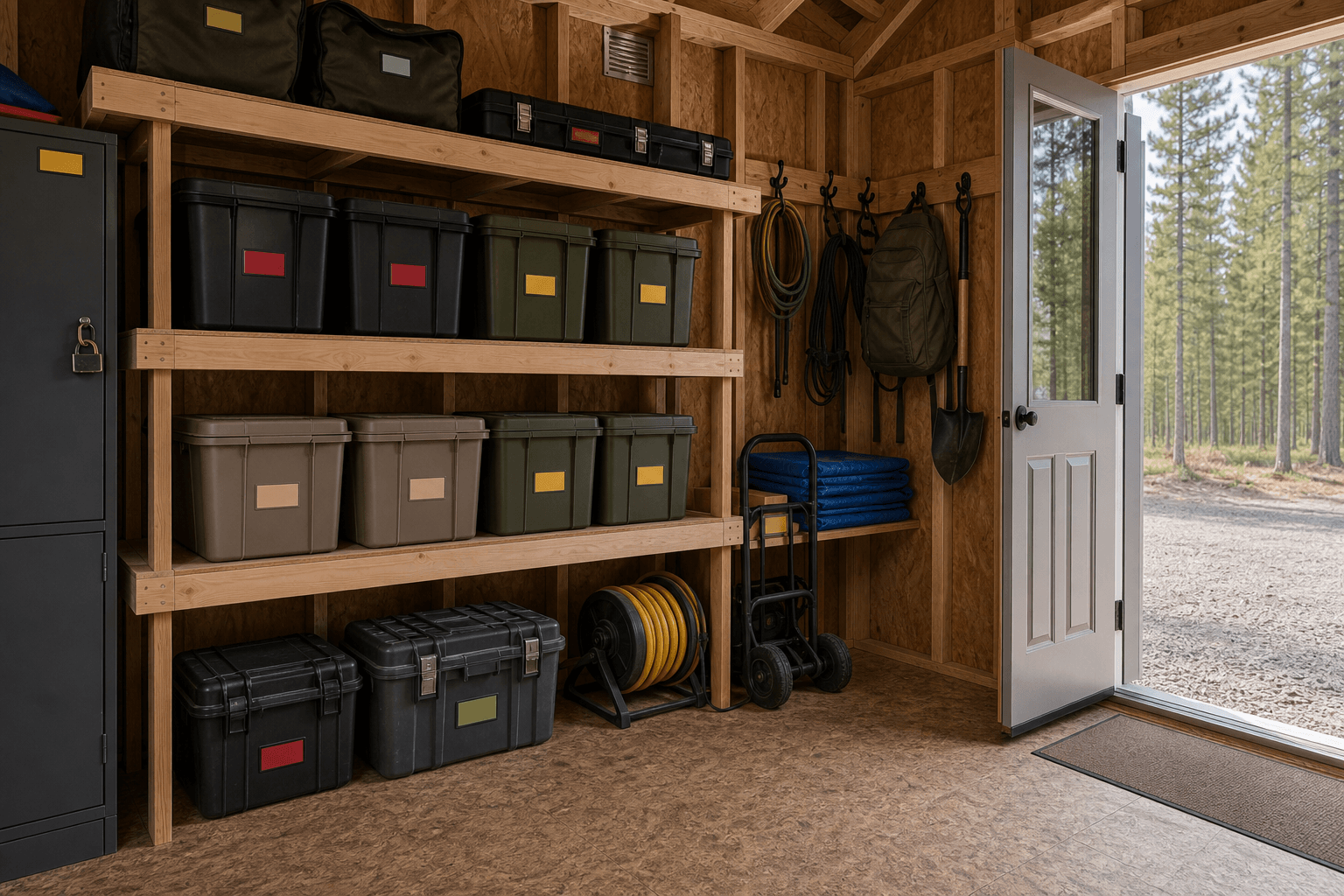
Numbered bays and labeled bins make picking fast, and a locked cabinet keeps the small, high-value inventory and tools secure.
| Commercial storage planning checklist | |
|---|---|
| Wide door & pallet access | A double or wide overhead-style door and a flat, hard apron outside so a pallet jack, a loaded handcart, or a stacked dolly rolls straight in and back out without threading past the racking or fighting a muddy threshold |
| Durable floor for daily traffic | A floor specced for the load — a tough framed floor on a solid pad or a concrete slab — that takes loaded pallets and a pallet jack rolling across it every day, resists wear, and sweeps or hoses down clean |
| Heavy-duty shelving & racking | Industrial shelving and rated pallet racking on adjustable standards, run floor to near-ceiling, so bulk inventory, cases, and totes can be stacked deep, picked fast, and rearranged as the product mix changes |
| Security for business assets | Solid doors with commercial-grade locks and protected hinges, a secured cabinet or cage for high-value stock, and an option for an alarm, a motion light, and a camera to protect inventory and equipment after hours |
| Climate & ventilation | Vents and a tight, dry envelope, plus insulation and a heater where stock demands it, so inventory stays dry and undamaged and the building does not sweat condensation onto cases, electronics, or equipment |
| Organized, scalable layout | Labeled bays, a clear pick lane, a receiving-and-staging zone by the door, and room to add racking as volume climbs, so the building keeps working as the business grows instead of needing a second one in a year |
Power, airflow, and a dry envelope decide whether the building keeps your inventory sellable or quietly ruins it, so spec them for what you actually store. A commercial building earns real wiring: dedicated 120V (and where the load calls for it, 240V) outlets along the staging bench and walls for a charger, a shrink-wrap or label station, shop tools, and a heater, plus bright, shadow-free LED light over the pick lane and the bench so you can receive, pick, and pack accurately before dawn and after dark through the short North Idaho winter days. Just as important is ventilation — passive vents low and high, or a fan — because a sealed building full of cardboard, packaging, and equipment holds moisture and grows condensation that warps cases, rusts tools, and spots product. A few well-placed vents keep the inventory dry and the building from sweating water onto a fresh pallet overnight.
Climate is where commercial storage gets specific, because the right answer depends on the product. Most general inventory, equipment, and supplies are happy in a dry, well-ventilated, unheated building as long as moisture and pests stay out. But the moment you store anything that should not freeze or cook — liquids and paint, electronics, batteries, adhesives, certain materials, or temperature-sensitive product — insulation and a thermostatic heater (and sometimes cooling) move from nice-to-have to required. North Idaho winters drive the rest: a tight, dry envelope and enough insulation to break the worst of the cold keep stock from freezing and condensation off your cases, and a building that holds an even, dry temperature is one where the inventory you pull is the inventory you can sell. Tell us what you store and we will help you decide where on the climate scale the building needs to land.
A commercial storage building earns a real base and a real approach, because everything about it is heavy and you are rolling loaded carts and pallets in and out of it all day. A compacted gravel pad drains well and works under a properly built framed floor, but if you are running a pallet jack and loaded handcarts across the floor daily, a concrete slab is usually worth it — it gives a dead-flat, washable surface that takes the weight without flex, rolls smooth under wheels, and stands up to commercial traffic year after year. Just as important is a flat, hard apron right outside the wide door, where a delivery truck or trailer can pull up off a gravel driveway and a pallet rolls straight across instead of dropping off a lip or sticking in mud. Grade the pad so snowmelt, rain, and runoff drain away from the door rather than pooling at the threshold, and plan the approach so receiving and shipping flow without a muddy, rutted bottleneck. Read how to prep a shed site before delivery so the pad, the drainage, and the apron are ready for a building this heavy and this busy.
North Idaho weather drives several more choices. Plan a roof and anchoring rated for local snow load, because a wider commercial building carries a lot of roof, and detail the door and threshold so drifting snow does not block you out of your own inventory on the morning you need to ship. Keep the gravel approach plowed and passable so deliveries and pickups keep moving after a storm, and channel snowmelt away so the threshold does not ice and the floor does not stay wet. Commercial buildings also tend toward larger footprints with added power and a business use, which can trigger local rules that a small backyard shed skips — bigger footprints, electrical work, commercial occupancy, and setback or zoning requirements often apply, and a business use on a property can carry its own conditions. Confirm what your town and county require on the service areas pages, and factor any permit and electrical work into the plan before you finalize the size, the siting, and the use.
Bulk inventory is heavy and constant, so spec industrial-grade shelving and rated racking, not light home shelves that sag under a season of stock. Run heavy-duty steel shelving on adjustable standards down the long walls for cases, totes, and bins, and add rated pallet racking or cantilever racking where you store palletized or long, bulky product, sized so a pallet jack or forklift can load the bays you mean to load. Run the shelving floor to near-ceiling to use every cubic foot, keep fast-moving product at waist height in the easy bays and slow stock up high, and standardize on labeled bins so you can see and grab what you need. Adjustable standards matter because your product mix will change, and shelving you can re-space and add to keeps the building working as inventory grows. Building on-site means the sidewall height and the door get sized so the racking and the loaded pallets actually fit.
Size the door around the widest load you move — a pallet, a stacked dolly, a loaded handcart, or a rolling rack — then add clearance, because the door is the one thing you cannot widen later. A single walk-in door works for a supply-and-inventory building you carry into by hand, but the moment you want to roll a pallet jack in, push a loaded handcart, or move product on wheels, you need a double door or a wide overhead-style opening and 8-foot-plus headroom so a stacked load clears the frame. Measure your largest pallet or cart — width, height stacked, and how it sits on the jack — and build the opening wider than that so you are not jockeying every load through. Pair the wide door with a flat, hard apron outside and a threshold a cart rolls across cleanly, so receiving and shipping flow instead of fighting a lip. Building on-site means the opening gets sized for your real loads, not a stock door.
Treat security as part of the build, because a commercial storage building holds real value and often sits on a lot after hours with no one around. Start with the envelope: solid, commercial-grade doors, quality deadbolts or padlocks on a hardened hasp, protected or concealed hinges, and secured windows or none at all. Inside, create a secured zone — a locking cabinet, a cage, or a back section with its own lock — for the small, expensive, and theft-prone items like power tools, electronics, and high-value stock, so a single failure at the main door does not expose everything. Then layer on detection: a motion light over the door and the apron, an alarm, and a camera covering the entry and the yard, all of which deter and document. Keep an inventory count so you know fast if something is missing. Building on-site lets us spec the doors, the locks, the secured section, and the wiring for an alarm and cameras from the start, instead of bolting security on after a loss.
Commercial use is daily and relentless — loaded carts, pallet jacks, dropped cases, and constant foot traffic — so build the floor and the structure for years of it, not for a backyard shed. A tough framed floor on a solid, well-compacted gravel pad handles a lot, but if you are rolling a pallet jack and loaded handcarts across it every day, a concrete slab is the upgrade that pays off: a dead-flat, washable surface that takes the weight without flexing, rolls smooth under wheels, and shrugs off years of traffic. Spec the structure to match — full-height sidewalls and headers sized for the racking and the door, solid framing, and a roof and anchoring rated for North Idaho snow load. Use commercial-grade doors and hardware, because the door is the part that gets worked hardest. A building that takes the daily abuse without sagging, wearing through, or racking out of square is one that protects the inventory for the long haul. Building on-site means the floor and the structure get specced for your actual loads and traffic.
It depends entirely on what you store, so match the climate to the product instead of guessing. Most general inventory, equipment, supplies, and packaging are perfectly happy in a dry, well-ventilated, unheated building as long as moisture and pests stay out — for that, good vents and a tight envelope do more than insulation. But the moment you store anything that should not freeze or overheat — liquids, paint, adhesives, batteries, electronics, certain materials, or temperature-sensitive product — you need insulation and a thermostatic heater, and sometimes cooling, to hold a steady, dry range through a North Idaho winter and summer. Ventilation matters across the board, because a sealed building full of cardboard and equipment grows condensation that warps cases and rusts tools. The right move is to sort your inventory into what tolerates the cold and what does not, then build the climate around the most sensitive thing on the shelf. Tell us what you store and we will help you land on the right insulation and heat.
Size it around what you store and move today, then build in room to grow, because outgrowing a commercial building means renting space or building a second one — both more expensive than a few extra feet now. For a lean operation, a 12x20 holds deep shelving or a short run of racking down both walls with a clear pick lane, but it fills up fast as inventory and equipment grow. To keep an inventory wall and still stage equipment and rolling racks, step up to a 12x24 or 16x24, where the added length and width give you aisles, a receiving zone, and room for a pallet jack to turn. For a true small-business warehouse with rows of racking, a real shipping-and-receiving area, and capacity to scale, a 20x24 gives you the floor to grow into. Plan the racking so you can add bays and re-space shelves as volume climbs, and leave a stretch of floor open as a flex zone. Building on-site means the footprint, the sidewall height, and the layout get matched to your inventory and your growth, instead of a stock plan you outgrow in a season.
Most commercial storage needs in Coeur d'Alene and Post Falls come down to one constraint: the building has to fit the lot you already own, not a lot you wish you had. Delivered steel buildings require a flat, clear staging area and a crane or forklift to set panels. A structure built on site by NIOS gets framed directly on your gravel pad — on a sloped commercial lot, on a tight side parcel, or behind an existing building without a wide approach.
Kootenai County commercial properties deal with real snow loading. A roof framed to local design loads — not to a generic national spec — carries the wet, heavy snow that can arrive in January and stay through February without the deflection that strains ridge connections over time. That matters for a building storing palletized inventory or equipment you cannot afford to have damaged.
For year-round access, the approach matters as much as the building. A gravel pad compacted to 95% and graded for drainage keeps the door area passable through freeze-thaw cycles. A 10-foot or 12-foot wide door opening, framed in during the build, means a handcart or pallet jack moves freely without clearance fights.
Businesses in Hayden, Rathdrum, and the Stateline corridor regularly use on-site builds to add storage capacity without relocating. If you are ready to spec out the footprint, price it in the shed builder or request a free estimate — no lot visit required to get to a real number.
Tell us what you store, what you move through the door, and what has to stay locked, and we will help spec the capacity, the wide pallet access, the durable floor, the heavy-duty racking, the security, and the site prep around your property — then you can build and price it online.
Keep planning your build with related North Idaho shed guides.