Some builds do not fit a category. You want a workshop on one end and a tidy storage bay on the other, or a footprint that is wider than the catalog but shorter than a garage, or a specific roofline with the windows where you want them and a finish that looks like it belongs next to the house instead of behind it. That is what a fully custom shed is for: you start from a blank slate and design the building around how you actually live, not around a standard model. This guide walks through how to plan a custom build from scratch — picking the style and roofline, settling on a size that splits the difference between two needs, laying out the inside, and choosing the doors, windows, and finishes — and how to turn all of that into a real, priced plan in the online configurator.
North Idaho On Site Sheds builds every custom shed on your property, which is exactly why a one-off design works here: the plan can answer to your real grade, your driveway, and the way the building has to sit relative to the house and the tree line. The best way to think about a custom build is to stop picturing a finished shed and start listing what has to happen inside it — what gets stored, what gets done, who uses it, and what it has to look like from the kitchen window. Get those answers down first, then design and price the building online and watch the cost move as you change the size, the doors, and the finish. The configurator is where a wish list becomes a buildable plan.
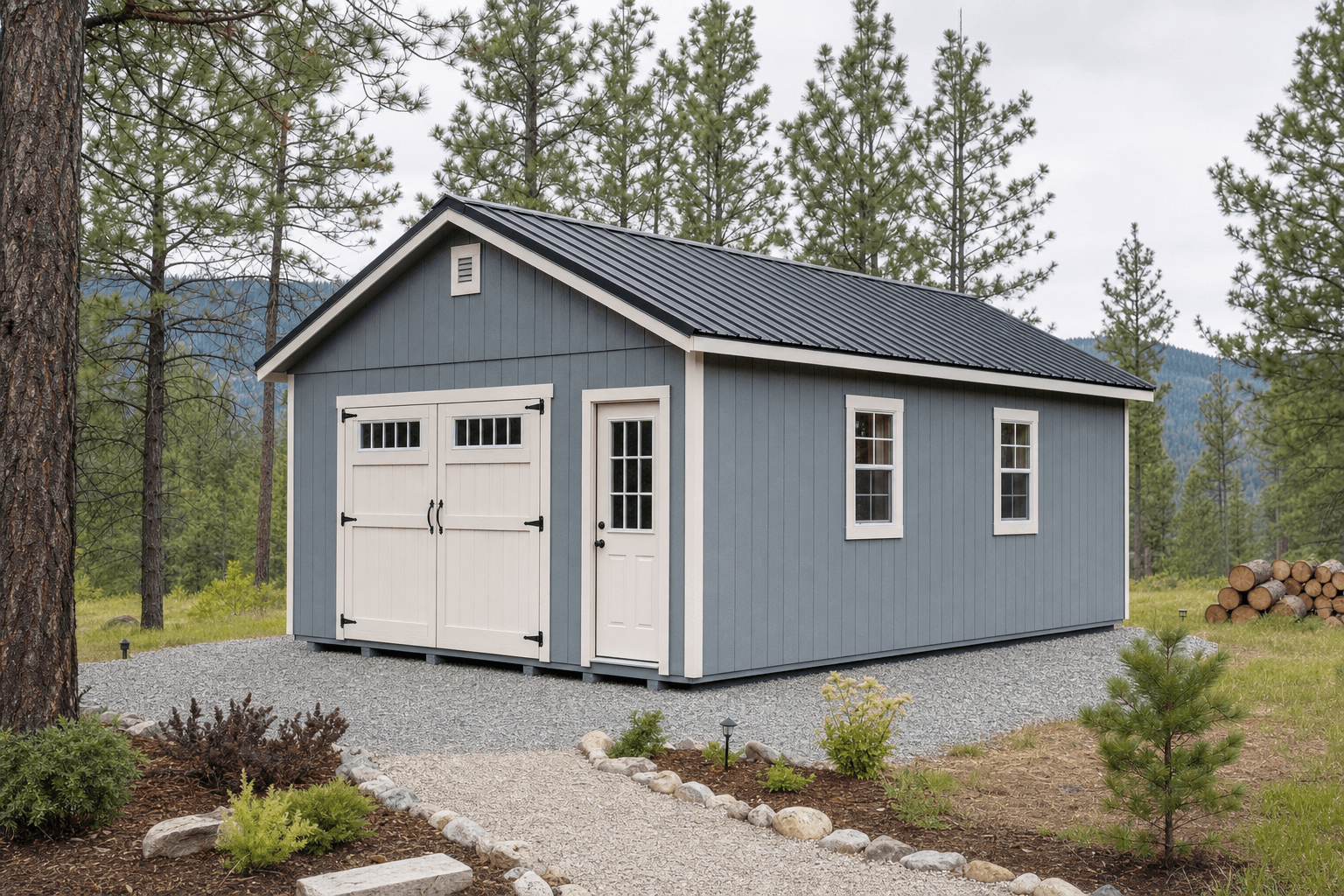
A custom build starts from a blank slate: your roofline, your doors, your windows, and a finish that fits the property.
With a custom shed you are not picking from a short menu of models — you are choosing the roofline that fits the job and the look you want, and that single decision shapes the headroom, the storage, and the silhouette. A standard gable is the workhorse: a clean peaked roof, generous height at the ridge, and walls that are easy to insulate and line, which makes it the natural base for almost any mixed-use plan. A lofted barn (gambrel) trades a little exterior height for a real overhead loft, so you can keep bulky or seasonal items up top and leave the main floor open for work. A lean-to or modern single-slope sheds North Idaho snow predictably to one side and gives you a tall front wall to fill with glass and light — the right call when the building wants to read modern or sit against a slope.
Style is also where a custom build borrows from its neighbors. If the plan leans toward serious project work, spec it closer to a stick-built workshop with taller walls and room for power and dust control. If it has to swallow a vehicle, trailer, or wide equipment, it shades toward a detached garage with a roll-up door and a slab. And if it is meant to be a finished, comfortable retreat, it shares DNA with a she-shed or studio — insulation, real windows, and interior finishes come first. Naming which direction yours leans is the most useful early decision, because it sets the wall height, the door type, and the finish level before anything else.
An 8x12 or 10x12 suits a focused custom build — a hobby corner, a tidy storage bay, or a compact studio — with a little extra width so it does not feel boxed in.
A 10x16 or 12x16 splits cleanly into a work end and a storage end, or living space plus a utility bay, without crowding either side.
A 12x20 up to a 16x24 carries a full workshop plus storage, a studio with a porch, or a bay wide enough for equipment and a trailer.
Custom builds are usually sized to a need that falls between the standard footprints, so compare the real dimensions before you settle — a couple of feet often decides whether two uses share the building comfortably or fight over the floor. A compact, single-purpose custom shed lives happily on an 8x12, which gives you a focused room with a bit of breathing space. Step up to a 10x16 and you have the length to run a genuine two-zone plan — a work bench on one end and shelving or a parked toy on the other — with a wall or curtain between them if you want. A 12x20 is the sweet spot for an ambitious mixed-use build: a real workspace, a storage bay, and still room to move. And when the plan includes a vehicle, a trailer, big equipment, or a true multi-zone layout, a 16x24 gives you the width to walk fully around things and the depth to keep everything in a straight line. The advantage of a custom build is that you are not rounding to the nearest model — you size to the job, and the configurator prices each footprint as you go.
A lot of custom builds start as a question of whether one of the focused buildings would have done the job, and the honest answer shapes your spec. A dedicated workshop is the better starting point when project work clearly leads — it puts wall height, bright lighting, insulation, and 240V circuits first, and a custom plan can simply add a finished storage end or an office corner to that shop base. A detached garage is the move when a vehicle, boat, or trailer has to fit, because it brings the wide roll-up door, the slab, and the clearances that smaller sheds do not — and you can still customize the rest of the building around that bay.
Where a fully custom build earns its keep is when no single category covers the plan: you want shop space and a comfortable she-shed-style retreat under one roof, or a storage bay paired with a home-gym corner, or a footprint and roofline that none of the standard models offer. In that case you are not bending a stock building to fit — you are designing the right building from the start. The deciding question is simple: does one clear use lead, or are you genuinely combining two or three? If one leads, start from that focused service and add to it; if you are truly mixing, plan it as a custom build and lay it out in the configurator so every zone gets the size, doors, and finish it needs.
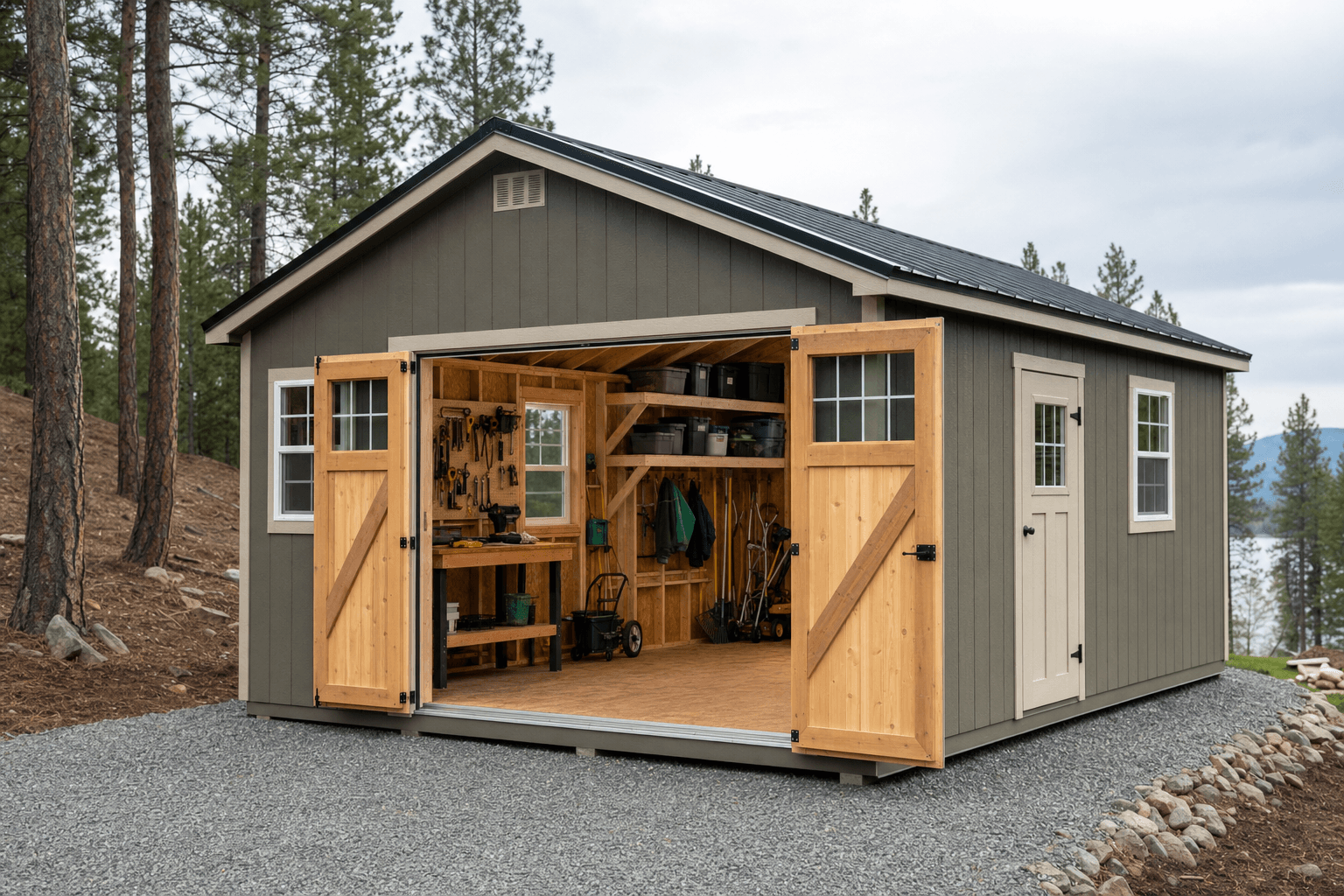
Mixed-use done right: a defined work zone, a separate storage bay, and a clear path between them.
The whole point of a custom build is that the inside is yours to arrange, so plan it as defined zones rather than one open box — that is what keeps a mixed-use building from turning into a cluttered hallway. Decide first which corner is the anchor: the workbench, the desk, the bar, or the bed that everything else organizes around, and give it the best wall and the best light. Then carve a secondary zone for the other job — a storage bay, a gear wall, a reading nook, a parked toy — and separate the two with whatever the use calls for, from an open boundary to a half-wall, a curtain, or a real partition with its own door. Keep a clear path from the main door straight to the anchor zone so the building stays usable when both sides are full.
Custom layouts live or die on the boundaries between uses. Put the messy, dusty, or noisy zone against an interior wall and the quiet or finished zone near the windows, so the two do not constantly intrude on each other. Run power and light to each zone independently — a work end wants outlets at bench height and bright task light, while a living or studio end wants softer, switchable lighting and a few well-placed receptacles. Leave aisles wide enough to move the largest thing you will carry through, and plan the door placement around the heaviest or bulkiest item the building has to swallow. Sketch the zones before you finalize the footprint, because the layout is what tells you whether you need another two feet of length or a second door.
Mix what the plan needs — a person door for a studio, double doors for big gear, or a roll-up for a vehicle — and put them where the workflow and the driveway approach actually want them.
Add windows where the use calls for it: a wall of glass for a studio or office, smaller utility windows for a shop, or a skylight to brighten a storage bay without giving up wall space.
Step up the exterior to match the house with premium siding, a metal or upgraded shingle roof, and trim, shutters, or a porch so the building reads finished rather than utilitarian.
Insulate the walls and ceiling, add a mini-split or heater, and finish the inside with lined walls, real flooring, and lighting so the space is comfortable through a North Idaho winter.
This is where a custom build separates from a standard shed, and it is worth naming exactly what you are choosing so the plan and the price reflect the building you actually want. On the outside, you are deciding the siding (LP SmartSide, board-and-batten, cedar-look, or a painted lap), the roof (architectural shingles or standing-seam metal), and the trim package — corner boards, window trim, shutters, a cupola, or a covered porch that turns a plain box into a building that matches the house. The doors and windows are fully yours to place: a 36-inch person door, a set of double barn doors, a 9-foot roll-up, transom or gable-end windows for light, and a porch entry if it is a retreat. Even the exterior color, the hardware, and the gable accents are choices, not defaults.
On the inside, the long-tail of a custom build is the fit-out: insulation and a vapor barrier, lined and painted walls, a finished floor (sealed plywood, LVP, epoxy, or rubber mats over a slab), and a lighting plan with switches and outlets sized to each zone. Layer in the use-specific pieces — a built-in workbench and pegboard for a shop-leaning build, shelving and a loft for storage, cabinets and a counter for a hobby or craft room, a mini-split and comfortable furniture for a finished retreat, or a 240V circuit and wide door for vehicle and equipment use. The details add up: ventilation and a vent fan, gutters routed away from the pad, a ramp at the wide door, exterior lighting, and shelving or a loft to reclaim overhead space. Every one of these is a line you can add, remove, and price in the build-your-shed configurator until the spec matches both the plan and the budget.
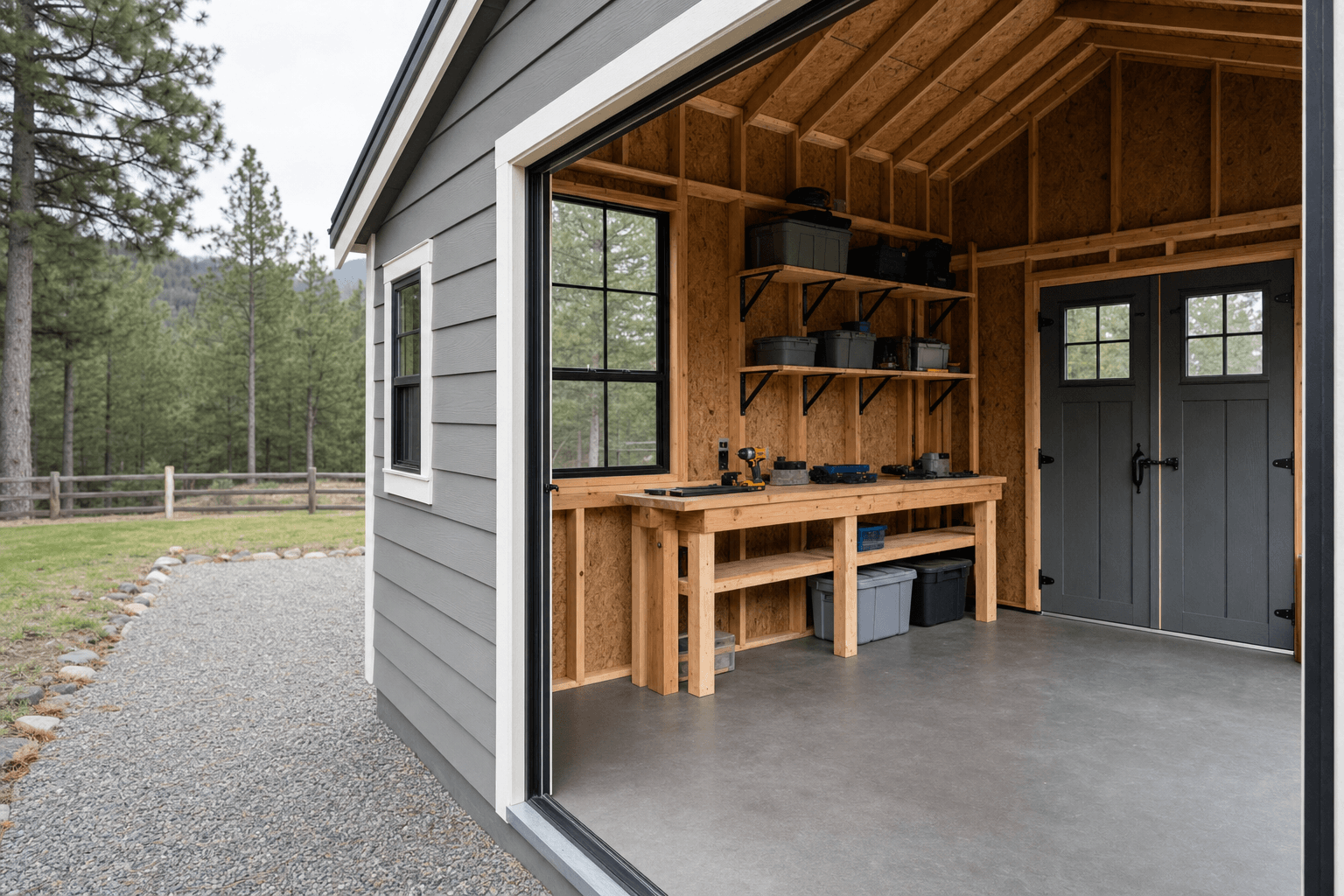
The details that make it custom: upgraded siding, trimmed windows, and doors placed exactly where you need them.
| Custom shed planning checklist | |
|---|---|
| Primary use(s) | List every job the building has to do — name the lead use and any secondary zones so the size and layout serve all of them |
| Roofline & height | Pick gable, gambrel, or single-slope, and set wall height for the tallest thing stored and the headroom each zone needs |
| Footprint | Size to the job rather than the nearest standard model — add length for a second zone and width to walk around equipment |
| Doors & openings | Choose person, double, or roll-up doors and place them for the driveway approach and the heaviest item that goes in or out |
| Windows & light | Add windows or a skylight where the use needs daylight, and keep wall space where you need shelving or cabinets |
| Finish level | Set siding, roofing, trim, insulation, and interior finish so the building matches the house and stays comfortable year-round |
Custom builds tend to ask more of their wiring than a plain storage shed, because they are usually doing real work or real living, so plan power generously and early — it is the hardest thing to add once the walls are insulated and lined. A finished studio, office, or hobby room wants several 120V circuits for outlets and lighting so a heater, a few tools, and the lights are not all on one breaker. A build with a serious shop zone or a vehicle bay often wants a small subpanel from the house and at least one 240V circuit for a cabinet saw, a welder, a dust collector, or a future EV charger. Space outlets where each zone needs them — bench height on the work end, wall height in the living end — and add exterior receptacles and a porch light if the plan calls for them.
Lighting and climate decide whether a custom build gets used in January. Layer bright, even LED light over a working zone and softer, switchable light over a finished one, and add daylight from the windows or a skylight you chose for the layout. Then make it a four-season building: insulate the walls and ceiling, seal the doors, and add a heat source sized to the space — a mini-split is the flexible favorite because it heats and cools and runs quiet, while an electric or gas heater works for a shop. Insulation also tames noise between a loud zone and a quiet one, keeps condensation off tools and finishes, and holds the morning chill out so the building is ready when you are. Decide the comfort level up front, because it drives the insulation, the wiring, and the heat — all of which are far cheaper to build in than to retrofit.
A custom building earns a real foundation, and the right one depends on what it carries. A compacted gravel pad drains well and suits a lighter storage-and-hobby build, while a concrete slab is the better base for a heavy shop, a vehicle bay, or a finished room — it takes anchor bolts, gives a dead-flat floor for rolling equipment or finished flooring, and stands up to weight. Plan the approach so the heaviest thing the building has to hold can come straight off the truck and through the door without a muddy uphill fight, and route gutters and grading so water runs away from the pad. Read how to prep a shed site before delivery day so the pad, drainage, and access are ready when the build goes up.
North Idaho winters drive several custom decisions: a roof and anchoring rated for local snow load, insulation that keeps the building workable through a long freeze, a snow-shedding roofline if the building sits where drifts pile up, and a clear, plowed path so the doors open after a storm. Bigger footprints, added electrical, and finished living space are exactly the kind of upgrades that can trigger local rules — many small sheds skip a permit, but larger custom buildings, wiring, plumbing, and setback or HOA limits often do not. Confirm what your town and county require on the service areas pages, and factor any building or electrical permit into the plan before you lock the size and where the building will sit. Settling the pad, the snow plan, and the permit early keeps a custom build on schedule.
Most of it is yours to decide. You choose the footprint and roofline, the wall height, where the doors and windows go and what type they are, the siding, roofing, and trim package, and the interior finish from bare to fully insulated and lined. The configurator lets you set those choices and see the price move as you go, so a custom build is less about a fixed menu and more about specifying the exact building you want and confirming the details on a free estimate.
Yes, and that is one of the most common reasons to go custom. The key is to plan it as two zones rather than one open room — give the workspace the best wall, light, and power, set the storage bay on the other end, and separate them with an open boundary, a half-wall, a curtain, or a real partition. Add length so neither side feels crowded, place a door for the bulkiest item, and run lighting and outlets to each zone independently so the work end and the storage end each work on their own.
Start from the use, not the look. A gable gives generous ridge height and easy insulating, a gambrel adds an overhead loft for storage, and a single-slope sheds snow to one side and suits a modern, glass-front design. Pick doors for what goes in and out — a person door for a studio, double doors for gear, a roll-up for a vehicle — and place windows where you need daylight while keeping wall space where you need shelving or cabinets. The configurator lets you try each combination and see the cost before you commit.
That is exactly what a custom build is for. Instead of rounding up or down to the nearest stock model, you size the building to the job — a couple of extra feet of length for a second zone, or extra width to walk around equipment or a vehicle. The size pages are a useful reference for how each footprint feels, but a custom build is not limited to them. Because we build on your property, the plan can also answer to your grade, your driveway, and how the building has to sit on the lot.
Plenty, and they are what make a shed look like it belongs by the house. On the outside you can step up to premium siding, a metal or architectural-shingle roof, and a trim package with corner boards, window trim, shutters, a cupola, or a covered porch. Inside you can add insulation, lined and painted walls, a finished floor like LVP or epoxy, and a lighting and power plan sized to each zone. You can mix finish levels too — a finished retreat end and a simpler storage end under one roof — and price each upgrade as you build the plan.
Use the build-your-shed configurator first. Pick the size, roofline, doors, windows, siding, and finish level, and the price updates as you change each choice, so you can shape the building to both the plan and the budget before you talk to anyone. When the spec looks right, send it in for a free estimate and we will confirm the details, the foundation, and the on-property build for your site. Designing it online first means the estimate reflects the exact building you want rather than a rough guess.
A delivered shed is built to a fixed footprint in a factory, then set down wherever the truck can reach. A custom shed built on site is framed directly on your property, which means dimensions, door placement, and roof pitch are chosen for your specific lot — not constrained by what fits on a flatbed. That distinction matters on the sloped, wooded, or narrow parcels that are common across Coeur d'Alene and Post Falls.
On-site framing also means the structure is engineered for actual North Idaho conditions. Roof pitch can be set to shed the snow loads typical in Kootenai County rather than spec'd for a generic Pacific Northwest average. Wall framing and insulation can be built for four-season use from the first nail, rather than upgraded piecemeal after a cold January proves the building isn't holding heat.
Permit requirements for accessory structures in Idaho vary by jurisdiction. In unincorporated Kootenai County the threshold is different from what Coeur d'Alene or Hayden city limits require, and a custom-sized building lets you stay under or meet those thresholds intentionally. That's harder to do when you're working backward from a delivered box.
The on-site advantage is most visible on challenging sites: a rear lot on a slope in Rathdrum or a wooded property in Athol where the only access is a narrow path. Delivered sheds don't reach those spots. A crew that builds in place does. See examples of finished custom builds or price your configuration now.
Pick the size, roofline, doors, windows, and finish in the configurator and watch the price update as you go — then send your custom plan in for a free estimate built around your North Idaho property.
Keep planning your build with related North Idaho shed guides.