Wildfire Readiness Shed Built On-Site in North Idaho
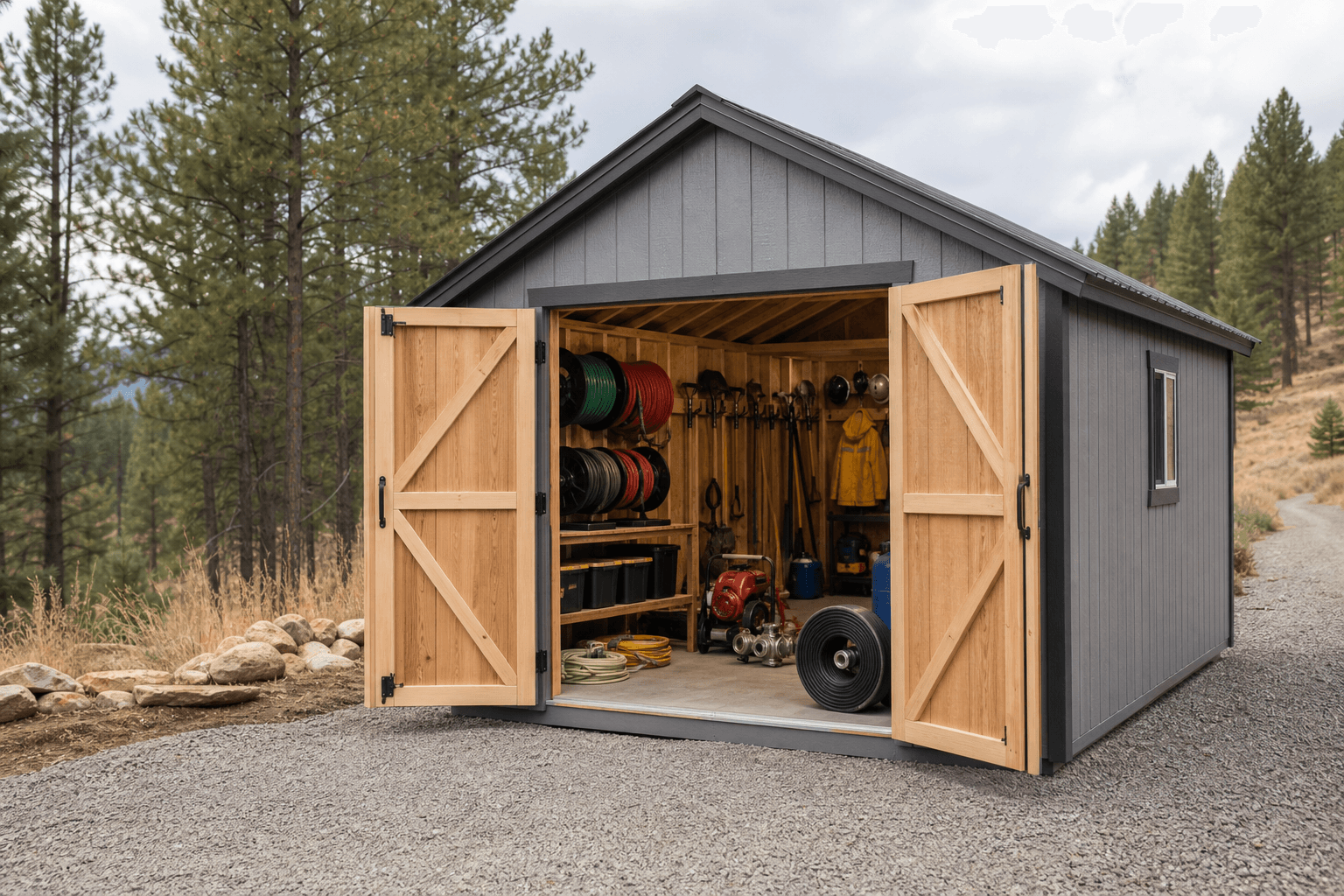
A wildfire readiness shed is built around fast access, clean organization, and the gear that actually matters during smoke season and evacuation pressure. Hoses, pumps, PPE, filters, radios, and go-kits all need defined places instead of getting scattered between the garage, shop, and mudroom. We build wildfire readiness sheds on-site so the size, layout, ember-resistant details, and access path fit the way your North Idaho property needs to respond.
Wildfire Readiness Shed Built for North Idaho Weather
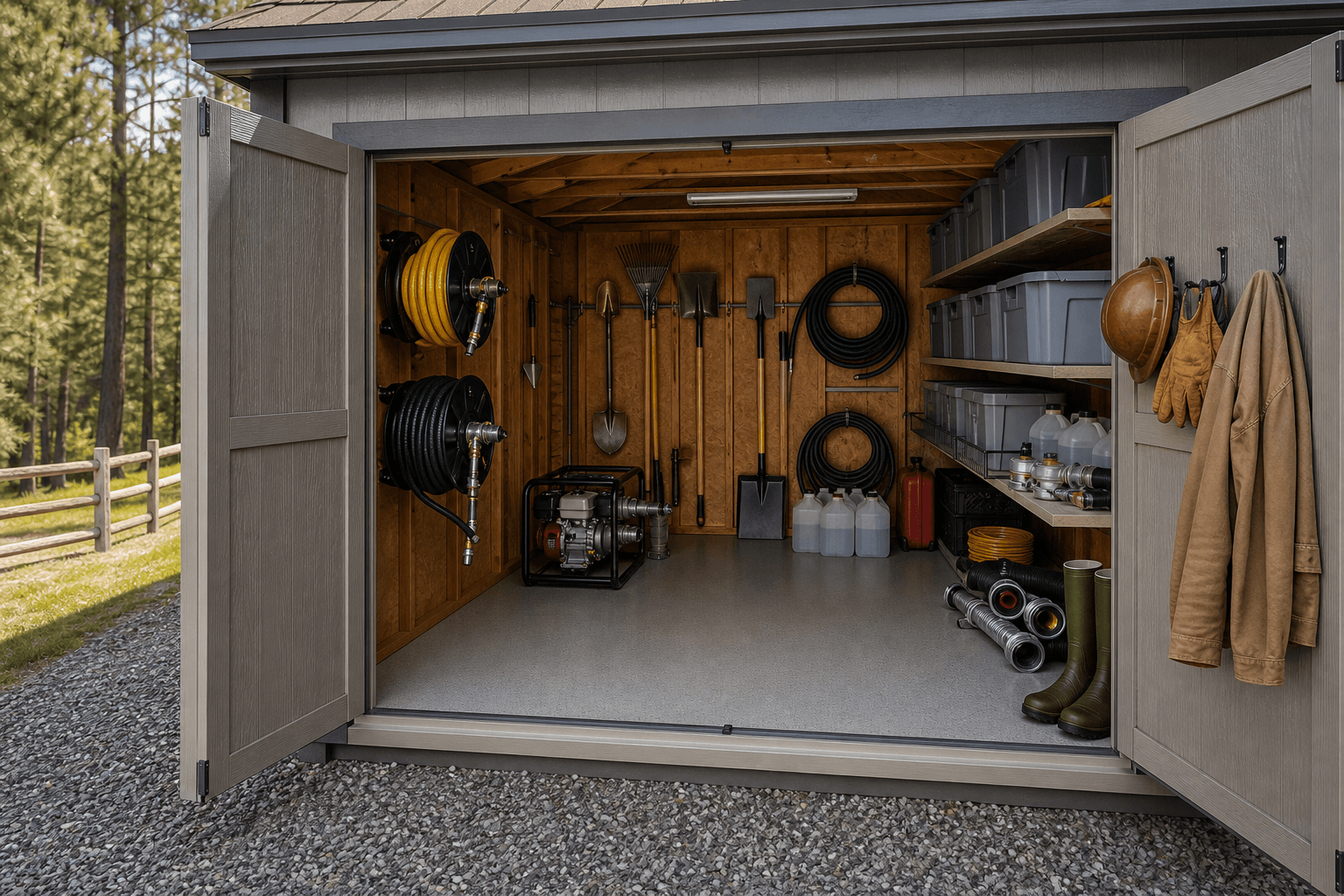
A wildfire readiness shed is not just a place to stash extra gear. It is a response building designed around fast retrieval, clean staging, and keeping critical fire-season equipment ready before the first smoke event or evacuation warning ever shows up. In North Idaho, that can mean pumps, hoses, nozzles, rakes, shovels, PPE, respirators, filters, emergency lighting, communications gear, and family go-kits all needing to live in one organized place instead of being scattered across the property.
What makes this shed different from a general emergency shed is the speed and specificity of the response. Wildfire readiness gear has to be grabbed in the right order and often under pressure. A pump without its hose kit, PPE without a defined bin, or spare filters buried behind summer clutter is not a workable system. The building should help the owner move quickly, see what is missing, and keep seasonal equipment in ready condition instead of in random stacks.
North Idaho conditions make this more than a summer-only topic. The building still has to handle real snow loads, wet shoulder seasons, and freeze-thaw movement because the shed sits on the property year-round. Roof framing should match local snow loads that commonly begin around 40 psf and rise higher depending on location. Site drainage matters because damp floors, muddy approaches, and blocked access are exactly the kinds of details that make a readiness shed fail when it needs to work. If the project grows in complexity, the usual 24-inch frost-depth conversation can matter too.
On-site construction is especially useful because readiness planning depends on where the shed sits relative to the house, driveway, defensible-space zones, water sources, and primary exit path. Some properties want it near the driveway for fast trailer or vehicle access. Others want it close to a pump point or beside an existing outbuilding. Building on-site allows the footprint and door layout to match the response pattern on the land instead of the delivery limits of a prefab unit.
Wildfire Readiness Shed Features & Build Options
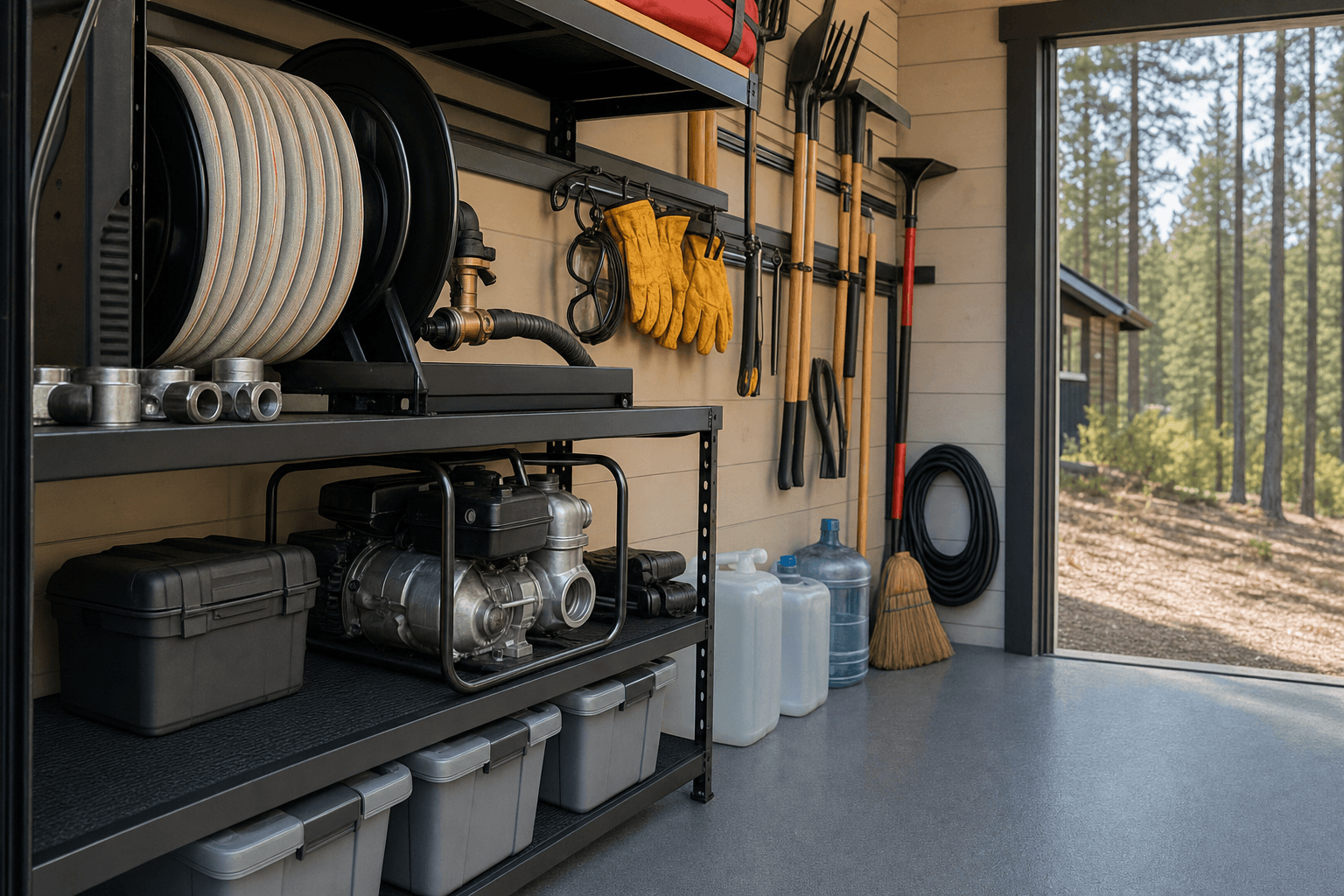
The most useful wildfire readiness sheds are laid out around zones. One zone for go-kits. One for PPE. One for pump and hose gear. One for hand tools used in defensible-space work. One for smoke-event support like filters or clean-air accessories. When those zones are clear, the shed becomes a response tool instead of a clutter problem.
Common options for this service include:
- A dedicated go-kit wall so evacuation bags, lights, radios, and key documents have a defined home.
- Pump and hose storage laid out for quick deployment instead of tangled floor piles.
- PPE storage for gloves, eye protection, masks, respirators, and other fire-season gear.
- Filtration-related storage when the property also needs smoke-event support supplies close at hand.
- Ember-resistant detailing and cleaner closures that make the shed itself a better fire-season outbuilding.
Building a wildfire go-kit storage system for the property is a good starting point because it helps owners separate evacuation gear from stay-and-defend tools. Organizing pumps, hoses, and tools for defensible-space work also matters because a lot of readiness failure comes from equipment being present but not staged well enough to use quickly.
This building often pairs naturally with other preparedness structures. A nearby emergency preparedness shed can hold the broader reserve items that do not need same-minute access. A clean-air shed may support smoke-event sheltering, and a generator shed can back up utility needs during fire season. The wildfire readiness shed works best when it stays focused on fast-action gear instead of trying to carry every emergency category at once.
Popular Wildfire Readiness Shed Sizes & Layouts
An 8x8 is a workable compact size when the main goal is storing pumps, hose packs, PPE, and a small evacuation wall without giving over too much property space. It works best for disciplined setups with clear wall planning.
An 8x10 gives more breathing room for separating hose and pump gear from PPE and go-kits. This is often a very practical size for residential readiness because it adds flexibility without becoming oversized.
An 8x12 works well when the property has more tools for defensible-space work or needs cleaner separation between fast-evacuation supplies and equipment used to protect the home site. The extra length helps the building stay organized through the whole smoke season.
A 10x10 or 10x12 becomes attractive when the gear list is longer, the family wants clearer aisles, or the shed needs to support both wildfire equipment and smoke-support supplies without feeling cramped. These larger sizes are often worth it on bigger properties where more hose, tool, and PPE volume is expected.
What Size Wildfire Readiness Shed Works Best?
The right size depends on the readiness plan, not just the number of people on the property. A small town lot with a few go-kits, PPE bins, and defensible-space tools needs something different from a rural property storing pump equipment, hose runs, hand tools, spare filters, and more robust evacuation staging. Start with categories: go-kits, PPE, hose and pump gear, tools, communications, and smoke support. Then look at what needs wall access versus what can live on shelves or in totes.
Accessibility is the real deciding factor. If the pump has to be moved to reach the filters, or if the go-bags are behind the tool wall, the shed is effectively undersized even if the square footage looks fine on paper. That is why many owners compare 8x8, 8x10, and 8x12 first. Once the building needs more open floor or a stronger separation between response categories, 10x10 and 10x12 become the better fit.
On-site construction helps because placement changes the size answer. A shed near the house may need a different footprint than one near a driveway gate or pump location. The best layout is the one that supports real fire-season use instead of just checking a square-footage box.
How Does On-Site Wildfire Readiness Shed Building Work?
We start with the property response plan. That means looking at where the gear should sit, how vehicles or trailers move, where hoses and tools are used, and how close the shed should be to the house or main access route. On-site construction is the real advantage because the building can be fitted to those response needs instead of forced into a drop location that happens to work for delivery.
From there we sort out size, door placement, internal zoning, ember-resistant details, and whether the shed also needs to support smoke filtration supplies or nearby backup-power planning. Costs move with footprint, site prep, snow-load requirements, and utility complexity, so the broad pricing guide is a solid first reference. For a quote tied to the actual lot and gear list, request a free estimate.
Many wildfire readiness sheds can be built quickly once the site is ready, but the real value comes from thinking through what you need to grab first, second, and third before the building is ever full. A shed that stays clear under pressure is much more useful than a larger shed that turns into mixed seasonal storage.
Wildfire Readiness Shed Service Areas Across North Idaho
We build wildfire readiness sheds across North Idaho, including Kootenai, Bonner, Boundary, Shoshone, and Benewah counties. Fire-season pressure can look different across the region, but the need to stage gear well is consistent whether the property is in town, on acreage, or tucked into more wooded ground.
In Athol, for example, a wildfire readiness shed may support defensible-space tools, pump gear, evacuation kits, and smoke-support supplies on a rural property with trees, longer driveways, and more dependence on self-contained response. Similar needs show up throughout the region as smoke events and fire-preparedness planning become more normal parts of the year. On-site construction gives owners the flexibility to put the building where it fits the land and the response plan.
Frequently Asked Questions About Wildfire Readiness Shed
How much does a wildfire readiness shed cost in North Idaho?
Most wildfire readiness shed projects in North Idaho start around $3,900 and can reach $7,900 depending on size, foundation, utilities, insulation, and finish level. Site access, snow loads, and feature upgrades can move pricing higher. See our pricing guide or request a free estimate.
What size wildfire readiness shed works best in North Idaho?
Most wildfire readiness shed builds land in the 8x8, 8x10, 8x12 range, while 10x10, 10x12 works better when you need more clearance, storage zones, or finished space. North Idaho lot layout, setbacks, and access matter as much as square footage. Compare 8x8, 8x10, and 8x12.
Do I need a permit for a wildfire readiness shed in North Idaho?
Sometimes. A simple wildfire readiness shed under 200 square feet may follow the common North Idaho permit-exempt path, but setbacks, HOA rules, utilities, and placement still need review. Once you go larger or add power, plumbing, or finished interiors, permitting becomes more likely. Review permit basics and request a site-specific estimate.
How long does it take to build a wildfire readiness shed on-site in North Idaho?
Most wildfire readiness shed projects take about 1-2 on-site days once the site is ready and materials are staged. Larger footprints, slab work, insulation, wiring, plumbing, and muddy or tight North Idaho access can extend the schedule. See how our build process works.
Built for North Idaho weather
Engineered for snow load
Roofs framed for North Idaho's 70+ psf ground snow load.
Wind-rated
Anchored and braced for the gusts that funnel down our valleys.
Sealed for freeze-thaw
Detailed drip edges, sealed penetrations, and breathable wraps.
12-year warranty
Bumper-to-bumper coverage on materials and workmanship.
What you get
Go-kit wall
pump/hose storage
PPE storage
filtration
ember-resistant
How it works
- Step 1Site visit
We come to you, listen to how you want to use the shed, and read the site.
- Step 2Free estimate
You get a single, all-in price — no surprises, no upsell.
- Step 3Build day
We build it on your property in a single visit. No delivery permits, no crane fees.
- Step 4Walkthrough
We hand it over with a walkthrough of materials, doors, and aftercare.
Frequently asked questions
How much does a wildfire readiness shed cost in North Idaho?
Most wildfire readiness shed projects in North Idaho start around $3,900 and can reach $7,900 depending on size, foundation, utilities, insulation, and finish level. Site access, snow loads, and feature upgrades can move pricing higher. See our pricing guide or request a free estimate.
What size wildfire readiness shed works best in North Idaho?
Do I need a permit for a wildfire readiness shed in North Idaho?
Sometimes. A simple wildfire readiness shed under 200 square feet may follow the common North Idaho permit-exempt path, but setbacks, HOA rules, utilities, and placement still need review. Once you go larger or add power, plumbing, or finished interiors, permitting becomes more likely. Review permit basics and request a site-specific estimate.
How long does it take to build a wildfire readiness shed on-site in North Idaho?
Most wildfire readiness shed projects take about 1-2 on-site days once the site is ready and materials are staged. Larger footprints, slab work, insulation, wiring, plumbing, and muddy or tight North Idaho access can extend the schedule. See how our build process works.
Ready to get started?
Get Your Free Estimate