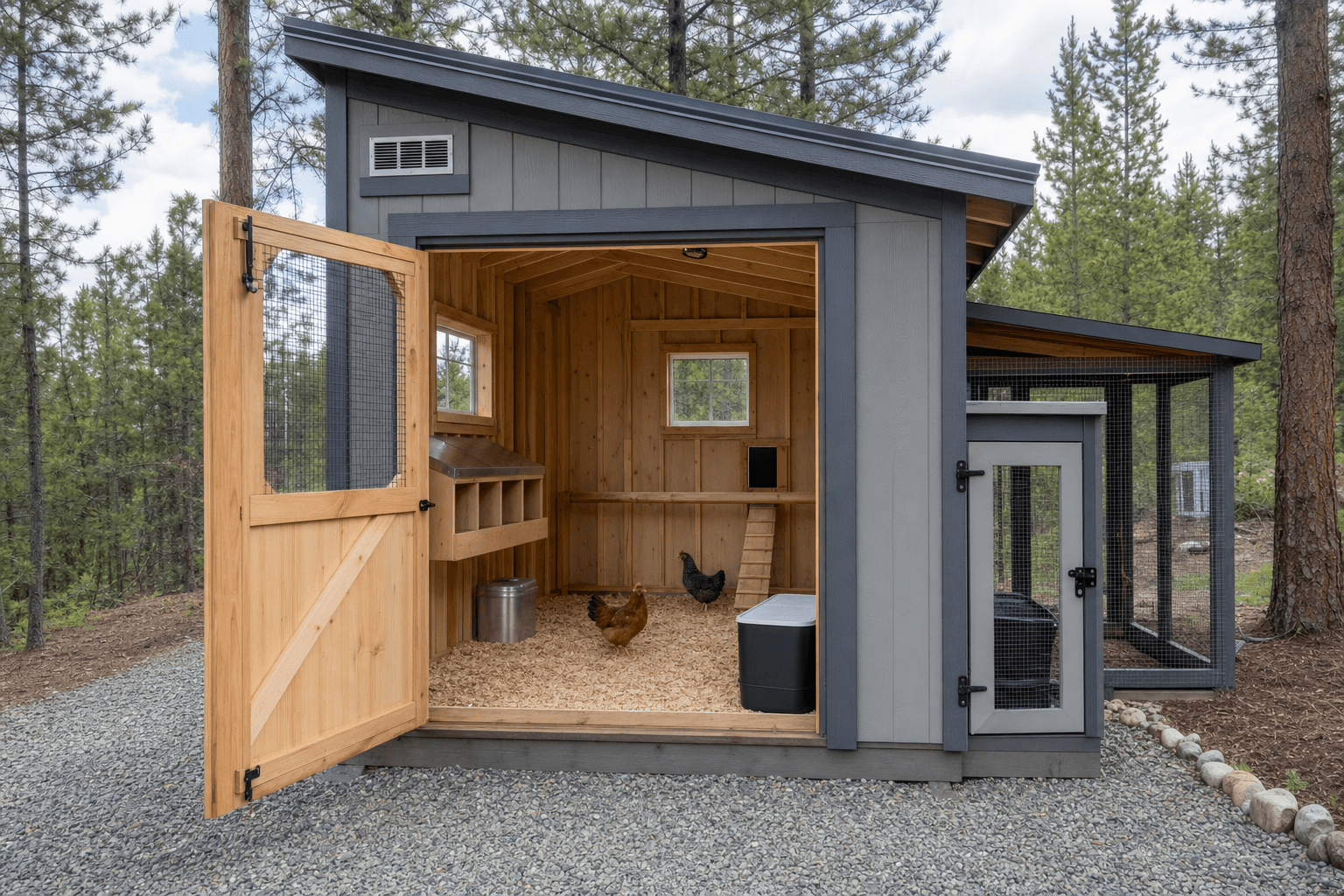
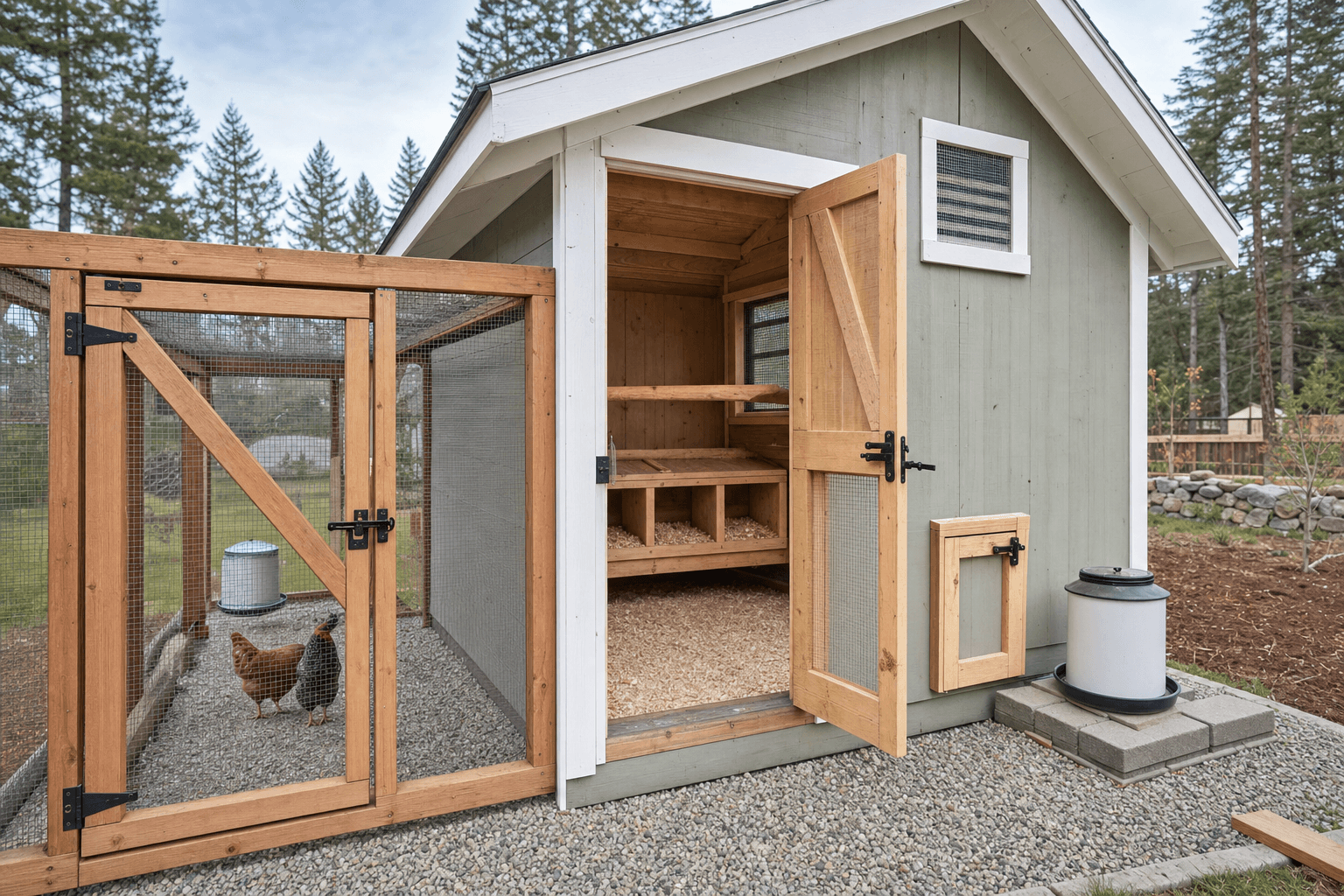
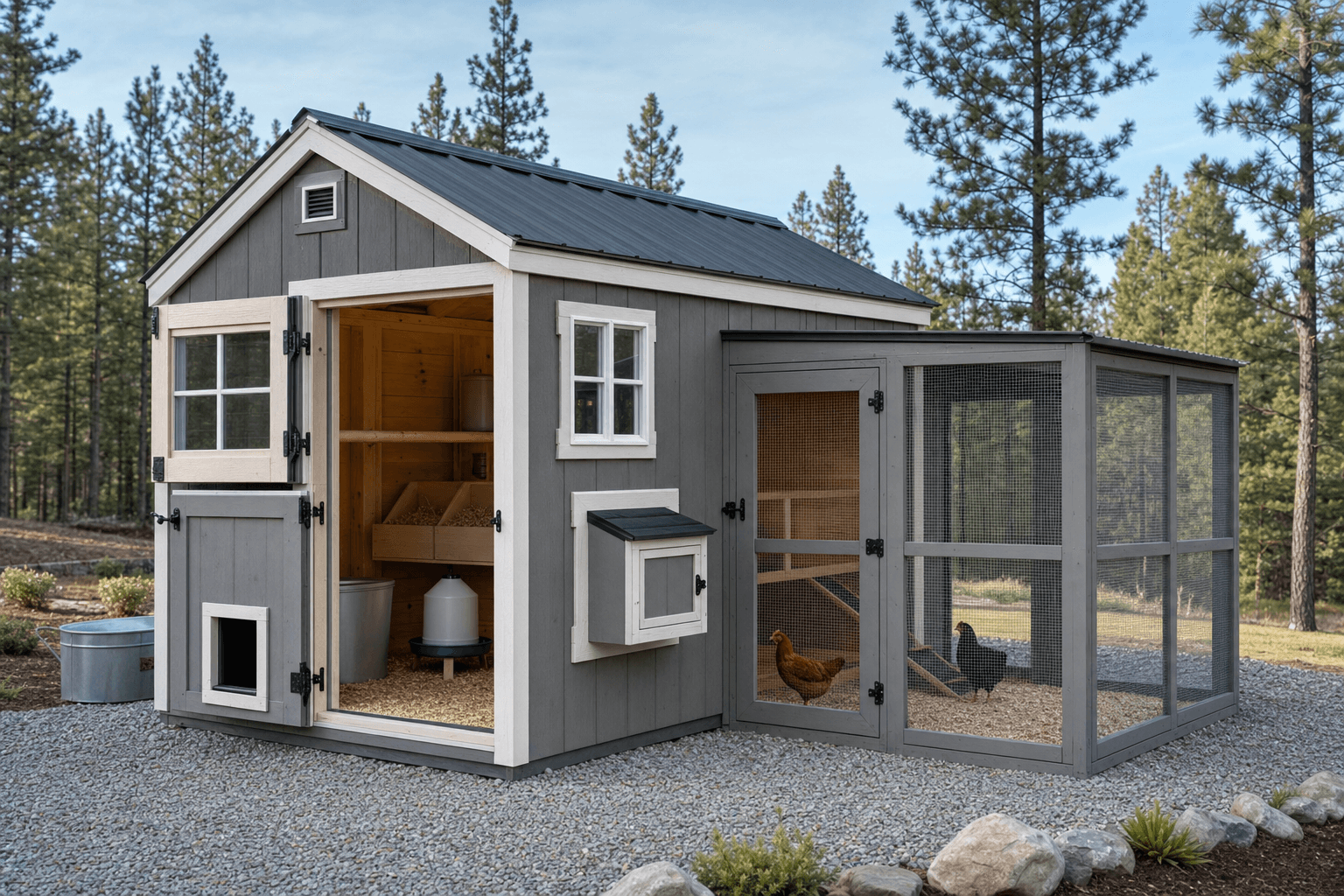
Chicken Coop & Run Built On-Site in North Idaho
A chicken coop has to work every day, not just look good the week it is built. In North Idaho that means planning for cold snaps, drifting snow, spring mud, predator pressure, and a layout that makes feeding, cleaning, and egg collection easy in the dark. We build chicken coop and run setups on-site so the footprint, ventilation, and predator-proof details fit your birds, your yard, and your county rules.
Chicken Coop & Run Built for North Idaho Weather
A solid chicken coop in North Idaho needs to solve more than one problem at a time. It has to keep birds dry, safe, and productive through cold weather, while still staying ventilated enough to control moisture and ammonia. It also has to stand up to snow load, handle muddy shoulder seasons, and keep predators from turning a backyard flock into an easy target. That is why a coop and run is a specialized animal building, not just a small shed with a pop door cut into the wall.
Winter is where weak coop design shows up first. Birds can handle cold better than damp air and poor ventilation, so the building needs to move stale air without blasting the flock with drafts at roost level. North Idaho snow and freeze-thaw cycles also put real demands on roof framing, site drainage, and how the run connects to the shelter. A low spot that looks fine in August can become a muddy disease factory in March. Good placement matters as much as the building itself.
On-site construction makes a big difference because coop projects are tied closely to the specific yard or rural lot. Sun exposure, prevailing weather, slope, existing fencing, and how the run should be oriented all depend on the property. Prefab coops often arrive with fixed dimensions and fixed assumptions that do not line up with real predator patterns or the way the owner needs to move through the area. Building on-site allows better placement, better run integration, and better adaptation to setbacks and access issues.
The structure still needs to be built for North Idaho conditions. Roof systems should match local snow loads that often start around 40 psf and can climb much higher. Base and floor decisions need to account for frost, drainage, and washdown habits. Once the building crosses the common 200-square-foot threshold or adds more utility work, local permit review becomes more likely too. A coop that is planned around the property from the start simply performs better over time.
Chicken Coop Shed Features & Build Options
Good coop design starts with bird health and chore efficiency. The flock needs clean roosting, practical nesting access, fresh air, and a layout that allows quick cleaning without turning the whole process into a half-day project. Owners also need the building to stand up to raccoons, dogs, hawks, and other predators that put real pressure on backyard birds in North Idaho.
Common features for this service include:
- Winter-ready planning that protects birds from wet cold while avoiding stale, damp air.
- Predator-proof details at doors, openings, and run transitions.
- Ventilation that moves moisture and ammonia without exposing the flock to harsh drafts.
- Nesting boxes placed for easy collection and less disruption.
- Easy-clean layouts that reduce labor when bedding needs to come out fast.
Predator resistance deserves careful thought. Latches, door fit, lower-wall detailing, and run perimeter treatment all matter. Predator-proofing your coop: hardware cloth aprons and door latches is useful because it explains why one weak edge can undo an otherwise decent coop. Cold-weather management matters too. Winterizing your chicken coop: insulation, ventilation, and heat lamp safety walks through the tradeoffs between warmth, moisture, and safe setup.
Some owners also decide whether feed should live inside the coop building or in a separate structure. For cleaner pest control and easier bulk storage, many properties are better served by a nearby feed storage shed. If the property has other animal needs beyond poultry, a separate dog kennel shed or other animal building keeps each space simpler and healthier to maintain.
Popular Chicken Coop Shed Sizes & Layouts
An 8x10 is a practical starting size for many backyard flocks. It gives room for roosts, nesting boxes, and basic human access without overwhelming a smaller lot.
An 8x12 adds welcome breathing room for feed bins, better interior movement, or more comfortable cleaning access. This is a common step up when the owner wants the building to feel less cramped during winter chores.
A 10x10 works well when the flock size grows or when the layout needs more wall length for nesting and roost separation. The extra width can also make it easier to keep the human work zone cleaner.
A 10x12 or 10x14 is a stronger fit for larger backyard flocks, mixed-use poultry setups, or owners who want more interior organization and less crowding around the door. Bigger layouts can also support a more comfortable covered transition to the run if the site and budget allow.
What Size Chicken Coop Shed Works Best?
The right size starts with bird count, but it should not end there. You also need to think about breed size, whether the birds are confined more during winter, how much feed or bedding stays inside, and how much room a person needs to clean and collect eggs comfortably. A coop that is technically large enough on paper can still be frustrating if every task involves squeezing past roosts, stepping over waterers, or moving bins just to open a nesting box lid.
Bigger is not automatically better either. Oversized volume can be harder to manage if the building is not insulated or ventilated well. The practical goal is enough room for healthy birds and efficient chores. Many North Idaho owners end up comparing 8x10, 8x12, and 10x10, with 10x12 and 10x14 becoming more attractive as flock size or storage needs grow.
Another part of sizing is the run. The coop and the run work together, so it makes sense to plan them as one system. On-site construction helps because the run can be oriented around drainage, snow shedding, and how the birds will use the yard. That usually creates a more workable setup than trying to force a standard prefab footprint into a site with uneven ground or awkward fencing.
How Does On-Site Chicken Coop Shed Building Work?
We start by looking at the property and how the flock will move through it. That includes sun, wind, drainage, predator exposure, access for cleaning, and how close the coop should be to the house, barn, or garden. Building on-site makes it easier to place the structure and run where they actually work instead of where a delivery trailer happens to fit.
From there we work through size, access doors, nesting arrangement, ventilation approach, run attachment, and whether the project stays simple or adds more finish, wiring, or winter upgrades. Pricing depends on footprint, site prep, snow-load requirements, and feature level, so the best way to get a broad frame is the pricing guide. For a number tied to your lot and your flock, request a free estimate.
Simpler coop projects can move quickly once the site is ready, but schedule still depends on ground conditions, weather, and how involved the run and utilities become. If the building stays under 200 square feet and avoids utilities, the permit path is often easier, though setbacks and local rules still matter.
Chicken Coop Shed Service Areas Across North Idaho
We build chicken coop and run projects across North Idaho, including suburban backyards, hobby farms, and larger rural properties in Kootenai, Bonner, Boundary, Shoshone, and Benewah counties. Each setting has a different challenge. Some need a compact coop that works around neighbors and setbacks. Others need a larger build with more predator pressure and more exposure to drifting snow and mud.
Around Rathdrum, for example, you see both neighborhood flocks and more rural properties where the coop has to fit around existing fencing, outbuildings, and access lanes. On-site construction is useful in both cases because the best location for bird health and daily chores is rarely identical to the easiest spot for a delivered prefab unit. The result is a coop that fits the land and gets used the way it should.
Frequently Asked Questions About Chicken Coop Shed
How much does a chicken coop shed cost in North Idaho?
Most chicken coop shed projects in North Idaho start around $4,500 and can reach $9,200 depending on size, foundation, utilities, insulation, and finish level. Site access, snow loads, and feature upgrades can move pricing higher. See our pricing guide or request a free estimate.
What size chicken coop shed works best in North Idaho?
Most chicken coop shed builds land in the 8x10, 8x12, 10x10 range, while 10x12, 10x14 works better when you need more clearance, storage zones, or finished space. North Idaho lot layout, setbacks, and access matter as much as square footage. Compare 8x10, 8x12, and 10x10.
Do I need a permit for a chicken coop shed in North Idaho?
Sometimes. A simple chicken coop shed under 200 square feet may follow the common North Idaho permit-exempt path, but setbacks, HOA rules, utilities, and placement still need review. Once you go larger or add power, plumbing, or finished interiors, permitting becomes more likely. Review permit basics and request a site-specific estimate.
How long does it take to build a chicken coop shed on-site in North Idaho?
Most chicken coop shed projects take about 1-2 on-site days once the site is ready and materials are staged. Larger footprints, slab work, insulation, wiring, plumbing, and muddy or tight North Idaho access can extend the schedule. See how our build process works.
Built for North Idaho weather
Engineered for snow load
Roofs framed for North Idaho's 70+ psf ground snow load.
Wind-rated
Anchored and braced for the gusts that funnel down our valleys.
Sealed for freeze-thaw
Detailed drip edges, sealed penetrations, and breathable wraps.
12-year warranty
Bumper-to-bumper coverage on materials and workmanship.
What you get
Winterized
predator-proof
ventilation
nesting boxes
easy-clean
How it works
- Step 1Site visit
We come to you, listen to how you want to use the shed, and read the site.
- Step 2Free estimate
You get a single, all-in price — no surprises, no upsell.
- Step 3Build day
We build it on your property in a single visit. No delivery permits, no crane fees.
- Step 4Walkthrough
We hand it over with a walkthrough of materials, doors, and aftercare.
Frequently asked questions
How much does a chicken coop shed cost in North Idaho?
Most chicken coop shed projects in North Idaho start around $4,500 and can reach $9,200 depending on size, foundation, utilities, insulation, and finish level. Site access, snow loads, and feature upgrades can move pricing higher. See our pricing guide or request a free estimate.
What size chicken coop shed works best in North Idaho?
Do I need a permit for a chicken coop shed in North Idaho?
Sometimes. A simple chicken coop shed under 200 square feet may follow the common North Idaho permit-exempt path, but setbacks, HOA rules, utilities, and placement still need review. Once you go larger or add power, plumbing, or finished interiors, permitting becomes more likely. Review permit basics and request a site-specific estimate.
How long does it take to build a chicken coop shed on-site in North Idaho?
Most chicken coop shed projects take about 1-2 on-site days once the site is ready and materials are staged. Larger footprints, slab work, insulation, wiring, plumbing, and muddy or tight North Idaho access can extend the schedule. See how our build process works.
Ready to get started?
Get Your Free Estimate