An accessory dwelling unit is not a fancy backyard room. It is a second, fully legal home on your lot: a permitted, year-round living space with its own kitchen, its own bathroom, its own heat, and its own front door, built to the same residential code as the house it sits behind. People plan an ADU for real reasons that don't go away after a weekend, rental income that helps carry the mortgage, an aging parent who wants independence without being across town, or a grown kid who needs a landing spot that isn't the basement. Because someone is meant to live in it full time, an ADU answers to zoning, building code, the health department, and the power company in a way a storage shed or a casual hangout never does. That is the whole story of planning one well, and it is why this guide reads more like a permit checklist than a decorating list.
The single biggest mistake we see is treating an ADU like a slightly bigger guest house. A guest house is a comfortable, optional space for visitors and occasional overnights; it can lean casual on plumbing, heat, and code. An ADU is a dwelling, and that one word changes everything: it has to be permitted as a residence, connected to approved water and sewer or septic, wired and inspected, insulated for a North Idaho winter, and given proper egress so a person can sleep, cook, and bathe in it legally. North Idaho On Site Sheds builds the shell of your ADU on your property, framed tight and to code, so your licensed plumber, electrician, and HVAC installer can finish the systems that make it a legal home. Plan the permits and utilities first; plan the throw pillows last.
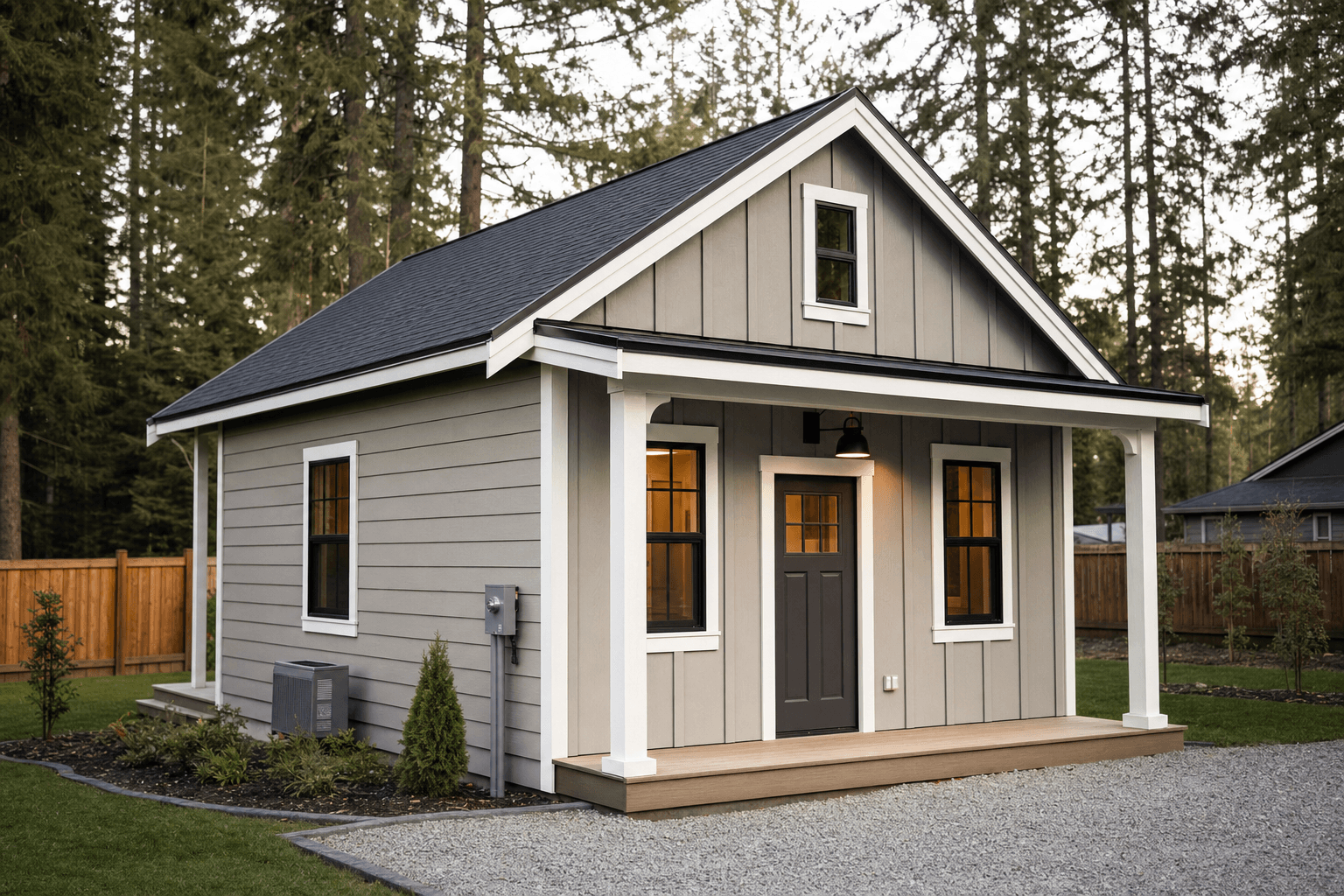
A true ADU: permitted, insulated, wired, and plumbed as a full-time residence, not a hangout shed.
An ADU has to read and live like a small house, so the shell that wins is the one with the most usable interior volume and the room to run real systems. Our Luxe Gable ADU shell in the configurator is built for exactly this: a steep, snow-shedding gable roof that opens up ceiling height and gives you wall space for a kitchen run, a bathroom wet wall, and tall windows, plus the structural headroom for proper insulation, a ventilation path, and a mini-split air handler. The straight, full-height walls matter more here than on any other build, because cabinets, a shower surround, an egress window, and a stacked washer-dryer all need flat, plumb surfaces and honest stud bays to land in.
A lofted barn (gambrel) roof is the other strong option when you want a true sleeping loft over a living-and-kitchen level, which is how many one-bedroom ADUs claw back square footage on a tight footprint, just confirm your jurisdiction counts and permits that loft as habitable space with its own light, air, and egress. A lean-to or modern single-slope reads contemporary and sheds snow cleanly to one side, but you trade away the symmetric loft. Because an ADU lives at the serious end of our guest houses and ADUs work, treat the roofline as a code decision as much as a style one: ceiling height, egress, and insulation depth come first, and the look follows. If you want the dwelling to feel more like a small cottage than a unit out back, the cottage and tiny home builds share the same conditioned-shell DNA and are worth comparing for finish level.
A combined living-sleep area, a galley kitchen, and a full bath fit a studio ADU. Around 12x24 to 14x24 gives an aging parent or a grown kid a complete, code-legal home without a separate bedroom.
Add a walled-off bedroom with its own egress window and you want 14x28 to 16x24, enough for a living room, a real kitchen, a full bath, and a private bedroom that rents or houses family comfortably.
Step up to 20x24 when the unit needs a living room, a kitchen with a dining nook, a full bath, in-unit laundry, and storage, the footprint that holds value as a long-term rental.
Footprint is where an ADU plan lives or dies, because you are fitting a kitchen, a bathroom, sleeping space, and circulation into one building and every system needs its place. A 12x24 shed is the sensible floor for a studio or in-law suite: 288 square feet absorbs a galley kitchen along one wall, a full bath in the back corner, and a combined living-and-sleeping area, which is plenty for one person living independently. A 14x24 shed adds two feet of width that immediately makes the kitchen and bath feel like a home rather than a trailer, with room to separate the sleeping zone with a half wall or a wardrobe. When you want a genuine private bedroom, step to a 14x28 shed or a 16x24 shed: the extra length or width lets you wall off a bedroom with its own egress window while keeping a real living room and a kitchen you can actually cook in. A 20x24 shed is the one-bedroom-plus build, 480 square feet that holds a living room, a full kitchen with a dining nook, a full bath, in-unit laundry, and storage, the size most owners wish they had started with when the unit becomes a long-term rental. Size up if the ADU will ever be rented; a few extra feet of width pays for itself in what you can charge and how long a tenant stays.
These three look similar parked in a yard, but legally and practically they are different animals, and naming the right one up front saves you from building the wrong thing. An ADU is a permitted full-time dwelling: it has a kitchen and bathroom, it is connected to approved water and sewer, it is wired and inspected, and a person can legally live in it year-round, which is what makes it rentable and what makes it count toward your property value. A guest house is the casual cousin, a comfortable space for visitors, a home office, or occasional overnights that may skip a full kitchen, run lighter on heat, and not carry dwelling-code requirements, depending on how your jurisdiction defines it. A tiny home overlaps heavily with an ADU on systems and finish but is often planned around minimal square footage and sometimes a movable chassis, where an ADU is a fixed, foundation-set second residence.
The practical test is simple: if someone needs to cook, sleep, and bathe there full time, and you want it permitted and rentable, you are building an ADU, and you should plan the permits, utilities, and code from day one. If it is genuinely for guests and the occasional stay and you want to keep the project simpler and cheaper, the guest houses and ADUs page walks through where the casual guest-house path makes more sense. Many owners start asking about a guest house and realize they actually want an ADU once they admit a parent or a tenant will live there permanently. Decide for full-time living and the whole plan, the kitchen, the bath, the heat, the wiring, the egress, gets built right the first time.
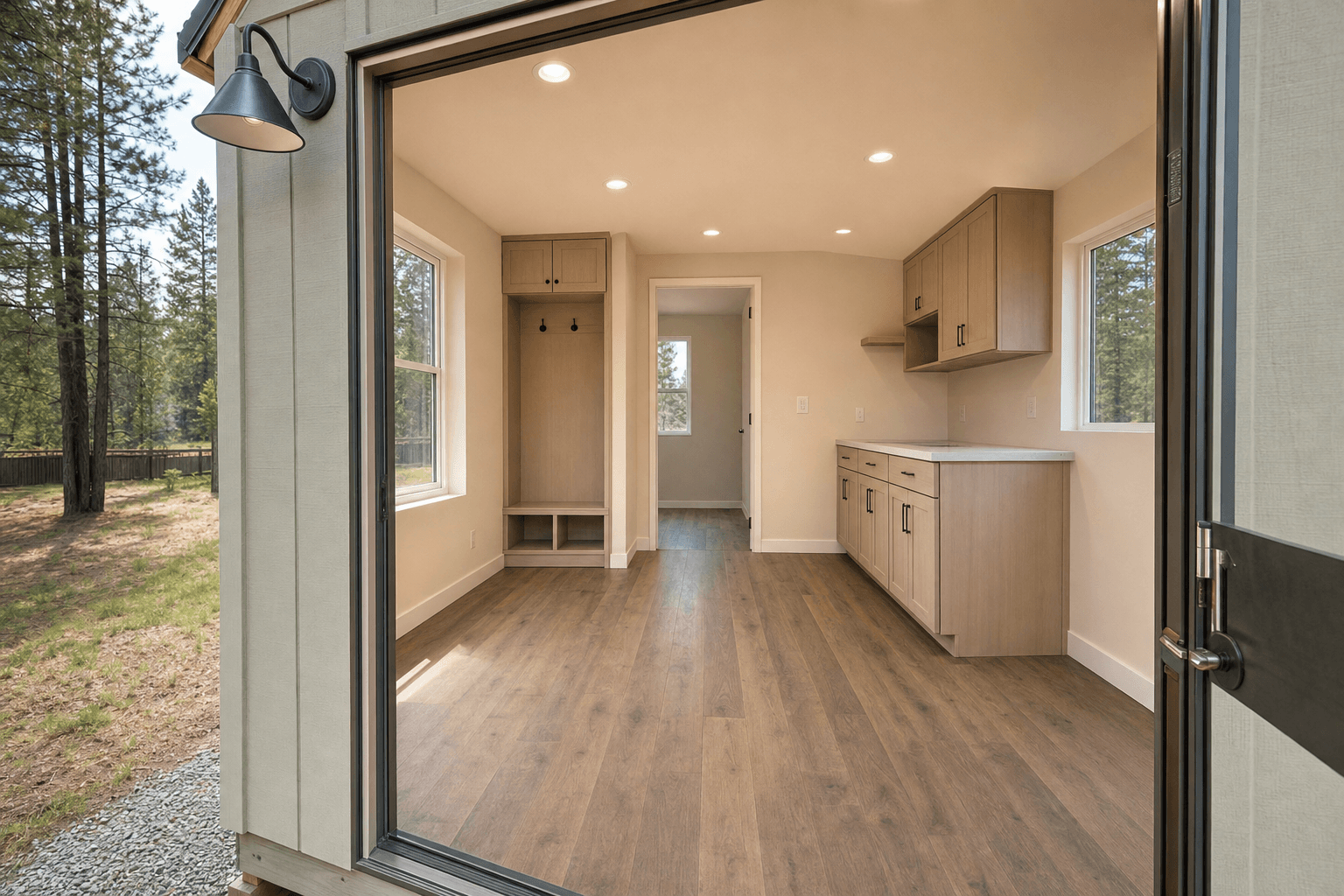
A real home in a small footprint: a full kitchen, a living zone, a private bedroom, and a code-compliant bath.
An ADU works only if you plan it as a small house with distinct zones, not one open room with a stove pushed against a wall. The wet zone is the anchor and it should drive the whole layout: stack the kitchen sink, the bathroom, and the laundry along a single plumbing wall so all the supply, drain, and vent lines share one run instead of crisscrossing the building, which is cheaper to plumb and far easier to insulate against freezing. The kitchen zone wants a continuous counter run with the range, sink, and refrigerator in a tight work triangle, upper and lower cabinets, and a vent to the outside, because a full-time kitchen produces real moisture and grease that have to leave the building. The living zone is the open floor where someone actually lives, sized for a sofa, a table, and daylight, and it is what separates a dwelling from a dorm room. The sleeping zone, whether a walled bedroom or a defined corner, must have a code-compliant egress, a window or door big enough to climb out of in a fire, and that single requirement often dictates where the bedroom can go. Finally, reserve a tidy mechanical zone for the electrical panel, the water heater, and the mini-split air handler, kept together and accessible so inspections and service are simple. Sketch these five zones before you lock a footprint; it is the fastest way to learn whether a studio fits your life or you need the width for a true one-bedroom.
A code-recognized ADU kitchen means a cooking appliance, a sink with hot and cold water, a refrigerator, counter and cabinet space, and a range hood ducted outside. Plan a dedicated small-appliance circuit and a moisture-tolerant floor, because this is a real kitchen that gets used three times a day.
A full bath needs a toilet, a sink, and a tub or shower, all tied to approved drain, waste, and vent lines, plus a GFCI circuit and an exhaust fan ducted outside to carry shower moisture away. A wet-wall layout shared with the kitchen keeps the plumbing tight and protected from freezing.
Full-time living means a continuous insulated envelope, walls, ceiling, and floor, sealed doors and windows, and a heat source sized for the unit. A ductless mini-split heats and cools efficiently and quietly, holds temperature through a cold snap, and keeps the kitchen and bath from freezing in January.
Every sleeping area needs an egress window or door sized so a person can escape and a firefighter can enter, plus natural light and ventilation that meet code. Plan the egress opening into the framing from the start, because retrofitting one into a finished wall is the expensive way to do it.
The keyword for an ADU is independent full-time living, and the fit-out is everything a person needs to actually run a household in a small space. In the kitchen: an apartment-size or full range, a refrigerator, a dishwasher if the footprint allows, a deep single-basin sink with a disposal, a ducted range hood, a tight counter run with uppers and lowers, and a dedicated circuit for the microwave and countertop appliances. In the bathroom: a comfort-height toilet, a vanity sink, a tub-shower or a curbless shower for an aging parent, a vented exhaust fan, a GFCI outlet, and grab-bar blocking in the walls if accessibility matters now or later. For laundry: a stacked or side-by-side washer and dryer on the shared plumbing wall, with the dryer vented outside and its own 240-volt circuit. For climate and air: a ductless mini-split head for heat and air conditioning, a fresh-air ventilation path so a tight, occupied building stays healthy, and a smoke and carbon-monoxide detector network the code requires. For the systems room: a properly sized electrical subpanel, a tank or tankless water heater, and the water shutoffs and cleanouts the plumber needs. For living: a sleeper sofa or a real bed, a small dining table, closet or wardrobe storage, and window coverings. Walk your own list like this before you settle on a size, because an ADU has to hold all of it, which is exactly why a true one-bedroom rarely fits below 14 feet of width, and a rentable unit usually wants more.
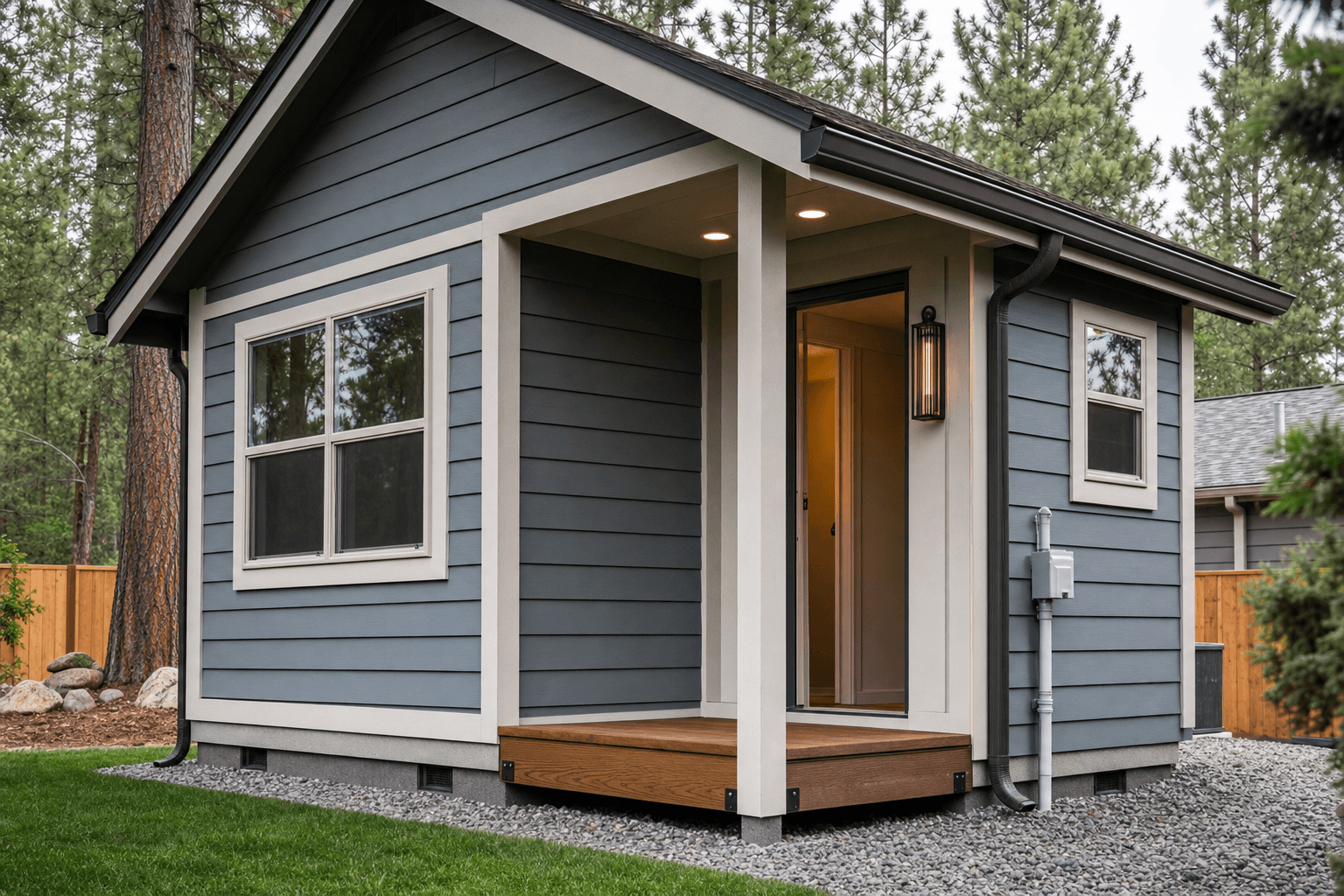
Detail that makes it a dwelling: a shared wet wall, an egress window, and a mechanical bay for panel, water heater, and HVAC.
| ADU planning checklist | |
|---|---|
| Permitting | Permitted as an accessory dwelling unit: building permit, electrical, plumbing, and mechanical inspections to residential code |
| Zoning | Confirm ADUs are allowed on your lot, plus setbacks, height limits, owner-occupancy, and parking rules before you set a size |
| Utilities | Approved water and sewer or septic connection, a dedicated electrical feed, and a heat source for full-time occupancy |
| Kitchen and bath | Full vented kitchen with cooking appliance and sink, plus a full bath with toilet, sink, and tub or shower on a wet wall |
| Envelope and HVAC | Continuous insulation in walls, ceiling, and floor, sealed openings, and a sized mini-split for year-round comfort |
| Egress and safety | Code egress window or door at every sleeping area, plus smoke and carbon-monoxide detectors and proper ventilation |
Three system decisions separate a legal, livable ADU from an expensive shed someone is cold and frustrated in. Water and sewer come first because they are the hardest to change later: the unit needs an approved potable-water supply, tapped from your house line or a meter, and an approved way to dispose of waste, either a connection to a public sewer or a septic system the health department has signed off on for the added load. On a septic lot, an ADU's extra bedroom and bath can push the existing system past its rated capacity, so confirm the design flow before you commit, because a septic upgrade is the line item that surprises people. Power is next: an ADU is a second household, so plan a dedicated subpanel fed from your main service with enough capacity for a range, a water heater, a dryer, a mini-split, and a full panel of branch circuits, all run and inspected by a licensed electrician. Build in the capacity even if you phase appliances later, because re-feeding a panel after the walls are closed is the expensive path. Winter readiness ties it together for North Idaho: a fully insulated envelope, sealed openings, a properly sized mini-split, and freeze protection on the plumbing, especially that shared wet wall, keep the unit warm, the pipes intact, and the occupant comfortable through a hard Panhandle cold snap. We build the shell tight, square, and dry on your property so your licensed plumber, electrician, and HVAC installer can run and inspect every system cleanly.
An ADU is a permanent residence, so it asks for more than a storage shed sitting on gravel. Most ADUs sit on an engineered, frost-protected foundation, a slab or footings set below the frost line, because a building with plumbing has to stay put through freeze-thaw and keep its drain and supply lines from heaving, and many jurisdictions require a permanent foundation for a unit to count as a dwelling at all. Plan the utility trenches, water, sewer or septic, and electrical, before you set the building, and place the unit where the gravel driveway or a clear path lets our crew bring materials in to build. North Idaho weather drives the rest: design the roof and anchoring for local snow load so a steep winter sheds cleanly, keep the floor and the plumbing protected from frost, and orient the building so meltwater drains away from the foundation rather than pooling against it.
Permitting is the part you cannot skip, and it is the whole reason an ADU is different from a guest hangout. Because an ADU is habitable, full-time living space with a kitchen and a bath, it triggers a building permit, plumbing and electrical permits, mechanical inspection, and full residential-code compliance, including egress, smoke and carbon-monoxide alarms, energy and insulation standards, and minimum ceiling heights. On top of that, zoning decides whether you can build an ADU on your lot at all: many areas regulate maximum ADU size, setbacks from property lines, building height, off-street parking, and sometimes whether the owner has to live on the property. Rules vary across Kootenai County and the cities around Coeur d'Alene, so the first move, before you fall in love with a layout, is to confirm with your local building and planning department that an ADU is permitted on your parcel and what it requires. Check the rules for your town on the service areas pages, then we plan the build around exactly what your jurisdiction allows.
Yes, on both counts, and this is the part that makes an ADU different from a guest space. Zoning comes first: your parcel has to allow an accessory dwelling unit at all, and local rules can cap the ADU's size, dictate setbacks and building height, require off-street parking, and in some places require the owner to live on the property. Once zoning clears, an ADU needs a building permit plus plumbing, electrical, and mechanical permits, because it is habitable, full-time living space that must meet residential code, egress, insulation and energy standards, ceiling heights, and smoke and carbon-monoxide alarms among them. Rules vary across Kootenai County and the cities around Coeur d'Alene, so the smart first step is to confirm with your local building and planning department that an ADU is allowed on your lot and what it requires before you finalize a size or layout. We then build the shell to code so your inspections go smoothly.
An ADU is a full residence, so it needs an approved potable-water supply and an approved way to handle wastewater, and these are the connections you plan first because they are the hardest and most expensive to change later. Water is typically tapped from your existing house service line or a dedicated meter and run in a frost-protected trench to the unit. For waste, you either connect to a public sewer or, on a rural lot, tie into a septic system, but only if the health department confirms the existing septic is rated to handle the added bedroom and bathroom load. That septic capacity check is the item that surprises people, because adding an ADU can push an older system past its design flow and require an upgrade. Plan the trenches and connections before the building is set, and have a licensed plumber make and inspect the final hookups.
Yes, and it is what legally makes the space a dwelling rather than a guest room. To be recognized and permitted as an ADU, the unit needs a kitchen with a cooking appliance, a sink with hot and cold running water, a refrigerator, and counter and cabinet space, along with a range hood vented outside, and it needs a full bathroom with a toilet, a sink, and a tub or shower tied to approved drain, waste, and vent lines. We recommend stacking the kitchen, bath, and laundry along a single shared plumbing wall so the supply, drain, and vent runs stay tight and easy to insulate against freezing. A casual guest house can sometimes skip the full kitchen, which is one of the main lines that separates it from a true ADU, so if cooking and bathing full time is the point, you are building an ADU and should plan both rooms to code.
In most cases yes, and rental income is one of the most common reasons people build one, but it depends on local zoning, so confirm the rules before you count on the rent. Because an ADU is a permitted, code-compliant dwelling with its own kitchen, bathroom, entrance, and utilities, it is built to be legally lived in, which is exactly what makes it rentable where rentals are allowed. Some jurisdictions place conditions on ADU rentals, such as requiring the property owner to live in either the main house or the ADU, limiting short-term or vacation rentals, or capping the unit size, and those rules vary across Kootenai County and the surrounding cities. The practical move is to check your local zoning and any HOA covenants on ADU rentals before you build, and to size the unit, a true one-bedroom holds a tenant longer than a studio, for the rental you actually want. Build it permitted and to code and you keep your options open.
Treat the ADU as the year-round home it is, with a continuous insulated envelope, insulated walls, ceiling, and floor, plus sealed doors and windows that meet the energy code for a dwelling, not the lighter build you would accept in a storage shed. For climate, a ductless mini-split heat pump is the workhorse: it heats and cools efficiently, runs quietly, and holds a steady temperature through a Panhandle cold snap, and you size it to the square footage and layout. Just as important in a building with plumbing, protect the pipes from freezing by keeping the kitchen, bath, and laundry on an interior, insulated wet wall and maintaining heat year-round so nothing freezes when the unit is briefly empty. A tight envelope also keeps heating costs reasonable because you are conditioning one small, well-sealed space. We build the shell tight and dry so your HVAC installer can size and set the system correctly.
For a true one-bedroom with a walled-off bedroom, a real living room, a full kitchen, and a code-compliant bath, plan on roughly 14 feet of width and around 24 to 28 feet of length, so a 14x28 or a 16x24 is the practical floor. Below that, you can still build a complete, legal home, but it lands as a studio or in-law suite where the sleeping area shares the main room, which a 12x24 or 14x24 handles well for one person living independently. The reason a one-bedroom needs the extra width and length is that the bedroom has to be walled off with its own egress window, while the living room, kitchen, and bath still need honest space, and squeezing all four into a narrow box makes the kitchen and bath feel cramped. If the ADU will be rented or house family long term, step up to 20x24 so the unit holds a living room, a full kitchen with a dining nook, in-unit laundry, and storage, the size most owners are happiest with.
An ADU is a more consequential structure than most backyard buildings — it needs to meet residential code, and it typically triggers a full permit review covering foundation, framing, electrical, plumbing, and HVAC. In Kootenai County the permitting path for a detached ADU built on site differs meaningfully from what Coeur d'Alene city limits require, and Post Falls or Hayden have their own setback and lot-coverage rules. Knowing your jurisdiction before you finalize a footprint prevents a redesign mid-project.
North Idaho winters shape what a livable ADU actually needs. Insulation values that pass minimum code aren't the same as insulation that keeps heating costs reasonable through a Panhandle January. A heat source sized correctly for the square footage, a well-sealed building envelope, and a roof engineered for local snow load are decisions that affect the building's livability and durability — not just its permit status.
On-site construction gives you control over utility rough-ins from the start. Water, sewer, and electrical stubs can be positioned to match the exact layout of your ADU rather than retrofitted into a delivered box. On sloped lots near Sandpoint or on the wooded parcels common west of Coeur d'Alene, building in place also means the structure reaches sites a delivered module can't.
Review current ADU pricing and configurations or design yours in the shed builder to get a working number before you bring the plan to the permit office.
Tell us who will live there and how your lot is set up, and we'll help you size, lay out, and price a permit-ready ADU shell for your North Idaho property, then your trades finish the kitchen, bath, and systems.
Keep planning your build with related North Idaho shed guides.