A side-by-side does not fit through a garden-shed door, and a quad with a loaded rack does not belong under a tarp through a North Idaho winter. If you ride here, you already know the routine: the machines live outside or fight for space in the garage, the gear ends up scattered across three buildings, and every spring starts with cleaning mud, mouse nests, and a dead battery out of something that should have been ready to go. A purpose-built ATV and UTV shed fixes all of that — one building sized so two machines roll straight in through a door wide and tall enough to clear a roll cage and a windshield, with a floor that takes the weight, a bench for the wrenching you actually do, and ventilation that keeps fuel fumes from collecting. Get the door, the floor, and the airflow right and the rest of the shed falls into place around them.
North Idaho On Site Sheds builds every ATV and UTV building right on your property, so the door opening, the floor system, and the ramp can be specified for the machines you actually own instead of a generic shed that happens to have a roll-up door. Start with your widest, tallest, heaviest rig — a full-size UTV with a cab and a cargo box loads very differently than a sport quad — and size the doors, the floor, and the approach around that. A shed planned around the machine is one you back into without folding the mirrors; a shed planned around a number on a brochure is one you clip the doorframe on every single time.
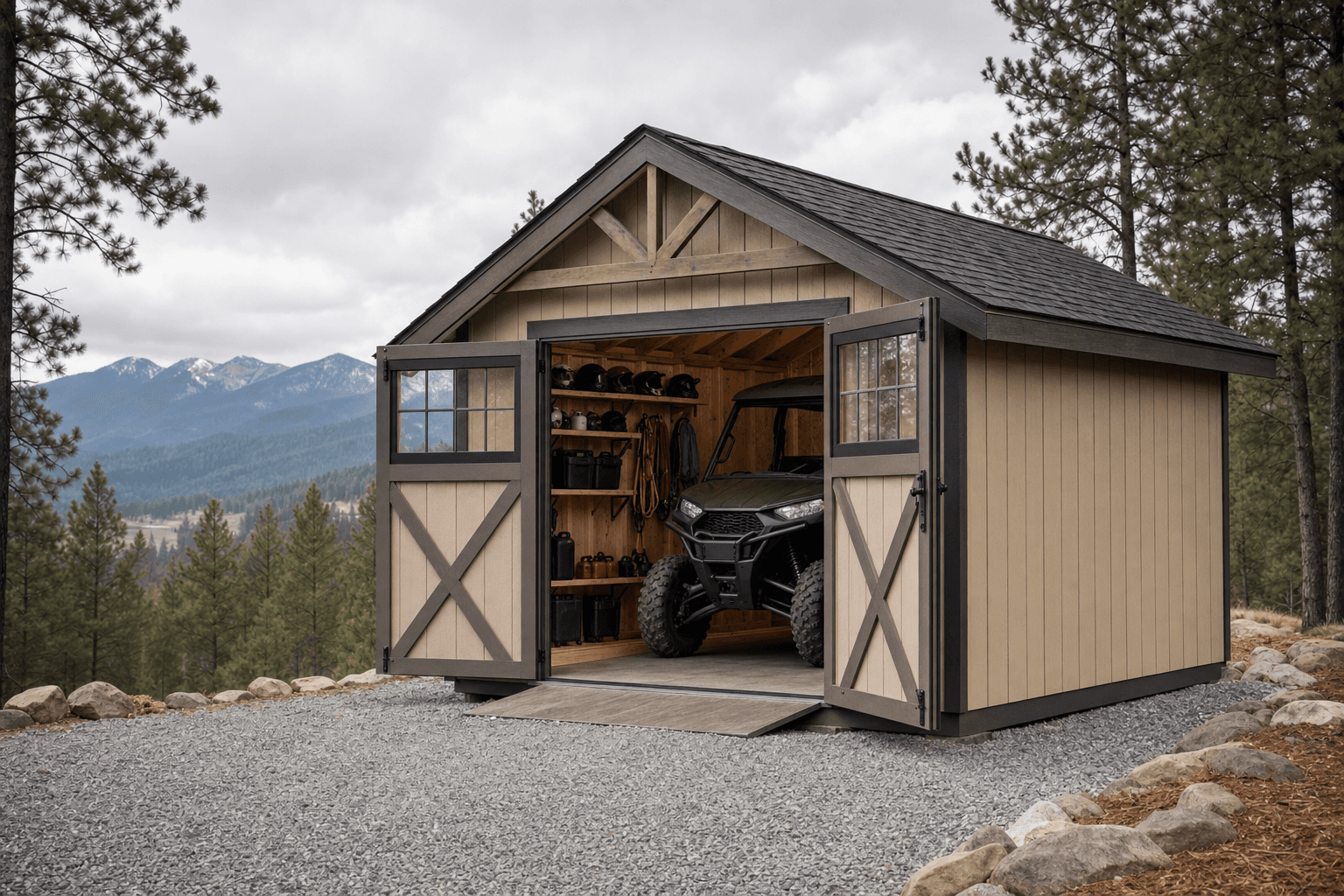
It starts at the door: wide enough and tall enough that a side-by-side rolls straight in without clipping the cage or the mirrors.
The whole building lives or dies on the door, so the roofline you pick is really a question of how wide and how tall an opening it can carry. A standard gable is the honest starting point — it frames a big, square opening on the gable end, gives you a flat, tall wall to hang a wide roll-up or a set of barn doors, and leaves clean sidewalls for shelving and a bench. Order taller sidewalls (think 8-foot-plus) so a full-size UTV with a cab, a light bar, or a tall windshield clears the header with room to spare. A lofted barn (gambrel) raises the center ridge even higher and adds a loft up top for helmets, riding gear, plows, and seasonal parts while the machines sit on the open floor below — a strong layout when you store a lot of accessories. A stick-built shop or a lean-to can work too: a lean-to sheds North Idaho snow predictably to one side and makes a tidy lean-to bay for a trailer alongside the main building.
Whatever the roofline, the door opening and the floor are the parts to spec up, not down — those are the two things you cannot fix after the build. An ATV and UTV shed sits closer to a working garage than to a storage shed, which is why it overlaps with a detached garage when you also want to pull a truck or car inside, and with a snowmobile shed when the sleds share the same building in winter. If you also wrench on smaller machines, the bench and floor plan carry straight over to a dirt bike and moto shed. Decide early whether the building is mostly parking or mostly a place to work on the machines, because that one call drives the floor build, how much open bench space you frame for, and how hard the ventilation has to work.
A 12x20 parks a full-size side-by-side or two ATVs nose to tail with a wall of shelving, a small bench, and room to walk around the machines.
A 12x24 or 14x24 fits two machines side by side or in tandem, a full workbench, a parts wall, and a clear lane to wheel a machine onto a jack.
A 16x24 holds two rigs plus a utility trailer or a second bay, a wash corner, and a workbench with open floor to spin a machine around.
Footprint decides whether you can walk around the machines and swing a wrench or whether you are climbing over a cargo box to reach the bench, so compare the real dimensions before you commit. A 12x20 is a comfortable one-UTV or two-quad shed with a wall of shelving and a small bench, but it gets tight the moment you add a second large machine. A 12x24 buys the length to park two machines in tandem and still keep a full workbench and a parts wall along one side. Step up to a 14x24 and the extra width lets you park two full-size side-by-sides next to each other, open both doors, and still walk between them — the width is what separates a shed you shuffle machines around in from one you actually work in. If you want both machines and a utility trailer under the same roof, or a real wash-and-wrench corner that stays set up, a 16x24 gives you the floor to spin a long UTV around without a fifteen-point turn. Length matters as much as width here: a long, deep bay is what lets a UTV with a cargo box and a tongue-mounted winch pull straight in instead of angling around your bench.
These overlap, and the right call comes down to what shares the building. A detached garage is the move when a truck, a car, or a boat needs to live inside alongside the machines — it leads with vehicle bays and a tall overhead door, and the ATVs become tenants in that larger space. A dedicated ATV and UTV shed leads with the machines themselves: the door is sized for a roll cage rather than a sedan, the floor is built for point loads from tires and a jack, and the layout is all about parking two rigs plus the gear and the bench that go with them. A snowmobile shed leads with cold-weather sled storage and ski clearance, though in North Idaho plenty of buyers run one building that holds quads and side-by-sides in summer and sleds in winter.
Plenty of riders want one building that does double duty, and that works as long as you build to the heaviest, widest job. A shed that stores ATVs in summer and snowmobiles in winter still needs the wide door, the strong floor, and the fuel ventilation the machines demand — but you can always add ski guides, a sled deck, or extra shelving for the seasonal swap. If you also tinker with smaller bikes, the bench, the floor drain, and the parts storage carry straight over from a dirt bike and moto shed. Naming the lead use up front keeps you from a building that parks poorly and works poorly both — and it locks in your door width, your floor spec, and your ventilation before the framing is ordered.
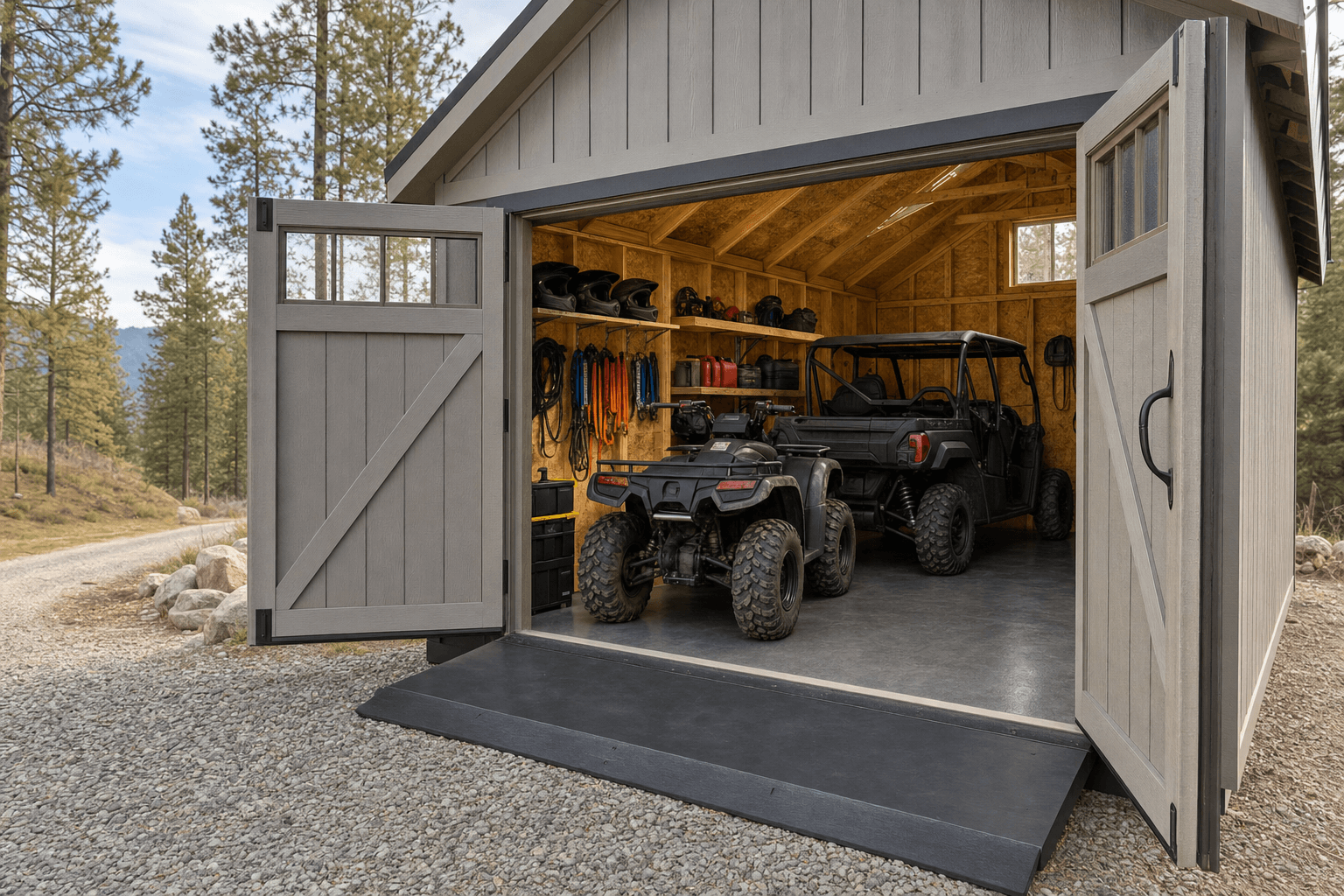
Zone it: a parking lane for the machines, a bench-and-parts wall for the wrenching, and hooks for helmets, gear, and recovery kit.
Think of the shed as three or four working zones instead of one open box, and lay them out so the machines never block the work you need to do. A parking zone runs down the door side, deep and wide enough to roll both machines straight in and back out without a three-point turn — keep the strongest, flattest part of the floor here, because this is where the tires, the jack, and the occasional dropped engine put their load. A work zone anchors a sturdy bench along a solid wall with the parts and tools above it, ideally near a window and within reach of where you park a machine to wrench on it. A gear zone takes the helmets, goggles, gloves, riding suits, and recovery kit up off the floor on hooks and shelves so the parking lane stays clear. If the building pulls double duty, a small wash or maintenance corner with a floor drain and a hose connection keeps the mud in one place.
Good zoning means you never have to back a UTV out to reach the bench, and you never trip over a winch strap to get to the helmets. Leave the length of your longest machine plus several feet of clearance in front of the door so you can load and unload with the tailgate down. Put the bench where you can pull a machine alongside it and still walk around the front, and keep a clear lane so you can wheel a quad onto a jack or roll a tire out without moving everything else first. Set the wash corner near the door and the drain so mud and rinse water head straight outside rather than tracking across the shop floor. A shed that flows is one where the machine you need is the one parked closest to the door, not the one buried behind the trailer.
A strong, stiff floor system carries two heavy machines and a floor jack without flexing, paired with a wide, low-angle ramp or a built-up threshold so a long UTV does not drag its hitch or belly-pan coming in.
A heavy-duty bench bolted to reinforced framing, pegboard or slat wall above it for wrenches and sockets, and cabinets or bins for filters, belts, plugs, and fluids so a spring service does not turn into a parts run.
A loft or overhead rack for plows, winches, spare tires, and off-season gear, plus wall hooks and shelves for helmets, riding suits, fuel cans, and recovery straps to keep the floor clear for the machines.
Low-and-high vents or an exhaust fan to clear fuel fumes, a floor drain or sloped wash area for mud and rinse water, and shadow-free LED lighting over the bench and the parking lane.
This is where a bare shell becomes a working machine shed, and it is worth naming exactly what lives inside so you size the floor, the door, and the airflow around it. The machines are the anchors: a full-size UTV or side-by-side with a cab and a cargo box, one or two ATVs or sport quads, and whatever bolts to them — a snowplow blade, a winch, a spreader, a sprayer, or a sled deck. Right behind them comes the rolling and seasonal gear: a utility trailer, a set of spare or studded tires, a floor jack and jack stands, ramps, and tie-down straps. Underneath all of it the floor takes mud, gravel, dripped fuel, and oil, which is why a sealed, washable surface and a place for the drips to go earns its keep.
Around the machines you fit out for the work and the riding: a parts wall with filters, drive belts, spark plugs, oil and coolant, and a battery tender so a service is a Saturday morning and not a parts run, plus a bench with a vise, a torque wrench, and a socket set. Hang the riding gear — helmets, goggles, gloves, riding suits, boots, and chest protectors — on hooks and shelves where it dries and stays off the floor. Store the fuel and chemicals smart: gas cans for the machines, two-stroke mix, chain lube, degreaser, and a parts cleaner, all kept in a vented spot away from heaters and ignition sources. Round it out with a battery charger station, a shop vac and a pressure washer for the wash corner, a first-aid kit, and a fire extinguisher within reach of the door — the kind of fit-out that turns a parking shed into the place every ride starts and ends.
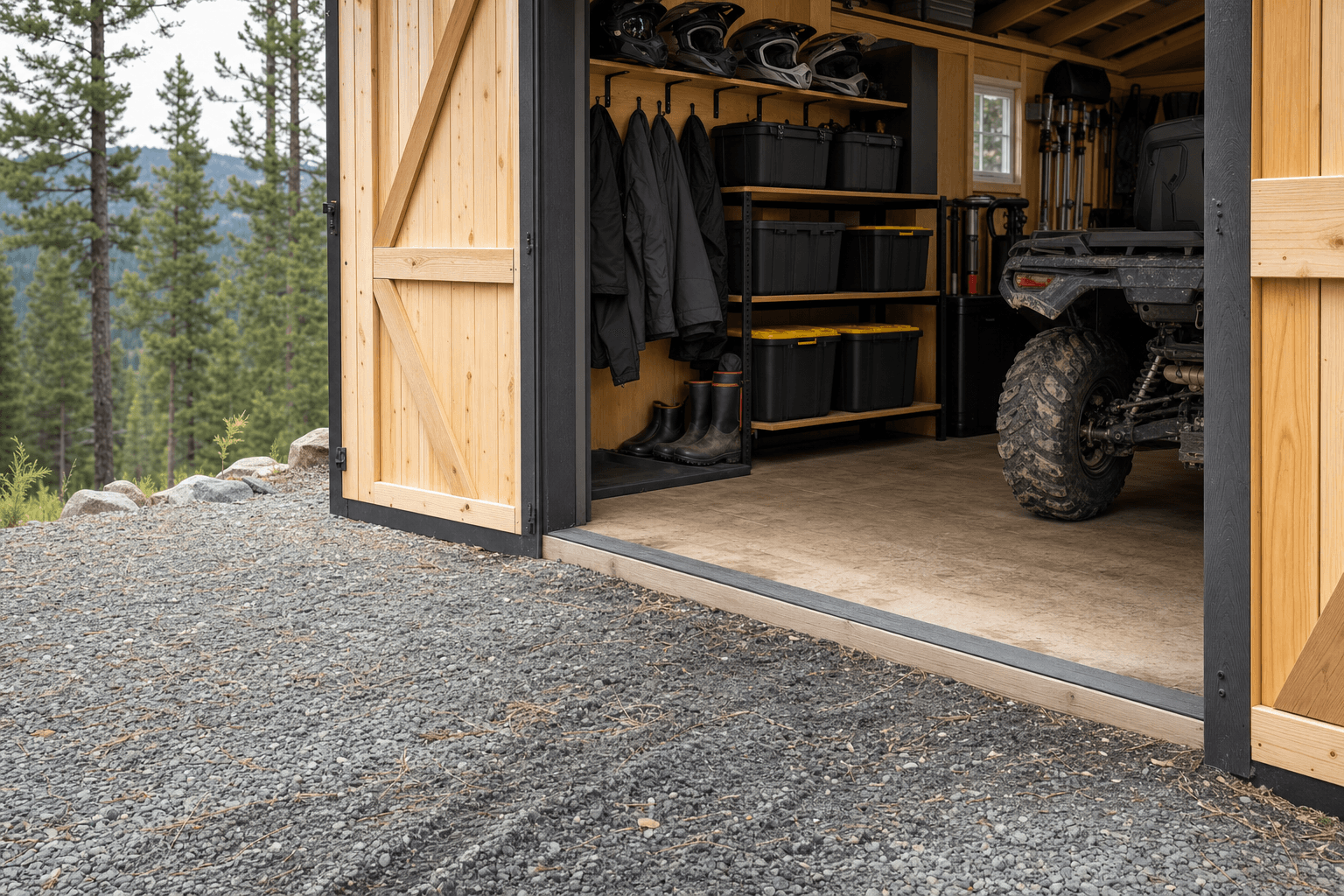
A bench against a solid wall, parts and fluids within reach, and fuel stored vented and away from heat — the details that make a spring service a Saturday job.
| ATV and UTV shed planning checklist | |
|---|---|
| Door width & height | A door wide and tall enough to clear your widest UTV's cab, mirrors, and roll cage — measure your biggest machine and add clearance on every side |
| Floor strength & surface | A reinforced, stiff floor system rated for two heavy machines and a jack, with a sealed, washable surface that shrugs off mud, gravel, and dripped fuel |
| Ramp & threshold | A wide, low-angle ramp or built-up threshold so a long UTV's hitch and belly pan clear the doorway without dragging |
| Ventilation | Low-and-high vents or an exhaust fan to clear gasoline fumes and exhaust, kept clear of heaters and ignition sources |
| Power & lighting | Dedicated 120V circuits for chargers, tools, and a compressor, with bright, shadow-free LED light over the bench and the parking lane |
| Wash & drainage | A floor drain or sloped wash corner near the door so mud and rinse water head outside instead of across the shop floor |
The floor and the ramp are the parts you cannot upgrade later, so spec them up front. Two heavy machines, a loaded utility trailer, and a floor jack put real point loads through the deck — a generic storage-shed floor flexes and eventually fails under that, especially with a UTV's narrow, heavy tires parked in the same spot for months. Plan a reinforced floor system with tighter joist spacing and a stiff, rated deck, or build on a concrete slab if you want the strongest, most washable surface for a true work bay. Then get the machines in cleanly: a long UTV with low ground clearance and a tongue or belly-mounted accessory will drag on a steep approach, so plan a wide, low-angle ramp or a built-up pad and threshold so it rolls in flat. A sealed slab or a coated floor also lets you hose out mud and wipe up fuel and oil instead of soaking them into bare wood.
Power and ventilation decide whether the shed actually works as a shop. Chargers, a battery tender, a compressor, an impact gun, and shop lights add up fast, so plan several dedicated 120V circuits run from the house with outlets where the bench and the chargers live so no cord crosses the parking lane. Ventilation is not optional in a building that stores gasoline: gas cans, fuel left in tanks, and a machine you run to move it all off-gas fumes that pool low, so plan low-and-high venting or an exhaust fan to clear them, and keep any heater well away from fuel and ignition sources. For North Idaho winters, insulate if you want a heated work bay, store a battery tender on each machine so nothing turns over dead in spring, and stabilize the fuel before the cold sets in. A vented, dry, lit shed is one where the machines come out of winter ready to ride instead of needing a shop day first.
An ATV and UTV shed is heavy and it earns a real base. A compacted gravel pad drains well and works under a properly reinforced framed floor, but if you want a permanent work bay you can hose out and park heavy machines on year-round, a concrete slab is the move — it carries two rigs and a jack without flex, gives a dead-flat, washable surface, and takes a floor drain cleanly. Either way, plan the approach so the machines, a trailer, and pallets of parts can come straight in off a gravel driveway without a muddy uphill fight, and grade the pad so rinse water and snowmelt drain away from the door rather than pooling at the threshold. Read how to prep a shed site before delivery so the pad, drainage, and access are ready for the weight and the wide door.
North Idaho winters and terrain drive several choices: a roof and anchoring rated for local snow load, a door and threshold detailed so drifting snow does not block you in, and a plowed, gravel approach that stays passable after a storm so you can actually get the machines out. Drainage matters year-round — a building you wash muddy quads in needs the water to leave, and a gravel pad that channels snowmelt away keeps the floor and the door from icing. These buildings also tend toward the larger footprints, added power, and floor drains that can trigger local rules: many small sheds skip a permit, but bigger buildings, electrical work, drainage, and setback or HOA requirements often do not. Confirm what your town and county require on the service areas pages, and factor any electrical or plumbing permit into the plan before you finalize the size and where the shed will sit.
Wide and tall enough to clear your biggest machine's cab, mirrors, and roll cage with room to spare, which is more than a standard shed door. Measure your widest UTV across the mirrors or fenders, then measure its full height with the windshield, cab, or a light bar in place, and add several inches of clearance on every side so you are not threading the needle every time. A full-size side-by-side often needs a noticeably wider and taller opening than a quad, so size the door to the largest rig you own or plan to own. Building on-site means the rough opening gets framed for your actual machine instead of a one-size door that almost fits.
Yes, but the footprint has to be planned around parking the machines and still leaving room to work. Two full-size side-by-sides parked next to each other with a walkway between them and a bench along one wall want real width, so a 14x24 or 16x24 is the comfortable range; a 12x24 works if you park in tandem rather than side by side. Plan a parking lane on the door side, a bench-and-parts wall along a solid wall, and overhead or loft storage for gear so the floor stays clear. Map out where each machine sits and where you wrench before you pick the size, because a few feet of width is the difference between walking around the machines and climbing over a cargo box.
Stronger than a standard storage-shed floor, because two heavy machines, a loaded trailer, and a floor jack put real point loads through the deck, and a UTV's narrow heavy tires concentrate that weight in one spot. Plan a reinforced floor system with tighter joist spacing and a stiff, rated deck, or build on a concrete slab for the strongest, most washable surface. For getting in, a long UTV with low ground clearance and a hitch or belly-mounted accessory will drag on a steep approach, so plan a wide, low-angle ramp or a built-up threshold so it rolls in flat. Match the ramp angle and the floor spec to your heaviest, lowest machine, not the lightest quad.
Treat ventilation as a safety system, because gas cans, fuel left in the tanks, and running a machine to move it all give off vapors that are heavier than air and pool near the floor. Plan low-and-high venting or an exhaust fan so fumes have a path out rather than building up, and keep any heater, water heater, or other ignition source well away from where fuel is stored. Store gas cans and chemicals in a vented spot, ideally near the door, and keep a fire extinguisher within easy reach of the exit. If you ever run an engine inside even briefly, make sure exhaust can clear, since carbon monoxide is the other reason a tight, sealed machine shed is a bad idea.
Yes, and it is one of the best upgrades for a North Idaho ATV shed since the machines come home caked in mud, snow, and trail grit. Plan a corner near the door with a sealed or sloped floor and a floor drain or a graded wash slab so rinse water and mud head straight outside instead of across the shop. Add a hose connection or run a pressure washer there, keep a shop vac handy, and seal or coat the floor so you can hose it down and wipe up fuel and oil instead of soaking them into bare wood. Putting the wash corner near the door and the drain keeps the muddy work in one place and the rest of the shed clean and dry.
Plan for the trailer length plus the tongue, not just the machine, because a loaded utility trailer or a sled deck adds several feet beyond the rig itself. If you want a machine to live on its trailer inside, or you want the trailer parked alongside the machines, a 16x24 gives you the length to pull a trailer straight in and still keep a bench and a parking lane, and the width to walk around it. A 14x24 can work for a smaller trailer parked in tandem with a machine. Measure your trailer hitched and loaded, add clearance to maneuver and to open the tailgate, and size the door and the bay around backing the whole rig in rather than the machine alone.
Side-by-sides are the part of this planning conversation that trips people up most. A full-size UTV is typically 60–65 inches wide, and that's before mirrors or cargo racks. A shed door that felt generous on paper can become a squeeze in practice. Coeur d'Alene and Post Falls owners who are housing a side-by-side should plan for a minimum 10-foot door opening — and a 12-foot door if two rigs will share the space.
The floor takes real abuse. Mud, oil, hydraulic fluid, and the weight of a machine being ridden in hot from the trail all go to the floor first. A concrete slab is the cleanest long-term option, but a treated wood floor on a properly engineered gravel base holds up well and is what we install on most on-site builds in North Idaho where a full concrete pour isn't practical.
Site access matters differently for UTV sheds than for most other storage builds. Properties in Hayden, Rathdrum, and rural Kootenai County often have the acreage to justify a UTV but also have the wooded or sloped lots that make a delivered unit impractical. Building in place means the structure meets the lot — not the other way around.
Fuel vapors require a specific ventilation approach: low-position vents near the floor where gas fumes settle, not just soffit and ridge vents designed for heat. See the full ATV and UTV shed overview for door specs and floor options, or configure your size and features. You can also get a free estimate before committing to a footprint.
Tell us what you ride and what you store, and we will help spec the door width, floor, ramp, ventilation, power, and site prep around your property — then you can build and price it online.
Keep planning your build with related North Idaho shed guides.