A backyard office shed solves the problem the spare bedroom never could: a real, separate place to work that isn't shared with laundry, the dog, or whoever is home during the day. When you walk across the yard and close the door, the commute is over and the workday starts. That physical separation is the whole point, and it's why a purpose-built home office shed beats a corner of the house for anyone on calls all day or doing focused work that can't tolerate interruption. It also keeps work out of your living space, so the kitchen table goes back to being a kitchen table and the evening actually feels like off-hours.
The difference between a year-round office and a glorified storage box comes down to six things you have to plan from the start: insulation, power, internet, climate control, lighting, and sound. Get those right and you have a quiet, comfortable room you'll use every working day through a North Idaho winter. Skip them and you have a shed that's freezing in January, an oven in July, and useless for the video call you took it outside to escape. The good news is that none of it is exotic. It's a tight insulated shell, a dedicated electrical circuit, a hardwired internet line, a quiet heat pump, and a little attention to where the light falls and how the room sounds on a call. This guide walks through each of those decisions in order, the sizes that actually fit a desk and a person, and how we build the structure on your property so it's solid, dry, and ready for your electrician to wire. If you'd rather see options priced out first, you can build and price a layout in a few minutes and come back to the details.
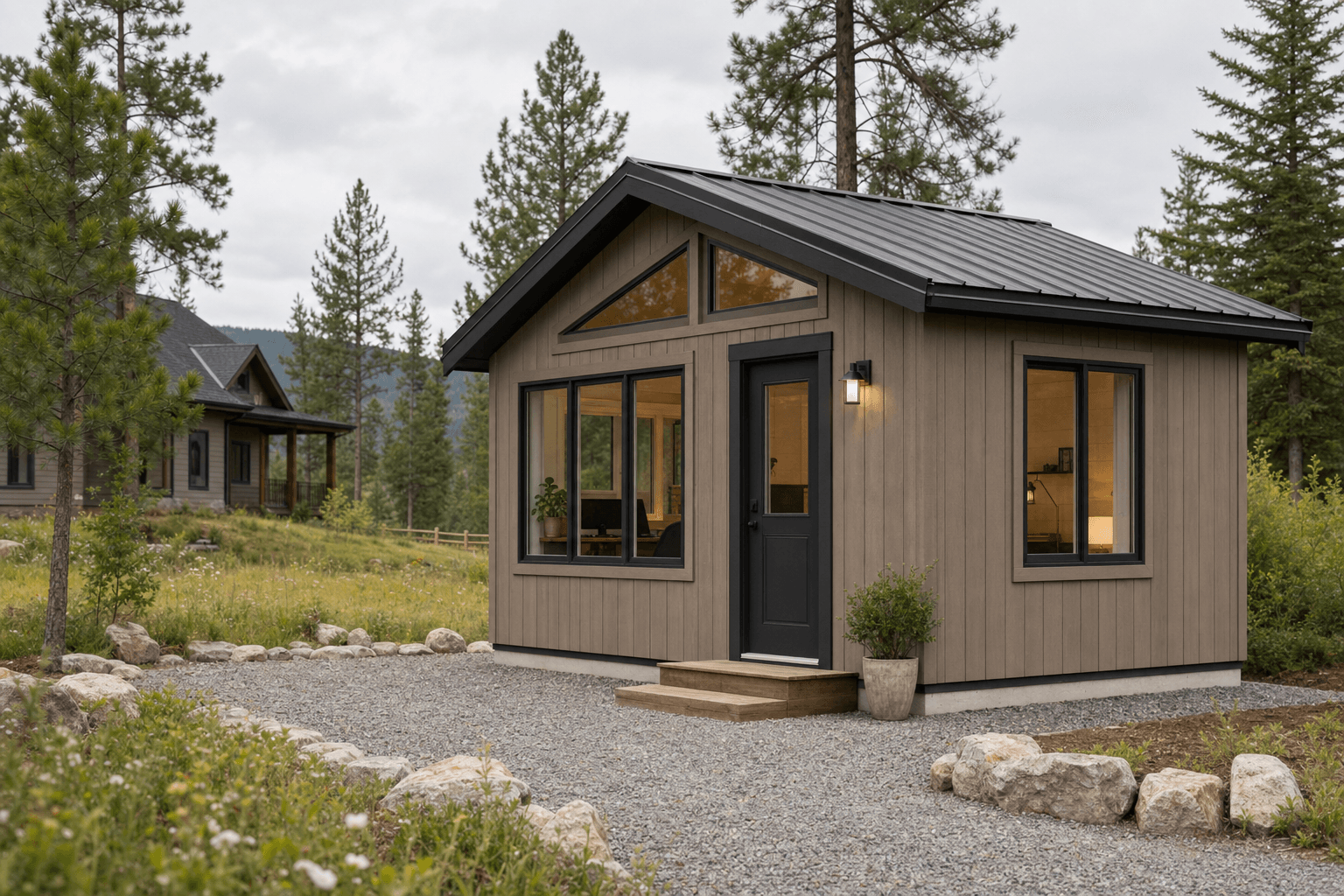
A backyard office built for year-round remote work: insulated, wired, and quiet.
Most backyard offices are happiest in a standard gable. The straight walls and simple roofline give you flat surfaces for a desk, monitors, shelving, and a wall-mounted heat pump head, with no slope eating into your headroom where you sit. It's the most efficient style to insulate and the easiest to lay out for a single quiet room.
If you want the office to feel less like a shed and more like a small studio, a lofted barn (gambrel) roof adds vertical volume and an optional loft you can use for a reading nook, storage, or a second monitor-free thinking spot. A lean-to or modern single-slope roof reads contemporary and pairs well with a big window wall and clerestory light, which is great if the view and natural light matter most to you. A model with a covered porch gives you a sheltered spot to step out between meetings without leaving the building. The same envelope decisions carry over to the other quiet-room builds we do, so it's worth looking at how we approach a music studio or a she shed when you're weighing rooflines, because the insulation and finish priorities overlap.
Whatever the roofline, an office is a habitable, conditioned room, not a tool shed. That means a continuous insulated envelope, a real door and windows that seal, and an interior you finish to live in for forty hours a week.
A single sit/stand desk, a chair with room to roll back, and a little floor for a heater and a plant. A 10x12 covers a focused solo office with no clutter.
Add a credenza, a file cabinet, a printer stand, and a bookshelf and you want 10x14 to 12x14 so the storage doesn't crowd your chair or the door swing.
If two people work, you add a client chair, or you want a small lounge or recording corner, step up to 12x16 so the room has real breathing space.
For a true year-round office, footprint is the decision everything else rides on, so size for the desk plus whatever lives next to it. A 10x12 shed is the sensible floor for a solo office: 120 square feet holds a generous desk, a comfortable chair, and a heat source without feeling tight. Move up to a 10x14 shed and the extra two feet absorbs a bookshelf, a filing cabinet, and a printer so your work surface stays clear. If you want a credenza, a guest chair for the occasional in-person meeting, or simply more room to think, a 12x14 shed gives you a square-feeling room that doesn't echo every keystroke. The 12x16 shed is the sweet spot when the office doubles as a quiet retreat, a second workstation, or a small studio corner, and it's the size most people wish they'd chosen if they started smaller. A long, narrow 10x16 shed is a smart option when your yard or setback rules favor a slim building along a fence line, and it still gives you a desk wall and a separate storage zone.
These quiet-room builds overlap, and the right label depends on how you'll use the space most. A backyard office is optimized for screen work and calls: a hardwired desk, glare-controlled light, and enough sound isolation to take meetings. A she shed leans toward a personal retreat, a hobby and reading space, or a creative room where the vibe matters as much as the workflow. If your work is creative production rather than meetings, an art studio prioritizes north light, wash-up space, and durable floors, while a music studio puts the budget into acoustic treatment and tighter sound isolation than an office needs. If you intend to host people or sleep out there, that crosses into guest house territory with its own permitting path, plumbing, and code requirements. Many buyers land on an office because they want the conditioned envelope and the wiring of a habitable room without the plumbing and dwelling-code complexity, and because an office is the one use that pays for itself in productivity from the first week. If you're genuinely torn, pick the use you'll do four days out of five and build for that, then let the rest of the room flex around it.
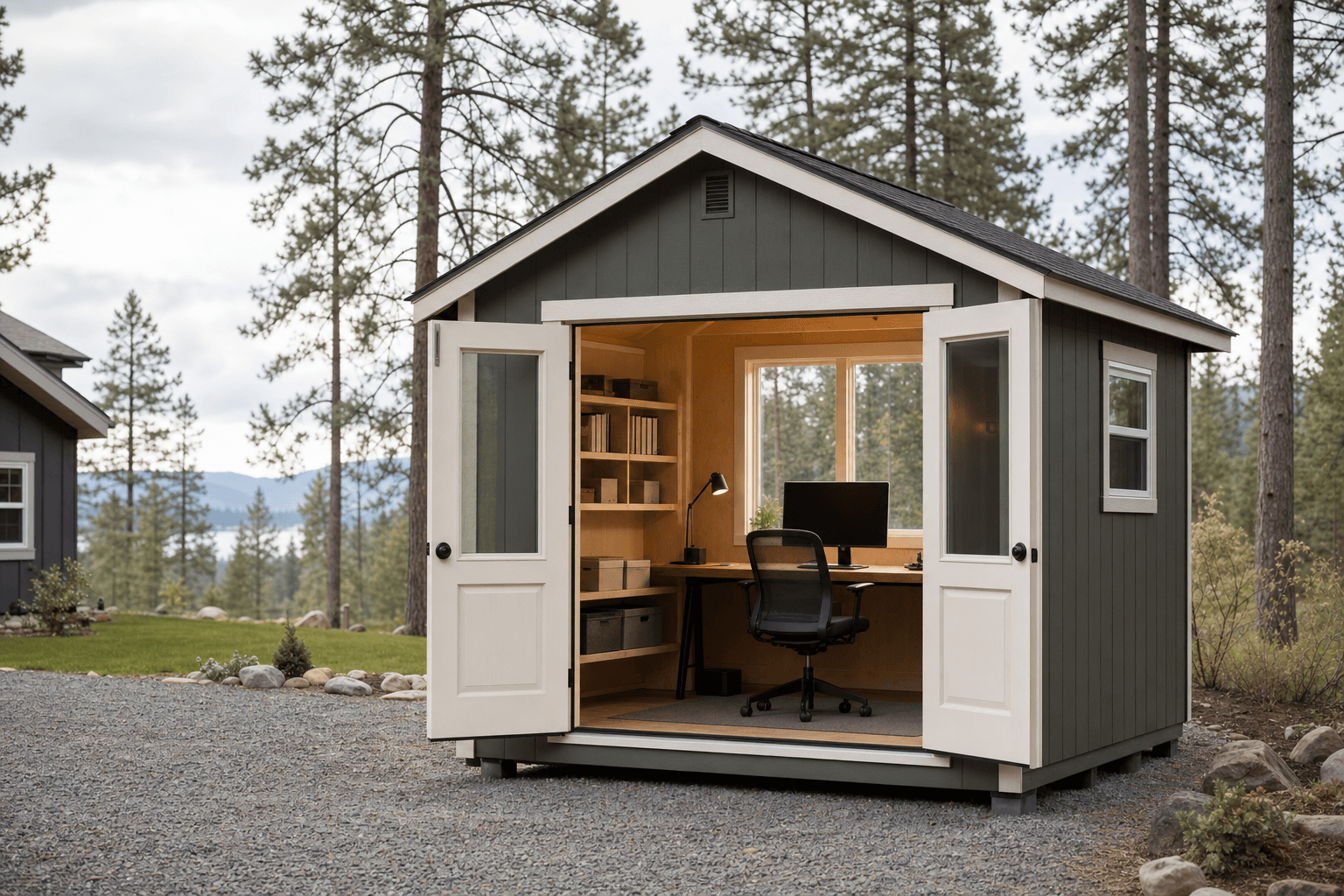
Zoned for work: desk at the window, storage on the back wall, climate control overhead.
Even a small office works better when you plan it as zones instead of one open box. The desk zone is the anchor: put it where the natural light crosses the room rather than behind you, so your screen doesn't fight a bright window and your face is lit for video. Give yourself enough depth behind the chair to push back and stand without hitting a wall or a shelf. The storage zone belongs on the wall behind or beside you, where shelves, a credenza, and a file cabinet stay in reach but out of the camera frame, which keeps your background clean on every call. Reserve a climate and power wall for the heat pump head, the electrical panel or subpanel feed, and the main outlet cluster, so cords run short and tidy and the noisy and warm equipment sits away from where you sit. Finally, leave a small transition zone at the door, a few feet of clear floor for a mat, a coat hook, and a spot to set a bag down, so the room doesn't feel cramped the second you walk in. Sketching these four zones on paper before you pick a footprint is the fastest way to tell whether you can work comfortably in a smaller building or whether you'll want the extra wall length of a larger one.
Plan a dedicated circuit with outlets every few feet at desk height, plus a floor or wall outlet for the heat pump. Two monitors, a laptop dock, a desk lamp, a space heater, and a phone charger add up fast, so wire for the load you'll actually run, not the minimum.
Combine bright, even overhead light for the room with a dimmable desk lamp for focus and a key light for video calls. Aim for neutral 3500K to 4000K bulbs so the space reads clean on camera and doesn't tire your eyes by mid-afternoon.
Wall-mounted shelves, a slim bookcase, and a closed credenza keep paper, gear, and supplies organized without using floor space. Closed storage behind your chair keeps the background tidy for every meeting.
A ductless mini-split heat pump heats and cools the room efficiently and quietly. Add a ceiling fan for shoulder seasons, an anti-fatigue mat at a sit/stand desk, and weatherstripped doors so the conditioned air stays put.
The keyword for an office is uninterrupted focus, and the fit-out is all the things that protect it. On the desk: dual monitors or an ultrawide, a laptop dock and stand, a mechanical or quiet keyboard, a webcam and a ring or key light for calls, a good headset or a boom mic, and a desk lamp you can dim. For the room: a ductless mini-split for heat and air conditioning, a small dehumidifier for shoulder-season damp, a surge-protected power strip or two, and a wireless access point or mesh node fed by a hardwired line. For storage: a lateral file cabinet, a printer and a paper drawer, a shredder, a labeled supply bin, and a bookshelf for reference material and binders. For comfort and acoustics: a rug or carpet tiles to deaden footstep noise, fabric or foam panels on a hard wall to soften echo on calls, blackout or solar shades to kill afternoon glare, and a sit/stand desk with an anti-fatigue mat. Walk through your own list like this before you settle on a size, because it adds up faster than people expect. None of it fits in a 6x8 shed, which is exactly why a real office starts at 10 feet deep, and most people end up happiest with extra wall length once the desk, the storage, a comfortable chair, and a heat pump all have to share the same room.
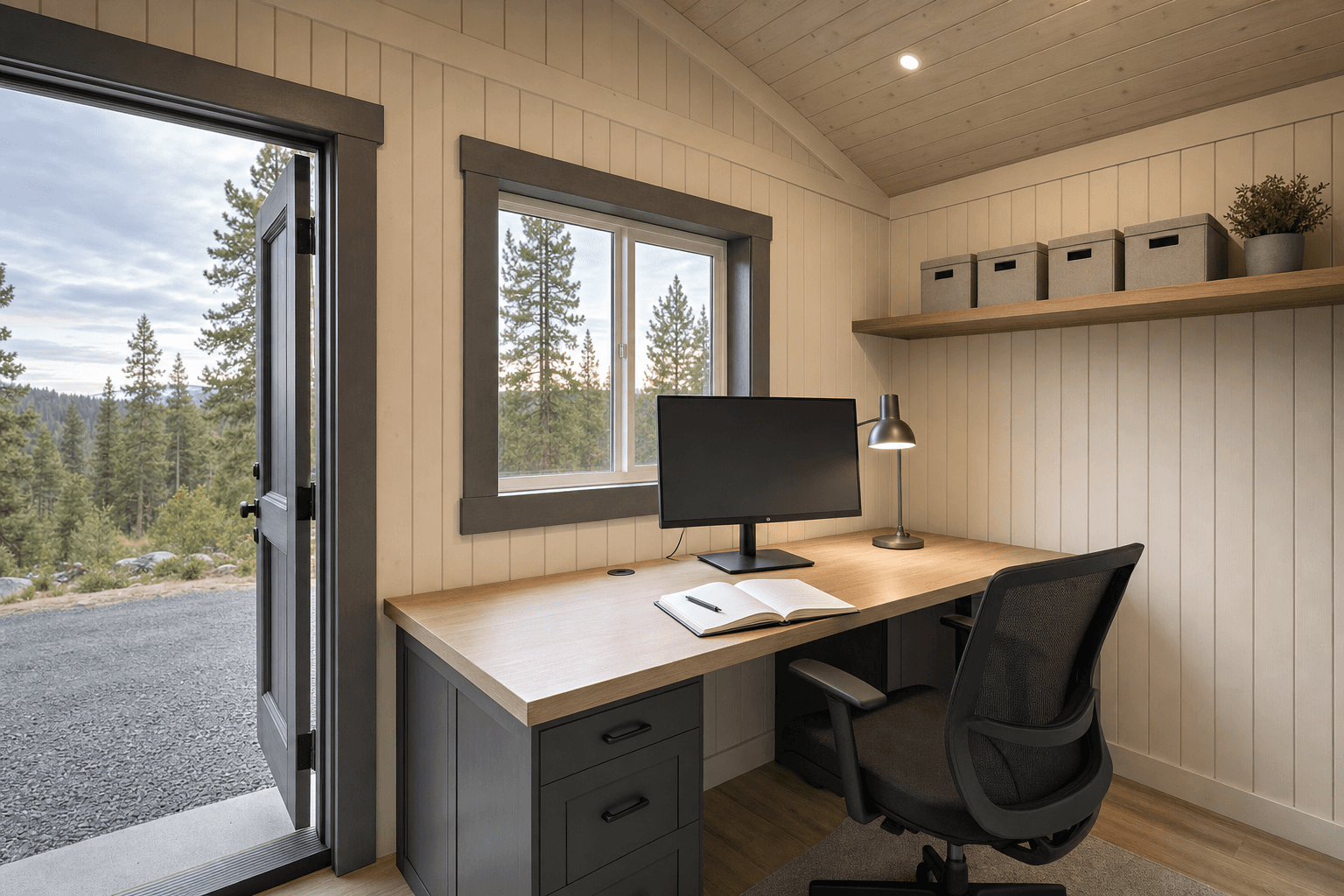
Detail that makes it a real office: a hardwired line, outlets where you need them, and controllable light.
| Backyard office planning checklist | |
|---|---|
| Best roofline | Standard gable for flat walls; lofted barn or single-slope for studio feel and light |
| Practical sizes | 10x12 solo minimum, 10x14 to 12x14 with storage, 12x16 for two people or a studio corner |
| Insulation | Continuous insulated walls, ceiling, and floor; sealed door and windows for year-round use |
| Climate | Ductless mini-split heat pump for quiet heating and cooling; dehumidifier for damp seasons |
| Power and data | Dedicated circuit, desk-height outlets, and a hardwired internet line or conduit to the house |
| Light and sound | Window placed for face-lit video, glare shades, a rug, and acoustic panels for calls |
Three systems decide whether your office works in February as well as it does in June. Power comes from a dedicated circuit run from your home's panel by a licensed electrician, ideally a subpanel in the shed so you can add circuits later without re-trenching. Plan outlets at desk height around the work wall and a separate run for the heat pump, because a space heater on the same circuit as your computers is how breakers trip mid-meeting. Internet is the make-or-break for remote work, and Wi-Fi from the house usually won't reach cleanly through exterior walls and a yard. The reliable answer is a hardwired Ethernet line or fiber run in conduit out to the building, feeding a small access point or mesh node inside, so your calls don't drop when someone streams in the house. If you only do one upgrade beyond the basics, make it the wired line. Winter readiness ties it together: a fully insulated envelope, a properly sized mini-split, and weatherstripped openings keep the room at a steady temperature through North Idaho cold snaps, while the same insulation keeps it cool and quiet in summer. We frame and build the shell tight and dry on your property so it's ready for your electrician and network installer to finish the wiring.
An office shell stays straight and dry only on a solid, level base, so most offices sit on a compacted gravel pad sized a foot wider than the building on each side for drainage, or on a concrete slab if you want a perfectly flat, sealed floor for a rolling chair. North Idaho weather drives the rest of the plan: design for local snow load so the roof shrugs off a heavy Panhandle winter, keep the floor up off the ground so spring melt and rain drain away rather than wicking in, and place the building where the gravel driveway or a clear path lets our crew get materials in to build. We build with weather-rated framing and finishes suited to pine-country freeze-thaw cycles, and we set the structure to drain and breathe so it lasts. On permits, the rule of thumb is the use: a pure storage shed under a size threshold often needs no permit, but the moment a building is conditioned and used as habitable office space, with power and climate control, your county or city may treat it differently and require a permit, electrical inspection, and adherence to setbacks. Rules vary across Kootenai County and the cities around Coeur d'Alene, so confirm with your local building department before you finalize size and placement. We can plan the build around whatever your jurisdiction requires once you know the answer.
Power should come from a dedicated circuit run from your home's electrical panel by a licensed electrician, usually in a buried conduit out to the shed, and a small subpanel inside makes it easy to add circuits later. For internet, plan on a hardwired Ethernet or fiber line pulled through conduit from the house to a mesh node or access point inside, rather than relying on Wi-Fi to punch through exterior walls and across the yard. The wired line is the single most important upgrade for a working office because it keeps video calls stable. We build the shell tight and dry so your electrician and network installer can run and terminate everything cleanly.
Treat the office as a conditioned room with a continuous insulated envelope: insulated walls, ceiling, and floor, plus a sealed door and windows that don't leak air. For climate, a ductless mini-split heat pump is the go-to because it both heats and cools efficiently, runs quietly enough for calls, and holds a steady temperature through cold snaps. Add a small dehumidifier for damp shoulder seasons. With a tight envelope and a properly sized mini-split, the room stays comfortable through a North Idaho winter and cool in summer, and your heating bill stays reasonable because you're conditioning one small, well-sealed space.
Yes, and an office needs less isolation than a recording studio, so it's very achievable. The biggest wins are simple: a solid-core door with weatherstripping, insulated walls that block outside noise, and soft surfaces inside, a rug or carpet tiles, fabric or acoustic foam panels on a hard wall, and shades on the windows, to stop your voice from echoing on the other end of the call. Because the building is detached from the house, you also get natural separation from household noise. If your work demands tighter sound control, we can look at the heavier treatment used in a music studio, but for typical meetings and focus work, standard insulation plus a few soft furnishings does the job.
Position your desk so daylight crosses the room from the side rather than streaming in directly behind your monitor or straight into your eyes. A window placed to light your face is ideal for video calls, while a window directly behind your screen creates a glare battle your camera will lose. Add adjustable solar or blackout shades so you can cut harsh afternoon sun, and layer in controllable artificial light, even overhead light plus a dimmable desk lamp and a small key light, so the room reads well on camera at any hour. A single-slope or lofted roof with higher windows can pull in soft, even daylight without putting the sun in your line of sight.
A 10x12 is the practical minimum for a focused solo office, with room for a full-size desk, a chair that can roll back, and a heat source without feeling boxed in. Once you add real storage, a bookshelf, a file cabinet, a printer, or a credenza, step up to a 10x14 or 12x14 so the storage doesn't crowd your work surface or block the door swing. If two people will work in the space, or you want a guest chair and a small lounge or studio corner, plan on a 12x16. Sizing for the desk plus whatever sits next to it, rather than the desk alone, is the way to avoid outgrowing the room in a month.
It depends on how the building is used, not just its size. A simple storage shed under your jurisdiction's size threshold often needs no permit, but a backyard office is typically conditioned, habitable space with power and climate control, and that can trigger a building permit, an electrical permit and inspection, and setback requirements. Rules differ across Kootenai County and the cities around Coeur d'Alene, so the safe move is to confirm with your local building department before you lock in the size and placement. Once you know what your jurisdiction requires, we plan the build around it so the structure, electrical rough-in, and siting all line up with the rules.
Remote work from a backyard office shed in North Idaho means the building has to hold its own through a real winter — not just a mild one. A home office shed built on site in Coeur d'Alene or Post Falls is insulated and framed for this climate from the first stud: wall cavity depth, vapor barrier placement, and window spec are chosen for a building that needs to be comfortable at 10°F without running a space heater at full blast.
On-site framing gives you control over the details that matter most for a working office. Internet conduit stubbed through the foundation to your house, a dedicated circuit with no shared load, and window placement chosen for glare reduction and natural north light — these are decisions made during construction, not workarounds added later. A delivered shed doesn't give you that flexibility.
Sound control is a real consideration on lots where the house is close. Insulated walls already help, but adding a second layer of drywall or acoustic bat in specific walls is simple during framing and meaningful in practice — especially for video calls. Summer ventilation also deserves attention: North Idaho summers can push afternoon temperatures into the high 90s, and a building with no shade and minimal airflow becomes unusable in July without a mini-split.
Wildfires and smoke seasons have become part of the North Idaho summer reality. A tightly built office shed with a quality filtered mini-split keeps air quality manageable on the days when outdoor smoke is heavy. Get a free estimate or design your office shed with the configuration that fits your lot.
Tell us how you work and we'll help you size, lay out, and price an insulated, wire-ready office shed for your North Idaho property.
Keep planning your build with related North Idaho shed guides.