North Idaho On Site Sheds

Music Studios Built On-Site in North Idaho

Need a music studio shed in North Idaho? On-site builds with sound isolation. Custom sizes for snow, setbacks, and year-round use. Get a free estimate.

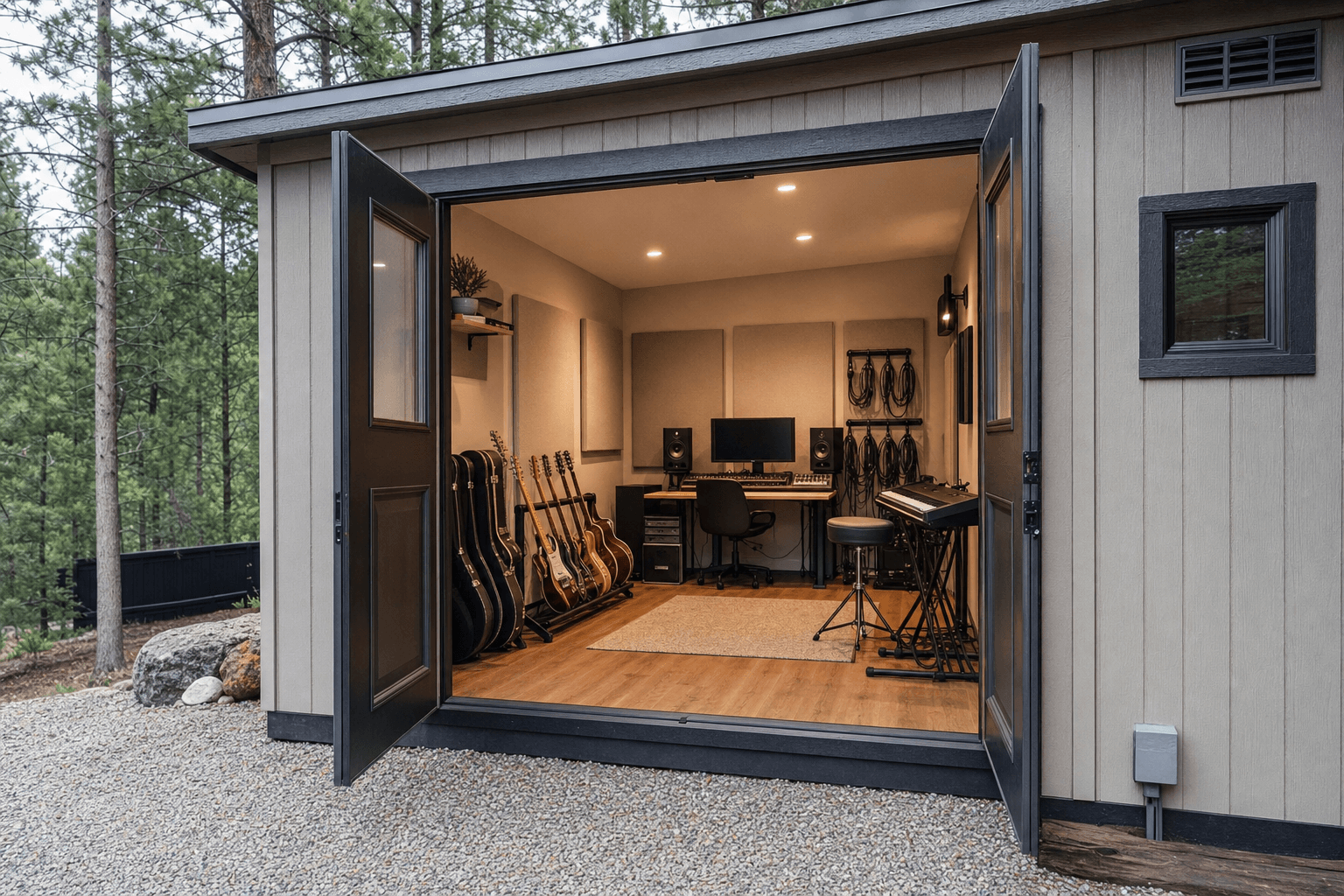
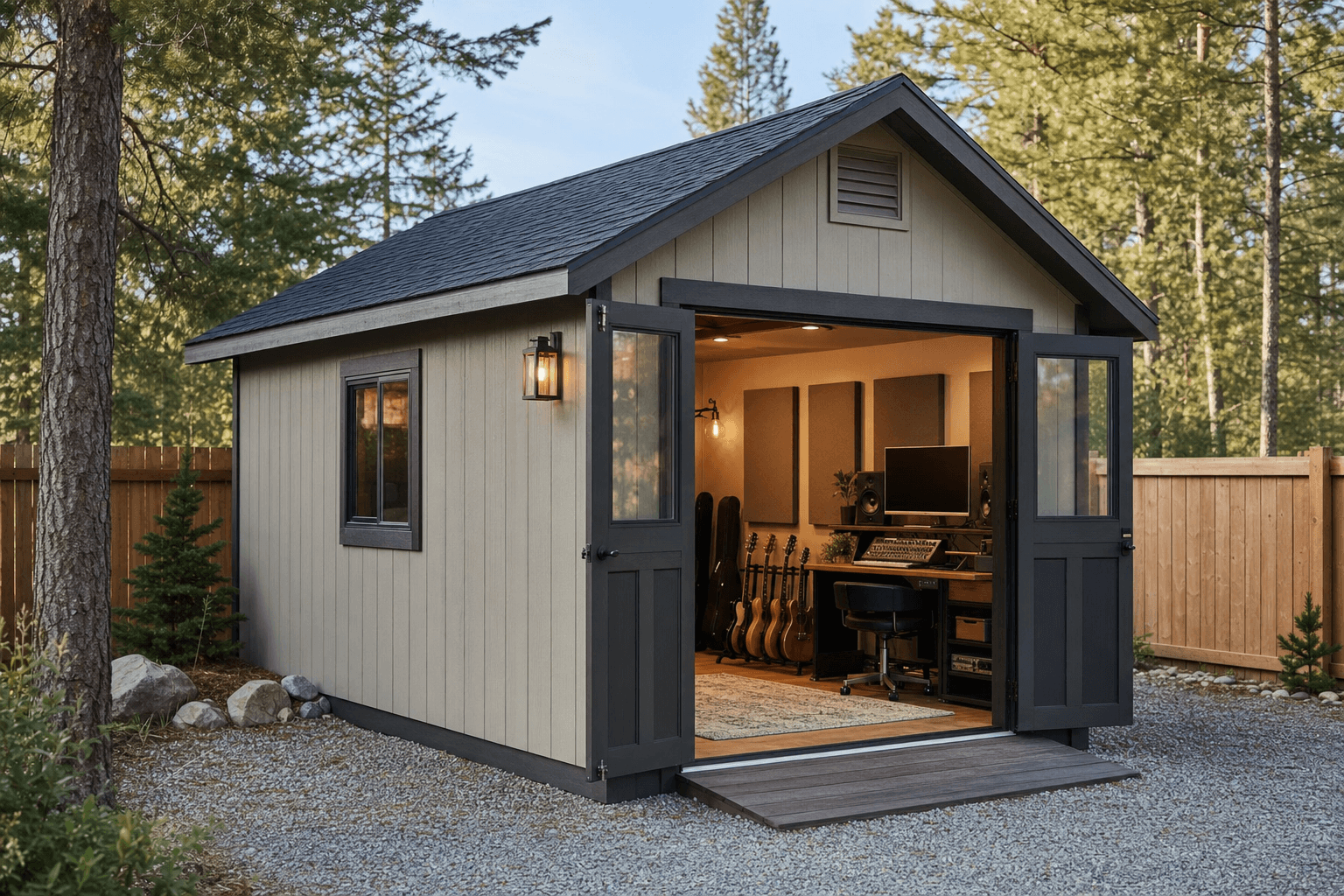
A music studio shed has to solve for sound, comfort, and power at the same time. We build music studios on-site so wall assembly, room dimensions, quiet HVAC, and electrical planning can be matched to your instruments, your neighbors, and your North Idaho property instead of being forced into a prefab structure that was never meant to record or rehearse cleanly.

Music Studios Built for North Idaho Weather

A music studio shed in North Idaho has to be treated like a real performance and recording room, not just a spare outbuilding with a rug on the floor. If the space is going to be used for drums, guitar amps, vocals, mixing, or songwriting through the winter, the shell has to stay warm, quiet, and consistent enough that the room is pleasant to work in and not a nuisance to everybody nearby.

That starts with the envelope. A studio that swings from frozen mornings to overheated afternoons is hard on people and hard on instruments. Guitars, microphones, interfaces, and outboard gear all behave better in a room with stable temperature and controlled moisture. In North Idaho, that means respecting local snow loads on the roof, frost-related movement below, and the fact that a lightly built shell will transmit outside noise and lose heat quickly.

The weather issue is not just about staying warm. Winter fan noise, drafty doors, and vibration through the floor all show up in recordings. Mud-season moisture and summer smoke season can also change how often the room needs to stay sealed up. A music studio that actually gets used year-round usually has better insulation, better air sealing, and a quieter mechanical strategy than a hobby shed or standard storage room.

On-site building matters because studio rooms are sensitive to wall assembly, openings, and exact size. A prefab shell might give you square footage, but it does not automatically give you the right proportions for instruments, a comfortable control position, or a realistic plan for keeping noise in check on a North Idaho lot.

Music Studio Features & Build Options

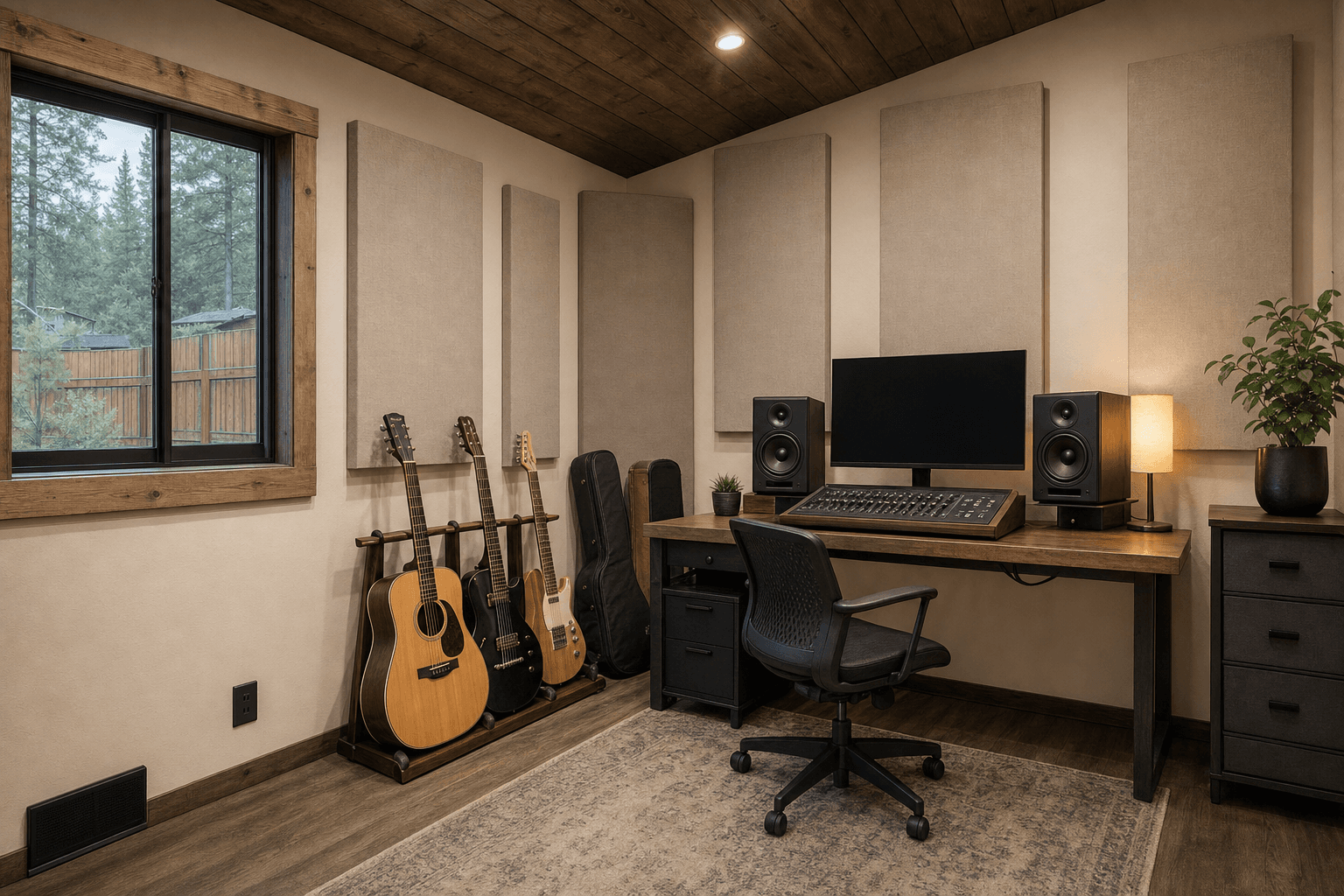
The biggest misconception about backyard music studios is that 'soundproof' is a single feature you can buy. In practice, music rooms work because several things are handled together: sound isolation to reduce noise transfer, acoustic treatment to make the room sound better inside, quiet HVAC so the room is usable year-round, and electrical planning that supports real studio gear.

Sound isolation starts with the structure. Wall assembly, door choice, window strategy, and floor behavior all matter. If you are trying to understand what is realistic in a detached backyard room, our guide on sound isolation basics and what is realistic in a backyard studio is a good place to start. A practical studio is usually about meaningful reduction, not fantasy-level silence.

Acoustic treatment is the next layer. Even if the room is fairly quiet from the outside, it still needs to sound controlled inside. That can mean absorption, bass management, diffusion, and a layout that keeps the listening position away from the worst room modes. Room proportions matter here, which is why odd leftover footprints often perform worse than a more disciplined studio plan.

HVAC needs special attention too. A loud mini-split head, noisy wall unit, or aggressive fan can ruin the whole point of the room. Before you settle on mechanicals, it is worth reading quiet HVAC for studios and minimizing noise while staying comfortable. Quiet heating and cooling is not optional if the room is supposed to record clean takes in January.

Power planning is another place where on-site building helps. Music studios often want dedicated circuits, controlled outlet placement, and a clean wiring plan for desks, amps, lighting, and computers. Some owners also compare the project with art studios or a podcast and creator studio before the build is finalized. That comparison is useful because the window, acoustics, and lighting priorities shift depending on whether the room is mainly for performance, production, or camera work.

If you are still shaping the interior, room dimensions and acoustic treatment fundamentals can help clarify why a slightly different width or length often matters more than people expect.

Popular Music Studio Sizes & Layouts

A 10x16 is a common starting point for a focused one-person studio. It can support a desk, monitors, a couple of instruments, and enough treatment to make the room useful for songwriting, editing, and light overdubs. It is also a practical size on many North Idaho lots where access or setbacks limit how large the outbuilding can get.

A 12x16 usually feels more comfortable when the room needs a clearer control area plus space for vocals, guitars, or a small amp setup. The extra width helps with desk placement and leaves more flexibility for treatment and circulation.

A 12x20 is one of the stronger all-around music studio sizes because it gives more room for separation between the listening position and the performance side of the room. That extra distance can help the studio feel less cramped and can make acoustic treatment easier to plan.

A 12x24 or 14x24 is more realistic when the room needs drums, multiple players, or a broader hybrid use that includes tracking, mixing, and storage. Bigger is not always better, but once the room starts supporting a full band workflow or multiple stations, the smaller footprints can get tight quickly.

What Size Music Studio Works Best?

The best size depends on what the room has to do on its busiest day. A solo writing and mixing room can work well in a smaller footprint than a studio that needs to record drums, host rehearsals, or leave instruments permanently set up. The room also has to accommodate acoustic treatment, which means the interior usable area ends up smaller than the raw outside dimensions suggest.

That is why many owners start with 10x16, compare it against 12x16 and 12x20, and only step larger if the instruments or workflow genuinely demand it. If the room needs a desk, a vocal corner, guitars on the wall, and a couple of seated players, 12-foot widths start becoming much easier to live with.

It also pays to think about the neighbors, not just the instruments. A slightly larger room with a better wall build, better door placement, and a saner HVAC layout usually performs better than a cramped room that forces everything into one noisy corner. On-site construction helps there because the final proportions and openings can be tuned to the real property.

If the room needs keyboards, guitars on stands, a desk, and enough air around a vocal position, the extra square footage disappears quickly. Most regrets in studio builds come from under-sizing the circulation, not over-sizing the shell.

How Does On-Site Music Studio Building Work?

Music studios are one of the clearest examples of why on-site construction is the better path. Studio rooms care about exact proportions, wall buildup, and where the doors and windows land. If the room is delivered as a generic shell first and figured out later, you usually lose the best chance to get the acoustics, isolation, and electrical plan right.

The process usually starts with how the room will actually be used. We look at whether the studio is for practice, mixing, full-band recording, or some hybrid of all three. From there, the shell, foundation approach, insulation level, and mechanical plan can be aligned with the real use case instead of guesses.

On-site framing also helps when the property has limited access, close neighbors, fences, trees, or awkward grades. Those are common realities across North Idaho. Rather than forcing a transport-friendly shape onto the lot, the room can be built where it belongs and detailed around real setbacks, real weather exposure, and the way sound should move across the site.

Music Studio Service Areas Across North Idaho

We build music studios across Kootenai, Bonner, Boundary, Shoshone, and Benewah counties. Around Coeur d'Alene, Hayden, and Post Falls, one of the biggest issues is usually neighbor proximity. The right room there often depends on thoughtful isolation, tighter mechanical control, and a footprint that respects both the lot and the people next door.

On rural properties around Athol, Spirit Lake, Sandpoint, Bonners Ferry, or farther into the counties, the lot may give you more freedom on size, but winter access, wind, and utility distance become bigger parts of the discussion. The studio still has to be usable when the driveway is snowy and the temperature drops hard. That is where a properly built shell and an honest HVAC plan start paying for themselves.

If you are deciding between size and finish level, the practical next stops are our pricing guide and free estimate page. Most studio projects benefit from a quick site-specific review because the room build is only half the story. The lot, the neighbors, and the intended use drive the rest.

Frequently Asked Questions About Music Studio

The FAQ section below covers the common short answers on price, permits, schedule, and sizing. For music studios, those answers matter, but the deeper issues are isolation, room dimensions, and whether the space will actually stay comfortable enough to use all year.

If you already know the room needs to function as a real studio and not just a spare shed, request a free estimate. That makes it much easier to sort out the right size, wall assembly, and comfort package before the build heads in the wrong direction.

Built for North Idaho weather

  • Engineered for snow load

    Roofs framed for North Idaho's 70+ psf ground snow load.

  • Wind-rated

    Anchored and braced for the gusts that funnel down our valleys.

  • Sealed for freeze-thaw

    Detailed drip edges, sealed penetrations, and breathable wraps.

  • 12-year warranty

    Bumper-to-bumper coverage on materials and workmanship.

What you get

  • Sound isolation

  • quiet HVAC

  • acoustic treatment

  • wired power

How it works

  1. Step 1Site visit

    We come to you, listen to how you want to use the shed, and read the site.

  2. Step 2Free estimate

    You get a single, all-in price — no surprises, no upsell.

  3. Step 3Build day

    We build it on your property in a single visit. No delivery permits, no crane fees.

  4. Step 4Walkthrough

    We hand it over with a walkthrough of materials, doors, and aftercare.

Frequently asked questions

  • How much does a music studio cost in North Idaho?

    Most music studio projects in North Idaho start around $8,300 and can reach $20,000 depending on size, foundation, utilities, insulation, and finish level. Site access, snow loads, and feature upgrades can move pricing higher. See our pricing guide or request a free estimate.

  • What size music studio works best in North Idaho?

    Most music studio builds land in the 10x16, 12x16, 12x20 range, while 12x24, 14x24 works better when you need more clearance, storage zones, or finished space. North Idaho lot layout, setbacks, and access matter as much as square footage. Compare 10x16, 12x16, and 12x20.

  • Do I need a permit for a music studio in North Idaho?

    Often yes. Many music studio projects land at or above 200 square feet or include utilities, which makes permit review more likely in North Idaho. Even when a simpler footprint follows the under-200-sq-ft path, setbacks, HOA rules, and intended use still matter. Review permit basics and request a site-specific estimate.

  • How long does it take to build a music studio on-site in North Idaho?

    Most music studio projects take about 4-6 on-site days once the site is ready and materials are staged. Larger footprints, slab work, insulation, wiring, plumbing, and muddy or tight North Idaho access can extend the schedule. See how our build process works.

Ready to get started?

Plan Your Music Studio