An 8x10 shed gives you 80 square feet — a small, hardworking footprint that does one job well and tucks almost anywhere. At 8 feet wide it is a reach-in building rather than a walk-around one: you set your bench, rack, or shelving along the 10-foot wall, stand in the doorway or take a step inside, and everything is within arm's reach. That is exactly what makes it efficient for a single, focused use. It is the size people pick when a tiny 8x8 box runs out of wall before they run out of stuff, but a full mid-size shed would dominate a small yard or a tight side setback.
It earns its keep as a potting shed with a bench under a window, a garden shed for the mower and the long-handled tools, or a place to hang and dry out wet gear between trips. Eighty square feet will not swallow a riding mower or double as a workshop, and it is not trying to — the 8x10 is the right-sized building for the person who wants one neat, dedicated space and none of the bulk that comes with going bigger.
At 80 square feet, an 8x10 reads as a tidy reach-in: the 10-foot wall holds a bench or a rack and the 8-foot depth keeps everything an arm's reach from the door, so you grab what you need without stepping around anything. It feels purpose-built for a single job rather than a room you spread out in.
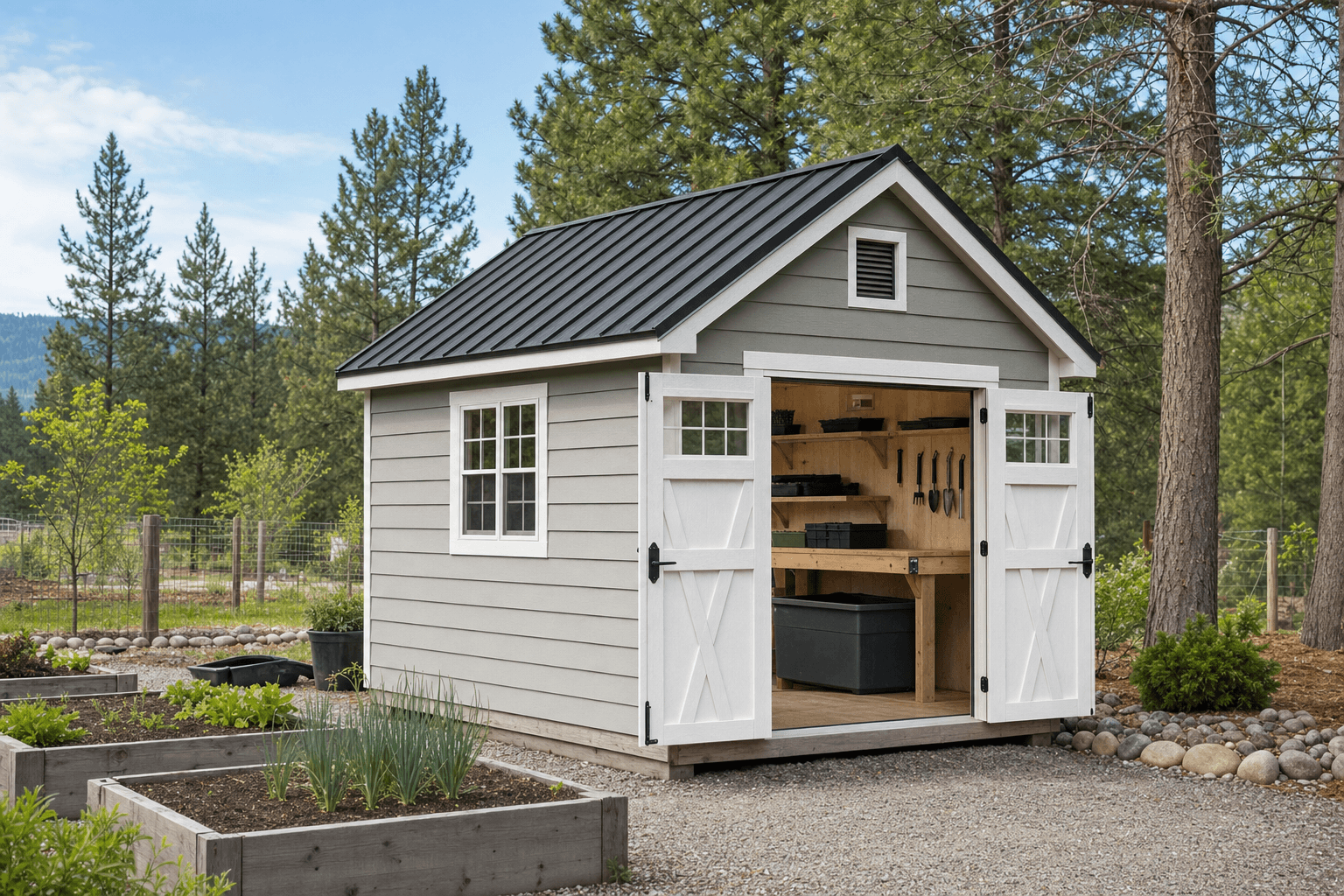
An 8x10 shed gives you 80 square feet — a compact reach-in sized for one focused job.
The 8x10 is built around a single 10-foot working wall, and the best uses are the ones that want exactly that. As a potting shed, it fits a full-length potting bench under a window, with bagged soil and pots stored on shelving above and below, and a wheelbarrow parked just inside the door. As a garden shed, the same wall holds long-handled tools, a wall of hooks and hangers, and a push mower or trimmer, leaving the floor clear for bags of mulch and the watering gear.
It is also a smart choice for drying out wet, muddy gear. A gear-drying shed at this size gives you a dedicated spot — away from the house and the garage — to hang waders, raincoats, boots, packs, and life jackets so they actually dry instead of stewing in a mudroom. The compact footprint is an advantage here: a small, well-vented room dries gear faster and is easier to keep warm than a big one. And as a plain tool shed, an 8x10 takes a workbench on the short wall, a pegboard above it, and shelving for the rest, keeping the basic tools out of the garage without committing to a full shop. The common thread is focus: one wall, one job, no wasted square footage.
Decide what owns the long wall — a bench, a rack, or shelving — and design the rest around it. The single working wall is the whole point of an 8x10.
With 8 feet of depth there is no room for floor clutter. Shelving, pegboard, and overhead racks are what make 80 square feet feel roomy instead of packed.
An 8x10 shines at a single dedicated use. If you already picture two jobs sharing it, step up to an 8x12 or a 10x10 before you build.
Coming up from an 8x8, the 8x10 adds two feet of length to that working wall — 80 square feet instead of 64. It does not sound like much, but on a single wall those two feet are the difference between a bench that fills the whole side and a bench plus a stretch of shelving, or a mower that fits alongside the tools instead of blocking the door. An 8x8 is a true small storage box; the 8x10 is the first size that gives a focused setup a little elbow room. Pick the 8x10 when you have a specific bench or rack in mind and the 8x8 leaves you an arm's length short.
Going the other way, an 8x12 keeps the same 8-foot reach-in depth and adds two more feet of length — step up to it when you want the bench and a full second zone on the same wall, like a potting station next to a tool wall. The bigger jump is to a 10x10: the same 100-ish square feet, but the two extra feet of width turn a reach-in into a building you can actually walk into and work around. Choose the 10x10 when you need to stand inside and turn, or want gear on two walls with an aisle between them. Stay at 8x10 when the job lives on one wall and a compact, easy-to-place building is what you are after; size up when you need depth to move or length for a second use.
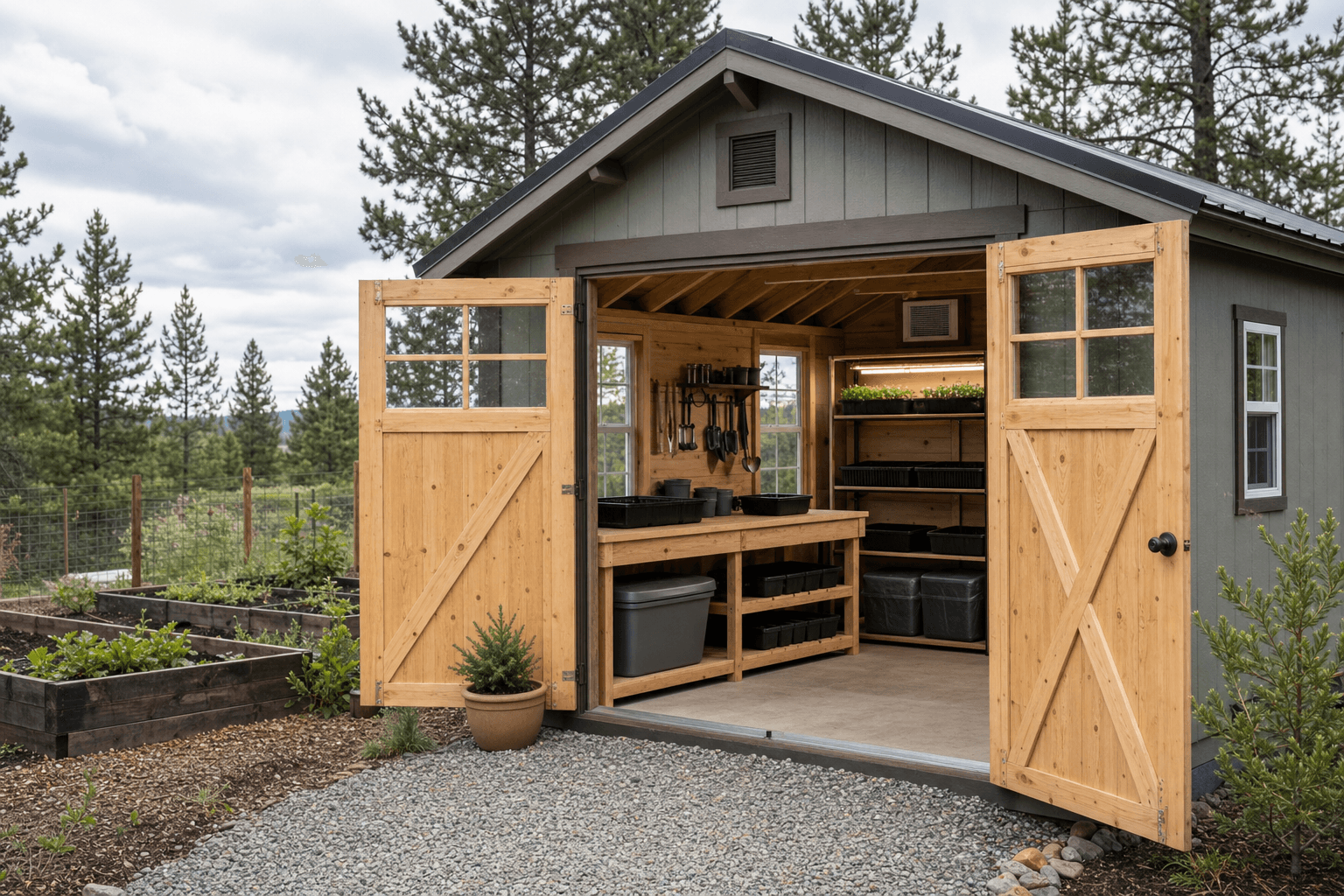
The 8x10 is built around a single 10-foot working wall, with shelving up high to keep the floor clear.
| 8x10 at a glance | |
|---|---|
| Square footage | 80 sq ft — compact reach-in footprint, ideal for one focused job |
| Typical door | A single 36-inch door; a 4-foot door if a wheelbarrow or wide totes go in and out |
| Foundation | Level, well-drained gravel pad, built on-site to carry North Idaho snow load |
| Best uses | Potting shed, garden and tool storage, drying wet gear, general overflow |
| Sizes up to | 8x12 for a second zone on the same wall, or 10x10 to walk in and work |
| Sizes down to | 8x8 when 64 sq ft covers it and you want the smallest footprint |
Because we build every shed on your property, an 8x10 is finished around the one job you have in mind — the window, door, and venting are chosen for the use, not pulled off a lot. For growing, a potting shed build puts a window over the bench wall for daylight and a wide door for the wheelbarrow; the potting shed planning guide covers bench height, light, and keeping soil and pots organized in a small space. For yard work and tools, a garden shed or tool shed build adds a hook wall and a compact bench — the garden shed planning guide and the tool shed planning guide walk through layout, hanging storage, and door width.
If the point is drying out wet gear, a gear-drying shed build leans on cross-ventilation, hanging racks, and a small heat source so waders and packs are dry by the next trip; the gear-drying shed planning guide covers venting, racks, and moisture control at this scale. Any of these can start in the configurator so you see the roofline, door, and window before you commit to a build.
Yes — a potting bench is one of the best fits for an 8x10. A full-length bench runs along the 10-foot wall under a window, with shelving above for pots and below for bagged soil, and you still have room to park a wheelbarrow just inside the door. The 8-foot depth keeps everything within reach while you work, which is what you want at a potting station. Where 80 square feet gets tight is if you also want a separate tool wall or a place to start seeds on racks; for a bench plus a full second zone, an 8x12 gives you the extra length.
No — a riding mower or zero-turn does not belong in an 8x10. Most lawn tractors are around 6 feet long and 4 feet wide, and once one is parked in an 8-foot-deep building it eats almost the whole floor and blocks the door. An 8x10 is sized for a push mower, a trimmer, and hand tools, not ride-on equipment. If a riding mower has to fit, step up to a 10x12, which parks the mower in one corner and still leaves a workbench wall and a clear aisle.
It works well, and the compact size is actually an advantage. An 8x10 gives you a dedicated spot away from the house to hang waders, raincoats, boots, packs, and life jackets so they dry between trips instead of sitting damp in a mudroom. A small room vents and warms faster than a big one, so gear dries quicker. The keys are cross-ventilation — a window or vents on opposite walls — and hanging racks up the 10-foot wall so air moves around everything. A small heater or a fan speeds it up in a cold, wet North Idaho fall.
Both are 8 feet deep, so they reach in the same way — the difference is two feet of length on the working wall. An 8x8 is 64 square feet, enough for a compact bench or a wall of shelving. An 8x10 is 80 square feet, and those two extra feet let you add a stretch of shelving beside the bench, or park a mower alongside the tools instead of in front of the door. If your setup lives on one wall and the 8x8 leaves you just short, the 8x10 is the easy upgrade without adding much footprint.
It comes down to whether you reach in or walk in. An 8x10 is 80 square feet and works as a reach-in: gear lives on the 10-foot wall and you grab it from the doorway. A 10x10 is 100 square feet, and the two extra feet of width let you stand inside, turn around, and put gear on two walls with an aisle between them. Choose the 8x10 when the job is one wall and you want a smaller, easier-to-place building; choose the 10x10 when you need to work inside the shed rather than just store in it.
For most 8x10 uses, a single 36-inch door is plenty — it clears tools, totes, and gear without taking up wall you want for shelving. If a wheelbarrow, a mower, or wide bins go in and out regularly, a 4-foot door makes that easier. Because the building is only 8 feet wide, door placement matters: we set it so the swing and the path line up with the way you load the shed, usually toward one end so the long wall stays clear for your bench or rack.
Eighty square feet is a real reach-in — there is room to step inside, turn around, and access two full walls of storage. An 8x10 handles the overflow that eats up a garage: long-handled garden tools, a bag of ice melt, a snow blower, or a stack of camping totes. It is not large enough to work in comfortably, but it keeps gear organized and off the ground.
A potting bench along the back wall is one of the most common fits at this size. You get about 8 feet of bench run with room to squeeze past and reach the shelf above. Garden hoses, kneelers, and small-pot supplies fill the sides. Coeur d'Alene gardeners with a full raised-bed setup use this configuration often.
The 8-foot width means a standard double door or a wide single fits without eating into usable wall space. NIOS frames the doors on site so the swing clearance actually works with your patio, fence, or grade — details a factory-built unit can't account for.
In Post Falls and the Rathdrum Prairie area, where lots sometimes have a narrow strip between the house and the side fence, an 8x10 is a common solution. The on-site crew can work in tight quarters and stage material off your driveway rather than needing a wide delivery corridor.
Start a free estimate to price an 8x10 with the door, roof style, and finish you want. See storage shed options for ideas on shelving and interior layouts at this size.
Pick your door, window, and roofline, then get a free estimate or price an 8x10 in the configurator.
Compare nearby footprints to find the right fit for your site and storage needs.