A 10x10 shed gives you 100 square feet in a clean square — equal walls, no long side and short side to plan around. That shape is the whole appeal: every wall is the same 10 feet, so the room reads as balanced and you can center a desk, a chair, or a table without one dimension fighting the other. It is the footprint North Idaho buyers reach for when they want a small, finished space rather than a storage box — a home office shed you step out to in the morning, or a she-shed tucked into the corner of the yard.
At 10 feet on a side it is the smallest size that genuinely feels like a room. You can stand in the middle, turn around, and reach two walls without taking a step, which is exactly what makes 100 square feet work for one person doing one focused thing. Most homeowners pick a 10x10 because it does a single job cleanly — office, craft room, quiet retreat, or square overflow storage — without dominating a side yard the way a wider building would.
At 100 square feet, a 10x10 is a true square — every wall is 10 feet, so the space feels centered and easy to lay out. It is roomy enough to walk around a desk or a craft table and reach shelving on the facing wall, while staying compact enough to read as a tidy garden building rather than a second garage.
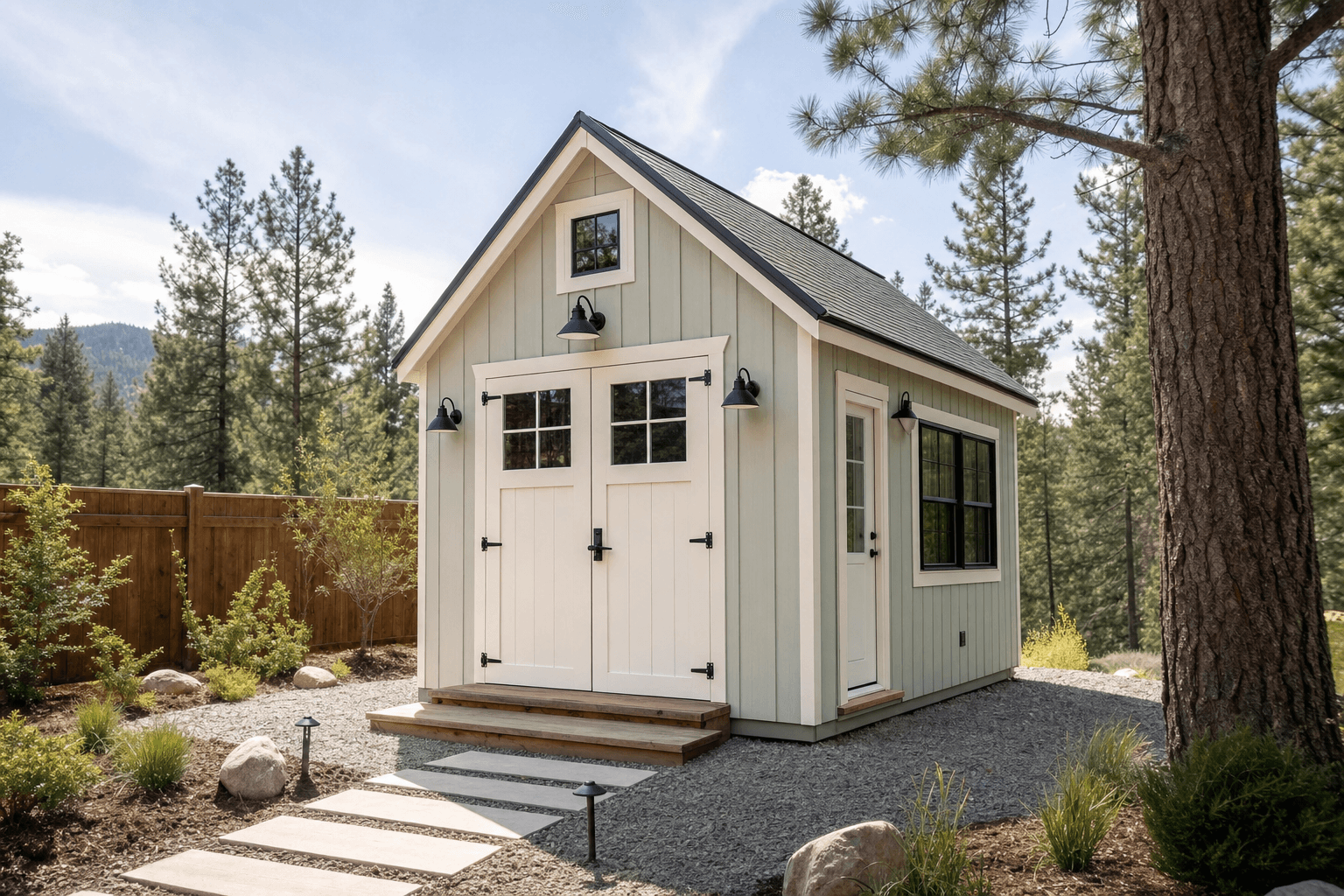
A 10x10 shed gives you 100 square feet in a square footprint — balanced walls and a compact, finished feel.
The square footprint suits jobs where you want a centered, finished room rather than a long working wall. As a home office shed, a 10x10 holds a desk against one wall, a chair with room to roll back, a bookshelf or two, and a window for daylight — enough for real remote work without the building swallowing the yard. As a she-shed, the same square takes a comfortable chair, a small craft table, and shelving on the facing walls, with daylight and a finished interior that make it somewhere you want to sit.
It is also a clean fit for a focused hobby shed — a sewing or model bench, painting station, or potting setup where you stand at one wall and keep supplies within arm's reach on the others. And when the job is simply square overflow storage, 100 square feet swallows totes, seasonal gear, and lawn furniture on shelving around all four walls, with the middle left open. The square shape means nothing ends up stranded in a deep corner you cannot reach.
With equal walls there is no long side to anchor to. Pick one wall for your main piece — desk, bench, or chair — and let shelving wrap the other three.
A 10x10 works best when the middle stays clear. Push the desk, table, or shelving to the walls so you can move and turn without bumping anything.
100 square feet is comfortable for a single focused use. If two people will work in it or jobs will share the room, step up to 10x12 or 12x12.
Coming up from an 8x10, you gain two feet of width and square the building off — and that is the difference between a room you reach into and one you sit in. An 8x10 is 80 square feet and works as a reach-in: a desk or bench fits, but with only 8 feet across, anything on the facing wall eats the space you would stand or roll a chair in. Square it up to 10x10 and you get a real walking lane on every side, which is what turns it from storage into an office or a retreat you spend time in.
Going up, a 10x12 keeps the same 10-foot width but adds two feet of length — pick it when you want a dedicated working wall for a longer bench, a second desk, or a daybed plus a craft station without crowding the door. A 12x12 is the next square up at 144 square feet, the move when you want the same balanced layout with room for two people, a seating area plus a desk, or a hobby that needs more bench and floor. Stay at 10x10 for one person and one focused use; size up the moment you are combining jobs or sharing the room.
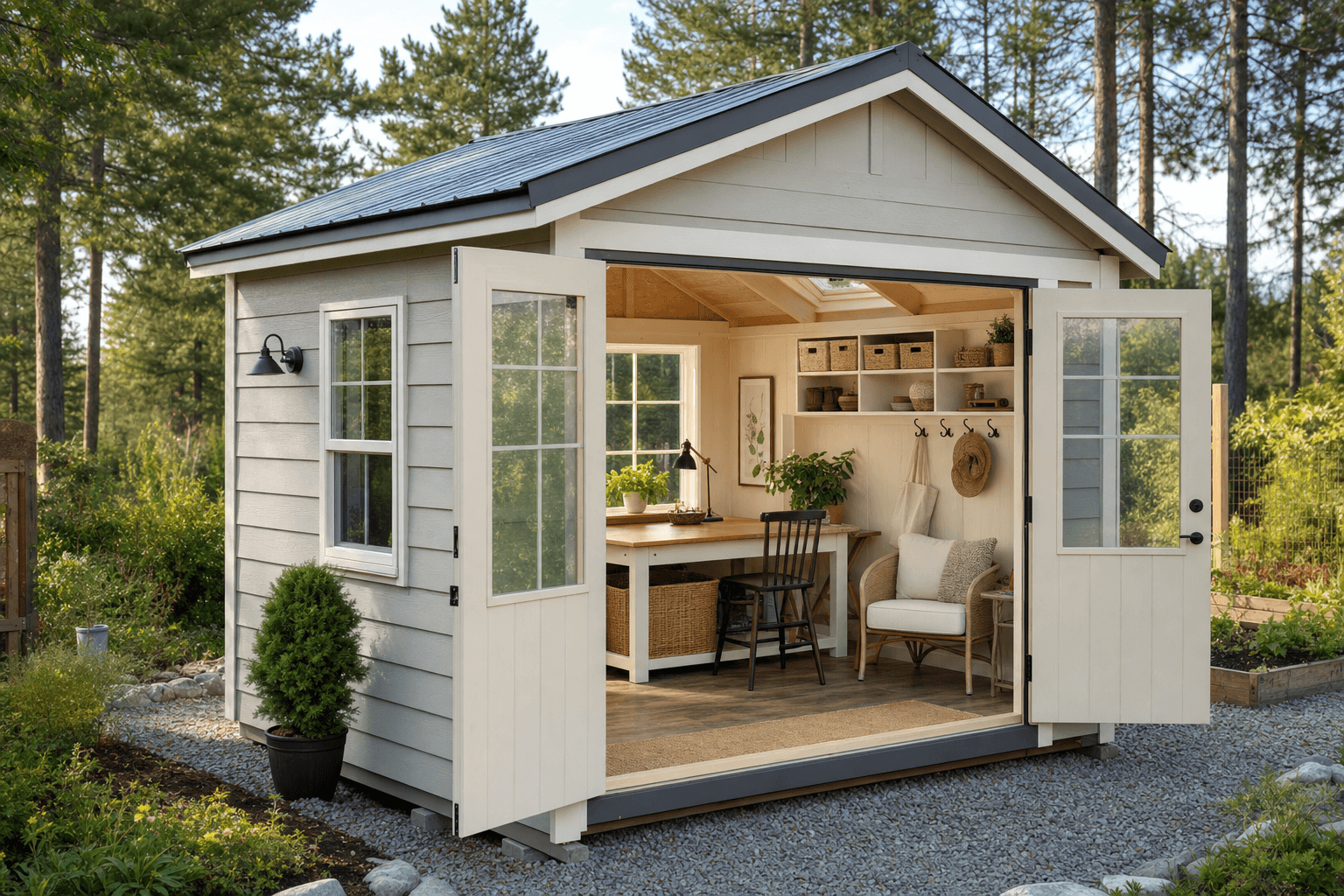
Equal 10-foot walls keep a 10x10 centered and open in the middle — easy to lay out as an office, craft room, or retreat.
| 10x10 at a glance | |
|---|---|
| Square footage | 100 sq ft — a tidy square, comfortable for one person and one focused use |
| Typical door | A single 36-inch door for an office or retreat; a 4-foot door if you carry totes or furniture in and out |
| Foundation | Level, well-drained gravel pad, built on-site to carry North Idaho snow load |
| Best uses | Home office, she-shed, hobby or craft room, square seasonal storage |
| Sizes up to | 10x12 for a longer working wall, or 12x12 for a larger square that fits two |
| Sizes down to | 8x10 to save yard space when a reach-in footprint is enough |
Because we build every shed on your property, a 10x10 can be finished for whatever the square is for — the windows, door, insulation, and interior are chosen around the use, not pulled off a lot. For remote work, a home office shed build adds insulation, a power run, and windows placed for daylight without screen glare; the backyard office shed planning guide walks through heat, internet, light, and sound for a year-round desk. For a personal retreat, a she-shed build leans into windows, a finished interior, and a comfortable layout, covered in the she-shed planning guide.
For a craft or maker space, a hobby shed build adds task lighting, bench space, and supply storage on the perimeter walls — the hobby shed planning guide covers light, climate, and bench layout for your craft. And when 100 square feet is plain overflow, a storage shed keeps it simple with shelving around all four walls; the storage shed planning guide covers shelving and access. Any of these can start in the configurator so you see the roofline, door, and windows before you commit.
Yes, for one person it is a comfortable home office. The square gives you 100 square feet, which holds a desk against one wall, a chair with room to roll back, a bookshelf or two, and a window for daylight. You can stand up and move around without bumping furniture, which is the part that separates a usable office from a cramped one. If you want it to work year-round in North Idaho, plan for insulation, a power run, and a small heater so the room holds temperature through winter. Two people working at once is where a 10x10 starts to feel tight — for that, step up to 10x12 or 12x12.
It depends on the job. A square 10x10 keeps every wall the same length, so the room feels balanced and you can center a desk, chair, or table and wrap shelving around the other walls — that suits an office, a retreat, or a craft room where you want open floor in the middle. A rectangular shed of similar square footage, like an 8x12 or 10x12, gives you one longer wall, which is better when you need a continuous run for a long bench, a row of shelving, or a parked machine. Pick the square when the use is a centered room; pick the rectangle when you want a long working wall.
Both are 10 feet wide, so they feel equally roomy side to side — the difference is the two feet of length. A 10x10 is a 100-square-foot square, ideal for one person and one centered use like an office or she-shed. A 10x12 adds two feet to make 120 square feet and, more importantly, gives you a longer working wall: room for a bigger bench, a second desk, or a daybed plus a craft station without crowding the door. Choose 10x10 when the square layout is exactly enough; choose 10x12 when you want that extra run of wall to spread out along.
For an office, she-shed, or hobby room, a single 36-inch door is the usual pick — it is plenty for people coming and going and keeps more wall free for a desk or shelving. If you will carry totes, furniture, or larger gear in and out, a 4-foot door clears wider loads without a struggle. Because the walls are all 10 feet, you have flexibility in where the door lands, so we place it where it lines up with how you plan to use the room rather than forcing the layout around a fixed opening.
A level, well-drained gravel pad is the standard base for a 10x10 here. It keeps the floor framing off wet ground, drains snowmelt away from the building, and gives a square structure even, stable footing on all four corners. Because we build on your property, the pad and placement are part of the plan, and the framing and roofline are built to carry local snow load. Site the shed off the lowest, soggiest spot in the yard and where snow sliding off the roof clears the door instead of burying it.
For short stretches, yes, but 100 square feet is really sized for one. A 10x10 comfortably fits one desk or one bench with open floor to move around; add a second person with their own desk or workspace and the room fills up fast, with little clear floor left in the middle. If you know two people will use the space at once — a shared office, a craft room for two, or a hobby setup with a helper — plan for a 10x12 for the extra working wall, or a 12x12 for a larger square that gives each person their own corner.
A 10x10 is the entry-size backyard shed — 100 square feet that comfortably holds a push or small riding mower, trimmers, hand tools, and a full wall of shelving with room to still walk in and grab things. Around Coeur d'Alene and Post Falls it's the size most homeowners reach for first when the garage has filled up.
Because we build it on site, a 10x10 tucks neatly into the spot you actually have — along a fence line, in a back corner, or on a slightly sloped Hayden lot a delivered shed couldn't reach level. The door width and shelving get sized to your gear.
It also makes a tidy small studio or hobby room. Add an insulated wall, a window, and electrical, and 100 square feet is enough for a potting bench, a craft table, or a quiet workspace that holds heat through a North Idaho winter — the roof is framed for real snow load either way.
Compare it against a 10x12 or 10x14 if you want a little more elbow room, browse the models we build, or design a 10x10 in the builder with live pricing and request a free estimate.
Pick your door, windows, and roofline, then get a free estimate or price a 10x10 in the configurator.
Compare nearby footprints to find the right fit for your site and storage needs.