A she-shed is the one room in your life that belongs to you and nobody else. It's a finished, comfortable space in the backyard, far enough from the house that the noise, the to-do list, and the foot traffic don't follow you in. Some people use theirs for crafts and sewing, some for painting or pottery, some for reading and a cup of tea, some for yoga or meditation, and plenty just want a quiet, pretty place to close the door and breathe. Whatever you call it, the point is the same: a calm, separate retreat that's yours to set up exactly how you like. A purpose-built she-shed does that better than a corner of the house ever will, because it's a room with a single owner and a single purpose, not a space you're constantly clearing off and sharing.
The difference between a backyard retreat you actually use and a cute building you visit twice a summer comes down to a handful of decisions you make before the first wall goes up. Insulation, heat, lighting, windows, power, and a finished interior are what turn a shed into a room you'll sit in through a North Idaho January. Get them right and you have a snug, light-filled space that works year-round; skip them and you have somewhere that's freezing half the year and dark by four in the afternoon. None of it is complicated, but it all has to be planned from the start, because you can't easily add insulation or move a window after the fact. This guide walks through the styles that suit a retreat, the sizes that actually fit how you want to use the room, how to lay out and finish the inside, and how we build the structure on your property so it's solid, dry, and ready to make your own. If you'd rather see options priced out first, you can build and price a layout in a few minutes and come back to the details.
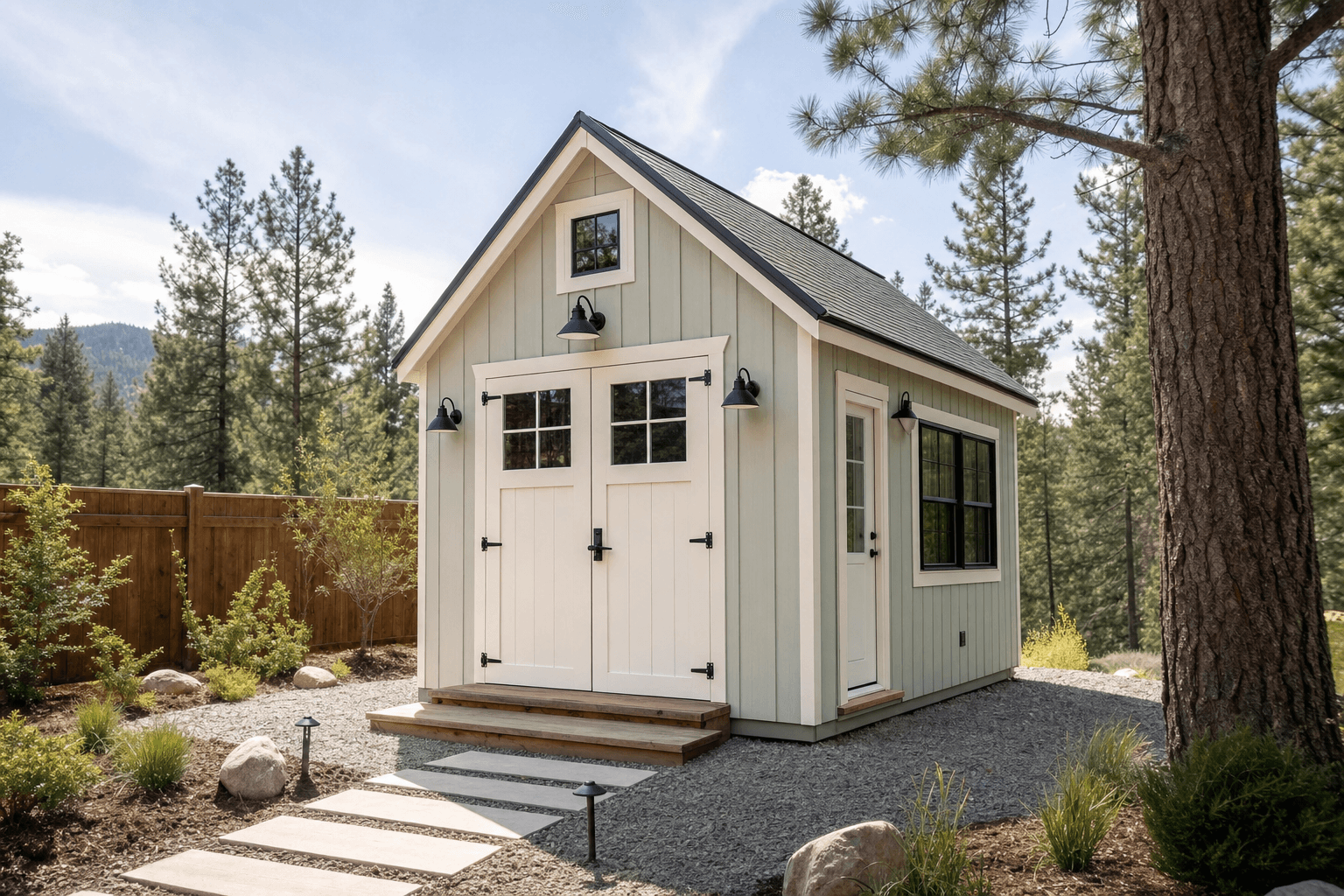
A she-shed built as a year-round retreat: insulated, light-filled, and finished to live in.
Most she-sheds look best in a standard gable. The straight walls and simple peaked roof give you flat surfaces for shelving, a daybed, a craft table, or a reading chair, and the symmetry reads as a tidy little cottage rather than a utility box. It's also the easiest style to insulate and finish cleanly, which matters when the inside is the whole point. If you want the room to feel taller and more open, a lofted barn (gambrel) roof adds vertical volume and an optional loft you can use as a reading nook, a meditation perch, or extra storage tucked overhead. A lean-to or modern single-slope roof feels contemporary and pairs beautifully with a tall window wall and high clerestory glass, which is lovely if natural light and a clean, gallery-like feel matter most to you. A model with a covered porch gives you a sheltered spot to sit with coffee and watch the yard before you step inside.
Because a she-shed is a finished, conditioned room rather than a storage shed, the envelope decisions overlap with the other live-in builds we do. It's worth looking at how we approach a home office shed when you're weighing rooflines and insulation, since the priorities are similar even though the use is different. Whatever roofline you choose, plan the building as a comfortable, year-round room, with a continuous insulated shell, a real door and windows that seal, and an interior you finish to relax in, not just to store things.
A comfortable chair, a small table, a lamp, and a shelf or two. A 10x10 is plenty for a quiet retreat built around reading, journaling, or a calm corner away from the house.
A work table, storage for supplies, and floor space to move around. Step up to 10x12 or 10x14 so a sewing table, an easel, or a yoga mat all have room to breathe.
If you want a craft zone and a lounge zone, or room for two people and a daybed, a 12x16 gives you a square-feeling room that handles more than one use at once.
Footprint is the decision everything else rides on, so size for how you actually want to spend time in the room, not just the furniture you have today. A 10x10 shed is a genuinely cozy retreat: 100 square feet holds a comfortable chair, a small table, a bookshelf, and a heat source without feeling cramped, which is ideal if your she-shed is mostly about reading, journaling, or a quiet escape. Move up to a 10x12 shed and the extra footage absorbs a craft table or a sewing station along one wall while still leaving an open spot to sit or stretch out. A 10x14 shed is the sweet spot for a working hobby room, with room for a generous work surface, real supply storage, and floor space for a yoga mat or an easel without everything competing for the same square foot. The 12x16 shed is the size to choose when the room needs to do more than one thing at once, a making zone and a lounging zone, or space for a daybed so the retreat doubles as a guest spot, and it's the size most people wish they'd picked once they fall in love with using the space. As a rule, size for the use plus a little breathing room, because a retreat that feels tight stops feeling like a retreat.
These backyard rooms overlap, and the right one depends on what you'll do in there most days. A she-shed leans toward a personal retreat where the feel of the room matters as much as the function: comfortable seating, soft light, a place to make things or simply unwind. If your space is built mainly around creative production, an art studio prioritizes steady north-facing light, a wash-up area, and durable, splatter-friendly floors, while a dedicated hobby shed is organized around a specific craft, with the bench, storage, and power tuned to that work. If you'll spend most of your time on a laptop or taking calls, that's really a home office shed, which puts the budget into a hardwired internet line and glare-controlled light instead of ambiance. Many buyers land on a she-shed because they want a finished, conditioned room that can flex, crafts one week, reading and yoga the next, a friend over for tea after that, without being locked into a single workflow. If you're torn, pick the way you'll use the room four days out of five, build for that, and let the rest of the space flex around it.
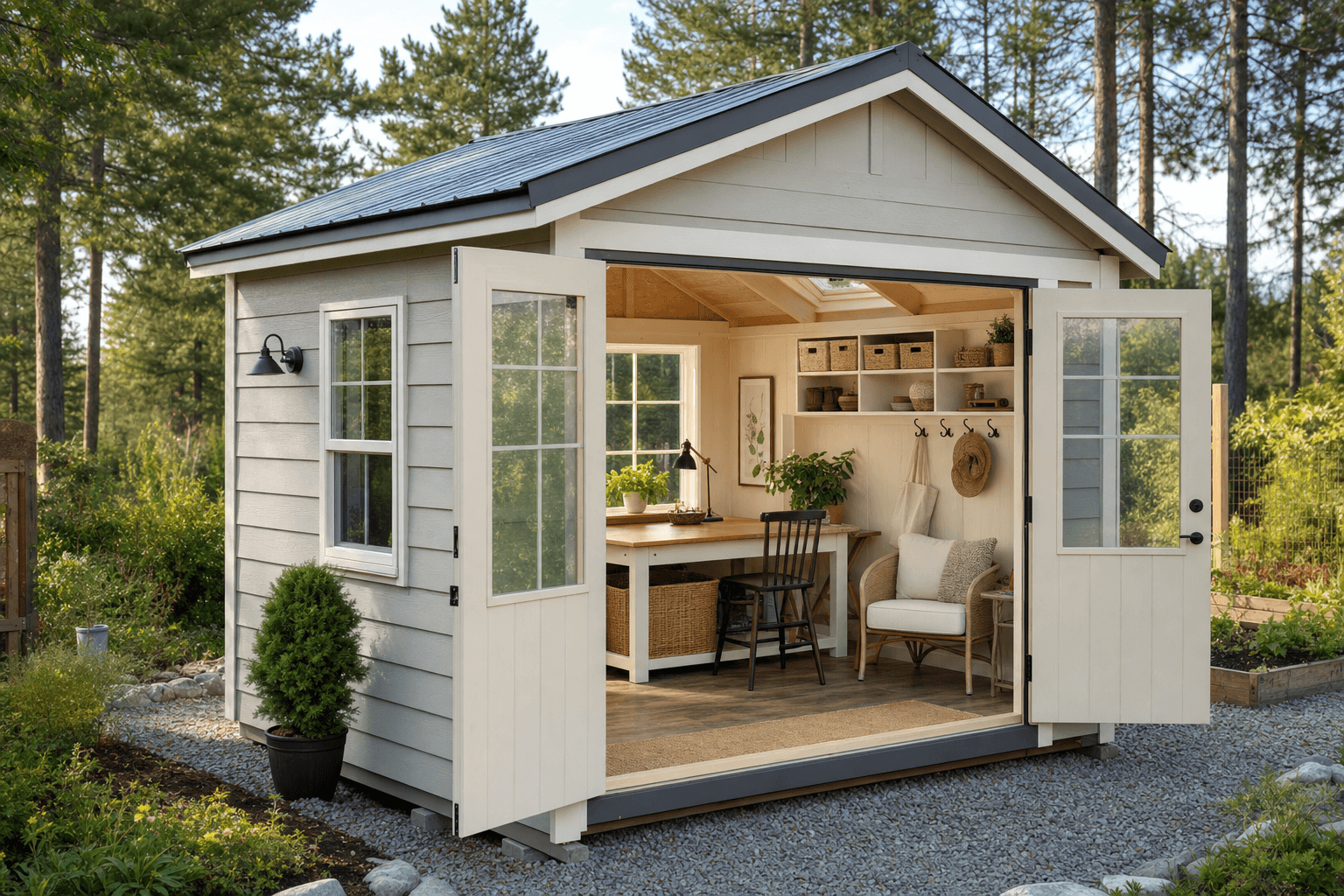
Zoned for comfort: a making area, a soft spot to relax, and warm light that works after dark.
Even a small she-shed feels bigger and works better when you plan it as zones instead of one open box. Start with a relax zone, the heart of the room, and put your most comfortable seat where it catches the best light and a view of the yard rather than a blank wall. This is the spot you sit in to read, knit, or just be quiet, so give it a little space of its own. Next comes the making zone if your retreat involves crafts, art, or any hands-on hobby: a work table or bench against a wall with good light, ideally near an outlet, so your projects have a dedicated home and don't migrate into the relaxing half of the room. Build a storage zone up the walls behind or beside the work surface, where shelves, baskets, and cabinets keep supplies in reach but off the floor, which is what keeps a small room from feeling cluttered. Reserve a calm transition at the door, a few clear feet for a rug, a coat hook, and a spot to set things down, so the room feels welcoming the moment you walk in rather than crowded. If you practice yoga or stretch, keep one stretch of open floor clear of furniture so you always have room to roll out a mat. Sketching these zones on paper before you settle on a footprint is the fastest way to tell whether a smaller building will work or whether you'll want the extra wall length of a larger one.
The single biggest comfort upgrade. Insulated walls, ceiling, and floor plus finished interior wall panels turn a bare shed into a snug room you can heat in winter and keep cool in summer, and they give you a clean surface to paint and decorate.
A dedicated circuit feeds outlets where you craft and relax, a quiet electric heater or mini-split holds a steady temperature, and a mix of overhead, task, and warm accent lighting lets the room shift from bright workspace to soft evening retreat.
Wall-mounted shelves, a slim cabinet, labeled baskets, and a window seat with storage underneath keep supplies organized without eating floor space, so even a 10x10 stays open and calm instead of crowded.
A soft rug or interlocking mats underfoot, a comfortable chair or daybed, curtains or shades on the windows, and a few plants and personal touches are what make the room feel like a retreat rather than a building.
The keyword for a she-shed is comfort, and the fit-out is everything that creates it. For relaxing: a comfortable armchair or a daybed, a soft throw, a side table, a reading lamp you can dim, and a rug that warms the floor and quiets your footsteps. For crafts and hobbies: a sturdy work table or sewing table, a cutting mat, a quality task lamp, thread and fabric storage or an art cart, labeled bins for supplies, a pegboard or wall rack, and a comfortable stool. For yoga and quiet time: a clear patch of floor, a mat and blocks, a small speaker, and shades you can close for privacy. For atmosphere: curtains, string or accent lighting, a small electric heater or fireplace, candles or a diffuser, framed art and photos, and a few houseplants by the window. For the practical side: a wastebasket, a clock, a coat hook by the door, and a kettle or a small fridge if you like a drink while you settle in. Walk through your own version of this list before you settle on a size, because a real retreat is more than a chair and a heater, and a 6x8 shed fills up the moment you add a work surface and storage. That's exactly why most she-sheds start around 10 feet on a side, and why people who size up are rarely sorry they did once the seating, the supplies, and the open floor all have to share the same room.
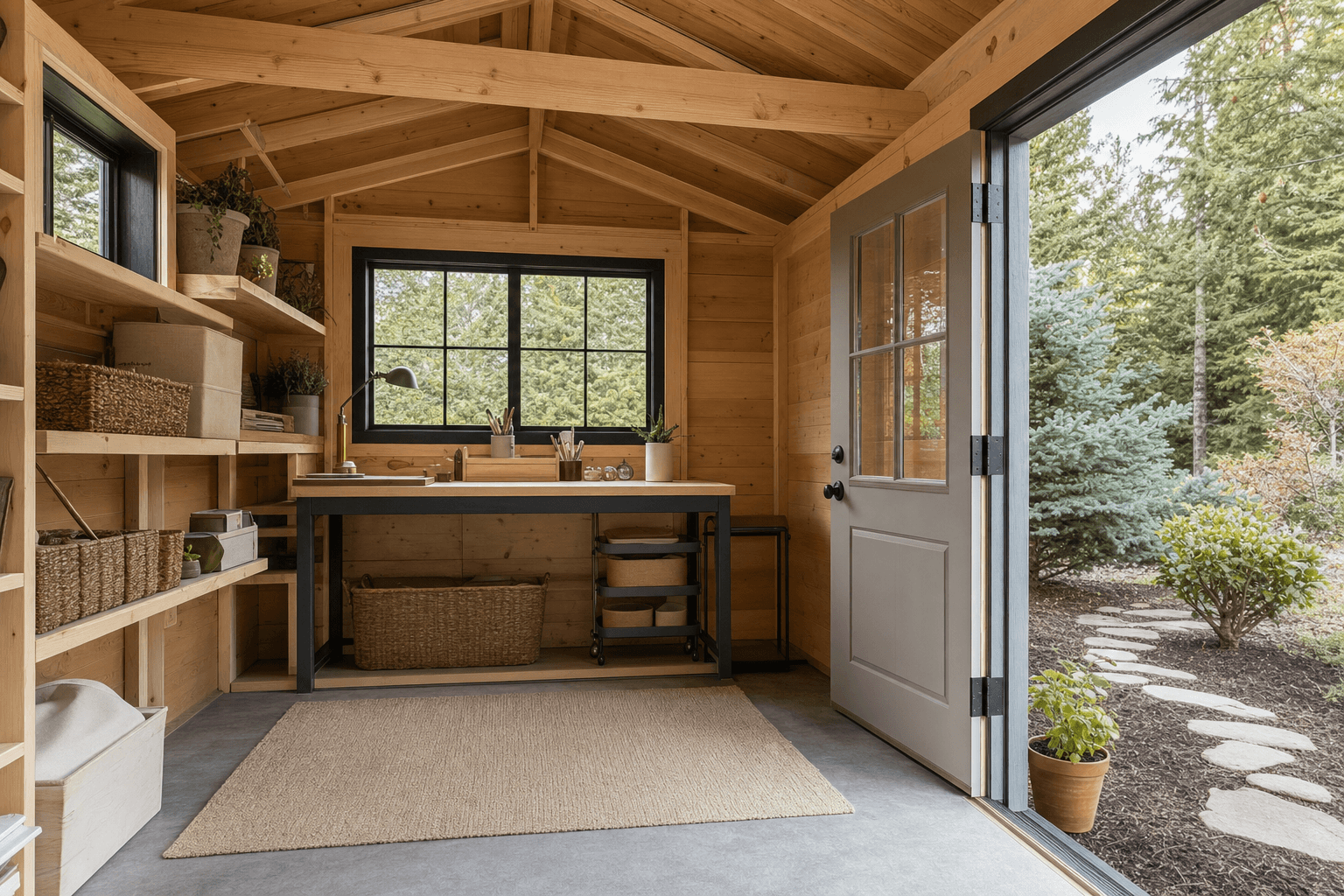
The details that make it a retreat: a window seat, warm light, and supplies within easy reach.
| She-shed planning checklist | |
|---|---|
| Best roofline | Standard gable for a cottage feel; lofted barn or single-slope for height, a loft, and more light |
| Practical sizes | 10x10 for a reading nook, 10x12 to 10x14 for a craft or yoga room, 12x16 for a multi-use retreat |
| Insulation and finish | Continuous insulated walls, ceiling, and floor with finished interior panels for a year-round room |
| Heat and climate | A quiet electric heater or ductless mini-split for steady warmth; a fan or mini-split for summer |
| Power and lighting | A dedicated circuit with outlets at the work and seating areas, plus layered overhead, task, and accent light |
| Windows and comfort | Generous windows placed for light and a view, with shades for privacy, a rug, and comfortable seating |
Three things decide whether your she-shed is just as inviting in February as it is in June. Power comes from a dedicated circuit run from your home's panel by a licensed electrician, usually in buried conduit out to the building, and a small subpanel inside makes it easy to add a circuit later without trenching again. Plan outlets where you'll actually use them, beside the work table, near the reading chair, and a spot for a heater, so you're not running cords across the floor. Lighting is what gives a retreat its mood, so layer it: bright, even overhead light for crafts and cleaning, a focused task lamp at the work surface, and soft, warm accent light, string lights, a lamp, or a sconce, so the same room can flip from a daytime workspace to a calm evening hideaway. Choose warm bulbs around 2700K to 3000K for the cozy layers and a brighter neutral light only where you do close work. Winter readiness ties it together: a fully insulated and finished envelope, a quiet heater or mini-split sized to the room, and weatherstripped doors and windows keep the space at a steady, comfortable temperature through North Idaho cold snaps, and the same insulation keeps it cool and pleasant in summer. We frame and build the shell tight and dry on your property so it's ready for your electrician to wire and for you to finish and furnish.
A finished room stays straight, dry, and comfortable only on a solid, level base, so most she-sheds sit on a compacted gravel pad sized about a foot wider than the building on each side so water drains away from the structure, or on a concrete slab if you want a perfectly flat, sealed floor under a rug or mats. North Idaho weather drives the rest of the plan. Design the roof for local snow load so it shrugs off a heavy Panhandle winter, keep the floor up off the ground so spring melt and rain drain away instead of wicking into the building, and place the shed where the gravel driveway or a clear path lets our crew bring materials in to build. We build with weather-rated framing and finishes suited to pine-country freeze-thaw cycles, and we set the structure to drain and breathe so it lasts and stays dry inside. On permits, the deciding factor is usually how the building is used, not just how big it is. A small detached shed under your jurisdiction's size threshold often needs no permit, but once a building is insulated, heated, and wired as a finished room you spend real time in, your county or city may treat it differently and require a building permit, an electrical permit and inspection, and adherence to setbacks. Rules vary across Kootenai County and the cities around Coeur d'Alene, so confirm with your local building department before you finalize the size and where it sits. Once you know what your jurisdiction requires, we plan the build around it so the structure, the electrical rough-in, and the placement all line up.
Treat the she-shed as a finished, conditioned room with a continuous insulated envelope: insulated walls, ceiling, and floor, plus a sealed door and windows that don't leak air. For heat, the two common choices are a quiet electric heater sized to the room or a ductless mini-split, which holds a steady temperature and adds cooling for summer. A small space like this heats up quickly once it's tightly insulated, so your running costs stay reasonable because you're only conditioning one well-sealed room. With a tight envelope and the right heater, your she-shed stays cozy through a North Idaho winter and comfortable in summer, which is what lets you actually use it all year instead of just in the warm months.
The biggest step is finishing the interior walls and ceiling over the insulation so you have smooth, paintable surfaces instead of exposed framing. From there, finished flooring or a quality rug, trim around the windows and door, and warm paint colors do most of the work of turning a shed into a room. Add comfortable furniture, curtains or shades, layered lighting, and personal touches like art and plants, and it reads as a cottage retreat rather than a storage building. We build the shell tight and square with a continuous insulated envelope so your interior finishes go on cleanly and the room stays comfortable, then you decorate it however suits the way you want to use the space.
Start with a dedicated circuit run from your home's panel by a licensed electrician, with outlets placed where you'll craft, relax, and plug in a heater, so you're not stringing cords across the floor. For ambiance, layer your lighting rather than relying on a single fixture: bright overhead light for crafts and cleaning, a focused task lamp at any work surface, and soft, warm accent light such as string lights, a table lamp, or a wall sconce for the evenings. Warm bulbs around 2700K to 3000K make the room feel cozy, while a brighter neutral light is better only where you do close detail work. Putting the warm layers on a dimmer lets the same room shift from a daytime workspace to a calm evening hideaway.
Plan the windows around how you'll use the room and where the light and the views are. A larger window or a pair of windows by your main seating area gives you natural light and something pleasant to look at while you read or relax, and placing windows to bring in soft, indirect light keeps the room bright without harsh glare. If you have a craft or work surface, a window beside or in front of it lights your hands and your project well. A lofted or single-slope roof lets you add higher clerestory windows that pull in even daylight while keeping wall space below for shelving and furniture. Add curtains or shades so you can soften strong afternoon sun and have privacy whenever you want it.
The trick in a small footprint is to go up the walls and keep the floor as open as possible. Use wall-mounted shelves, a slim cabinet, hanging baskets, and a window seat with storage underneath so your supplies and books live off the floor. Keep one piece of furniture as the anchor, a comfortable chair or a daybed, and give it room rather than filling every corner. Light colors on the walls, a mirror, and good natural light make a small room feel larger, while a single rug helps define a cozy zone. If you craft, store supplies in closed or matching containers so the room reads calm rather than busy. Leaving a little open floor, even in a 10x10, is what keeps a small she-shed feeling like a retreat instead of a closet.
For a year-round retreat in North Idaho, running a dedicated electrical circuit from your home is almost always the better choice, because it powers steady heat, reliable lighting, and any appliances or chargers without you having to think about it, which matters most in the dark, cold months when you'd otherwise use the room least. A licensed electrician runs the line, usually in buried conduit, and a small subpanel makes future additions easy. Off-grid setups with solar and a battery can work for a light-use, warm-season space or where running a line is impractical, but they limit how much heat and lighting you can count on in winter. If your she-shed is meant to be a true four-season room, plan for wired power; if it's a fair-weather hideaway, a modest off-grid setup may be enough. We build the shell ready either way so your electrician or solar installer can finish the job.
A she shed in North Idaho needs to work year-round, not just in summer. That means insulation in the walls and ceiling, a heat source sized for a small space, and enough weatherproofing to stay dry and draft-free through a Coeur d'Alene or Post Falls winter. A structure that's comfortable in January doesn't cost dramatically more than one that isn't — but the insulation decisions need to happen at framing time, not as a retrofit.
Natural light is the feature most owners mention first. North-facing or east-facing windows reduce afternoon glare while keeping the space bright. A she shed built on site can be oriented and positioned to take advantage of your lot's actual light exposure rather than defaulting to a catalog footprint.
The on-site advantage shows up most clearly on properties where the shed sits in a corner, behind a fence line, or at the back of a wooded lot in Hayden or Rathdrum. Those are exactly the placements that a delivered building can't reach without significant disturbance to the property. Framing in place protects mature plantings and stays within setbacks precisely.
Interior finish level is worth deciding before framing, not after — insulated and drywalled walls take longer and change the framing schedule. Browse she shed options on our service page to see common interior configurations, design your footprint in the configurator, or get a free estimate to understand the cost range for the finish level you have in mind.
Tell us how you want to use the space and we'll help you size, lay out, and price an insulated, finished retreat for your North Idaho backyard.
Keep planning your build with related North Idaho shed guides.