A 6x8 shed gives you 48 square feet — the smallest footprint we build, and the one to pick when the goal is to clear the clutter, not to make a room. At 6 feet deep it is a reach-in building: you open the door, grab what you need off the wall or a shelf, and close it again. That is exactly what most people want it for. It is the footprint that finally gets the garden tools, the mower, and the bagged soil out of the garage and off the patio without taking over a tight lot.
Homeowners choose 6x8 for one reason above all others: space, both in the yard and in the budget. It tucks against a fence line, fits beside a driveway, or slips into the narrow strip down the side of the house where nothing bigger would go. If you have a small backyard, an HOA that limits accessory buildings, or you simply have one job — keep the lawn gear and hand tools dry — a storage shed at this size does it without dominating the view.
At 48 square feet, a 6x8 reads as a tall closet you stand at rather than a room you walk into. The 6-foot depth means you reach in from the doorway, and the 8-foot width gives you one good wall for shelving, hooks, or a narrow bench along the back.
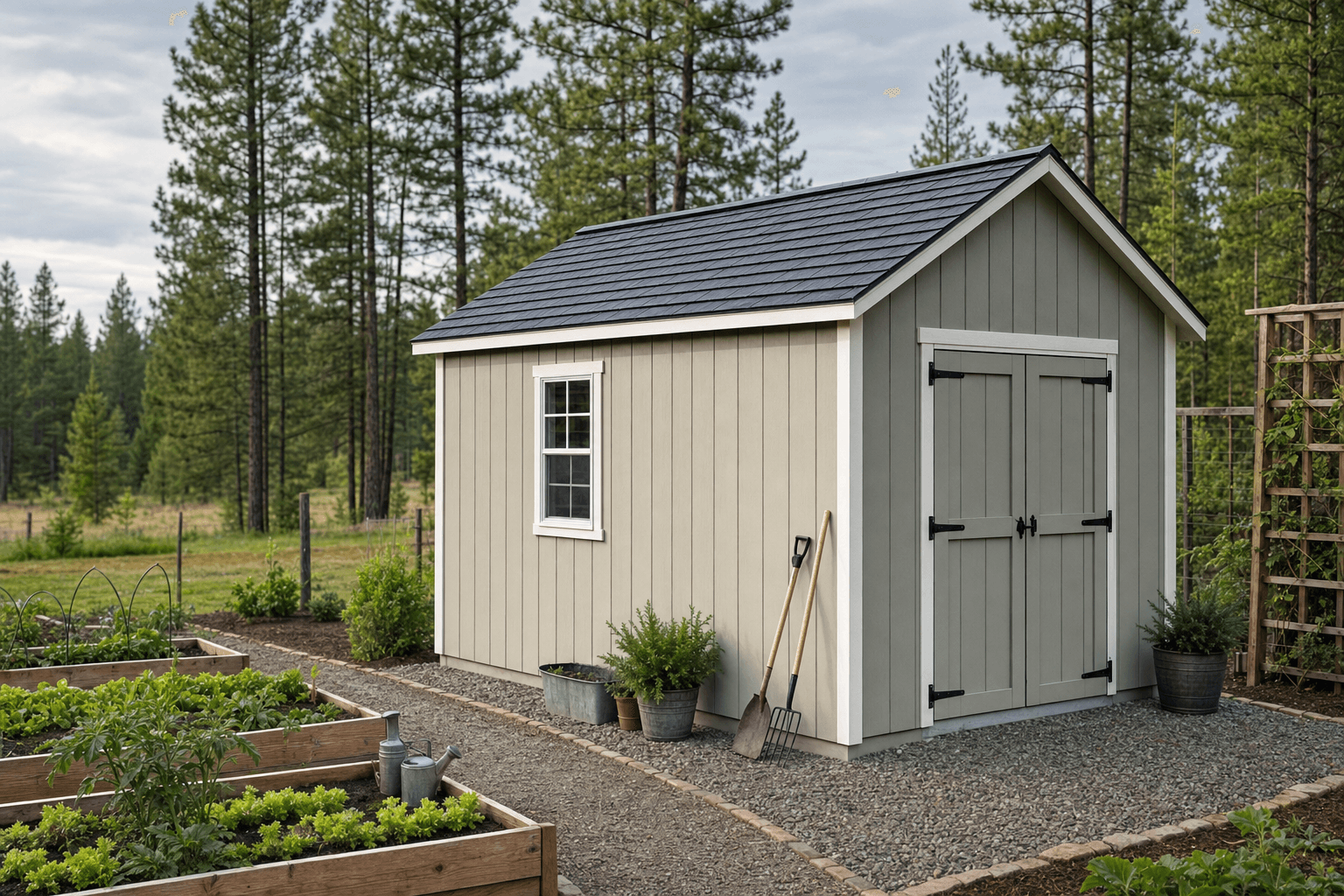
A 6x8 shed gives you 48 square feet — the compact footprint for tools, a mower, or firewood on a tight lot.
The 6x8 is a specialist, and it is good at a small set of jobs done well. As a garden shed, it holds long-handled tools on a wall rack, a wheelbarrow stood on end or rolled in, bagged soil and fertilizer, and a couple of shelves of pots and hand tools — the everyday kit without the potting-bench-and-walk-around-it ambitions of a bigger building. As a light tool shed, the 8-foot back wall takes a narrow bench or a pegboard with the yard and hand tools hung above it, freeing your garage for the car.
It also shines for the single-purpose stuff that a garage hates: a firewood shed sized to keep a few cords split, stacked, and dry through a North Idaho winter, or a clean dry home for bikes, a push mower, and the snow shovels. Think of 6x8 as the building that handles one defined job and gets it off your hands — not the one you grow a hobby into.
With only 48 square feet of floor, your storage lives vertically. Plan for wall racks, hooks, and shelving on the 8-foot back wall so the floor stays clear for the mower or wheelbarrow.
A 6x8 does one thing well. Decide whether it is garden gear, bikes, firewood, or overflow before you commit, and size the door and shelving to that single use.
This is a reach-in shed, not a walk-in one. If you picture standing inside to work, step up to 8x8 or 8x10. If you just need things dry and off the patio, 6x8 is right.
There is nothing smaller in our lineup, so the only direction from a 6x8 is up — and the first step is the big one. Move to an 8x8 and you add two feet of depth, which is the difference between reaching in and stepping in. At 8 feet deep you can stand inside the door, turn around, and actually work at a bench instead of leaning over everything from the threshold. If you ever picture yourself inside the shed rather than at its doorway, 8x8 is the size that earns it.
From there, an 8x10 keeps that comfortable 8-foot depth and adds length for a second wall of shelving or a parked mower with room to spare, and an 8x12 gives you a full 12-foot run for a bench plus storage plus a machine. Stay at 6x8 when space or budget is the hard limit and the job is genuinely one defined thing — tools, bikes, firewood, or seasonal overflow. Size up the moment you find yourself listing two jobs for it, or wishing you could walk in and turn around.
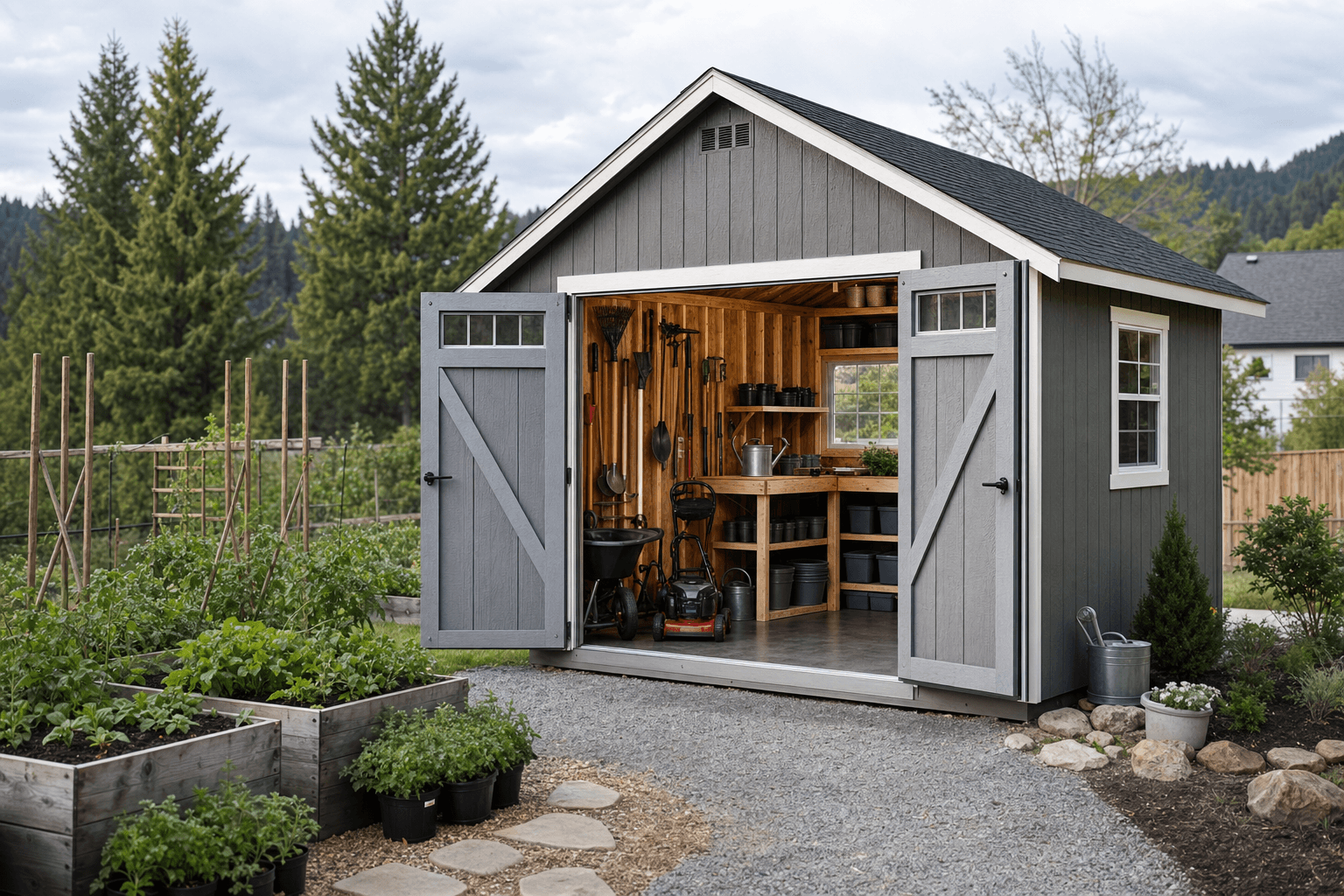
With 48 square feet, storage in a 6x8 goes up the walls so the floor stays clear for a mower or wheelbarrow.
| 6x8 at a glance | |
|---|---|
| Square footage | 48 sq ft — the smallest footprint, built for one defined job and compact storage |
| Typical door | A single 36-inch door; a wider single if you roll in a mower or wheelbarrow |
| Foundation | Level, well-drained gravel pad, built on-site to carry North Idaho snow load |
| Best uses | Garden tools, light tool storage, firewood, bikes, and seasonal overflow |
| Sizes up to | 8x8 to stand and work inside, or 8x10 for a second wall of storage |
| Sizes down to | This is the smallest we build — nothing sits below a 6x8 |
Because we build every shed on your property, a 6x8 is finished around the one job you have for it — the door placement, the wall framing, and the venting are chosen for the use rather than pulled off a lot. For lawn and yard work, a garden shed build puts a wide door for the wheelbarrow and racks on the back wall; the garden shed planning guide covers tool storage, light, and venting at this scale. For hand tools and a tidy garage, a tool shed build adds a narrow bench and pegboard, walked through in the tool shed planning guide.
If the job is firewood, a firewood shed build leans into airflow and a dry stack — the firewood shed planning guide covers venting, spacing, and how much wood a small footprint really holds. And for plain overflow, a storage shed keeps it simple with shelving and a clear floor, covered in the storage shed planning guide. Any of these can start in the configurator so you see the roofline, door, and window before you commit.
More than it looks, as long as you store up the walls. The realistic load for 48 square feet is a push mower or small self-propelled mower in one corner, long-handled garden tools on a wall rack, a wheelbarrow, bagged soil, and two or three shelves of pots and hand tools. Swap the garden gear for two or three bikes, or a couple of shelves of totes and folding chairs, and it works just as well. What it will not hold is a riding mower, a workbench you walk around, or two separate jobs at once — for that you want at least an 8-foot depth.
It is small, but not too small for the right job. A 6x8 is a reach-in building: you open the door and take things off the wall or a shelf without stepping inside to maneuver. If your goal is to get the lawn tools, bikes, or firewood out of the garage and off the patio, that is exactly what 48 square feet is for, and it does it cheaply and without crowding the yard. It only becomes too small when you want to stand inside and work, store a riding mower, or combine two uses — at that point you have outgrown a 6x8 before you bought it, and an 8x8 is the better call.
The two feet of depth, and it changes everything about how the shed feels. A 6x8 is 48 square feet and works as a reach-in — you grab what you need from the doorway. An 8x8 is 64 square feet, and at 8 feet deep you can step fully inside, turn around, and work at a bench instead of leaning over your stuff. If all you do is store and retrieve, the 6x8 saves space and money. If you want to stand inside, hang a real workbench, or fit a mower with walking room around it, the 8x8 is worth the upgrade.
Stacked the full 8-foot length and roughly 5 to 6 feet high, a 6x8 holds in the neighborhood of a cord and a half of split firewood, give or take depending on how tightly you stack and how much room you leave to pull pieces out. That is a meaningful chunk of a North Idaho heating season for a wood stove used as backup or ambiance, though not a whole winter for a home heated entirely by wood. A firewood build leans on open or vented walls so air moves through the stack and the wood keeps seasoning rather than trapping moisture.
For most uses, a single 36-inch door on the 8-foot wall is plenty — it clears garden tools, bikes, and totes without trouble. If you plan to roll in a push mower, a wheelbarrow, or a snow blower, ask for a wider single door, around 4 feet, so the machine goes in straight instead of catching on the frame. On a 6x8 we place the door on the long wall so you face the back shelving as you walk up, which keeps the floor in front of it clear and the reach short.
A level, well-drained gravel pad is the standard base, even for a building this small. It keeps the floor framing off wet ground, drains snowmelt away from the shed, and gives it stable, even footing through frost and thaw. Because we build on your property, the pad and placement are part of the plan, and the framing and roofline are built to carry local snow load. A small footprint is easy to site well — tuck it out of the lowest, soggiest spot and where snow sliding off the roof clears the door rather than blocking it.
At 48 square feet, a 6x8 is the smallest shed we build — a lean, purposeful box about the size of a large walk-in closet. That footprint holds a push mower and four to six long-handled garden tools hung on the walls, or a season's worth of firewood stacked chest-high on one side with room to open the door. It is not a workspace and it is not a storage catch-all. It does one narrow job well, which is exactly what Coeur d'Alene homeowners with constrained lots are after.
A 6x8 also works as a secure well-head enclosure or a small utility housing — something to keep a pressure tank or a battery bank out of the weather without consuming setback allowance that a larger building would. Post Falls properties with tight side yards are a natural fit.
Because NIOS frames each building directly on your property, a 6x8 can go into a corner a delivered shed could never reach — against a fence, along a narrow passage, or at the end of a side yard. There's no crane, no wide-load delivery, and no damage to existing landscaping getting it there.
Even at this scale, the roof is framed for North Idaho snow loads. A 6x8 that buckles under a February accumulation isn't saving anyone money. Single-door entry is standard; a pair of small vents keeps condensation from building up on stored tools. Design the options in the shed builder or see what a finished small build looks like in our gallery.
Pick your door, window, and roofline, then get a free estimate or price a 6x8 in the configurator.