If you ski Schweitzer, Silver Mountain, or Lookout Pass, you know what a tuned edge and fresh wax do for a day on the hill — and what a pain it is to do that work on the kitchen table or a wobbly sawhorse in a cold garage. Wax shavings end up in the carpet, the iron drips on the floor, the vises have no home, and the skis lean in a corner where they get nicked. A dedicated ski tuning shed fixes all of that by giving your skis and snowboards one purpose-built room: a solid bench with vises at the right height, a wax station with a heat-safe surface, edge and base tools within reach, racks that hold the whole quiver by the tip and tail, and ventilation that pulls hot-wax and solvent fumes out instead of letting them hang. Do it right and tuning becomes something you look forward to the night before a powder day, not a chore you skip until the bases are gray and the edges are dull.
North Idaho On Site Sheds builds every tuning shed right on your property, so the bench height, vise spacing, lighting, and ventilation get specified around the skis and boards you actually ride instead of a generic storage shed with a workbench in it. Start with an honest inventory — how many pairs of skis and boards, alpine or touring, whether you mount your own bindings, how much wet gear comes off after a storm day, and whether you tune for the family or a race team — and plan the bench, racks, drying corner, and airflow around all of it. This guide covers which roofline suits a tuning room, what size fits the bench plus storage plus drying, how to zone the interior, and how to wire, heat, and vent it for a Panhandle winter.
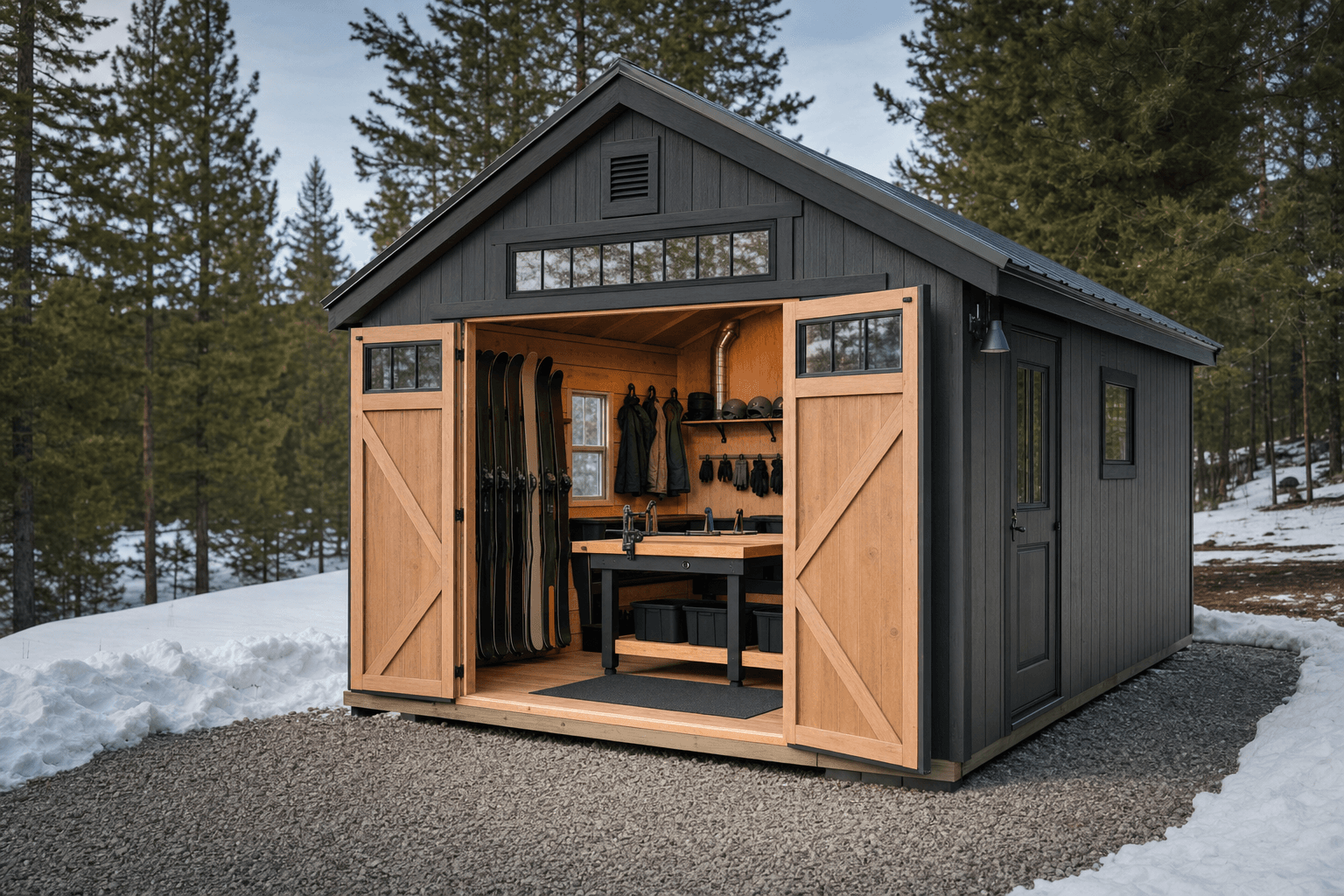
One room for the whole quiver: a vise bench for edges, a wax station, racks for skis and boards, and a drying corner for wet gear.
A tuning shed asks three things of its shell: enough length to set up a real bench and still rack a quiver, enough wall height to work over a vise without ducking, and a roof that sheds North Idaho snow off the door you use all winter. The standard gable is the natural starting point — it gives the most usable headroom and clean, straight sidewalls you can line with plywood and screw vises, racks, and pegboard into anywhere, and it sheds snow evenly off both slopes. A lofted barn (gambrel) raises the center ridge and adds a loft for the off-season kit — summer gear, spare boards, ski and boot bags — while keeping the floor and working walls open for the in-season quiver. A stick-built shop style with a tall, square wall gives you full-height pegboard and a long, uninterrupted bench without the roof slope crowding your head over the vises, the move if you tune a lot of skis and want a true home shop.
A lean-to or modern single-slope sheds snow predictably to one side, so you control where the roof avalanche lands relative to the door and the plowed path, and it gives a tall front wall for a big window over the bench. Whatever the roofline, line the walls in plywood and size the door wide enough to carry a pair of 190s and an armful of boards through. A tuning shed sits right next to a gear drying shed the moment drying wet shells, boots, and gloves matters as much as the tuning, and it overlaps with a snowmobile shed when the same family waxes sleds and skis off one winter staging building. If tuning is one of several hobbies sharing the space, it also leans toward a flexible hobby shed built to hold more than one workbench.
An 8x8 fits a tuning bench with a pair of vises on one wall, ski and board racks on another, and a corner for wet gear — enough for one skier's setup.
An 8x10 or 8x12 adds a longer bench, a wax station separate from the edge vises, more rack wall for the family's skis and boards, and a real drying corner.
A 10x12 gives a long bench, a dedicated wax station, deep tool storage, a full quiver wall, a binding-work area, and open floor to dry a storm day's gear.
Footprint decides whether the shed feels like a real shop or a cramped closet, so compare the actual dimensions before you commit — a couple of feet of length is the difference between a bench long enough to clamp a ski at both vises and one where the tail hangs off the end. An 8x8 fits a tuning bench with vises along one wall, racks for a personal quiver on another, and a small drying corner — right for one skier who waxes and edges a few pairs. An 8x10 adds length for a longer bench and lets you separate the wax station from the edge vises, plus more rack wall for a family's gear. An 8x12 opens up a genuine drying corner and a binding-work spot. If you want a long bench, a dedicated wax station, a full quiver wall, deep tool storage, and open floor to dry a storm day's gear, step up to a 10x12. Length matters more than width here — skis are long, and a long sidewall gives you the bench run and the rack space a quiver needs.
These overlap, and the right call comes down to what the building does most. A ski tuning shed leads with the workbench — vises, a wax station, edge and base tools, and the racks that hold the quiver — focused on doing real tuning work in comfort and keeping the gear organized and protected. A gear drying shed changes the emphasis the moment drying is the main event: it is built around heat, airflow, and hanging hardware that pull the damp out of shells, bibs, base layers, gloves, and boots overnight, with boot dryers and a warm, moving-air corner as the centerpiece rather than a bench. Most skiers want both in one building, and that works well — but naming which job leads tells you whether to spend the footprint on bench and rack or on drying capacity and a bigger boot-dryer bank.
The other natural neighbor is the sled shed. If you also ride snowmobiles, the waxing and tuning side of a snowmobile shed shares a lot with a ski tuning room — both want a solid bench, bright light, and ventilation for hot wax — and plenty of North Idaho families run one winter staging building for sleds, skis, and wet gear off the same gravel pad. The difference is that a sled shed plans around a low ramp, a rot-proof floor for studded tracks, and fuel storage, while a pure tuning shed stays smaller and cleaner. And if tuning is one of several things you do, a flexible hobby shed built to hold multiple stations may be a better frame. Naming the lead use up front locks in your bench, racks, drying corner, and ventilation before the framing is ordered.
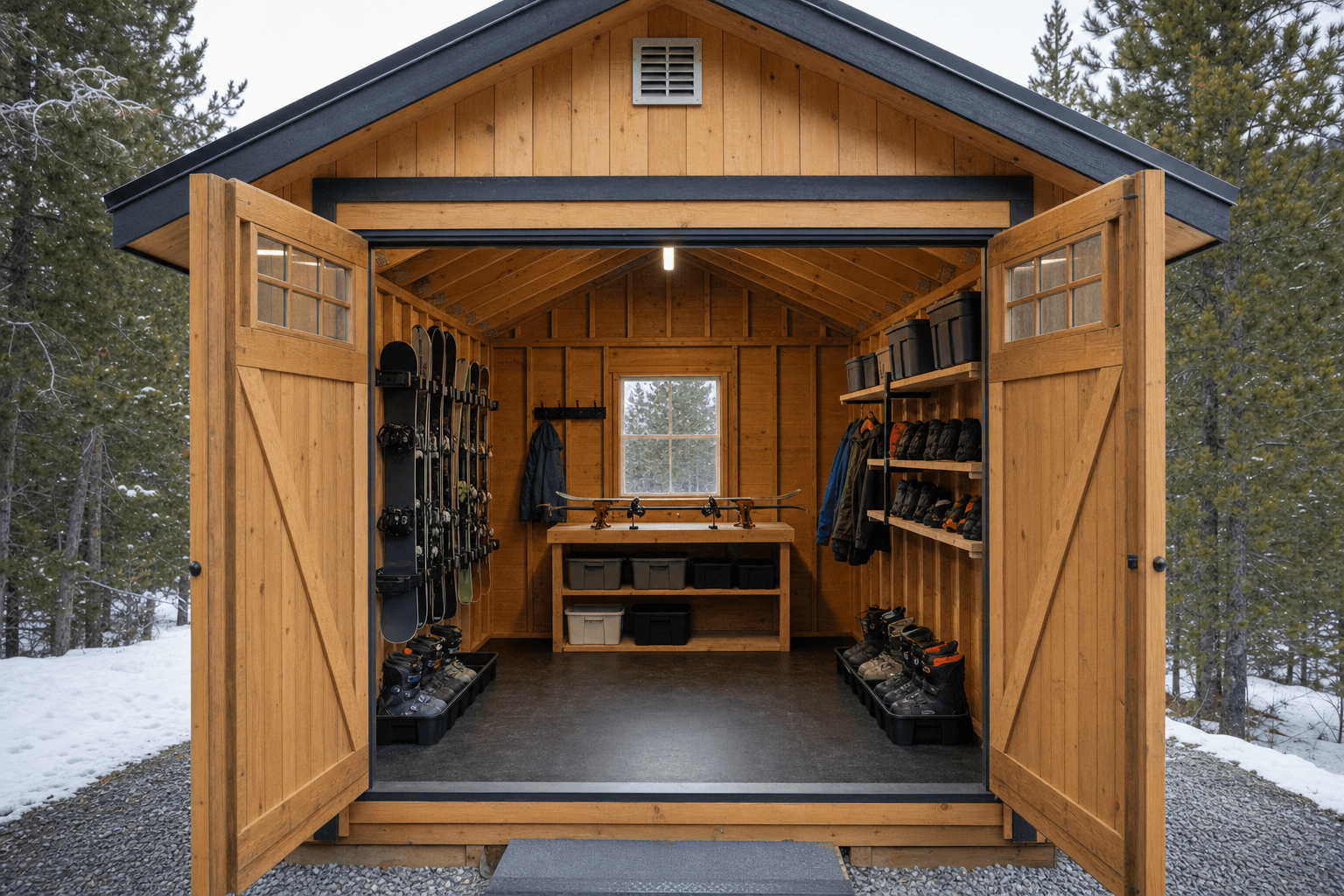
Zone the room: an edge-and-base vise bench, a wax station, a quiver rack wall, a binding-work spot, and a drying corner by the door.
Think of a tuning shed as four or five working zones instead of one open box, laid out so a hot iron is never elbow-to-elbow with your edge work and a dripping shell never hangs over the bench. A vise and edge zone anchors the long bench along one solid, plywood-lined wall, with a pair of ski vises (and a snowboard vise or adjustable jaws) at the right spacing and height, pegboard above for files, guides, stones, and brushes, and drawers below. A wax zone sits beside it but a little apart — a heat-safe surface for the iron, a profile vise to hold the ski base-up, wax bars racked by temperature, and the scraper and brush kit — so molten wax does not land in your edge work. A quiver and rack zone lives on another wall, with horizontal racks or slots holding skis and boards by tip and tail so bases and edges never lean together. A binding and mount zone, if you do your own work, wants a clear bench section and a jig that holds the ski flat. A drying zone rounds it out near the door and the heat, with boot dryers, hooks for shells and bibs, and a rack for gloves and layers.
Good zoning means you never reach across a hot iron to grab a file and a wet jacket never drips onto a freshly waxed base. Put the bench where the light is best, keep the wax station and any solvent near your ventilation so fumes go straight out, set the drying corner where the building is warmest and the air moves, and leave the bench and quiver rack a clear lane to the door so carrying skis in and out never means rearranging the room.
A solid, plywood-backed bench with a pair of ski vises and a snowboard vise or adjustable jaws set at a comfortable working height, pegboard above for files, edge guides, diamond stones, and brushes, and drawers below for the smaller tools.
A dedicated waxing surface a little apart from the edge vises, with a profile or wax-specific vise to hold the ski base-up, organized wax bars by temperature, a fireproof spot to rest a hot iron, and the scraper and brush kit within reach.
Horizontal wall racks or slotted holders that store skis and snowboards by tip and tail so bases and edges never lean together or sit on the floor, grouped by skier and type, plus a shelf for boots, poles, and skins.
Boot dryers, hooks and a bar for shells, bibs, and base layers, and a glove rack near the heat and airflow so a storm day's wet gear dries overnight, plus through-venting and a fan to clear hot-wax and solvent fumes.
This is where a bare shell becomes a working tuning room, and it is worth naming what lives inside so you size the bench, racks, storage, and airflow around it. The edge and base tools cluster at the vises: a base and side edge guide set, a panzer and mill file, diamond and ceramic stones, a gummi stone, a true bar, a P-tex gun or candles for base repair, a metal scraper, structure brushes, and a base cleaner. The wax kit anchors the wax station — a waxing iron, hot-wax bars sorted by temperature, a paste or rub-on wax for quick days, a plexi scraper, nylon and horsehair brushes, a fibertex pad, and a roll of fiberlene — with its own surface and ventilation, since hot wax and base cleaner both off-gas. If you mount your own bindings, the binding zone holds a hand impact driver or drill, bits, a tap, screws and inserts, a binding jig or paper templates, and glue.
Around the bench you store and dry the rest of the kit. The quiver leads: alpine skis, touring or splitboard setups, snowboards, the kids' gear, poles, and climbing skins racked by tip and tail, plus ski and boot bags in the loft. The boots and soft gear want a real drying setup — and a dedicated drying corner earns its keep here — with boot dryers, hooks for shells and bibs, a bar for base and mid-layers, glove clips, goggle and helmet shelves, and a tray for the snowmelt. Round it out with a shop vac and broom for wax shavings and metal filings, and a covered scrap bin. The right vises, an organized wax station, honest racks, and a real drying corner are what turn a storage shed into the room you tune from all season.
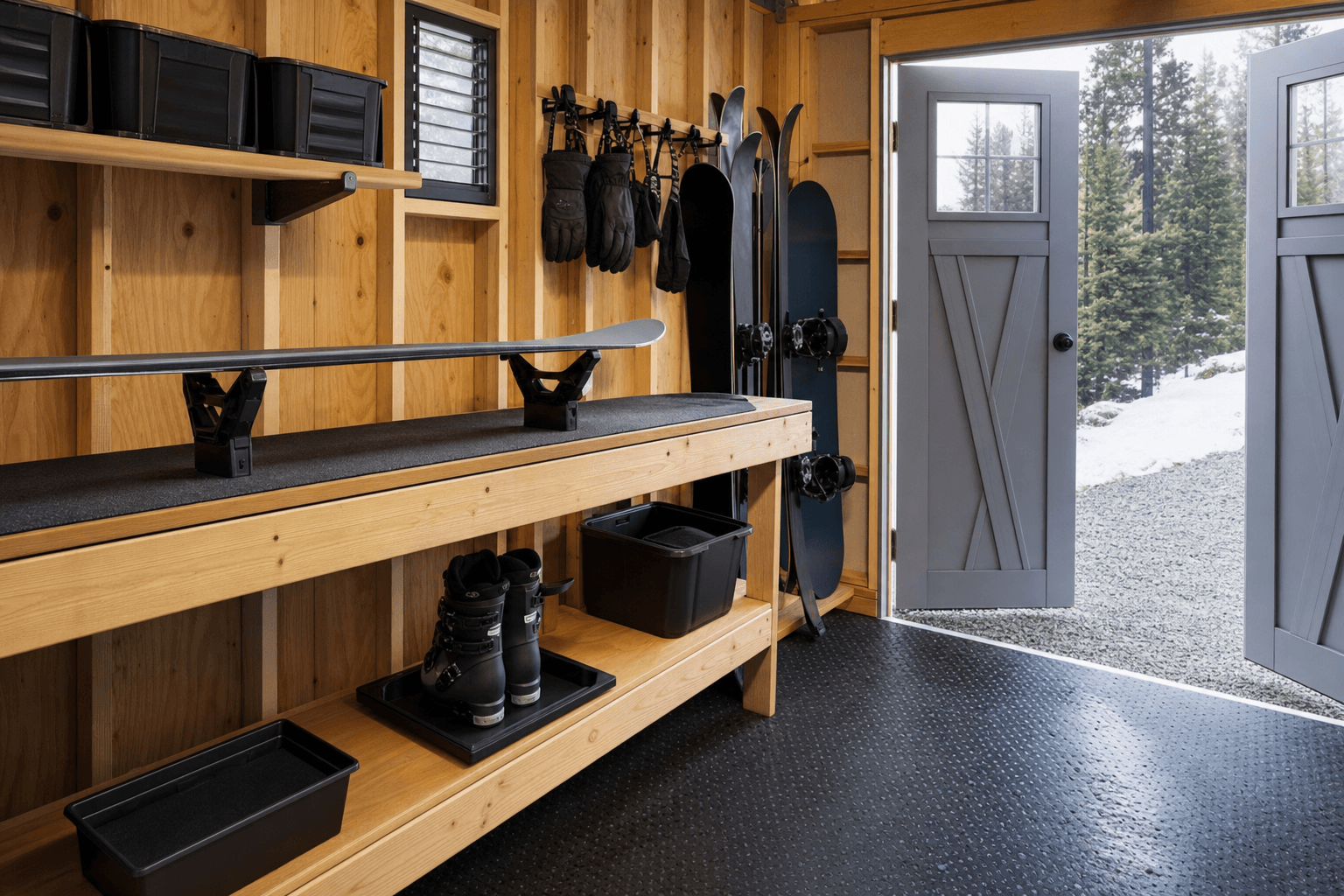
The working details: a ski locked in the vises, edge tools and stones at hand, and the wax iron and bars staged at a separate heat-safe surface.
| Ski tuning shed planning checklist | |
|---|---|
| Bench & vises | A solid, plywood-backed bench at a comfortable height with a pair of ski vises and a snowboard vise or adjustable jaws, pegboard above and drawers below |
| Wax station | A heat-safe surface set a little apart from the edge vises, with a profile vise, wax sorted by temperature, and a fireproof rest for a hot iron |
| Quiver storage | Horizontal racks or slotted holders that hold skis and boards by tip and tail so bases and edges never lean together or sit on the floor |
| Drying corner | Boot dryers, hooks for shells and bibs, and a glove and base-layer rack near the heat and airflow so a storm day's gear dries overnight |
| Ventilation | Through-venting or an operable window plus a fan near the wax station to clear hot-wax and base-cleaner fumes instead of letting them hang |
| Heat, light & power | Insulation and a heater so wax flows and glues set, bright shadow-free light over the bench, and dedicated 120V outlets for the iron, dryers, and tools |
A tuning shed earns real power, good light, and steady heat because the work inside is precise, electrical, and temperature-sensitive all at once. Plan dedicated 120V circuits from the house so the waxing iron, boot dryers, a shop vac, a hand drill, and the lights are not all fighting over one breaker, with outlets at the bench, the wax station, and the drying corner. Light is the part people underestimate: reading a base, setting a precise edge angle, and chasing a fine burr go badly in a dim shed, so layer bright, even LED fixtures across the ceiling and add a focused task light over the vises and the wax station. Mount it so your own shadow does not fall across the ski, and plan a window over the bench for daylight.
Heat decides whether wax and glue behave and whether gear dries. A cold shed is a problem on several fronts: hot wax chills and flakes instead of soaking into a cold base, P-tex and binding glues do not set well when it is freezing, and wet boots and shells stay damp and musty. Insulate the walls and ceiling and add a heater — a mini-split, an electric shop heater, or a small wall unit — sized to keep the room above freezing, and the bench becomes a place you will actually use in January. Then treat ventilation as a real requirement, because hot wax gives off fumes as it melts and base cleaners and solvents off-gas. Plan through-ventilation near the wax station — a low intake and high outlet, or an operable window plus an exhaust fan — so fumes go straight outside instead of pooling, and keep any open-flame heater clear of the wax and solvent zone. The same airflow pulls humidity out of a room full of drying gear so it does not condense on your edges and tools and rust them.
A tuning shed is not heavy, but it still earns a proper base and a smart approach, because you carry skis and boards in and out all winter on snow and ice and track snowmelt onto the floor. A compacted gravel pad drains meltwater well and keeps a framed floor dry, and it is plenty for a tuning room; if you want the toughest, easiest-to-clean surface for dripping gear, wax shavings, and metal filings, a sealed framed floor or a small concrete slab hoses out clean. Plan the approach so you can carry a quiver straight from the door, point the door at a path you can keep plowed, and think about where the roof sheds snow — you do not want a season's roof avalanche burying the door you use most. Read how to prep a shed site before delivery so the pad, drainage, and access are squared away.
North Idaho winters drive the rest of the build. A roof and anchoring rated for the local snow load are not optional — Kootenai, Bonner, and Shoshone county winters pile real wet snow on a roof — and a lean-to or single-slope should dump that snow away from the door and your plowed path. Insulation and heat keep the room workable through the freeze so wax flows, glues set, and gear dries. Tuning sheds tend toward smaller footprints, but added electrical and a slab can still trigger local rules — many small storage sheds skip a permit while wiring and a foundation often do not. Confirm what your town and county require on the service areas pages, and factor any permit into the plan before you finalize the size and site. Pine pollen, gravel-driveway dust, and damp mountain air all argue for a well-sealed, well-ventilated building that keeps your skis, edges, and tools clean and rust-free between storms.
Build a solid, plywood-backed bench along one wall at a height where you can stand and work over a clamped ski without hunching, and mount a pair of ski vises spaced to grab a ski at the tip and the binding area so it sits flat and steady. For snowboards, add a dedicated snowboard vise or a center vise with wide, adjustable jaws, since a board is too wide for ski vises alone. Put pegboard above the bench for files, edge guides, diamond stones, and brushes so the tools you reach for constantly are in plain sight, and use drawers below for the smaller bits. Keep the bench long enough that the tips and tails do not hang off the end, and leave a clear section for binding work if you mount your own. A bench set up this way lets you edge, repair, and wax without fighting the gear.
Treat fume ventilation as a real requirement, because hot wax gives off fumes as it melts and can smoke if the iron runs hot, and base cleaners and citrus solvents off-gas while you work. Plan through-ventilation near the wax station — a low intake and a high outlet, or an operable window paired with a small exhaust fan — so the fumes draw straight outside instead of hanging in a sealed, heated room. Set the wax station and any solvent storage close to that airflow so the smell and the vapor never drift across the rest of the shed. Run the fan or crack the window whenever you are ironing wax or using cleaner, and keep any open-flame heater well clear of the wax and solvent zone. The same airflow that clears fumes also pulls humidity out of a room full of drying gear, which keeps it from condensing on your edges and tools.
Store skis and boards so the bases and edges never lean against each other, the wall, or the floor, because that is how edges get nicked and bases get scratched. Mount horizontal wall racks or slotted holders that cradle each ski and board by the tip and tail, and group them by skier and type so the alpine setups, the touring or splitboard gear, and the kids' skis each have a home. Leave space between slots so you can pull one pair without dragging it across the next, and put the gear you ride most at easy reach with the off-season and backup boards up high or in a loft. Add a shelf or hooks nearby for poles, and a spot for climbing skins where they hang flat and dry. Racking the quiver properly keeps a freshly tuned and waxed base protected right up until you load it for the hill.
Yes — heat is what makes both the tuning and the drying actually work in a North Idaho winter. Hot wax needs a base that is not freezing cold to soak in properly; on a cold base the wax chills, flakes, and sits on top instead of penetrating, so your wax job does not last. P-tex base repair and binding glues also set poorly when it is below freezing. And wet boots, shells, and base layers stay damp and musty in an unheated, sealed room. Insulate the walls and ceiling and add a heater — a mini-split, an electric shop heater, or a small wall unit — sized to keep the room comfortable and above freezing. Pair the heat with airflow so the warm, moist air from drying gear moves out instead of condensing on your tools. A heated, ventilated shed is the difference between a room you tune in all season and a cold box you avoid.
Tuning is close, precise work — reading a base for structure, setting a base and side edge angle, chasing a fine burr, judging a wax scrape — and all of it goes badly in a dim shed, so plan the lighting deliberately. Layer bright, even LED fixtures across the ceiling so the whole bench and the rack wall are well lit, then add a focused task light directly over the vises and the wax station where the detail work happens. Position the fixtures so your own shadow does not fall across the ski when you lean over it, which often means light from more than one direction. A window over the bench is worth planning for, since daylight makes it much easier to read a base and judge an edge and a wax job. Good, shadow-free light is one of the cheapest upgrades you can make and one of the biggest differences between sloppy and sharp tuning.
Size it around the three jobs at once — bench, quiver storage, and gear drying — not just the bench. For one skier who waxes and edges a personal quiver, an 8x8 fits a vise bench on one wall, racks on another, and a small drying corner. For a family or a deeper quiver, an 8x10 or 8x12 adds the length to separate the wax station from the edge vises, more rack wall for everyone's skis and boards, and a real drying corner with boot dryers and hanging space. If you want a long bench, a dedicated wax station, a binding-work area, a full quiver wall, and open floor to dry a whole storm day's worth of gear, a 10x12 keeps everything usable at once. Length matters more than width because skis are long and a longer sidewall gives you both the bench run and the rack space. Size up if you tune for a family or a team, since a tuning shed fills fast with gear.
Coeur d'Alene and Post Falls skiers heading to Schweitzer, Silver Mountain, or Lookout Pass burn more time hauling gear and waiting on shop queues than they spend tuning. A ski tuning shed built on your property puts the bench, the wax iron, and the edge tools ten steps from the garage, not an hour away. Because NIOS builds each shed on site rather than delivering a prefab box, the building can be sited and sized for your driveway layout — wide enough for a full-length ski to clear the door, with the electrical already roughed in for a wax station circuit.
Winter access is a real design variable here. Kootenai County properties see enough snow that a gravel pad with positive drainage keeps the shed usable all season without an ice rink forming at the threshold. A covered entry overhang — a detail we build into the framing — shields the door from snow loading off the roof and keeps gear dry when you're loading up pre-dawn.
Ventilation matters more than most people plan for. Fluorocarbon-free waxes still produce fumes when melted, and a sealed room in a North Idaho winter holds that air. A passive vent pair — low intake, high exhaust — keeps the workspace safe without a power fan running constantly. The framing is the right time to locate those openings, before the walls are sheathed.
Rathdrum and Hayden properties often have the side-yard space for a dedicated tuning shed that a CDA in-town lot can't spare. If that's your situation, design the footprint in the shed builder, or get a free estimate to see what fits your lot. You can also see the ski tuning shed service page for build details and options.
Tell us how many skis and boards you tune, whether you mount your own bindings, and how much wet gear comes off after a storm day, and we will help spec the bench, vises, wax station, racks, drying corner, and ventilation around your property — then you can build and price it online.
Keep planning your build with related North Idaho shed guides.