A backyard sauna is one of the most rewarding buildings you can put on your property in North Idaho, and one of the easiest to get wrong if you treat it like a normal shed. The whole point is heat: a tight, well-built room that climbs to 150 to 195 degrees, holds that temperature, and lets you sweat, unwind, and warm up after a cold day on the lake or the mountain. To do that well, the building has to manage two things most sheds never face, which are intense, repeated heat and a lot of moisture, and it has to do both for years without the wood rotting, the framing warping, or the heat leaking out the walls. A purpose-built sauna shed is designed around exactly those pressures from the first stud, which is why it stays comfortable, dry, and structurally sound long after a converted garden shed would have started to break down.
Done right, a sauna in the backyard becomes a habit you keep all winter, not a novelty you use twice. The decisions that get you there are made before the first wall goes up: the heat source, the way the room is insulated and sealed, how it breathes through a planned intake and exhaust, the cedar that lines the inside, the bench layout that fits your body, and whether you want a small changing or cool-down room attached. None of it is fussy once you understand it, but it does have to be planned together, because a sauna is a system. This guide walks through the styles that suit a sauna, the sizes that actually fit how many people you want to seat, how to lay out and finish the inside, and how we build the shell tight and moisture-safe on your property. If you'd rather price options first, you can build and price a layout in a few minutes and come back to the details.
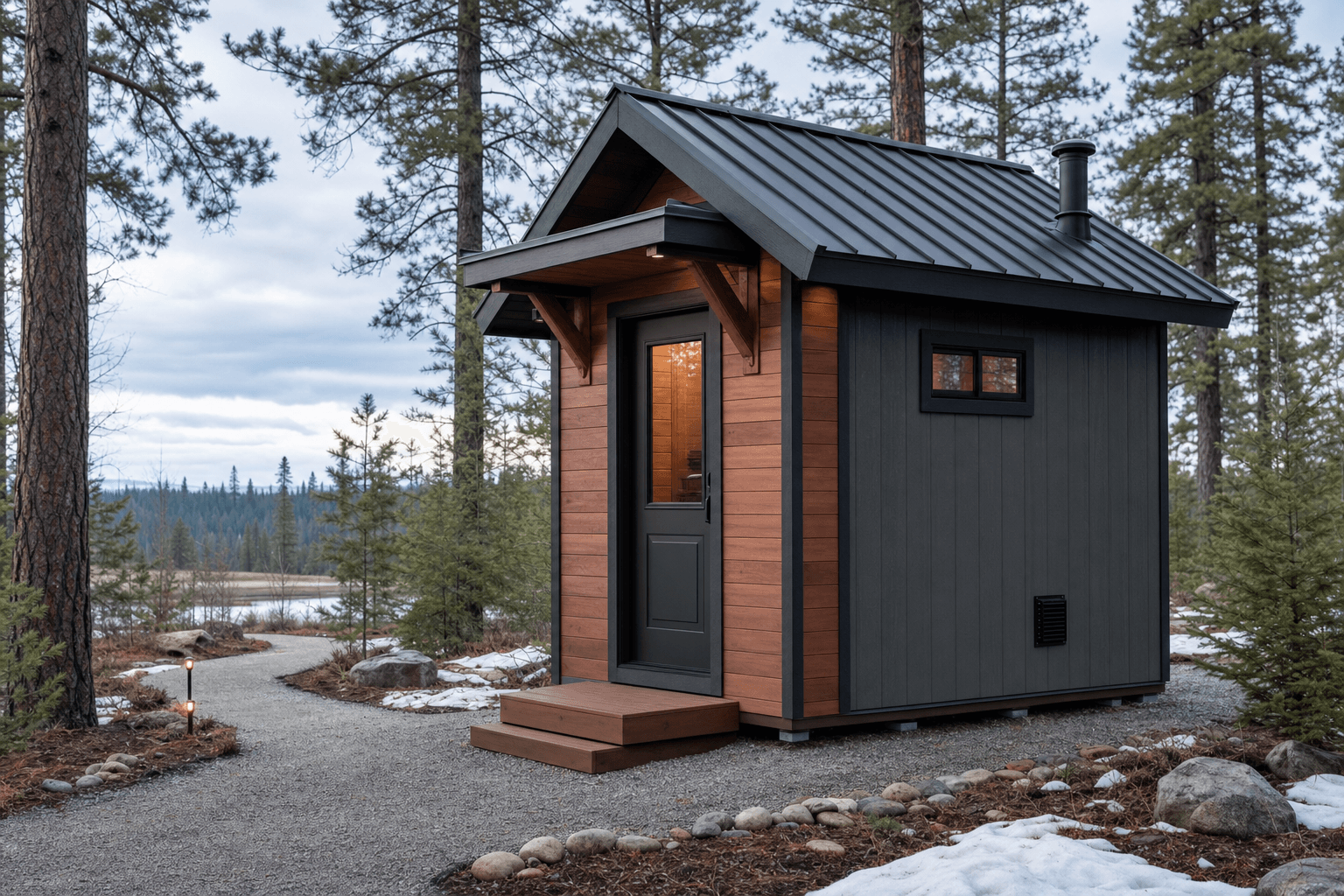
A purpose-built sauna shed: tightly sealed, cedar-lined, and built to take heat and moisture year-round.
Most backyard saunas are built in a standard gable. The straight walls and simple peaked roof give you clean surfaces to insulate and line with cedar, leave headroom over a raised upper bench, and read as a tidy little cabin rather than a utility box. The gable peak also helps with the one thing every sauna needs, which is somewhere for the hottest air and rising moisture to collect and vent. A lean-to or modern single-slope roof works well too, especially for a compact one- or two-person sauna or a contemporary look, and the sloped ceiling can sit low over the benches to keep the heat pocket tight, which is exactly what you want. If you plan to add a changing area or a cool-down porch, a model with a covered porch gives you a sheltered spot to step out, drop a layer, and catch your breath between rounds without standing in the snow.
Because a sauna is a heated, moisture-heavy room rather than dry storage, the envelope is the whole game, and the build overlaps with the other wet-use and wellness buildings we do. It's worth looking at how we approach a cold plunge shed if you're picturing a heat-and-cold setup, since the moisture detailing and drainage carry over even though one room is hot and the other is cold. Whatever roofline you choose, plan the building as a sealed, vapor-controlled, well-ventilated hot room, with a continuous insulated shell, a true vapor barrier behind the cedar, a planned air path, and a heat source sized to the volume, not just a pretty box with a heater dropped inside.
A single bench, room to sit or lie back, and a compact heater. A 6x8 is plenty for a personal sauna built for one or two people who mostly sit upright.
Two bench levels and room to lie down on the upper bench. Step up to 8x8 or 8x10 so three or four people can sit comfortably and someone can stretch out flat.
If you want a separate hot room and an attached changing or cool-down space, an 8x12 lets you split the footprint into two real zones behind one weather-tight shell.
Footprint is the decision everything else rides on, so size for how many people you want to seat and whether you want to lie down, not just stand inside. A 6x8 shed makes a genuinely comfortable one- or two-person sauna: the hot room stays small enough to heat fast and hold temperature, with a single bench and a compact heater, which is ideal if it's mostly for you or a couple. Move up to an 8x8 shed and you have room for two bench tiers and enough floor for three or four people, with space to lie flat on the upper bench, which is where a sauna gets really comfortable. An 8x10 shed is the sweet spot for a family sauna, giving you a roomy two-level layout, a proper landing zone by the door, and a little breathing room around the heater so nobody is crowded against it. The 8x12 shed is the size to choose when you want a dedicated hot room plus a separate changing or cool-down area under the same roof, so you can undress, towel off, and rest between rounds without tracking water and snow straight into the heat. As a rule, size for the number of people plus the heater clearance, because a cramped sauna with no room around the stove stops being relaxing fast.
These wellness buildings overlap, and the right one depends on what you'll actually do in the backyard. A sauna is a dry-framed, heavily insulated hot room built to climb to high heat and vent steam, lined in cedar, with the whole envelope tuned to take repeated heat-and-moisture cycles. If your real interest is contrast therapy, pairing the heat with cold, look at a cold plunge shed, which is organized around a tub or tank, cold-water plumbing, and a floor built to get wet and drain, and many people end up wanting the two close together. If you already own or plan to buy a hot tub and just need somewhere to change and store towels out of the weather, that's really a hot tub changing shed, which puts the budget into a dry, finished changing space and storage rather than a sealed hot room. And if you mostly want a quiet, finished backyard retreat where a sauna is one feature among several, a flexible she-shed can be planned with a sauna corner instead of being built as a pure hot room. If you're torn, decide whether the building's main job is to get hot, get cold, or simply keep you dry and comfortable, and build for that.
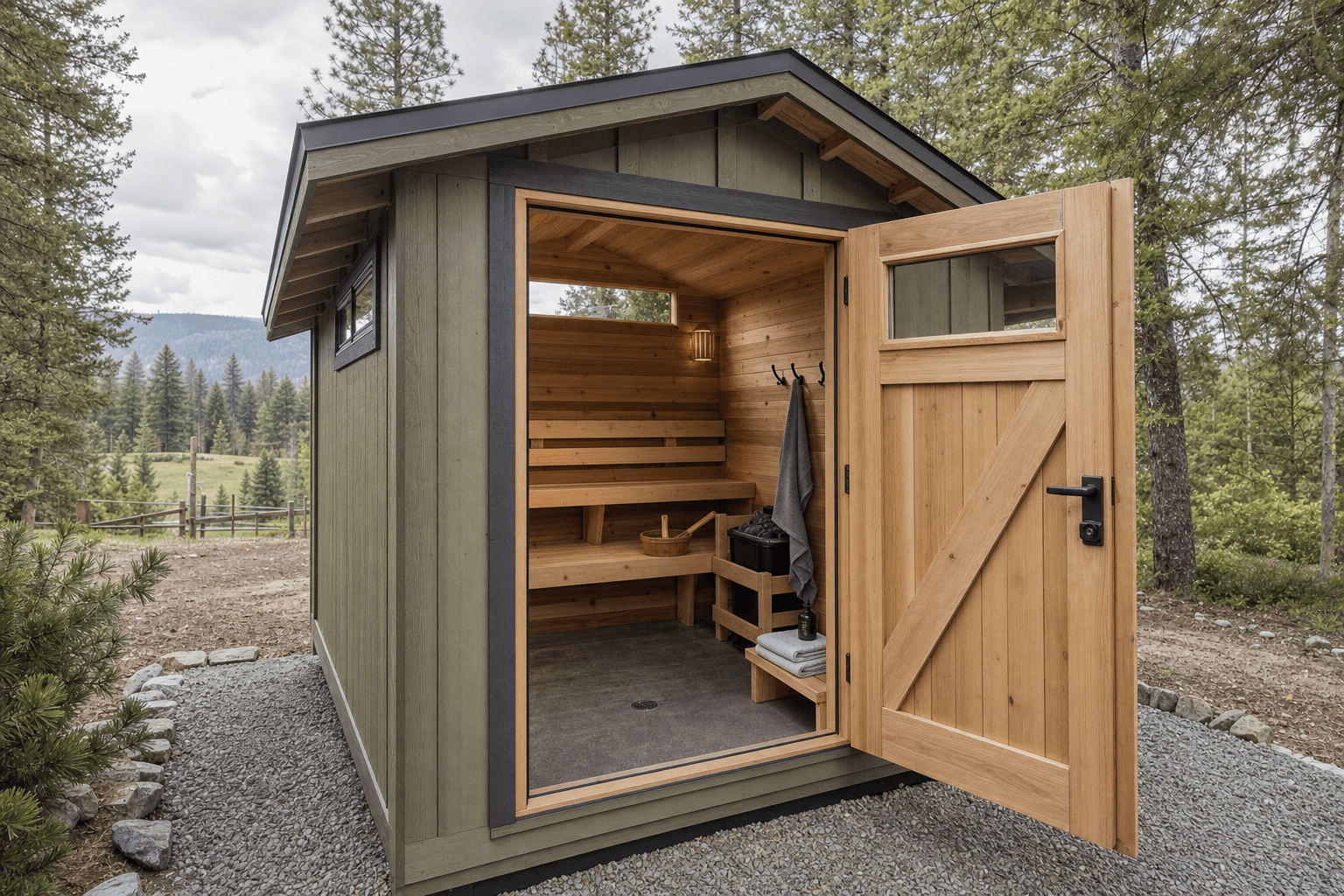
Two-tier cedar benches with clearance around the heater: comfortable to sit, room to lie back, safe around the stove.
Even a small sauna works better when you plan it as zones instead of one open box. Start with the heater zone, because everything else is laid out around it. The stove needs clear clearance to combustibles on every side per the manufacturer's spec, a heat guard or railing so nobody brushes against it, and a position near the door so cold makeup air is drawn across the floor and up past the stones rather than straight at the people on the benches. Next comes the bench zone, ideally two tiers: a lower bench around 18 inches off the floor for sitting and stepping up, and an upper bench around 36 to 42 inches up where the air is hottest and you can sit or lie down. Leave the upper bench deep enough, roughly 20 to 24 inches, to actually recline. Then plan the air path as its own deliberate zone, with a low intake near the heater and a high exhaust on the far wall, so fresh air moves through the room and stale, oxygen-poor air leaves the top. Finally, keep a landing zone of clear floor just inside the door for stepping in, setting down a towel, and getting on or off the benches, and if you're adding a changing or cool-down room, that becomes its own zone behind a door so wet feet and cold air stay out of the hot room. Sketching these zones on paper before you settle on a footprint is the fastest way to tell whether a smaller building works or whether you'll want the extra length of a larger one.
The heart of a sauna build. Heavy insulation in the walls and ceiling, a true foil vapor barrier behind the cedar to keep moisture out of the framing, and a tight, sealing insulated door are what hold high heat in and keep rot out of the structure for the long run.
Western red cedar lines the walls and ceiling and forms the benches because it resists heat, shrugs off moisture, stays cool to the touch, and won't drip resin. Bench frames, backrests, duckboard floor mats, and a cedar door pull complete a true sauna-grade interior.
A low fresh-air intake near the heater and an adjustable high exhaust vent on the opposite wall move air through the room, supply oxygen, and carry moisture out. Good ventilation is what keeps the air breathable and the wood drying between sessions.
A wood-fired stove with a code-compliant insulated chimney, or an electric sauna heater on its own dedicated high-amp circuit. Either way the heater is matched to the room's cubic volume, set on a protected hearth, and guarded so the sauna heats evenly and safely.
The keyword for a sauna is heat managed safely, and the fit-out is everything that creates and survives it. For the heat itself: a wood-fired sauna stove or an electric sauna heater, a basket of sauna stones (igneous rock that holds heat), a stainless ladle and a wooden bucket for water on the rocks (the loyly that gives you that wave of steam), and a clip-on thermometer and hygrometer so you can read the temperature and humidity. For the interior: clear, knot-free cedar wall and ceiling boards, two tiers of cedar benches with removable tops for cleaning, a cedar backrest, a duckboard or slatted floor mat that drains and stays cool underfoot, and a heat-rated low-voltage or sealed light fixture. For comfort and use: a sand timer, a sturdy headrest, towels and a towel hook, a felt sauna hat if you run it hot, and a small floor drain or sloped, sealed floor so rinse water has somewhere to go. For the wood-fired version specifically: a hearth pad under the stove, a log rack, kindling storage, and a safe outside ash spot. Walk through your own version of this list before you settle on a size, because a real sauna is more than a heater and a bench, and an 8x8 shed fills up quickly once you add two bench tiers, heater clearance, and a clear landing area by the door. That's exactly why most family saunas start around 8 feet on a side, and why people who plan in a changing room are rarely sorry they did once wet towels and cold boots need somewhere to live.
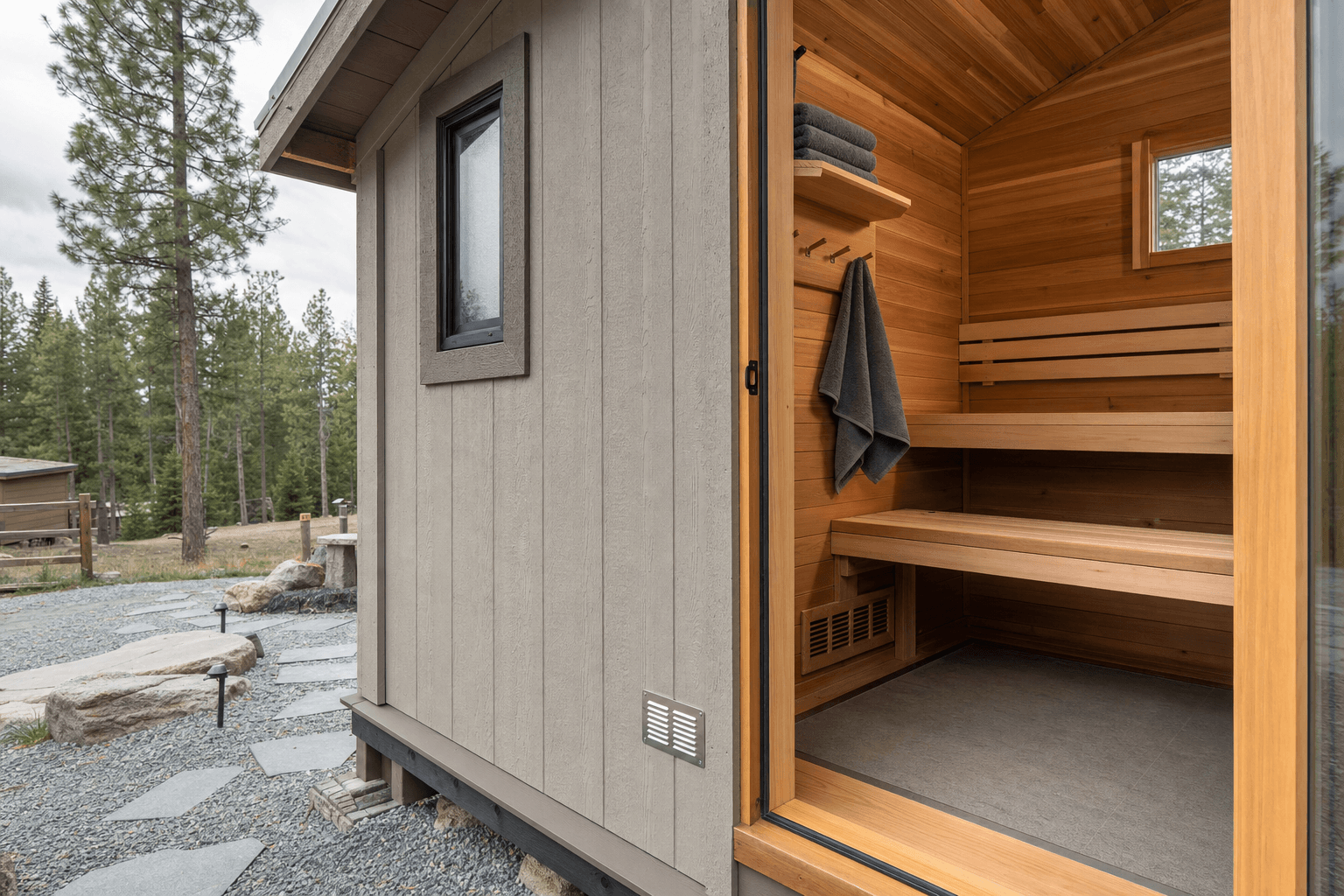
The working details: a stone-topped heater, a bucket and ladle for steam, and a thermometer to read the room.
| Sauna planning checklist | |
|---|---|
| Best roofline | Standard gable for headroom and a vent pocket; single-slope for a compact, low-ceiling heat pocket |
| Practical sizes | 6x8 for one or two people, 8x8 to 8x10 for a family two-tier sauna, 8x12 with a changing or cool-down room |
| Heat source | Wood-fired stove with an insulated chimney, or an electric sauna heater on a dedicated circuit, sized to room volume |
| Insulation and vapor | Heavy wall and ceiling insulation with a foil vapor barrier behind the cedar and a tight, sealing insulated door |
| Ventilation | Low fresh-air intake near the heater and an adjustable high exhaust on the far wall for airflow and drying |
| Interior and floor | Cedar walls, ceiling, and two bench tiers; a sealed, sloped or drained floor with a duckboard mat on top |
Three things decide whether your sauna heats fast, stays comfortable, and lasts through North Idaho winters. The heat source is the first big fork. A wood-fired stove gives you the classic crackle, very high heat, and independence from the electrical panel, which is appealing if you're off the grid or just love tending a fire, but it needs a code-compliant double-wall insulated chimney through the roof, a protected hearth, proper clearances, and a way to bring in combustion air, and it takes longer to come up to temperature. An electric sauna heater is simpler to live with, heats on a timer, and holds a steady set temperature, but it needs a dedicated high-amperage 240-volt circuit run by a licensed electrician, so the wiring has to be planned before the walls close. Either way, the heater is sized to the room's cubic feet, undersize it and it never gets hot, oversize it and it bakes the cedar and wastes fuel. Ventilation is what most home-built saunas miss and what keeps yours breathable: a low intake near the stove feeds the fire and the people with fresh oxygen, while an adjustable high exhaust on the opposite wall pulls humid, stale air out and, left cracked after a session, dries the benches and framing so the wood lasts. Winter readiness ties it together: a continuous insulated and vapor-sealed envelope, a tight insulated door, and the right heater mean the sauna reaches temperature quickly even on a sub-freezing night and holds it without leaking heat. We frame and build the shell tight, insulated, and vapor-controlled on your property so it's ready for your stove install or your electrician to wire.
A sauna stays straight, dry, and tight only on a solid, level base, so most sit on a compacted gravel pad sized about a foot wider than the building on each side so water drains away from the structure, or on a concrete slab if you want a hard, sealed, easy-to-drain floor under the duckboard, which many people prefer for a wet room. North Idaho weather drives the rest of the plan. Design the roof for local snow load so it carries a heavy Panhandle winter, keep the floor up off the ground so spring melt and rain drain away instead of wicking into the building, and place the sauna where the gravel driveway or a clear path lets our crew bring materials in to build, and where a wood-fired chimney clears the roof and any nearby trees safely. We build with weather-rated framing and finishes suited to pine-country freeze-thaw cycles, and we set the structure to drain and breathe on the outside while it stays sealed and vapor-controlled on the inside, which is the combination that makes a hot, humid building last. On permits, the deciding factor is usually how the building is used and how it's heated, not just how big it is. A small detached shed under your jurisdiction's size threshold often needs no permit, but a sauna adds wrinkles: an electric heater means an electrical permit and inspection, and a wood-fired stove and chimney typically mean a mechanical or wood-stove permit and a clearance and chimney inspection, plus attention to setbacks. Rules vary across Kootenai County and the cities around Coeur d'Alene, so confirm with your local building department before you finalize the size, the heat source, and where it sits. Once you know what your jurisdiction requires, we plan the build around it so the structure, the heater rough-in or chimney, and the placement all line up.
Both work well, and the right one comes down to how you want to run it and whether you have the power. A wood-fired sauna gives you very high heat, the crackle and smell of a real fire, and independence from the electrical panel, which is great if you're off the grid, already burn wood, or simply love the ritual, but it needs a code-compliant insulated chimney, a protected hearth, combustion air, and 30 to 45 minutes to come up to temperature. An electric sauna heater is the lower-maintenance choice: it heats on a timer, holds a steady set temperature, and lets you walk out without tending a fire, but it requires a dedicated high-amperage 240-volt circuit run by a licensed electrician, which has to be planned before the walls close. If you value the classic experience and don't mind the chimney and the fire-tending, go wood-fired; if you want push-button convenience and reliable heat, go electric. We build the shell ready for either, with the framing, clearances, and rough-in planned around the heat source you choose.
Ventilation and moisture control are what separate a sauna that lasts from one that rots, so we plan them from the start. For airflow, the building gets a low fresh-air intake near the heater and an adjustable high exhaust vent on the opposite wall, which together pull fresh oxygen across the floor, up past the stones, and out the top, keeping the air breathable during a session and, left cracked afterward, drying the benches and framing between uses. For moisture, the walls and ceiling get a true foil vapor barrier behind the cedar so steam can't soak into the insulation and framing, the cedar interior naturally resists and sheds humidity, and the floor is sealed and sloped, or fitted with a drain, so rinse and sweat water has somewhere to go rather than pooling. The result is a hot room that breathes well, dries out between sessions, and keeps the structure dry where it counts, which is exactly what you need in a building that gets hot and humid over and over for years.
Western red cedar is the standard for a reason and is what we line a sauna with: it tolerates high heat without warping or cracking, resists moisture and the rot that comes with it, stays comfortably cool to the touch even when the room is hot, and doesn't weep sap or resin the way pine and most softwoods do. We run clear, knot-free cedar boards on the walls and ceiling and build the benches, backrests, and trim from cedar as well, because anything you sit or lean on needs to stay cool and dry. Behind the cedar sits the vapor barrier and insulation, and the floor is typically a sealed surface with a removable cedar or aspen duckboard mat on top so it drains and stays cool underfoot. Avoid treated lumber, plywood, and resinous woods inside the hot room, since heat can draw out chemicals or sap. The cedar interior is what gives a sauna both its longevity and that clean, aromatic feel the moment you open the door.
Bench layout is what makes a sauna comfortable, so plan it around how people actually sit and lie down. The best setup is two tiers: a lower bench around 18 inches off the floor for sitting, stepping up, or cooling off, and an upper bench around 36 to 42 inches up where the air is hottest. Make the upper bench deep enough to recline, roughly 20 to 24 inches, so you can lie down rather than just perch, and give each seated person about 2 feet of width. In a compact one- or two-person sauna a single deep bench may be enough, while a family sauna wants an L-shaped or facing two-tier arrangement so several people fit without crowding the heater. Leave clear clearance between the benches and the stove so nobody brushes against it, and keep a landing area by the door for getting on and off. We frame the building to the bench plan you want, and the cedar bench tops are built removable so they're easy to clean and dry.
Yes, and it's one of the most popular upgrades because it makes the sauna far nicer to use, especially in winter. The simplest approach is to divide a slightly larger footprint into two rooms behind one weather-tight shell: a sealed, insulated hot room and an adjacent changing or cool-down space separated by an insulated door. The changing room gives you a dry place to undress, hang clothes and towels, leave cold boots, and rest or rehydrate between rounds without tracking snow and water into the heat or letting the hot room's warmth escape every time you step out. An 8x12 is a common size for a hot-room-plus-changing-room layout, and a model with a covered porch adds a sheltered outdoor cool-down spot as well. If you're pairing the heat with cold, the changing room can also serve a nearby cold plunge. We plan the partition, the door, and the separate ventilation so the hot room stays sealed and the changing side stays dry and comfortable.
It depends on your heat source, and both need to be planned before the walls close. An electric sauna heater requires a dedicated 240-volt circuit sized to the heater's amperage, run from your home's panel by a licensed electrician, usually in buried conduit out to the building, plus a properly rated heater controller and any low-voltage sauna lighting on its own circuit, and it typically needs an electrical permit and inspection. A wood-fired sauna stove instead needs a code-compliant double-wall insulated chimney carried up through the roof with the right clearances to combustibles, a protected non-combustible hearth under and in front of the stove, and a source of combustion air, and it usually requires a mechanical or wood-stove permit and a clearance and chimney inspection. Either way, clearances to the walls and ceiling follow the manufacturer's listed specs, and a wood stove's chimney has to clear the roofline and nearby trees safely. Requirements vary across Kootenai County and the Coeur d'Alene-area cities, so confirm with your building department, and we build the shell with the wiring rough-in or the chimney penetration and hearth planned around what you choose.
A backyard sauna shed in Coeur d'Alene or Post Falls gets used hard from October through March — which means moisture management and thermal performance in real winter conditions matter more than they would somewhere mild. Sauna construction generates sustained high heat and heavy humidity, and those loads work against the building envelope over time if the vapor barrier, interior cedar, and ventilation details aren't right from the start. Built on site, the wall assembly and ventilation spec are done once, correctly.
Wood-fired versus electric heat is the central decision, and each has real site-specific implications. A wood-fired heater needs a proper combustion air path and a rated chimney penetration through the roof — details handled cleanly during framing. An electric heater needs a dedicated 240V circuit roughed in before the walls close. Trying to add either after the fact in a finished shed is a significant retrofit.
The exterior roofline matters in North Idaho snowpack country. A sauna sees repeated freeze-thaw cycles at the roof edge because of the heat differential between interior and exterior. Proper overhang, a steep enough pitch to shed snow, and ice-and-water shield at the eaves protect the structure from the damage that accumulates in a standard delivered building not designed for local snow loads.
On wooded or sloped lots around Hayden Lake or Priest River — the kind of properties where a delivery truck can't position a pre-built structure — on-site framing is the only realistic path to a quality sauna. Browse sauna build examples or design your layout and get a free estimate.
Tell us your heat source, how many people you want to seat, and whether you want a changing room, and we'll help you size, lay out, and price a sealed, cedar-lined sauna for your North Idaho yard.
Keep planning your build with related North Idaho shed guides.