Anyone who has put up a season's worth of tomatoes knows the problem a canning kitchen shed solves. A heavy canning day fills the house with steam, fogs the windows, drives the kitchen to ninety degrees, and leaves every counter sticky with brine and pectin while the rest of the family is trying to live there. A dedicated canning kitchen shed moves all of that out to its own building: a heat-tolerant work surface, a high-output burner big enough for a loaded pressure canner, a deep sink for washing produce and jars, real ventilation for the steam, and food-safe, wipe-clean finishes throughout. The heat, the mess, and the smell stay outside, and your home kitchen stays a home kitchen.
North Idaho On Site Sheds builds every canning kitchen on your property, so the plan can answer to your real harvest, your water source, and where a propane tank or an electrical run can reach. The thing that separates a canning shed from a finished hobby room is sanitation: every surface has to clean up to a sterile standard, water has to be close at hand, and the room has to shed steam fast so nothing stays damp. Get those three right and you have a space that handles a serious preserving season — water-bath and pressure canning, pickling, jam, sauce, and the dry-pack work that follows. If you want to see layouts priced first, you can build and price a shed in a few minutes and come back to the details.
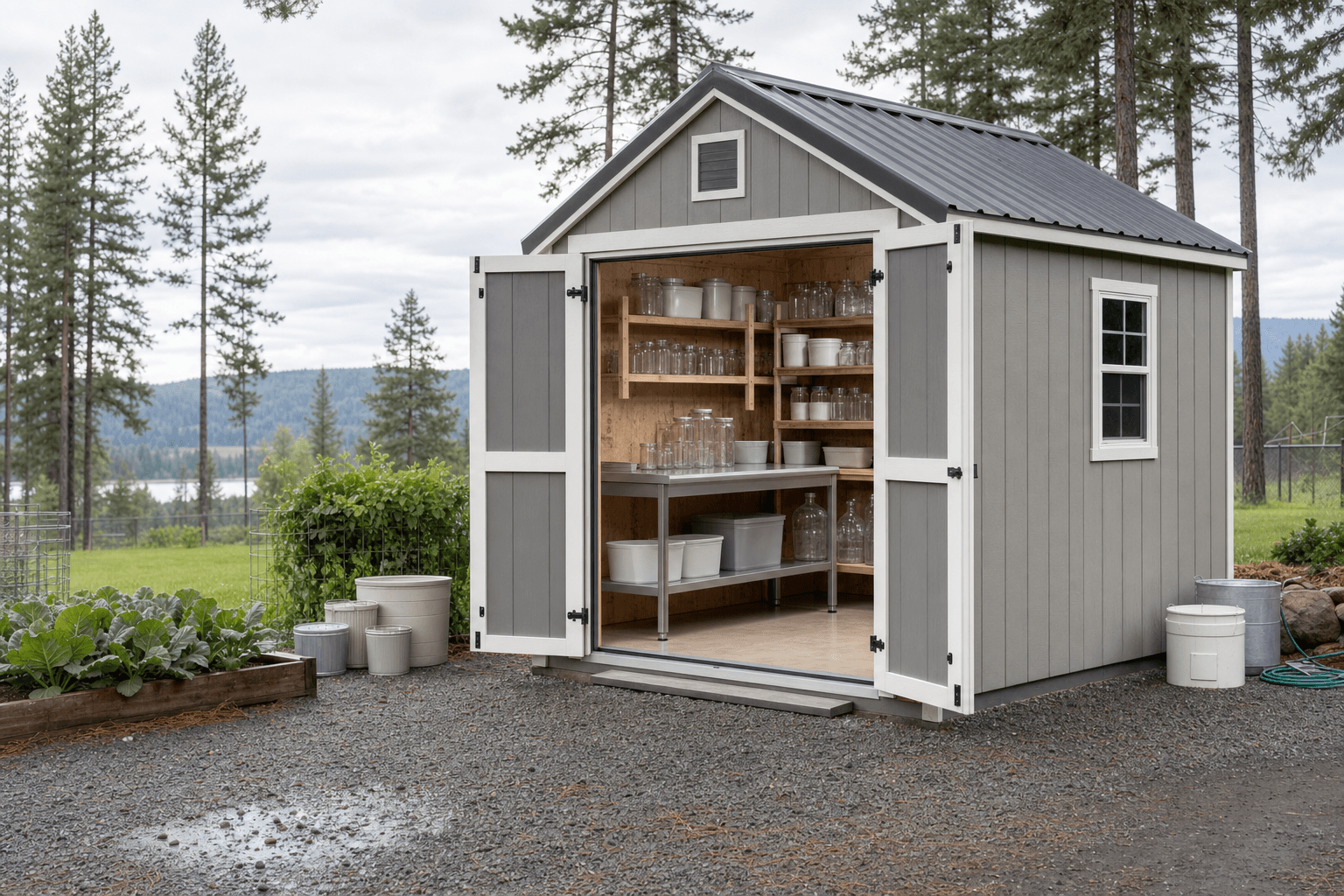
A canning kitchen shed keeps the steam, heat, and mess of a big preserving day out of the house and in its own cleanable, well-vented room.
Most canning kitchens are happiest as a standard gable. The straight walls make it easy to run a continuous counter and to frame a wide window over the sink and the burner where the steam rises, and the symmetrical roof carries snow and lets you place a vent at the ridge. A single window per eave is the baseline for a canning kitchen shed; add one over the work surface and the room stays bright and the steam has somewhere to go. The gable also gives you clean wall height for upper cabinets and open shelving full of empty jars.
A lofted barn (gambrel) is worth a look if you preserve at volume, because the upper bay swallows the bulky, seasonal kit — the canners, the boxes of empty jars, the boiling-water bath pot, the crocks — and frees the floor for the work counter below. A lean-to or single-slope reads clean and lets you pitch one tall wall toward the prevailing breeze, which helps a powered vent clear steam, though you lose loft storage up high. Because a canning shed pairs naturally with cool storage for the finished product, many buyers build it near or alongside a root cellar shed so the jars move a short distance from the burner to a cool, dark shelf. Whatever the roofline, a canning kitchen is a finished, working wet room, not a storage box: it needs durable, food-safe surfaces, water, power for a serious burner, and a way to move steam, all planned in before the walls close up.
Reserve one long wall — 8 to 12 feet — for a continuous, heat-tolerant counter with the sink and the burner on it before anything else. That run drives the whole footprint.
A loaded pressure canner needs the burner, landing counter on both sides, and a clear path to the sink. Measure that triangle and protect it; everything else fits around it.
Empty jars, full jars cooling, lids, rings, and a pantry of finished goods add up quickly. Size up one increment so a big season has shelf space instead of stacking on the floor.
For one person putting up a steady but modest season — sauce, salsa, jam, and pickles — an 8x12 shed is the honest floor: 96 square feet holds a counter run with a sink and a burner, a small stretch of landing counter, and shelving for jars overhead, with the finished pantry kept lean. Step up to a 10x12 shed and the extra width gives you room to stand at a loaded canner without backing into the opposite wall, plus a real island or prep table for sorting and packing produce. The sweet spot for a serious preserving household is a 10x16 shed: 160 square feet absorbs a full counter run with the sink and a high-output burner, a dedicated prep table, a wall of jar and pantry shelving, and floor space to set a second canner going.
If you preserve at real volume — a big garden, an orchard, game and bulk meat, or shares for the extended family — a 12x16 shed gives you two work zones so washing-and-prepping does not collide with hot-canning, a wide pantry wall, and room to run two burners on a heavy day. The deeper footprint also leaves a natural spot to stage incoming harvest and outgoing cases without crowding the sterile work surface. Many of these households pair the canning room with bulk food storage so flour, sugar, salt, and the cases of empty jars live in their own dry, rodent-proof building rather than under the canning counter.
These three buildings work as a system, and knowing which job each does keeps you from asking one room to do everything. A canning kitchen is the hot, wet workroom: the burner, the sink, the steam, and the heat-tolerant counter where raw produce becomes sealed jars. A root cellar shed is the opposite — a cool, dark, humidity-controlled room built to hold the finished jars, plus fresh roots, squash, apples, and onions, at a stable temperature through a North Idaho winter. Sending hot, sealed jars to a cool cellar to rest is exactly the handoff these two buildings are designed for.
A bulk food storage shed is the dry pantry and supply depot: sealed bins of flour, sugar, salt, and grain, plus the cases of empty jars, lids, and rings you draw down through the season. And the canning kitchen leans on the garden that feeds it — if a big share of your produce comes from your own beds, a well-planned garden shed keeps the harvesting and washing gear staged so produce arrives at the canning counter clean and ready. Many North Idaho homesteaders land on a dedicated canning kitchen precisely because it keeps the heat and the mess contained, while the cellar, the dry pantry, and the garden each do the job they are built for.
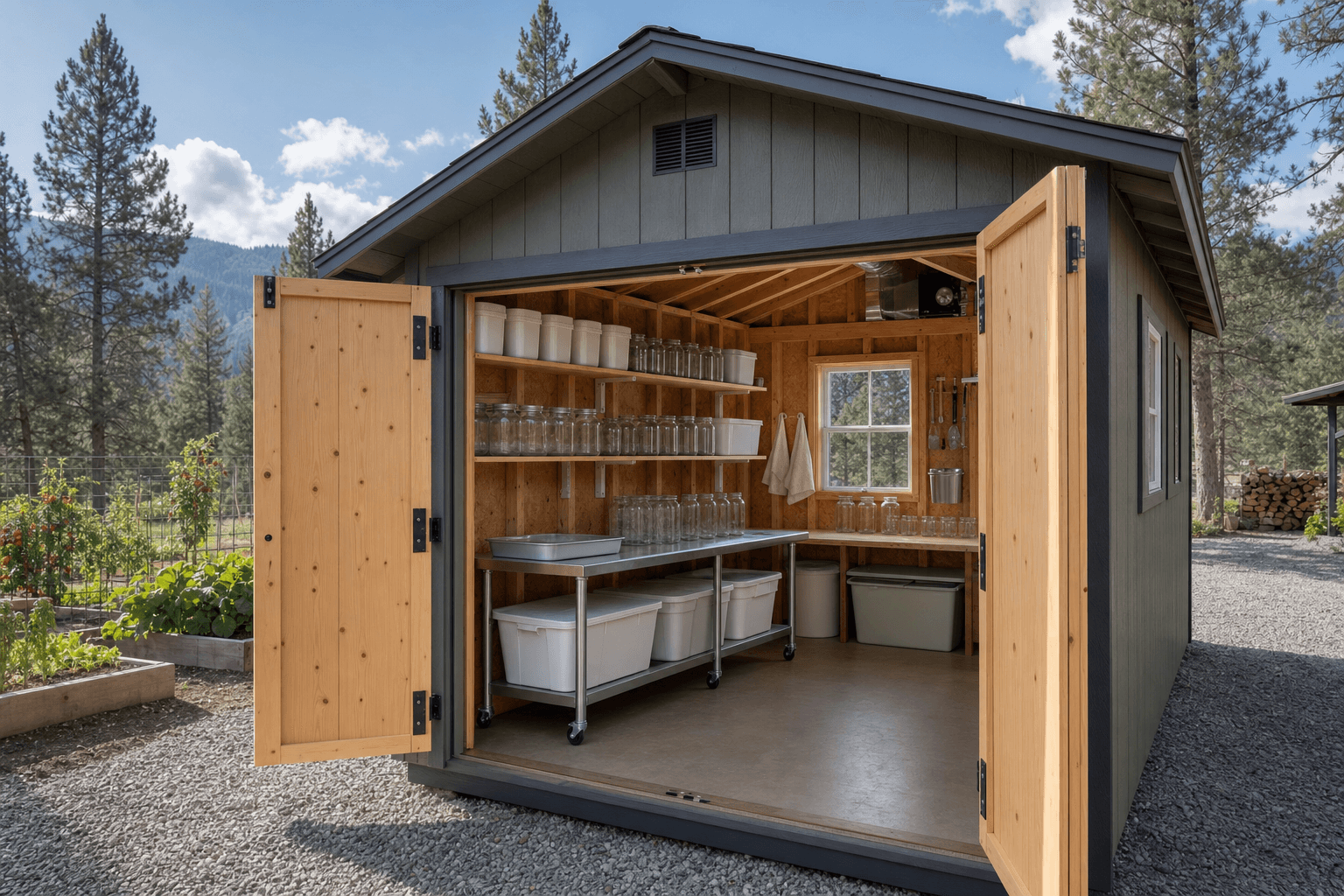
Zoning the room keeps the wash, the hot burner, and the cooling and packing stations from colliding on a busy preserving day.
A canning kitchen works when the wash, the heat, and the packing each get their own territory, because the workflow runs in one direction — dirty produce in, sealed jars out — and crossing those streams is how you contaminate a batch. Build it around four zones. The wash-and-prep zone lives at the deep sink: rinse, sort, peel, chop, and blanch, on a counter you can flood and squeegee. The hot zone is the heart of the room — the high-output burner with the water-bath or pressure canner, set with heat-tolerant landing counter on both sides so you can stage full jars going in and lift them out without a long carry.
The cooling-and-sealing zone is a clear stretch of counter, out of any draft, where hot jars rest undisturbed for the ping and the overnight set — towels down, nothing stacked on top. The packing-and-pantry zone is the shelving where lidded, labeled jars wait to go to the cellar, alongside the working stock of lids, rings, and empty jars. Keep a one-way path from the door to the wash to the burner to the cooling counter so a tray of jars never has to backtrack. Plan the door wide — a 36-inch or double door clears a hand truck of produce boxes and a loaded canning rack without a fight, where a narrow door turns every harvest haul into a struggle.
Run a continuous counter in stainless or a sealed, non-porous food-safe top with no seams to trap brine, plus a coved backsplash and FRP or scrubbable wall panels behind the burner and sink. Every surface should sterilize and wipe down to a sanitary standard with no raw wood in the splash zone.
Plan a heavy propane or electric burner rated to bring a full pressure canner to a hard boil and hold it — far more output than a kitchen stove. Set it on a non-combustible, heat-tolerant surface with landing counter beside it, and wire or plumb the fuel for the load you will actually run.
A deep, single-basin utility or commercial-style sink with a high-arc faucet washes muddy produce, fills canners, and rinses jars without splashing the room. Group the supply and drain in one corner and plan the line to drain down or stay heated so a North Idaho freeze never bursts it.
Build open, washable shelving sized to the case so empty jars nest by size and full jars line up for the cellar run, with bins for lids and rings and a labeling station. A wall of pantry shelving keeps the finished stock visible, rotated oldest-first, and up off a floor you need to mop.
The fit-out is everything that turns a clean, vented room into a working preserving kitchen, so plan storage for the specific gear you reach for. On and around the counter: a water-bath canner and a pressure canner (often both), a jar rack and a jar lifter, a wide-mouth funnel, a bubble remover and headspace tool, a lid magnet, and tongs. For prep at the sink: large stockpots and bowls, colanders and a salad spinner, a food mill and a sauce strainer, an apple peeler-corer, cutting boards in a sanitizable material, sharp knives, and a scale. For the produce itself: stainless or food-grade bowls and totes, a blancher, and a steam juicer for jelly and tomato work.
Then the stock: cases of Mason jars in half-pint, pint, and quart, boxes of lids and rings, pickling salt, sugar, vinegar, pectin, citric acid, and the spices you go through by the pound — kept dry and, where it matters, sealed against rodents in a dedicated dry pantry. Keep a labeling station with a date stamp and a marker so every jar leaves the room dated. For dehydrating and dry-pack work, plan a shelf and an outlet for a dehydrator and a vacuum sealer. For comfort and cleanup, a wall-mount paper towel holder, a sanitizer station, a hose bib or sprayer at the sink, and a floor drain or a squeegee-friendly slope so the room hoses out. Walk your own list like this before you settle on a size, because the canners, the stockpots, and a season's worth of jars claim the counter and the shelving faster than people expect — which is exactly why a serious preserving household tends to land at a 10x16 shed rather than something tighter.
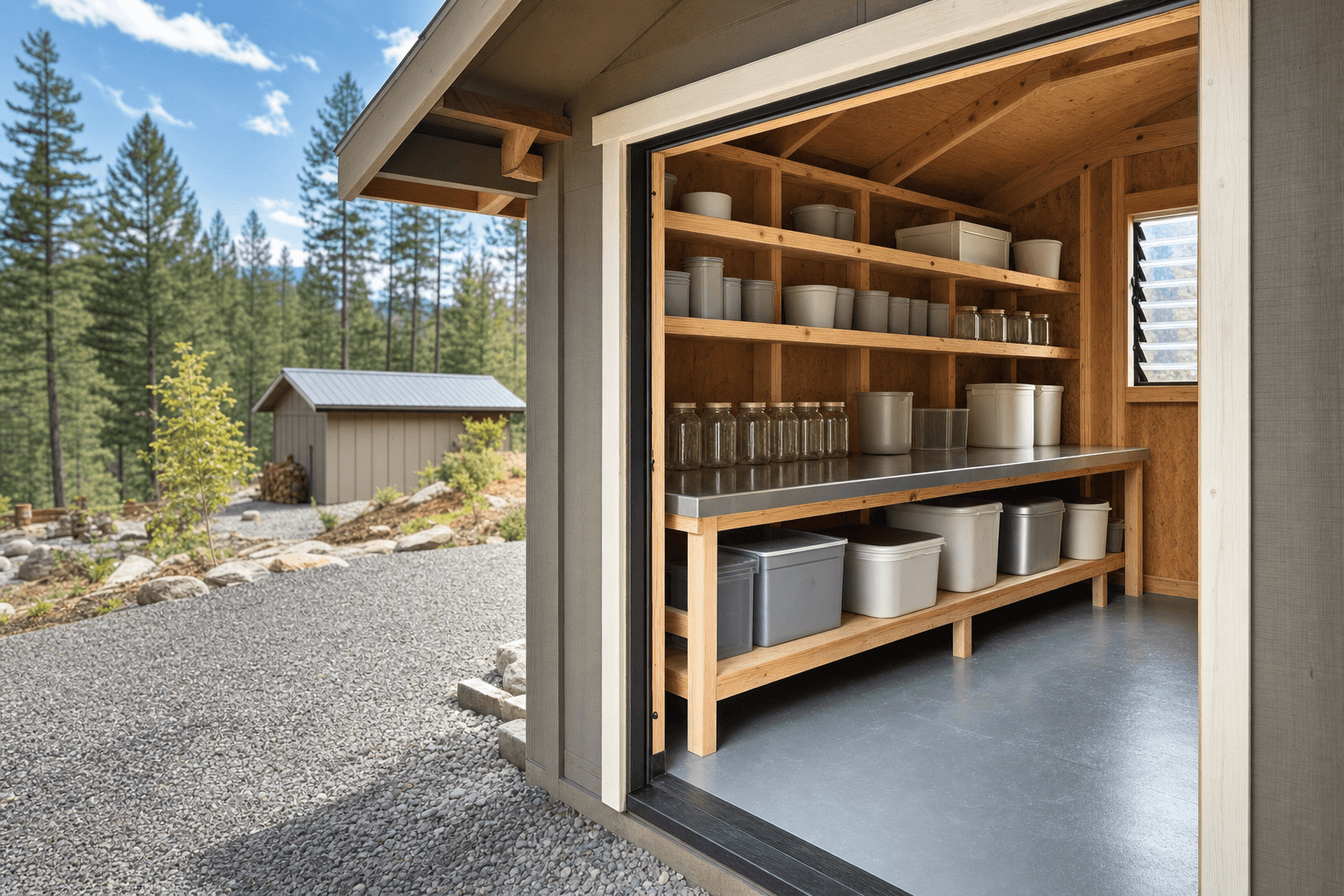
Detail that makes it a canning kitchen: a high-output burner under a loaded canner, landing counter beside it, and jars cooling undisturbed on the next run of counter.
| Canning kitchen planning checklist | |
|---|---|
| Best all-round size | 10x16 for a full counter run, sink, high-output burner, prep table, and a wall of jar and pantry shelving |
| Work surface | 8 to 12 feet of continuous stainless or sealed food-safe counter with no open seams, a coved backsplash, and no raw wood in the splash zone |
| Burner | Heavy propane or electric burner rated for a full pressure canner, on a non-combustible surface with landing counter on both sides |
| Water | Deep single-basin utility sink with a high-arc faucet; supply and drain grouped, planned to drain down or stay heated for winter |
| Ventilation | Range hood or powered exhaust over the burner plus an operable window and a ridge or gable vent to clear steam and heat fast |
| Surfaces and cleanup | Sealed, washable floor with a drain or squeegee slope, FRP or scrubbable wall panels in the wet zone, jar shelving up off the floor |
Four systems decide whether a canning kitchen actually works on a hot August day with two canners going. Ventilation comes first here, because steam is constant and relentless: a boiling-water bath and a pressure canner dump enormous moisture and heat into the room, and without a way out it fogs the windows, soaks the structure, and turns the space into a sauna. Plan a range hood or a powered exhaust fan over the burner to pull steam and heat straight out, paired with an operable window for cross-flow and a ridge or gable vent up high where hot, moist air collects. Good airflow is what keeps the room comfortable to stand in and keeps mold off the walls and shelving between seasons.
Power and fuel size to the burner, which is the heaviest load in the room. An electric high-output burner wants a dedicated circuit run from your home's panel by a licensed electrician, ideally feeding a small subpanel so you can add outlets for a dehydrator, a vacuum sealer, and good lighting without re-trenching. Many canners prefer a propane burner for the raw output a pressure canner needs, which means a tank, a regulator, and a properly run gas line — plan the tank location and the run on purpose, and keep the burner on non-combustible surroundings. Lighting should be bright task light over the counter and the sink so you can read headspace and check seals, plus general overhead light for the room. Winter readiness matters in North Idaho even for a seasonal room: insulate enough to take the chill off late-fall apple and game seasons, protect the water line from freezing with a drain-down or heat, and seal the building tight so nothing nests in it over winter. We frame and finish the shell tight and dry on your property, with the vent, the burner wall, and the plumbing roughed in, so it is ready for your electrician and plumber to complete.
Because we build on your property, the base and placement are part of the plan, and a canning kitchen leans toward a solid floor more than most sheds. A level, well-drained gravel pad sized about a foot wider than the building on each side is the standard base and keeps the framing off wet ground, but many canning kitchens go on a concrete slab instead, because a sealed slab handles standing water, a floor drain, the weight of loaded canners, and the constant mopping a sterile wet room needs. Set the building where a gravel driveway or a clear path reaches the door so a hand truck of produce boxes and cases of jars rolls right up, and place it near your water source and within reach of a power run or a propane tank so the utilities land cleanly.
North Idaho weather drives the structure. We build for local snow load so the roofline and framing carry a heavy Panhandle winter without sagging, and we use treated and pine materials suited to freeze-thaw swings, with the floor kept up off the ground so spring melt drains away instead of wicking into a building that sees wet use. Site the shed so snow shedding off the roof clears the door, the windows, and the vent rather than burying them. On permits, the rule of thumb is the use: a plain storage shed under a size threshold often needs no permit, but the moment a building is finished, wired, and especially plumbed with a sink and a drain, your county or city may require a building permit, an electrical inspection, and a plumbing inspection, plus adherence to setbacks. Rules vary across Kootenai County and the cities around Coeur d'Alene, so confirm with your local building department before you finalize size, placement, and whether you are running water and gas out there. When you are ready, get a free estimate or build and price a shed to see your size, counter run, and venting options come together.
Plan ventilation as the first system, not an afterthought, because a water-bath and a pressure canner dump huge amounts of steam and heat into the room. Put a range hood or a powered exhaust fan directly over the burner to pull moisture and heat straight outside before it spreads, and size it for a small commercial-style load rather than a residential stove. Pair that with an operable window for cross-flow and a ridge or gable vent up high where the hottest, most humid air collects. The goal is to clear the steam fast so the windows do not fog, the walls and jar shelving stay dry, and the room stays comfortable enough to stand in for a long canning day. Mold on a damp, closed-up structure between seasons is the failure you are designing against, so keep at least the passive vents working even when the building is shut.
Canning needs far more heat output than a typical kitchen stove, because a full pressure canner is heavy and has to reach and hold a hard boil, so plan a high-output burner deliberately. You have two common paths. An electric high-output burner wants a dedicated circuit run from your home's panel by a licensed electrician, ideally feeding a small subpanel in the shed so you can add outlets for a dehydrator, a vacuum sealer, and lighting later without trenching again. Many serious canners prefer a propane burner for the raw BTUs a loaded canner needs, which means a tank, a regulator, and a properly run gas line, all planned with the tank location and clearances in mind. Either way, set the burner on a non-combustible, heat-tolerant surface with landing counter on both sides, and wire or plumb the fuel for the load you will actually run on a two-canner day, not the minimum. We build the shell so your electrician or gas fitter can run and terminate everything cleanly before the walls close.
A canning kitchen is a sanitation-first space, so every surface has to clean up to a sterile standard with no places for brine, pectin, or raw produce to lodge. For the work counter, run a continuous, no-seam top in stainless steel or a sealed, non-porous food-safe surface, with no open joints or raw wood in the splash zone where bacteria could hide. Add a coved backsplash so the counter-to-wall joint wipes clean, and finish the wet-zone walls behind the sink and burner in FRP panels or another scrubbable, water-resistant surface. For the floor, use a sealed, washable surface, ideally a concrete slab with a drain or a squeegee slope, so you can flood and mop the room down after a messy day. Keep jar shelving in a washable material and up off the floor. The whole idea is that the room sanitizes and dries quickly, because food-contact surfaces that cannot be cleaned properly are the one thing you cannot compromise on when you are preserving food.
Plan separate, washable storage for empty jars, cooling jars, and finished pantry stock so they never get mixed up or crowd the work surface. Build open shelving sized to the standard case so empty jars nest by size, half-pint, pint, and quart, within reach of the burner where you fill them. Give cooling jars their own clear stretch of counter, out of any draft, where they rest undisturbed for the seal, then move them to a labeled pantry wall. Use bins for lids and rings and a labeling station with a date stamp so every jar leaves the room dated and gets rotated oldest-first. Keep all of it up off a floor you need to mop, and seal the building against rodents since they target stored food. Because finished jars keep best somewhere cool and dark, many homesteaders move them from the canning shed to a nearby root cellar for long-term storage rather than leaving a full season's harvest on warm shelves.
A deep utility sink with running water is close to essential for serious canning, because you are constantly washing muddy produce, filling and topping off canners, and rinsing jars and tools, and hauling water in by hand gets old fast on a big day. Plan a deep, single-basin utility or commercial-style sink with a high-arc faucet so a stockpot fits under it without splashing the room. Group the supply and the drain in one corner so the plumbing lands together, ideally over a slab where the wet zone has a sealed floor and a drain. Running water out to a shed usually means trenching a supply and waste line from the house and a plumbing permit, and in North Idaho the line has to be protected from freezing, planned either to drain down for winter or to stay heated, since a frozen line is a burst line. If a full plumbed sink is not in the first build, a large basin filled from a hose bib can bridge the gap, but a serious preserving kitchen really wants a proper deep sink and drain.
Size for your real harvest and how much you put up at once, not an average week, because canning season comes in heavy bursts. For one person doing a steady season of sauce, salsa, jam, and pickles, an 8x12 is the honest floor: a counter run with a sink and a burner, some landing counter, and jar shelving overhead. Step up to a 10x12 for room to stand at a loaded canner without backing into the wall, plus a real prep table for sorting and packing. The sweet spot for a serious preserving household is a 10x16, which absorbs a full counter run, a sink, a high-output burner, a dedicated prep table, a wall of jar and pantry shelving, and floor space for a second canner. If you preserve at volume, a big garden, an orchard, or game and bulk meat, a 12x16 gives you two work zones so washing and prepping do not collide with hot canning, plus room to run two burners and a wide pantry wall. Count the canners, the sink, the prep space, and a full season of jars before you choose, and you will not outgrow the room the first heavy August.
Canning season in North Idaho runs hard from August through October — tomatoes, stone fruit, beans, and the apple and pear harvests that come off trees across Kootenai and Bonner County properties. Doing that volume of work in a home kitchen means heat, steam, and mess in the space you also live in. A dedicated canning kitchen shed built on your property puts all of it outside where it belongs.
The burner is the anchor. A high-output propane burner — the kind that brings a water-bath or pressure canner to a hard boil in minutes — throws more BTUs than most residential ranges are rated for and produces heat and steam that a residential exhaust fan can't keep up with. A shed with a purpose-built ventilation hood over the burner station and open-able windows handles that load without making the room miserable to work in.
Food-safe surfaces and washability are requirements, not upgrades. Epoxy-sealed concrete floors, fiberglass or painted-metal wall panels in the work zone, and a deep stainless utility sink let you clean the room properly at the end of a long canning day. When those surfaces are framed in during the build, they're correct from day one — not a renovation you add later after a summer of working on wood.
Jar and pantry storage in the same building closes the loop. A cool, dark interior wall with deep shelving for filled jars keeps your pantry in one place and off the basement stairs. Coeur d'Alene and Post Falls properties with limited interior storage particularly benefit from the shed doing double duty as the processing room and the storage location year-round.
Water supply needs to be frost-protected if the shed will be used into November — a heat-taped line or a frost-free sill cock with indoor shut-off keeps that from being a problem. Start with the footprint in the shed builder — a 10x14 or 12x16 covers most canning setups — and get a free estimate with plumbing and electrical included.
Tell us how you preserve and we'll help you size and lay out a high-output burner, a deep sink, steam venting, and food-safe surfaces in a canning kitchen shed for your North Idaho property.
Keep planning your build with related North Idaho shed guides.