A clean-air shed is a small, sealed building you can breathe easy in: a room held tight against the outside air, fed by HEPA and MERV filtration, and finished in low-VOC materials so the air inside stays cleaner than the air in most houses. The point isn't storage. The point is a controlled little atmosphere of your own, a place where dust, pollen, mold spores, and wildfire smoke get filtered out and what's left is fresh and steady. For anyone with allergies, asthma, a compromised immune system, or a low tolerance for the August smoke that rolls into the Panhandle most summers, that kind of room is genuinely useful, and a purpose-built clean-air shed does it far better than a corner of the house you can never fully seal off from the rest of the building.
What separates a real clean-air room from a tightly built office is the air itself: how it's filtered, how often it's exchanged, how well the shell keeps unfiltered outside air from leaking in, and how little the building's own materials off-gas into the space. Get those four things right and you have a refuge that holds clean air through smoke season, a low-dust workspace for sensitive electronics or finishing work, and a comfortable allergy-friendly retreat the rest of the year. Get them wrong and you have a stuffy box that smells like fresh paint and lets smoke seep in around the door. This guide walks the planning in order: which shed style seals up best, the sizes that fit a sealed conditioned room, how to lay out filtration and air handling, the materials and gear that actually matter, and how we build the shell tight and dry on your property so it's ready to finish. If you'd rather see options priced first, you can build and price a layout in a few minutes.
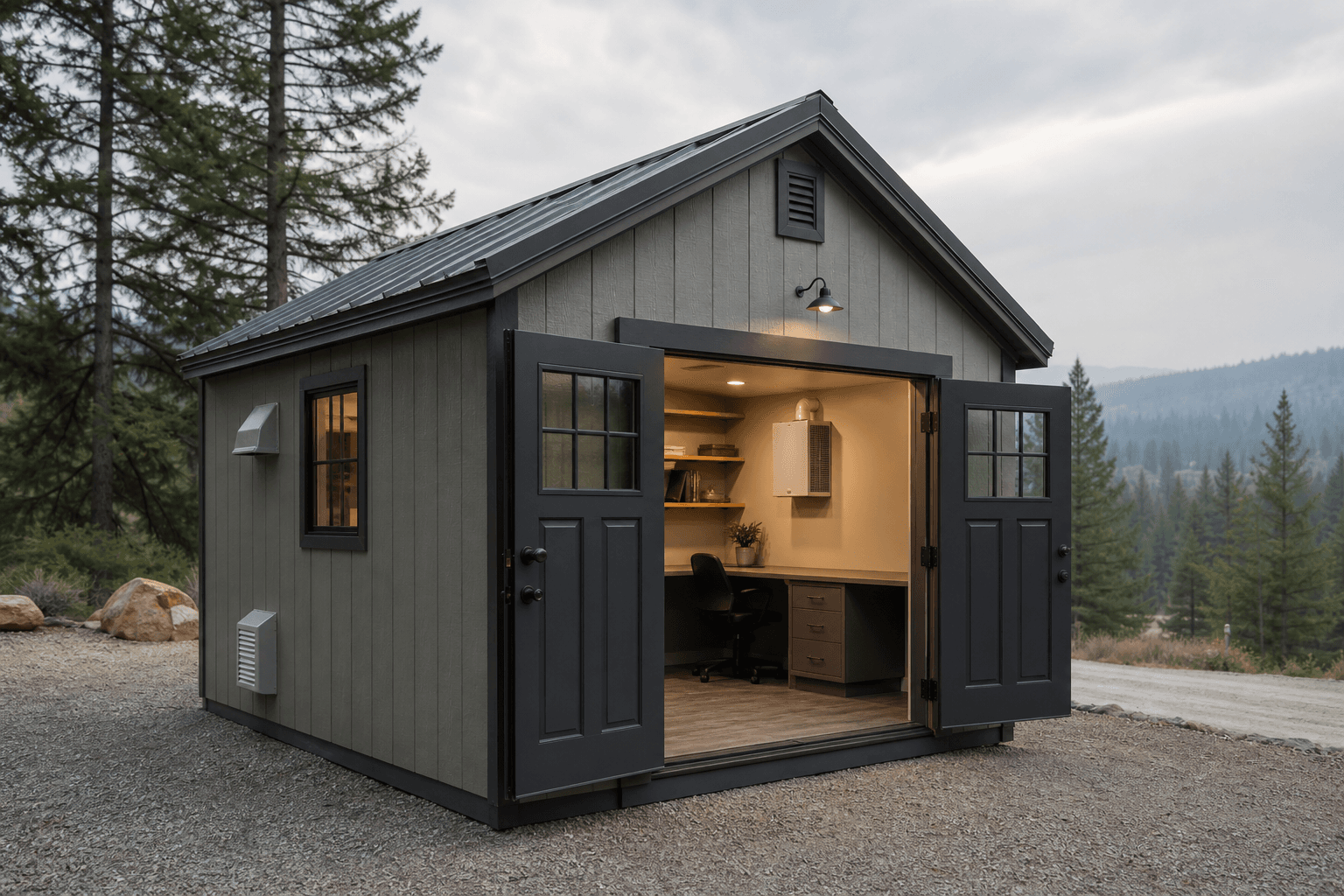
A clean-air shed built to seal tight and breathe through filters, not gaps.
A clean-air shed lives or dies by how tightly the shell seals, so simple wins. A standard gable is the easiest envelope to make airtight: straight walls, a plain roofline, few penetrations, and flat surfaces to mount an air handler, a filter box, and shelving without slopes complicating the air path. It's the style we steer most clean-air builds toward because every seam you don't add is a seam you don't have to seal.
If you want more interior volume so a standalone air purifier and a mini-split can both run without crowding the room, a lofted barn (gambrel) roof adds height, though the extra ridge and wall joints mean a little more sealing detail to get right. A lean-to or single-slope roof keeps the structure simple and contemporary and works well when you want a clerestory window for light without opening the room to a lot of operable glass. Whatever the roofline, treat the building as a conditioned, sealed envelope, not a vented shed: continuous insulation, a tight air barrier, weatherstripped openings, and as few wall and roof penetrations as you can manage. The same envelope discipline carries into the other tight-room builds we do, so it's worth seeing how we approach a home office shed when you're weighing rooflines, because the insulation and air-sealing priorities overlap closely with a clean-air room.
The one place to resist temptation is operable windows and vents. Every window that opens and every passive vent is a path for unfiltered outside air, so a clean-air shed favors fixed glass for daylight and routes all fresh air through filtered, controlled intakes instead.
A chair or daybed, a side table, and floor space for a standalone HEPA purifier and a mini-split. An 8x10 makes a tight, easy-to-filter retreat for one person to ride out a smoke day.
Add a small desk or a reading and craft corner and you want 10x12 to 10x14, enough room for filtration plus a real activity without crowding the air handler.
If two people share the refuge or you want a low-dust work zone and a rest zone, step up to 12x16 so the air volume is generous and the room never feels close.
Footprint matters more here than in an ordinary shed because air volume and filter sizing scale with the room. Smaller is actually easier to keep clean, so don't over-build. An 8x10 shed is a sensible floor for a solo smoke-season refuge: 80 square feet is quick to filter, holds a comfortable chair or a daybed, and lets a single portable HEPA unit do real work. Move up to a 10x12 shed and you gain room for a small desk or a rest-and-read corner alongside the filtration, which is the sweet spot for a retreat you'll use year-round. A 10x14 shed adds enough length to keep a low-dust work surface separate from a seating zone without the two competing for floor space. The 12x16 shed is the call when two people share the room, or when you want both a clean work area and a place to rest, and the larger air volume stays steadier when the door opens and closes. Bigger rooms need bigger filtration to keep the same air-change rate, so size the building for the people and tasks you actually have, then match the air handler and purifier to that volume.
These builds overlap, and the right one depends on the threat you're planning around. A clean-air shed is optimized for air quality every day: continuous filtration, low-VOC finishes, and a sealed envelope that keeps pollen, dust, and smoke out so the room is a comfortable refuge in any season. A wildfire-readiness shed overlaps on the smoke side but tilts toward fire-resistant materials, ember-resistant detailing, and protecting gear during an active event, so if your main worry is the fire itself rather than the air you breathe day to day, that's the build to compare. If your real use is creative production in a dust-controlled space, an art studio shares the low-dust, sealed-room goals and adds wash-up space, durable floors, and good light, and a clean-air shell makes an excellent base for finishing work that can't tolerate airborne particles. Many buyers land on a clean-air shed because they want the filtration and healthy materials without the dwelling complexity of a guest room, and because the room earns its keep on smoky days and high-pollen weeks alike. If you're torn, pick the use you'll lean on most often, build the sealed envelope for that, and let filtration and finish do the rest.
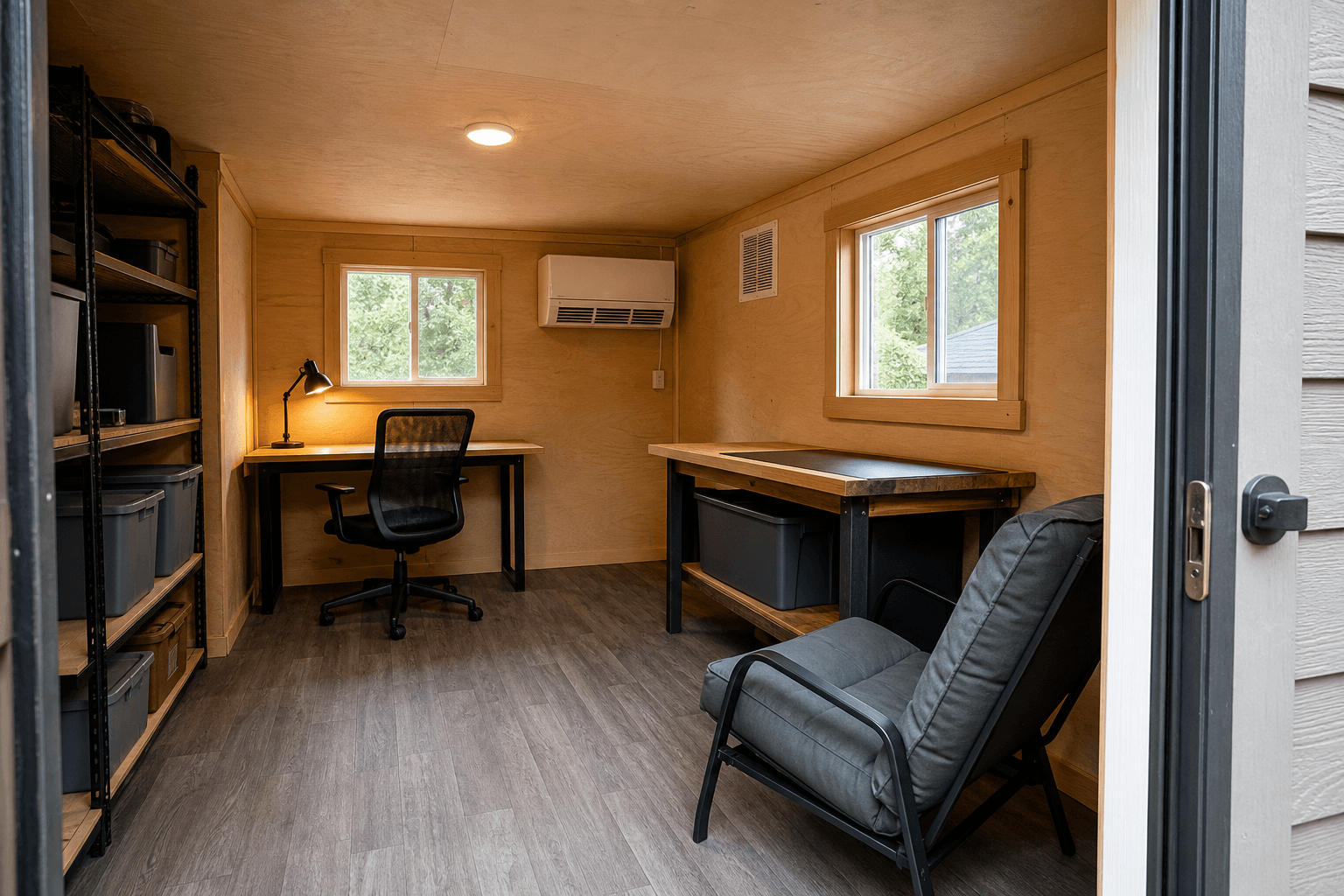
Zoned for clean air: filtered intake and air handling on one wall, a calm low-dust room on the other.
Even a small clean-air room works better planned as zones than as one open box. The air-handling zone is the anchor: pick one wall for the filtered fresh-air intake, the air handler or ERV, and a standalone HEPA purifier, so the equipment and filter access sit together and the rest of the room stays open. Set the intake and return per your installer's layout so filtered air circulates across the room instead of short-cycling back to the unit. The occupied zone is where you sit, rest, or work, kept clear of the equipment so the air washes past you cleanly and the purifier isn't blowing straight at your chair. Reserve a small entry zone at the door, a few feet of clear floor for a mat and a spot to leave shoes and a smoke-day jacket, so you track in as little outside dust as possible, and keep the door as the only operable opening so every entry is controlled. Finally, leave a storage zone for spare filters and supplies on closed shelving that doesn't shed dust. Sketching these zones before you choose a footprint tells you fast whether a compact building filters easily or whether you want the extra wall length of a larger one.
Pair a true HEPA standalone purifier sized for the room with high-MERV filter media (MERV 13 or better) on any mechanical fresh-air intake. HEPA catches the fine smoke and allergen particles; MERV media keeps the bigger stuff off the HEPA so filters last. Size both to the room's air volume so you hit a real air-change rate, not a token one.
A continuous air barrier, sealed sheathing seams, weatherstripped doors, gasketed penetrations, and fixed windows keep unfiltered air and smoke from leaking in around the edges. The tighter the shell, the more of your air actually comes through the filters, and the easier the room is to hold clean during a smoke event.
A sealed room still needs fresh air, so plan a mechanical path for it: a filtered intake or a balanced energy-recovery ventilator (ERV) that swaps stale inside air for filtered outside air without dumping in raw smoke. A simple damper lets you cut the intake entirely on the worst smoke days and run on recirculated, filtered air.
A clean-air room is only as good as its filters, so build for service. Keep purifier and intake filters reachable, label the sizes, store spares on a shelf inside, and place the air handler where you can swap media without moving furniture. Plan the layout so a filter change is a two-minute job, not a chore you skip.
The keyword for this room is filtered, controlled air, and the fit-out is everything that delivers and protects it. For filtration: a true HEPA air purifier rated for the room's square footage with headroom so it isn't maxed out on smoky days, high-MERV media on the fresh-air intake, spare filters labeled by size, and an indoor air-quality monitor that reads particulates (PM2.5), CO2, and humidity so you can see the room working. For ventilation and climate: an ERV or a filtered makeup-air intake with a shutoff damper, a quiet ductless mini-split that heats and cools without bringing in outside air, and a small dehumidifier to hold humidity in the comfortable, mold-discouraging range. For the envelope and entry: weatherstripping and door sweeps, a walk-off mat at the door, and gasketed covers on any wall penetration. For the room itself, choose low-off-gassing finishes that don't fight the filters: low-VOC or zero-VOC paint, formaldehyde-free insulation, sealed hard flooring like LVP or sealed concrete instead of dust-trapping carpet, and closed, easy-clean shelving. Walk your own list like this before you settle on a size, because filtration, climate, and ventilation gear all need floor and wall space. None of it fits comfortably in a 6x8 shed, which is why a real clean-air room starts around eight to ten feet deep and most people are happier with extra wall length once the air handler, the purifier, and a comfortable place to sit all share the room.
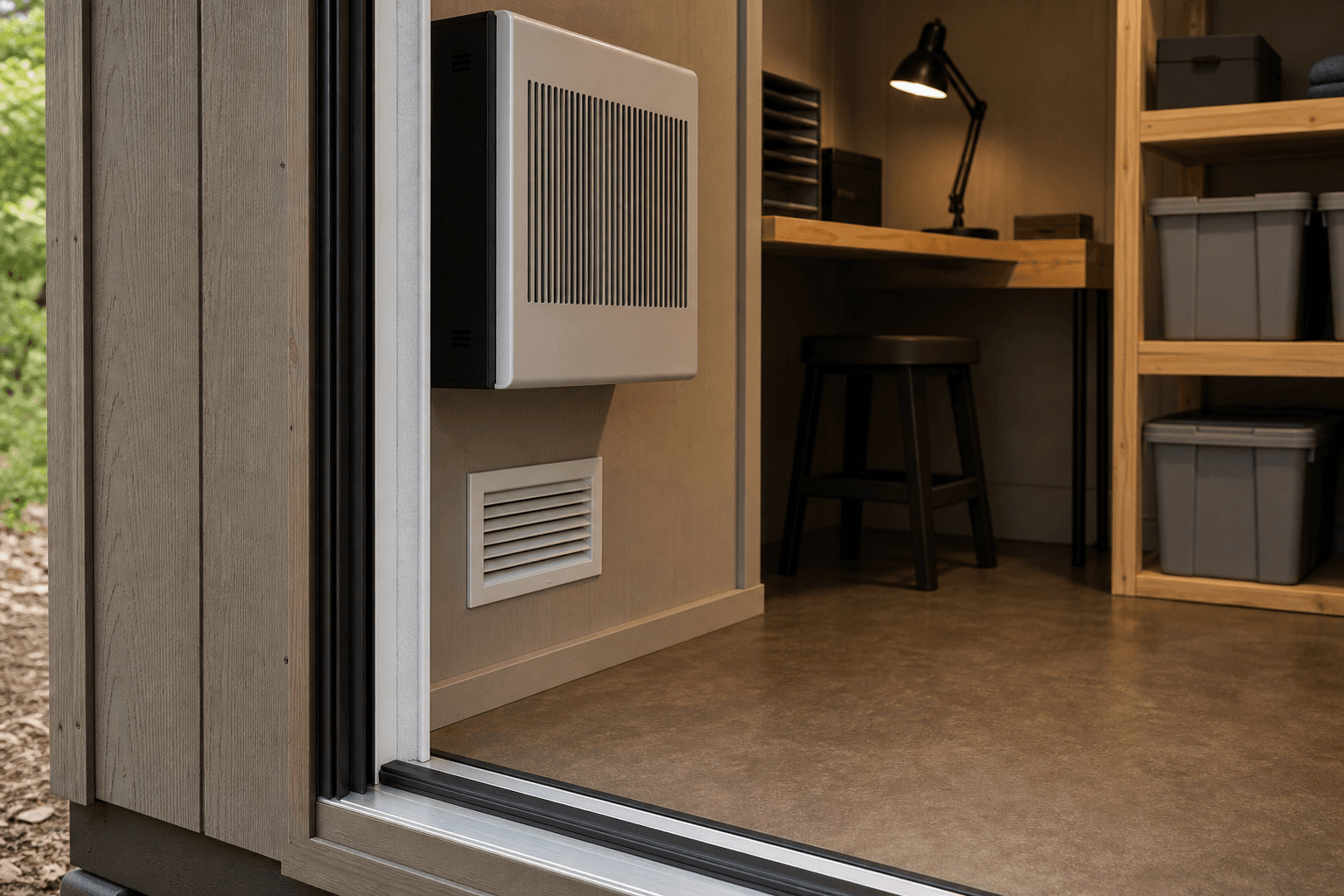
Detail that makes it a clean-air room: a sealed door, a walk-off mat, and filtered air coming through media, not gaps.
| Clean-air shed planning checklist | |
|---|---|
| Best roofline | Standard gable for the tightest, simplest envelope; gambrel for extra air volume |
| Practical sizes | 8x10 solo refuge, 10x12 to 10x14 retreat plus a task, 12x16 for two people or work plus rest |
| Filtration | True HEPA purifier sized to the room plus MERV 13+ media on any fresh-air intake |
| Envelope | Continuous air barrier, weatherstripped door, gasketed penetrations, fixed windows |
| Ventilation | ERV or filtered makeup-air intake with a shutoff damper for the worst smoke days |
| Materials and climate | Low-VOC finishes, sealed hard floors, a quiet mini-split, and a small dehumidifier |
Three systems decide whether the room holds clean air when you need it most. Power comes from a dedicated circuit run from your home's panel by a licensed electrician, and a small subpanel in the shed makes it easy to add circuits as you add gear. Plan outlets for the purifier, the air handler or ERV, the mini-split, the dehumidifier, and the air-quality monitor, and don't share the mini-split's circuit with a stack of filtration so nothing trips when everything runs during a smoke event. If the room is meant to be a refuge during the kind of summer where the power can flicker, consider wiring it so a portable generator or a battery backup can keep at least the purifier and a fan running. Climate matters because a sealed room can't just open a window to cool off: a quiet ductless mini-split heats and cools without pulling in outside air, and a small dehumidifier keeps humidity in a comfortable range so the tight envelope doesn't trap moisture. Smoke-season readiness ties it together for North Idaho: a tight shell, a HEPA purifier with real capacity, a filtered intake you can damper shut, and a sealed door mean that when the smoke rolls in from regional wildfires, you close the intake, run on recirculated filtered air, and keep the room breathable while the outside air is not. We frame and build the shell tight and dry on your property so it's ready for your electrician and HVAC installer to finish.
A sealed shell stays straight and tight only on a solid, level base, so most clean-air sheds sit on a compacted gravel pad sized about a foot wider than the building on each side for drainage, or on a concrete slab when you want a perfectly flat, dust-free, easy-to-seal floor for a low-dust room. North Idaho weather shapes the rest: design the roof for local snow load so it shrugs off a heavy Panhandle winter, keep the floor up off the ground so spring melt and rain drain away rather than wicking in and feeding mold inside a tight building, and place the shed where the gravel driveway or a clear path lets our crew get materials in to build. We build with weather-rated framing and finishes suited to pine-country freeze-thaw cycles, and set the structure to drain and shed water so the envelope stays sound. On permits, the use drives the answer: a plain storage shed under a size threshold often needs no permit, but a conditioned, occupied room with power, climate control, and ventilation may require a permit, an electrical inspection, and adherence to setbacks. Rules vary across Kootenai County and the cities around Coeur d'Alene, so confirm with your local building department before you finalize size and placement, and we'll plan the build around whatever your jurisdiction requires.
Plan two layers. Inside the room, run a true HEPA air purifier rated for more square footage than you actually have so it isn't maxed out on smoky days, since HEPA is what captures the fine wildfire-smoke and allergen particles. On any mechanical fresh-air intake, add high-MERV filter media, MERV 13 or better, to pull out larger particles before they reach the HEPA and to extend filter life. As a rule of thumb, size the purifier so it can turn over the room's air several times an hour, roughly four to five air changes for a comfortable clean-air room and more if you want it to recover quickly after the door opens. Use an air-quality monitor that reads PM2.5 so you can confirm the room is actually clearing, and keep spare filters on hand because a clean-air shed is only as good as the media in it.
Tightness comes from the whole envelope, not one product. We build a continuous air barrier, seal the sheathing seams, weatherstrip the door and add a door sweep, gasket every wall and roof penetration, and favor fixed windows over operable ones so there are fewer paths for unfiltered air. The goal is to make the filtered intake the main way air enters the room, so smoke can't seep in around the edges. For the worst smoke days, the intake gets a shutoff damper so you can close it entirely and run on recirculated, filtered air. Keep operable openings to the door alone, add a walk-off mat and a shoe spot just inside, and you minimize both leakage and what you track in. A tight shell is also what lets a modestly sized purifier keep up, because it isn't fighting a steady inflow of dirty air.
Since you're sealing the room tight, the materials inside have nowhere to off-gas but into your air, so choose low-emitting finishes from the start. Use low-VOC or zero-VOC paint, formaldehyde-free or low-formaldehyde insulation, and adhesives and caulks rated low-VOC. For flooring, sealed hard surfaces like luxury vinyl plank or sealed concrete beat carpet, which traps dust, pollen, and dander and is hard to fully clean. Pick closed shelving and easy-wipe surfaces over open particleboard that sheds and off-gasses. If you do add new furniture or cabinetry, let it air out before it goes in, or choose solid-wood and low-emission options. Combined with continuous filtration, low-VOC material choices keep the indoor air genuinely clean rather than just trapping fresh-paint and adhesive fumes inside a tight box.
Yes, and that's one of the main reasons people in the Panhandle build one. When regional wildfire smoke settles in for days, you close the filtered intake's damper, run the room on recirculated air through a HEPA purifier sized with headroom, and keep the door sealed so smoke can't leak in. With a tight envelope and real filtration capacity, the room can hold breathable air while the outside PM2.5 is in the unhealthy range. Cooling matters too, because you can't open a window, so a quiet mini-split keeps the sealed room comfortable without pulling in smoke. It helps to plan for power continuity, even a battery or generator that can keep the purifier and a fan running through a flicker, so the refuge stays a refuge. An air-quality monitor inside lets you watch the room stay clean while the smoke outside comes and goes.
The key is to separate temperature control from ventilation. A ductless mini-split heat pump heats and cools by moving refrigerant through a wall-mounted head and an outdoor unit, so it conditions the room without drawing outside air inside, which is exactly what a sealed clean-air shed wants. It's quiet, efficient, and holds a steady temperature through both a North Idaho winter and a smoky summer. Fresh air, when you want it, comes separately through a filtered intake or a balanced ERV that you can damper shut on the worst days, so you control ventilation and temperature independently. Add a small dehumidifier so the tight envelope doesn't trap humidity and risk mold, and you have a room that stays comfortable and clean year-round. We build the shell insulated and tight so the mini-split conditions a small, well-sealed space efficiently.
A clean-air shed pays off for anyone whose comfort or health depends on the air around them. That includes people with allergies, asthma, or chemical sensitivities who want a low-pollen, low-dust place to breathe and sleep, people with compromised immune systems who benefit from a controlled, filtered environment, and anyone who suffers through North Idaho's wildfire-smoke season and wants a reliable refuge. It also suits sensitive work that can't tolerate airborne particles, such as electronics, optics, finishing, or fine craft, where a low-dust room protects the work as much as the person. For one person, an 8x10 or 10x12 is plenty and easy to keep clean, and many solo owners value it most on the handful of high-pollen weeks and smoky days a year when the rest of the house just isn't comfortable. If clean, controlled air would change how you feel at home, a dedicated room is hard to beat.
North Idaho sees meaningful wildfire smoke most summers — smoke events that push AQI into the unhealthy range for days at a stretch, particularly in Coeur d'Alene and Post Falls during late July and August. A clean-air shed is only effective when the building envelope is genuinely airtight. Gaps at rim joists, around electrical penetrations, and at threshold transitions are where smoke infiltrates, and those details are far easier to address during framing than to seal after the fact in a delivered box.
HEPA and MERV filtration require a tight shell to work as intended. A filtered recirculation unit installed in a leaky structure just cycles air past the filter while drawing unfiltered outdoor air through every gap — you get the noise and power draw with none of the benefit. An on-site build starts with a sealed envelope, so filtration actually performs to spec.
Low-VOC materials matter here too. A clean-air space that off-gasses from interior finishes, adhesives, or flooring undermines its own purpose. Specifying low-VOC paint, flooring, and caulks at build time costs nothing compared to airing out a finished shed for weeks. This is an easier spec to meet when the builder is working in place and the material choices are made upfront.
Quiet climate control — a ductless mini-split rather than a noisy window unit — is worth planning for in the electrical rough-in even if you don't install it immediately. Rathdrum and Hayden properties with wooded surroundings often see worse smoke concentrations during inversion events. Design the envelope in our shed builder, check pricing, or get a free estimate for your lot.
Tell us who it's for and how you'll use it, and we'll help you size, seal, and price a filtered, low-VOC clean-air shed for your North Idaho property.
Keep planning your build with related North Idaho shed guides.