A chicken coop is the one shed where the people living inside it can't tell you what's wrong, so getting it right is as much about the birds' welfare as it is about your convenience. A good chicken coop is a small, well-built house that keeps a flock dry, draft-free, and safe from everything that wants to eat it, while making the daily chores of collecting eggs, refreshing bedding, and topping up feed and water quick and pleasant rather than a cold, cramped struggle. Whether you keep a handful of laying hens for breakfast eggs or a larger backyard flock, the coop is the single piece of equipment that decides whether your birds thrive through a Panhandle winter or merely survive it. Crowding, drafts, a leaky roof, or a gap a raccoon can reach through are the difference between a calm, healthy, productive flock and a stressed one that stops laying, picks at each other, or gets killed in the night.
What separates a coop that keeps birds healthy and predators out from one that turns into a damp, smelly problem is a short list of decisions you make before the first wall goes up. A coop is a living space with its own climate, so ventilation, predator-proofing, the nesting boxes, the roosts, the floor, and an attached run all have to be planned as one system rather than bolted on later. Get the airflow, the hardware-cloth security, the roost-and-box layout, the easy-clean floor, and a way to keep the birds warm and dry through a cold winter right, and you have a coop that cleans out in minutes and runs itself most of the year; skip any of them and you get frostbitten combs, ammonia-soaked bedding, scared hens that won't lay, or a heartbreaking morning after a predator gets in. None of it is complicated, but it has to be built in from the start. This guide walks through the styles that suit a coop, the footprints that fit your flock plus a run, how to lay out the inside for happy birds, and how we build the shell on your property so it stays tight, dry, and safe. If you'd rather see options priced first, you can build and price a layout in a few minutes and come back to the details.
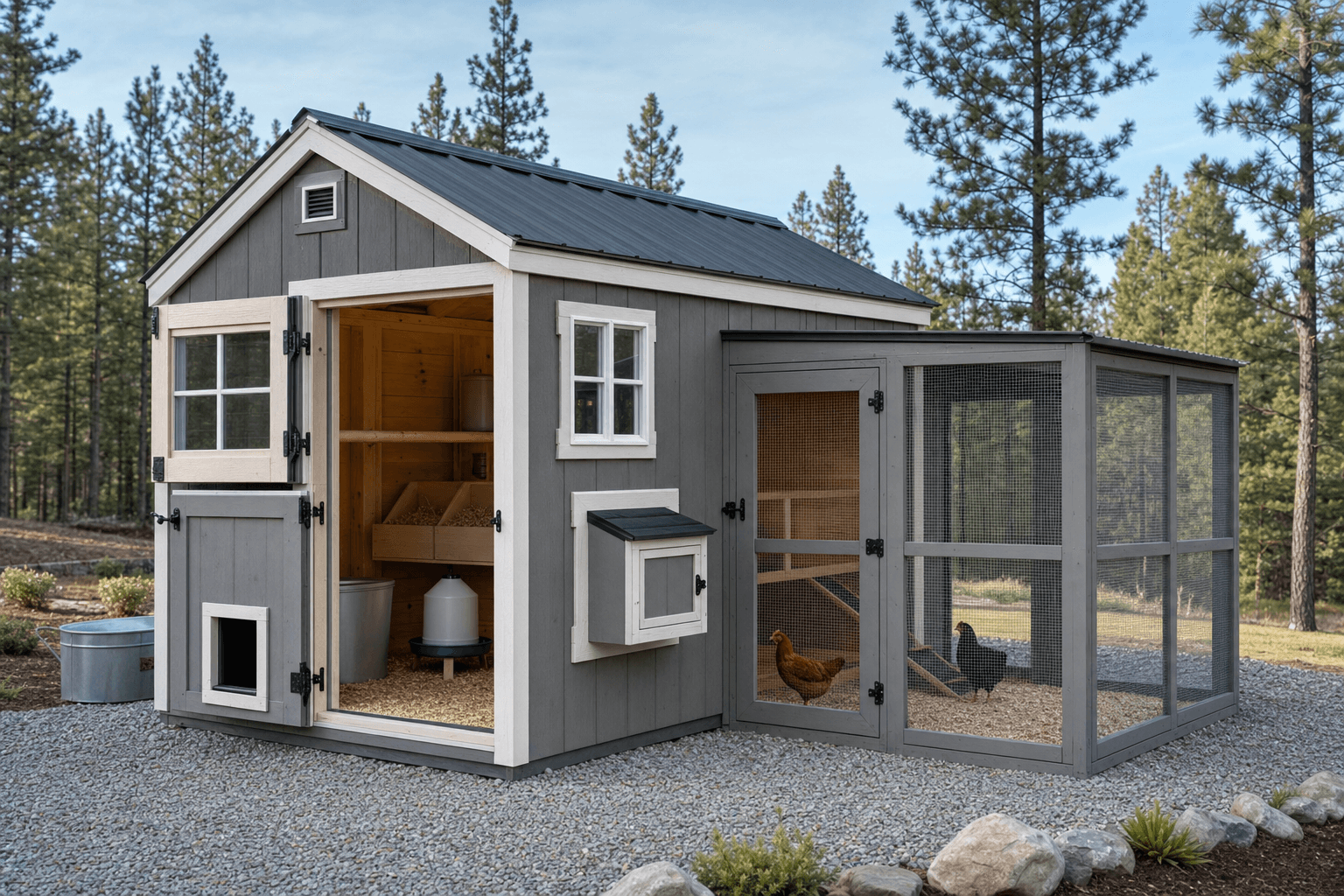
A coop built for the birds first: draft-free ventilation up high, secure hardware-cloth openings, roosts and nesting boxes inside, and a safe run attached.
Most backyard chicken coops work best as a standard gable, because the peaked roof gives you the height to mount roosting bars well above the nesting boxes, leaves a ridge area where you can add protected vents that exhaust warm, moist air without blowing a draft across the birds, and keeps headroom for you to stand and clean. A gable also sheds snow off both sides, which matters when a heavy Panhandle winter piles up on the roof. If you'd rather the coop read as a tidy little barn, a lofted barn or gambrel roofline buys you an upper space you can use for bagged feed, bedding, and supplies so the feed storage lives right where the chores happen instead of in the garage. A lean-to or single-slope modern roof pairs neatly against a fence or another building and sheds snow cleanly toward the back, which works well when the coop tucks into a corner of the yard. Whatever roofline you choose, plan the coop around a safe, dry house for living animals, with a human-sized door so you can muck it out standing up, a small pop door for the birds, weatherproof vents placed high and out of the wind, and an interior built to be scraped and hosed rather than treated like a finished room.
Because a coop is fundamentally an animal shelter, it has a lot in common with other pet and livestock shelters, and the same priorities apply: a dry, draft-free interior, security against predators, easy cleaning, and protection from a hard winter. The difference with chickens is the specific fit-out they need inside, the nesting boxes, the roosting bars, and the ventilation balance, so it's worth building the shell with those in mind from the start rather than adapting a plain storage shed after the fact.
Plan for roughly four square feet of coop floor per standard hen, plus the run. A 6x8 comfortably and humanely houses a small backyard flock of about eight to ten birds with their boxes, roosts, and easy-clean floor.
Step up to an 8x8 or 8x10 when you want a dozen or more hens, room to store bedding and feed inside, and space to walk in and clean comfortably without disturbing birds on the roost.
If you keep a big flock, want a walk-in coop with a covered attached run built on, or plan to add birds over time, an 8x12 gives every bird room and leaves space for a sheltered run section under roof.
Footprint is the decision everything else rides on, and with chickens it ties directly to welfare, so size for the flock you actually want plus a little room to grow, not the three hens you start with. The honest rule of thumb is about four square feet of coop floor per standard-size laying hen, with a generous run on top of that, because crowded birds are the ones that fight, pick feathers, foul their bedding fast, and stop laying. A 6x8 shed gives a small backyard flock of roughly eight to ten hens a comfortable, humane house with room for nesting boxes on one wall, roosting bars along another, and a floor you can scrape clean, which suits most families who want a steady supply of eggs. Move up to an 8x8 shed and the extra width lets you keep a dozen birds, add a feed bin and a bale of bedding inside, and step in to clean without crowding the roosts. An 8x10 shed adds enough length for a larger flock, a proper storage corner, and an interior you can fully walk and work in, which is the size many people land on once a few hens turn into a real backyard flock. The 8x12 shed is the size to choose when you want a sizeable flock, a walk-in coop, and the option to build part of the footprint as a covered, predator-secure run so the birds have a sheltered place to scratch even when snow is on the ground. As a rule, size up rather than down, because a coop that's a little roomy stays clean, calm, and healthy, while one that's packed tight is the single most common cause of pecking, disease, and dropped egg production.
If you keep more than chickens, or expect to add other equipment and animals over time, it's also worth thinking about how the coop sits alongside your other outbuildings. A dedicated farm storage building nearby can hold the bulk feed, the bedding, and the tools, which keeps the coop itself focused on the birds and lets you choose a slightly smaller, easier-to-clean coop footprint.
These animal-and-supply buildings overlap, and the right one depends on what happens inside most. A chicken coop is purpose-built around living birds: roosting bars, nesting boxes, balanced draft-free ventilation, predator-proof hardware-cloth openings, an easy-clean floor, and an attached run, all sized so the flock has room to be healthy. If your real need is keeping bagged feed, bedding, scratch, and supplies dry, rodent-resistant, and organized, a feed storage shed focuses on tight shelving, pest exclusion, and a sealed, dry interior rather than roosts and boxes, and the two pair so naturally that many people build a coop and a small feed shed together so the chores all happen in one corner of the yard. If you keep other animals too, a more general pet or livestock shelter is built around the same dry, secure, easy-clean priorities but flexes to ducks, rabbits, goats, or a mixed-use barn rather than being optimized for a laying flock. And if you mainly need to store the tractor, the tools, and the seasonal gear that come with keeping animals, a farm storage building handles the equipment and frees the coop to stay small and bird-focused. Many buyers choose a true coop because it does the chicken side properly, the ventilation balance, the predator security, and the roost-and-box layout that a flock's welfare depends on, while pairing it with a feed shed for the supplies. If you're torn, build the coop for the birds first, since their welfare sets the strictest requirements for airflow, security, and cleanability, and let storage live in a building of its own.
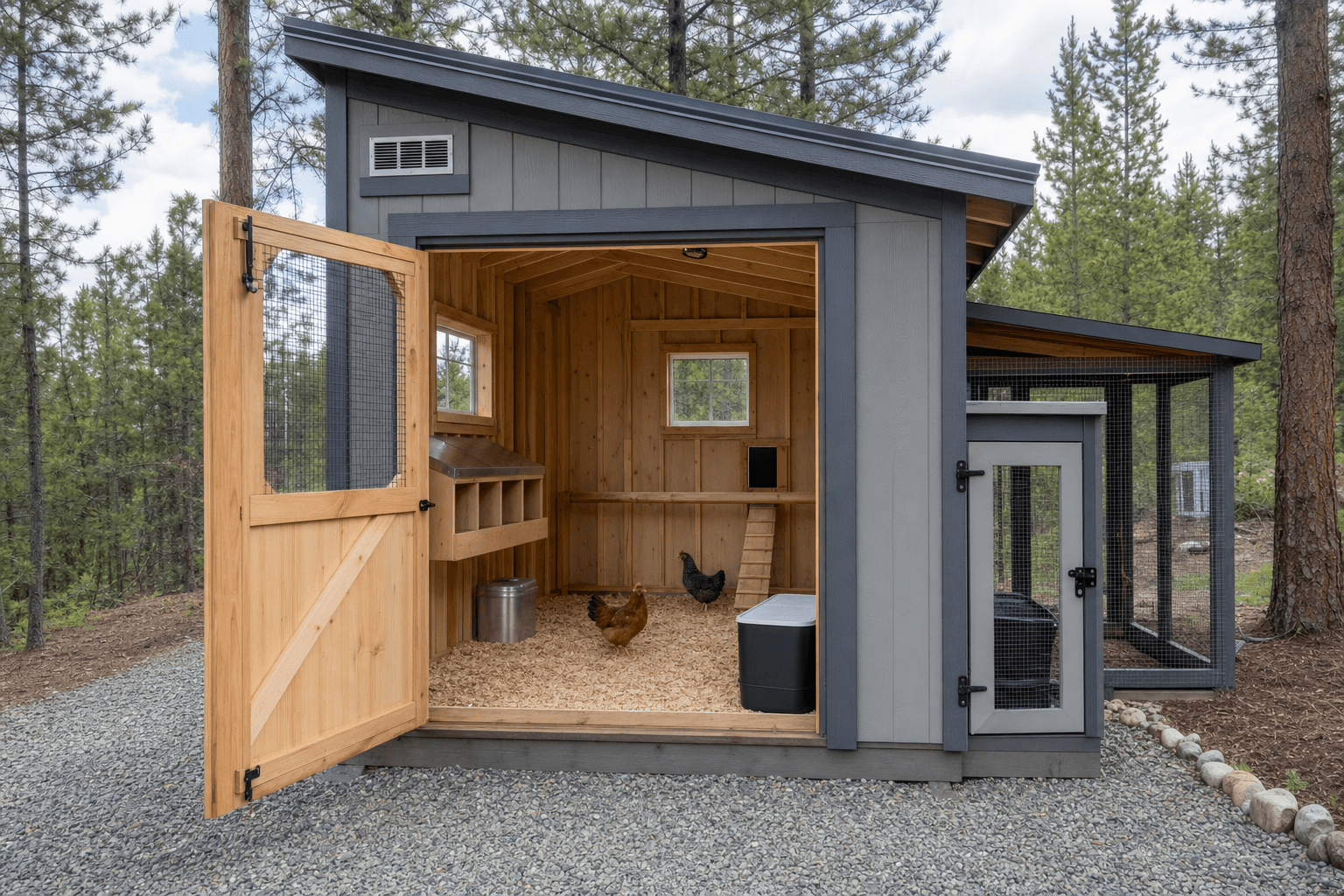
Zoned for the flock: roosting bars sit highest, nesting boxes lower and tucked in the dark, and protected vents exhaust moist air up near the roof.
A chicken coop works far better when you plan the inside as a set of zones that match how birds actually use the space, because a flock has strong instincts about where to sleep, where to lay, and where to eat, and a coop that respects them stays cleaner and calmer. Start with the roosting zone, the highest place in the coop, because chickens want to sleep up off the floor and will pile onto the highest perch they can find. Mount sturdy roosting bars, ideally a flat two-by with the edges rounded so birds can cover their feet in winter, higher than the nesting boxes and set back from the wall, allowing roughly eight to ten inches of bar per standard hen so nobody gets crowded off the perch. Below and apart from the roosts comes the nesting zone, a row of dim, private boxes set lower than the bars so hens don't roost in them and foul the eggs, with one box for every three or four hens. Then plan the feed and water zone, raised off the floor to keep bedding and droppings out of it, positioned away from under the roosts so it doesn't catch the night's manure, and ideally close to your storage so refilling is a few steps. Reserve a floor and litter zone, the open scratching and dust-bathing space where the birds spend their waking hours indoors and where the bedding does its work. Finally, plan the access and run zone, the human door you clean through, the small pop door the birds use to reach the attached run, and the transition between them, all secured so the same opening that lets birds out doesn't let predators in. Sketching this layout, roosts highest, boxes lower and dark, feed and water raised and clear of the roosts, on paper before you settle on a footprint is the fastest way to tell whether a 6x8 will do or whether you'll want the room of an 8x10 or 8x12.
This is the most misunderstood part of a coop and the one that matters most for welfare. Chickens give off a surprising amount of moisture and ammonia, and that damp air, not the cold itself, is what causes frostbite and respiratory illness. Plan generous vents placed high near the roofline, above the height of the roosting birds, ideally protected under the eaves so they exhaust warm, moist air all winter without ever blowing a draft across the flock. The goal is a coop that breathes constantly but never feels windy where the birds sleep.
Nearly everything in North Idaho will try for a chicken: raccoons, weasels, mink, skunks, hawks, owls, coyotes, and dogs. Cover every window and vent with welded hardware cloth rather than flimsy chicken wire, which a raccoon can tear or reach through, and fasten it with screws and washers, not staples. Fit the pop door and the human door with predator-resistant latches a clever raccoon can't work, and on an attached run, skirt the hardware cloth outward or bury it so diggers can't tunnel under. A covered run section also blocks hawks and keeps snow out.
A coop you dread cleaning is a coop that gets dirty, and dirty bedding is how disease and ammonia take hold, so plan the floor to be scraped and emptied fast. A sealed, smooth floor, or a removable droppings board under the roosts where most manure lands overnight, lets you clear the worst of it in minutes. Many keepers run a deep-litter system over a dry, sealed floor, building up pine shavings that compost in place, which works only if the floor stays dry and the air moves. Either way, smooth, sealed surfaces and a wide door make mucking out quick.
Give hens private, dim nesting boxes, roughly twelve inches square for standard breeds, one per three or four birds, set lower than the roosts and bedded soft so eggs stay clean and unbroken. Mount roosting bars as flat, splinter-free perches higher than the boxes, with enough total length that every bird has its own space on the bar. Getting the heights right, roosts clearly above boxes, is what stops hens sleeping and pooping in the nests, which is the single most common rookie coop problem.
The keywords for a chicken coop are healthy flock, and the fit-out is everything that keeps living birds safe, dry, fed, and comfortable through the year. For sleeping and laying: flat roosting bars sized for the flock, a row of dim nesting boxes with soft bedding, and a droppings board or sealed floor beneath the roosts. For air and warmth: high, protected vents that exhaust moisture without a draft, an insulated or at least tight, dry shell, and in a hard winter a safe, low source of warmth or simply enough birds and bedding to hold their own heat. For security: welded hardware cloth on every opening, predator-proof latches on the pop door and the human door, and a skirted or buried apron around an attached run so nothing digs in. For feeding and watering: a raised feeder and a waterer kept clear of the roosts, plus a heated base or a plan to keep water from freezing solid in winter. For cleaning: a sealed, smooth floor, a wide human door, pine-shaving or deep-litter bedding, and easy access to scrape the boards. For the run: a secure, roomy attached run, ideally with a covered section so the birds can get outside to scratch and dust-bathe even when snow is down. Walk through your own version of this list before you settle on a size, because a coop fills up fast once you add roosts, boxes, a feeder, a waterer, and bedding for a growing flock, which is exactly why people who start with a few hens are rarely sorry they sized up from a 6x8 to an 8x10 or 8x12.
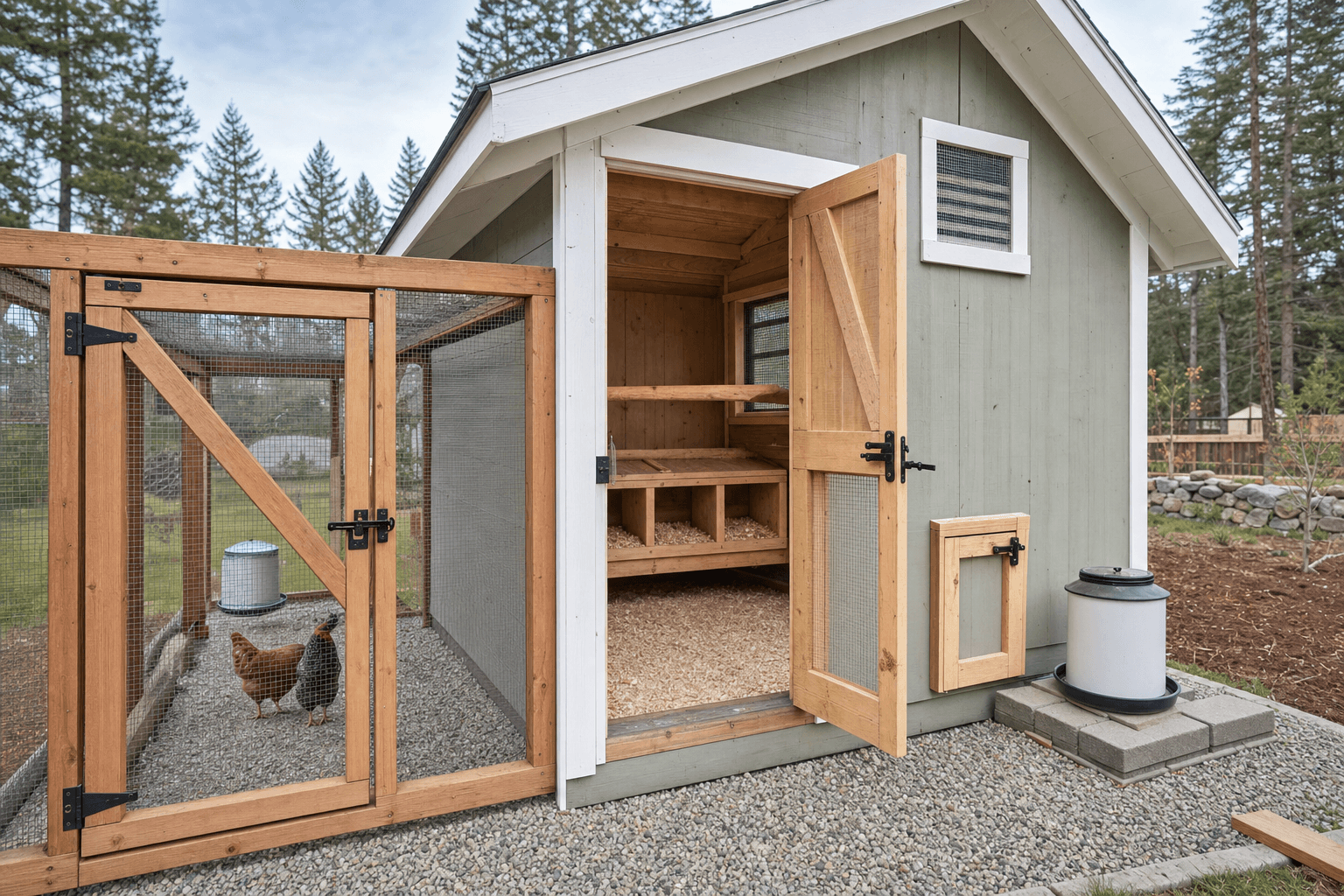
The details that keep a flock safe: welded hardware cloth screwed over every opening, protected high vents, and soft, private nesting boxes set below the roosts.
| Chicken coop planning checklist | |
|---|---|
| Best roofline | Standard gable for roost height and protected ridge venting; lofted barn or gambrel for feed and bedding storage above; single-slope modern to tuck against a fence and shed snow off the back |
| Practical sizes | 6x8 for a small flock of eight to ten hens, 8x8 to 8x10 for a dozen-plus birds with feed and bedding inside, 8x12 for a large flock or a built-on covered run |
| Ventilation | Generous vents placed high near the roofline above the roosting birds, protected under the eaves so they exhaust moist air all winter without drafting the flock |
| Predator-proofing | Welded hardware cloth screwed over every window and vent, predator-resistant latches on both doors, and a buried or skirted apron around an attached run |
| Floor and bedding | Smooth sealed floor with a droppings board under the roosts, pine shavings or a deep-litter system, and a wide door so mucking out is fast |
| Winter readiness | Tight, dry, draft-free shell, roosts wide enough to cover feet, a freeze-proof or heated waterer, and a safe low heat source only if a hard cold snap demands it |
A few practical systems decide whether your flock sails through a North Idaho winter or struggles, and chickens are surprisingly cold-hardy when the coop is dry and draft-free, so the goal is rarely to make the coop warm and usually to keep it dry, secure, and lit. Power is worth running because a heated waterer base, a few hours of supplemental light, and the occasional safe heater all want electricity, so plan a dedicated circuit run from your home's panel by a licensed electrician, usually in buried conduit out to the coop, with weatherproof outlets mounted where cords can't tangle with the birds or the bedding. Light matters because hens slow or stop laying as the short, dark Panhandle days set in, and many keepers add a timed low-wattage light to hold the day length around fourteen hours and keep eggs coming through winter, while others prefer to let the flock rest naturally, so plan the wiring so you have the choice. Water is the chore that bites hardest in a cold winter, because an open waterer freezes solid overnight, so plan for a heated waterer base, a heated dish, or a freeze-resistant nipple system kept on its own circuit, positioned off the floor and clear of the roosts. Winter readiness ties it together, because the real threats in January are dampness and frostbite, not the cold number on the thermometer: a tight, well-ventilated, draft-free shell lets moisture escape up high while the birds stay calm and feathered-up on a wide roost that lets them cover their feet, and a heat lamp is a genuine fire risk in a dusty, bedding-filled coop, so most experienced keepers avoid it and rely on dryness, ventilation, and the flock's own warmth instead, adding a safe, enclosed heater only for a true deep cold snap. We frame and build the coop tight, dry, and ready on your property so your electrician can finish the circuits and you can keep the flock healthy through the winter.
A coop stays dry, level, and predator-resistant only on a solid, well-drained base, so most chicken coops sit on a compacted gravel pad sized about a foot wider than the building on each side, which lets rain and snowmelt drain away instead of pooling under a building full of birds and bedding. A gravel pad also helps deter the diggers, since predators have a harder time tunneling through compacted rock than through soft soil, and it keeps the floor up off wet ground. Some keepers prefer a sealed slab for the easiest possible cleaning, while many do fine with a raised, sealed wood floor over gravel; either way the priority is a dry floor that drains and hoses out. North Idaho weather drives the rest of the plan. Design the roof for local snow load so it shrugs off a heavy winter and the run cover doesn't sag, keep the floor up off the ground so spring melt drains away rather than wicking into the bedding, and build the shell tight enough that the birds stay dry and freeze-protected while the high vents still let moisture out. Because chores happen every day in every season, place the coop where a cleared path or the gravel driveway lets you carry feed and bedding in and muck waste out year-round, and where our crew can bring materials in to build. We build with weather-rated framing and finishes suited to pine-country freeze-thaw cycles, and we set the structure to drain and breathe so it lasts and stays healthy inside. On permits, the deciding factor is usually your jurisdiction and how the building is used, not just its size. A small detached coop under your county or city's size threshold often needs no building permit, but many areas have their own rules about keeping poultry, including limits on flock size, restrictions on roosters, and setback distances from property lines and neighboring homes, and an HOA may add rules of its own. Confirm both the building requirements and the local livestock or nuisance ordinances with your local building department before you finalize the size and where it sits. Once you know what your area allows, we plan the build around it so the structure, the run, and the placement all line up.
Hens share nesting boxes, so you need fewer boxes than birds: plan one box for every three or four standard hens, sized roughly twelve inches square and set in a dim, private spot, because a hen wants a quiet, dark place to lay and several will happily take turns at a favorite box. Roosting bars are different, since every bird wants its own space on the perch at night, so plan about eight to ten inches of bar per standard hen and run enough total length that the whole flock can roost without anyone getting crowded onto the floor. The critical detail is height: the roosting bars must sit clearly higher than the nesting boxes, because chickens instinctively sleep on the highest spot they can reach, and if the boxes are as high as or higher than the roosts the birds will sleep and poop in them and foul your eggs. Use a flat, splinter-free perch like a rounded two-by so the hens can settle down and cover their feet in winter rather than gripping a thin round dowel. We build the shell so your roosts and boxes mount cleanly at the right heights for a calm, clean flock.
This is the question that trips up most first-time coop owners, and getting it right is central to the flock's welfare. Chickens are cold-hardy but they give off a lot of moisture and ammonia, and it's that damp, stale air, not the cold, that causes frostbitten combs and respiratory disease, so a coop actually needs a lot of ventilation even in winter. The trick is where you put it: place generous vents high near the roofline, above the height of the birds on their roosts, ideally tucked up under the eaves and protected from blowing weather, so warm, moist air rises and escapes constantly without ever moving across the sleeping flock. What you want to avoid is openings at roost level or low on the walls that send cold wind straight over the birds. Done right, the coop breathes around the clock, stays dry, and never feels drafty where it counts. We build the shell tight where the birds sleep and vented high where the moisture leaves, which is exactly the balance a healthy winter coop needs.
Predator pressure here is serious, with raccoons, weasels, mink, skunks, hawks, owls, coyotes, and loose dogs all hunting chickens, so security has to be built in rather than added after a loss. The single most important upgrade is to cover every window, vent, and run panel with welded hardware cloth, not chicken wire, because a determined raccoon can tear chicken wire or reach right through it, and to fasten that cloth with screws and washers rather than staples a predator can pry loose. Fit both the human door and the small pop door with predator-resistant latches, since raccoons are clever enough to work simple hooks and slide bolts. For an attached run, stop diggers by burying the hardware cloth down into the ground or, easier, by laying a skirt of it flat on the surface extending outward from the base so a digging animal hits wire and gives up, and add a covered top section to block hawks and owls from above. Closing the pop door every night adds a reliable last line of defense. We build the coop and run shell tight and frame the openings so your hardware cloth seals cleanly with no gap a predator can exploit.
In almost every case, no, and trying to heat a coop often does more harm than good. Standard laying breeds are remarkably cold-hardy and stay warm by fluffing their feathers and roosting together, so a healthy flock handles a Panhandle winter fine as long as the coop is dry, well-ventilated, and free of drafts where they sleep. The real winter dangers are dampness and frostbite, which come from trapped moisture, not from the temperature itself, so the priority is a tight, draft-free shell with plenty of high ventilation to carry moisture out, plus wide, flat roosting bars that let the birds settle down and cover their feet and combs. Heat lamps are a genuine fire hazard in a dusty, bedding-filled coop and cause coop fires every winter, so most experienced keepers avoid them entirely. If a true deep cold snap arrives, a safe, fully enclosed radiant panel heater on its own circuit is a far better choice than a clamp lamp, but for ordinary North Idaho cold, dryness, ventilation, and the flock's own body heat are what keep them comfortable. We build the coop tight and dry so the birds stay warm on their own and you rarely, if ever, need to add heat.
A coop you can clean fast is a coop that stays healthy, because built-up wet droppings are what drive ammonia, flies, and disease, so plan the floor and bedding for quick chores from the start. A smooth, sealed floor is the foundation, since it scrapes and hoses clean and doesn't soak up moisture the way bare wood does. The biggest time-saver is a droppings board or removable tray mounted under the roosts, because chickens produce most of their manure overnight directly below where they sleep, so catching it on a board you can scrape each morning keeps the rest of the coop remarkably clean. From there, many keepers run a deep-litter system, building up pine shavings on the floor that compost slowly in place and only need a full clean-out a couple of times a year, which works beautifully but depends on a dry, sealed floor and good ventilation to keep the litter from going damp and sour. Avoid cedar shavings, which can irritate birds' airways, and stick with pine or a similar soft bedding. A wide human door is the last piece, since it lets you get a rake, a shovel, and a wheelbarrow in to muck out without a fight. We build the floor and the door so cleaning the coop is a quick job rather than a dreaded one.
Size comes down to how many birds you keep and, just as importantly, their welfare, since crowding is the number-one cause of pecking, stress, disease, and dropped egg production. Inside the coop, plan for roughly four square feet of floor per standard-size hen, so a 6x8 comfortably and humanely houses a small backyard flock of about eight to ten birds with their roosts, boxes, and an easy-clean floor, an 8x8 or 8x10 suits a dozen or more hens with room to store feed and bedding and to walk in and clean, and an 8x12 fits a larger flock or lets you build part of the footprint as a covered, secure run. The attached run should be even more generous, because birds spend their waking hours out there scratching and dust-bathing, so aim for at least eight to ten square feet of run per bird, and more is always better for behavior and health. A covered or partly covered run is a real advantage in North Idaho, since it gives the flock a snow-free, hawk-safe place to be outside through the winter when an open run is buried or exposed. The honest advice is to size up rather than down on both the coop and the run, because a little extra room keeps a flock calm, clean, and laying, and most people are glad they built bigger once a few hens turn into a real backyard flock. Tell us your flock size and we'll help you match the coop and run to it.
Keeping backyard chickens in North Idaho means building a coop that handles genuine winter. Coeur d'Alene sits in a climate zone where overnight lows below 0°F are possible in January, and a coop that relies entirely on passive heat from the birds will struggle to keep water thawed and combs frost-free during the worst cold snaps. A chicken coop shed built on site can be framed with insulated walls and a well-sealed ceiling — details that make a real difference in January without requiring a heat lamp running continuously.
Ventilation is the part most first-time coop builders get wrong. Chickens produce significant moisture from respiration, and a tight, unventilated coop will have dripping condensation on cold surfaces within days. The right ventilation is high on the wall — above roost height — so cold air does not fall directly onto birds while moisture-laden air still escapes. That placement is a framing decision, not an afterthought.
Predator pressure in North Idaho is real. Coyotes, weasels, raccoons, and birds of prey are regular visitors in Hayden, Rathdrum, and rural Kootenai County. A coop built with hardware cloth rather than chicken wire, a concrete or hardware cloth apron around the base, and a secure door latch survives predator attempts that flimsy prefab coops do not. On-site framing integrates these details into the structure itself.
City limits in Coeur d'Alene allow backyard chickens with hen limits and setback requirements — check the current municipal code for your zone before sizing the run. County parcels typically have more flexibility. See what a finished backyard building looks like, then design the coop footprint in the configurator to check whether it fits your lot.
Tell us how many birds you keep and we'll help you size, lay out, and price a draft-free, predator-proof coop with the nesting boxes, roosts, easy-clean floor, attached run, and winter readiness your North Idaho flock needs.
Keep planning your build with related North Idaho shed guides.