A backyard playhouse is the kind of thing kids remember for the rest of their lives. It's their own front door, their own windows, their own little house in the yard where they run the rules, and for a few years it's the center of every summer. The best ones aren't plastic boxes that fade and crack after two winters. They're real, solid buildings, scaled down so a child can open the door and look out a window without help, but framed and finished to the same standard as anything else we build on your property. That's the difference between a toy that gets dragged to the curb and a playhouse the next kid in the family inherits, and eventually a tidy garden building you keep using long after the kids have moved on to other things.
The whole point of building one on purpose, rather than buying a kit, is that you get to make the decisions that actually matter for a child's building: how the construction keeps small hands and heads safe, how the door and windows are sized and finished, how well the inside breathes on a hot afternoon, and how easily you can wipe down a wall after a craft session goes sideways. Plan those well and you get a space that's genuinely safe, holds up to years of hard play, and quietly converts to storage when the time comes. This guide walks through the styles that suit a kids' playhouse, the sizes that fit how children actually play, how to lay out and finish the inside for safety and cleanup, and how we build the shell on your land so it's sturdy, dry, and ready for years of use. If you'd rather see a footprint priced out first, you can build and price a layout in a few minutes and come back to the details.
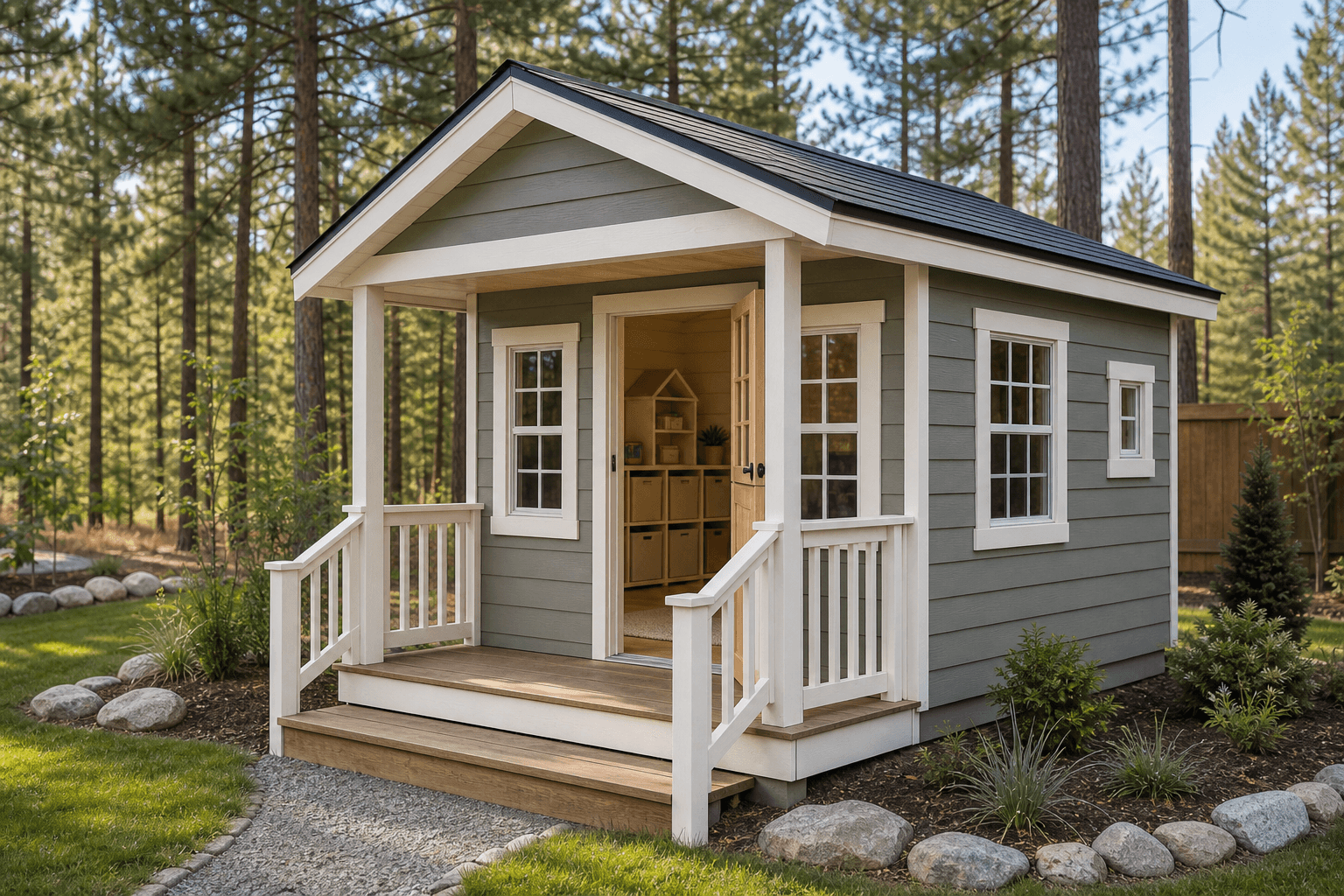
A real building, scaled for kids: a low door, windows at child height, and finishes that wipe clean.
A standard gable is the natural choice for a playhouse, and not just because it looks like the little house a child draws. The straight walls and simple peaked roof read as a real cottage, they give you flat surfaces inside for a play kitchen, a craft table, or a bookshelf, and the symmetry leaves clean wall space for windows at the right height. A lofted barn (gambrel) roof is the other favorite, because the extra headroom up top turns into a low, railed loft your kids will treat as a secret hideout, a reading nook, or a lookout. If you go that route, the loft has to be planned for safety from the start, with a sturdy guard rail, a wide and gentle ladder or stair, and a low ceiling that a child can stand under but can't fall far from. A model with a small covered porch adds a sheltered spot to sit, a place for muddy boots, and a bit of shade on a bright Panhandle afternoon, all of which make the building more useful and keep more of the play out of the rain.
Because a playhouse is built for children rather than for tools, the priorities lean hard toward safety and durability over raw capacity, which sets it apart from the other small buildings we make. It's worth looking at how we handle a finished, light-filled she-shed when you're weighing windows and interior finishes, since a playhouse borrows the same idea of a comfortable, well-lit little room, just built tougher and lower. Whatever roofline you pick, plan the building as a safe, child-scaled space: rounded and sanded edges, a door and windows a kid can work without pinching fingers, good airflow, and surfaces you can clean without a second thought.
A snug clubhouse for solo and side-by-side play, with room for a small table, a few toy bins, and a play kitchen along one wall. A 6x8 is plenty for toddlers and early grade-schoolers.
Space for a craft table, dress-up storage, a rug for floor play, and a couple of friends at once without anyone stepping on toes. An 8x8 or 8x10 covers the busy years well.
If you want a loft, a porch, and a footprint that earns its keep as a shed later, an 8x12 gives you a building the whole family uses long after the play years end.
Footprint is the decision everything else rides on, so size for how your kids actually play and for what the building becomes once they outgrow it. A 6x8 shed is a genuinely cozy clubhouse: 48 square feet holds a small play table, a play kitchen, and a few bins of toys, which is exactly right for one or two younger children who mostly want a door to close and a window to peek out of. Step up to an 8x8 shed and the square footprint gives every wall a job, a craft station on one side, dress-up and book storage on another, and an open patch of floor in the middle for blanket forts and group play. An 8x10 shed is the sweet spot for the busy years, with room for a play kitchen, a table that seats a few friends, a reading corner, and storage that keeps the floor clear, and the extra length leaves space for a loft ladder if you add one. The 8x12 shed is the size to choose when you're thinking past the play years from the start: it carries a loft and a porch comfortably, it never feels crowded, and when the kids move on it converts cleanly into a garden, tool, or general storage building you'll actually use. As a rule, size for the play plus a little room to grow, because a playhouse that's tight on day one is tight for every birthday after.
These small buildings overlap more than people expect, and the right one depends on who's using it and for how long. A playhouse is built around children: lower door and windows, soft and sanded edges, tough washable surfaces, and a layout that flexes from a clubhouse to a hobby room. If the building is really for the grown-ups, a finished she-shed puts the budget into insulation, heat, and a quiet, comfortable interior instead of kid-height fittings and crash-proof finishes. A dedicated hobby shed is organized around a specific craft or activity, with the bench, storage, and power tuned to that work rather than to play, and it's a natural second life for a playhouse once your kids are into projects of their own. And if you mainly need a place to put things, a plain storage shed skips the windows and finishes entirely and spends every dollar on shelving and floor space. Many families land on a playhouse precisely because it can be all of these in sequence: a clubhouse now, a craft or homework room in a few years, and a storage building after that, without ever being torn down and replaced. If you're torn, build for the way the kids will use it for the next handful of summers, and pick a size and roofline that convert gracefully when those summers are over.
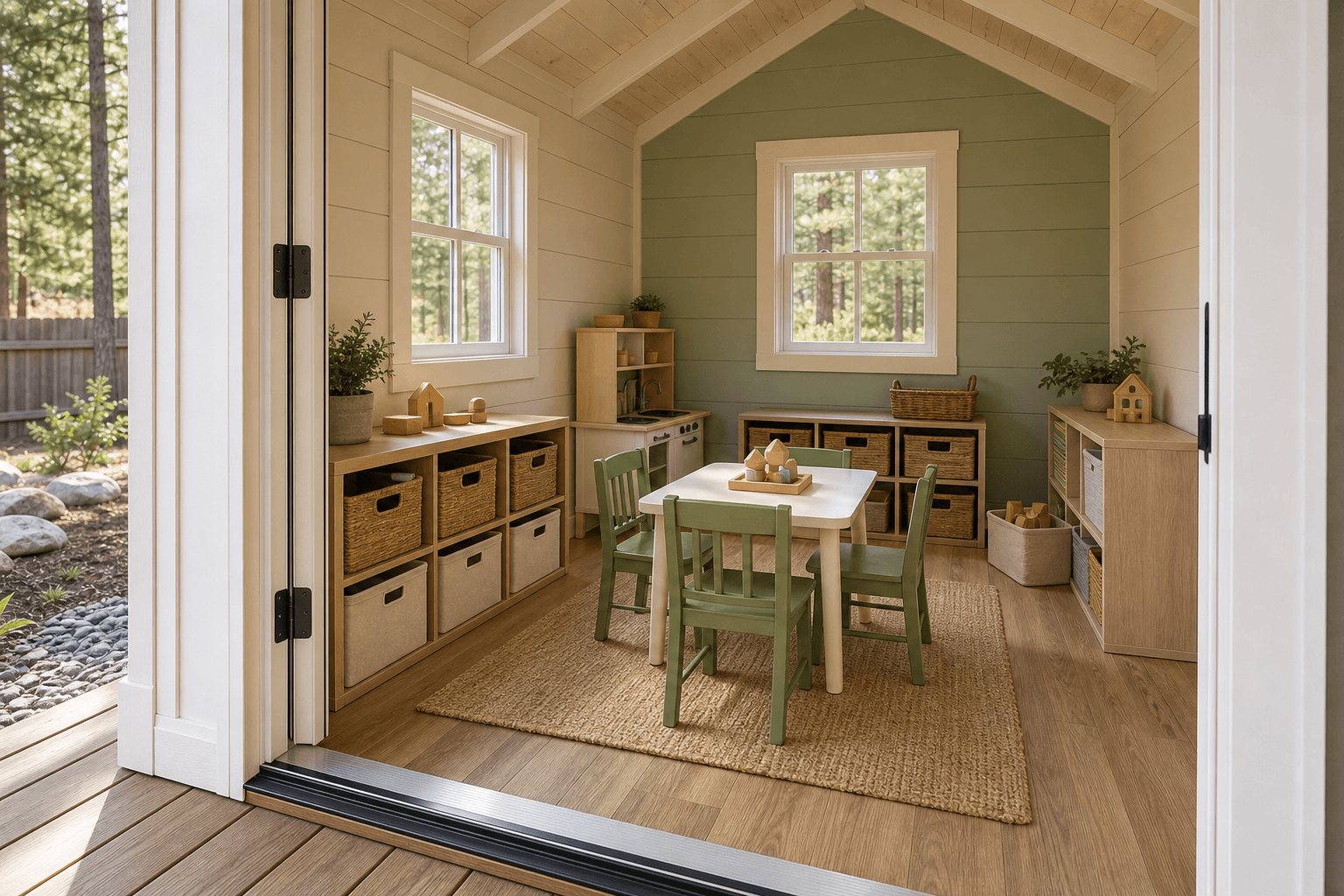
Zoned for play: a make-believe corner, low storage kids can reach, and a clear, padded floor.
Even a small playhouse plays bigger and stays safer when you think of it as a few simple zones instead of one open box. Start with a clear play floor in the middle, kept open for floor games, building, and the inevitable blanket fort, with a soft rug or interlocking foam mats so falls are gentle and the floor is warm to sit on. Around the edges goes a make-believe zone: a play kitchen, a small table and chairs, or a workbench against a wall, set at a child's height so kids can use it without climbing. Build a low storage zone the kids can actually reach, with short open shelves, labeled bins, and a toy chest with a soft-close or lightweight lid that can't slam on fingers, so cleanup is something a child can do alone and toys don't end up underfoot. Keep a calm corner by a window for books, drawing, or a quiet moment, where the best light lands and a beanbag or cushion makes it inviting. If you add a loft, treat it as its own zone with a guarded edge, a gentle ladder or stair, and nothing stored up there that a child shouldn't be lifting. Sketching these zones on paper before you lock in a footprint is the fastest way to tell whether a smaller building will do or whether you'll want the extra wall length of the next size up, and it doubles as a map for how the same room will hold shelving and gear once it becomes storage.
Rounded, sanded edges and corners, no exposed fastener points at kid height, safety glass or shatter-resistant acrylic in the windows, pinch-guarded doors, and low-VOC, child-safe paints and sealers so the building is genuinely safe to play in every day.
Washable, scrubbable wall surfaces, sealed and slip-resistant flooring or wipeable mats, and a tough exterior coating that shrugs off sticky hands, marker, mud, and years of hard use without looking beaten up.
Operable windows on more than one wall for cross-breeze, a screened vent or window screens to keep bugs out, and a roof and openings placed so the inside stays cool and airs out on hot afternoons instead of turning into an oven.
A standard footprint, full-size framing, and a roofline that suits a future shed mean the playhouse becomes a garden, hobby, or storage building down the road, so the investment keeps paying off long after the play years.
The keyword for a playhouse is safe, washable fun, and the fit-out is everything that delivers it. For make-believe: a play kitchen, a market stand or puppet theater, a small table and chairs, a chalkboard or dry-erase panel on the wall, and a dress-up rack with a bin of costumes. For active play and comfort: a soft rug or interlocking foam mats, a beanbag or floor cushions, and a reading corner with a few low shelves of books. For storage that kids can manage: short open shelving, labeled toy bins, a lightweight toy chest with a safe lid, wall hooks at child height for bags and coats, and a basket by the door for muddy boots. For safety and air: shatter-resistant or safety glass windows that open, window screens, a screened vent, soft corner guards on any hard edges, and a door that latches but that a child can always open from the inside. For the practical side: a small broom and dustpan sized for kids, a clock, and a couple of battery lanterns or a simple light if you run power. Walk through your own version of this list before you settle on a size, because a play kitchen, a craft table, a reading corner, and a clear floor add up fast, and a 6x8 shed fills the moment you add storage on top. That's why most playhouses that see daily use start around eight feet on a side, and why families who size up rarely regret it once the toys, the table, and the open floor all have to share one room, and even less once the building moves into its storage years.
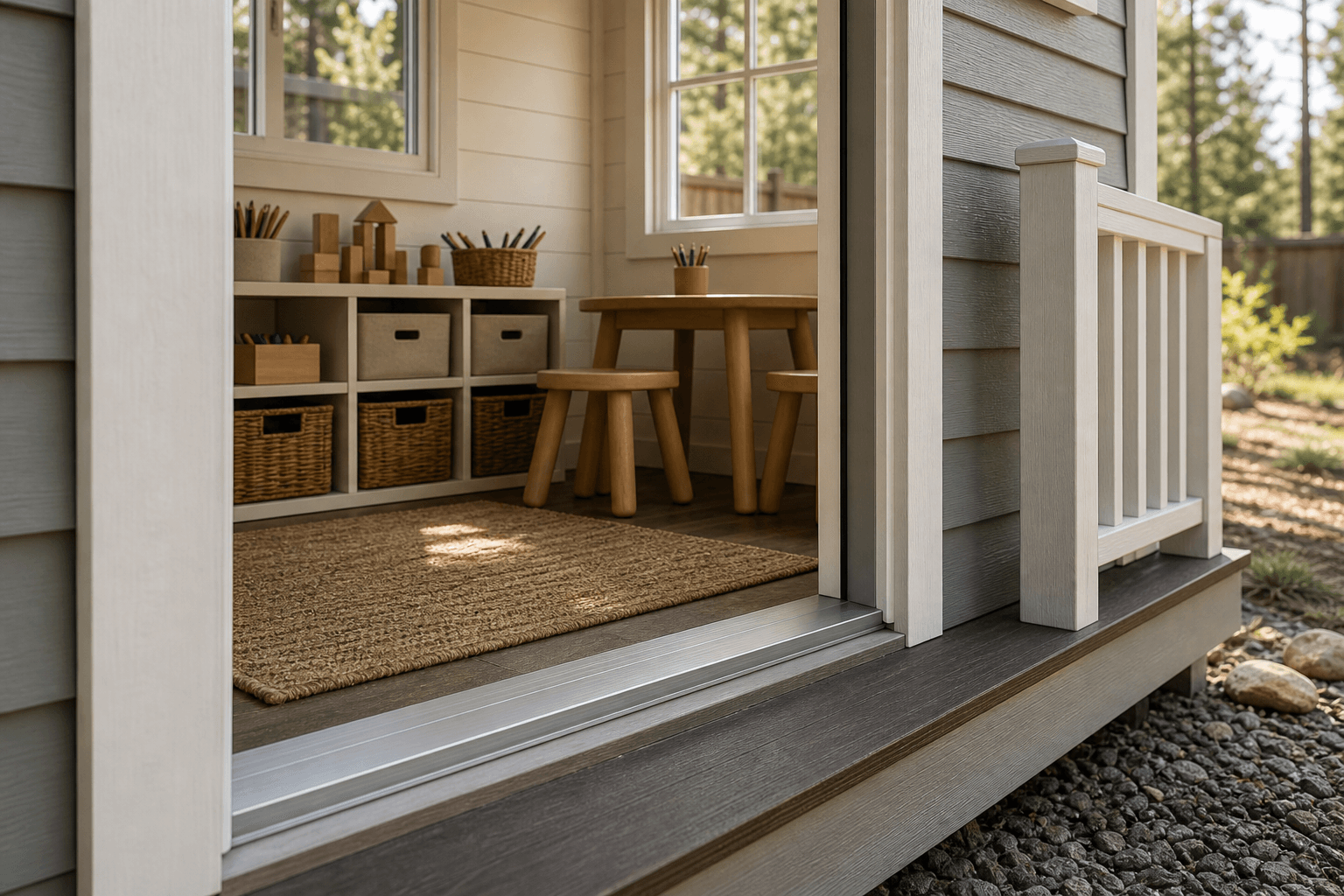
The safety details that matter: a sanded sill, a screen for airflow, and a latch a child can work alone.
| Playhouse planning checklist | |
|---|---|
| Best roofline | Standard gable for a classic look; lofted barn for a safe railed loft; add a covered porch for shade and boots |
| Practical sizes | 6x8 for one or two little kids, 8x8 to 8x10 for the busy years, 8x12 for a loft, a porch, and easy conversion later |
| Child-safe build | Rounded sanded edges, safety glass or acrylic glazing, pinch-guarded doors, and low-VOC child-safe paints and sealers |
| Durable finishes | Washable, scrubbable walls and a sealed, slip-resistant floor or wipeable mats that take years of hard play |
| Ventilation and light | Operable windows on two walls for cross-breeze, screens for bugs, and a screened vent so it stays cool and airs out |
| Built to convert | Full-size framing and a standard footprint so it becomes a garden, hobby, or storage shed when the kids grow up |
A playhouse usually doesn't need the wiring a finished adult room does, but a little planning around light and air goes a long way, and it sets the building up for its second life. Most families keep electricity out of a playhouse on purpose, since kids and outlets aren't a great mix, and lean on natural light and battery lighting instead: generous, well-placed windows make the inside bright through the day, and a couple of LED battery lanterns or a stick-on light cover the gloomy corners without a single cord for a child to tug. If you do want a circuit, run it for the future shed rather than for play, place outlets up high and out of easy reach, use tamper-resistant receptacles, and have a licensed electrician do the work in buried conduit so it's safe and ready when the building converts. Staying cool is the bigger day-to-day concern in a small kids' building, because a closed-up box bakes fast in summer sun, so plan operable windows on at least two walls for a real cross-breeze, add window screens and a screened vent near the roof to let hot air escape, and position the playhouse to catch some afternoon shade if your yard allows. Staying dry keeps it safe and lasting: a tight roof, flashed and sealed window openings, and a floor lifted off the ground keep moisture out, which matters even more in a building where kids sit and play on the floor. We frame and build the shell tight and dry on your property so the windows seal, the inside breathes, and the structure is ready for whatever you finish it with.
A playhouse stays level, dry, and safe to play in only on a solid base, so most sit on a compacted gravel pad sized about a foot wider than the building on each side so water drains away instead of pooling under a building full of kids. Place it where you can keep an eye on it from the house or the kitchen window, on firm ground rather than a low spot that collects spring melt, and far enough from fences and slopes that the play area around it is safe. North Idaho weather drives the rest of the plan. Design the roof for local snow load so it carries a heavy Panhandle winter without strain, keep the floor up off the ground so freeze-thaw and runoff drain away instead of wicking into a floor kids sit on, and set the building where the gravel driveway or a clear path lets our crew bring materials in to build. We build with weather-rated framing and finishes suited to pine-country freeze-thaw cycles, and we set the structure to drain and breathe so it lasts and stays dry inside through years of seasons. On permits, a small detached playhouse under your jurisdiction's size threshold often needs no permit, but the moment you add a loft, a porch, electrical, or a larger footprint, your county or city may treat it as a structure that requires a building permit, an electrical permit, and adherence to setbacks. Rules vary across Kootenai County and the cities around Coeur d'Alene, so confirm with your local building department before you finalize the size, the loft, and where it sits. Once you know what your jurisdiction requires, we plan the build around it so the structure, any rough-in, and the placement all line up.
Child safety is built into the structure, not added on afterward. The edges and corners a child reaches are rounded and sanded smooth, fasteners are set so there are no sharp points at kid height, and the windows use safety glass or shatter-resistant acrylic rather than ordinary glass. The door is hung so it can't pinch small fingers and always opens from the inside, and the finishes are low-VOC, child-safe paints and sealers that are fine to be around every day. If you add a loft, it gets a sturdy guard rail and a gentle, wide ladder or stair, and any hard interior edges can take soft corner guards. We build the shell tight and solid on your property to that standard, then you outfit the inside with the same safety-first mindset.
The goal is surfaces that take abuse and wipe down fast, because a playhouse sees mud, markers, sticky hands, and the occasional spilled juice. Inside, choose washable, scrubbable wall surfaces and a paint that takes repeated cleaning, plus a sealed, slip-resistant floor or wipeable interlocking mats that you can hose off or sponge clean. A chalkboard or dry-erase panel gives kids a place to draw that's meant to be wiped, which saves the walls. Outside, a tough exterior coating shrugs off weather and handprints and keeps the building looking cared for. We frame and finish the shell so it's solid and weather-tight, and you pick interior finishes that match how hard your kids will play, knowing the surfaces are built to be cleaned, not babied.
A small, closed-up building heats up fast in direct sun, so ventilation is a real planning decision, not an afterthought. Put operable windows on at least two walls so you get a genuine cross-breeze rather than stale air, and add a screened vent up high, near the roof, so the hottest air can escape. Window screens keep bugs out while the windows stay open, which matters in a North Idaho summer. Positioning the playhouse to catch some afternoon shade helps a lot if your yard allows it, and a light-colored roof reflects heat better than a dark one. We build the roof and place the openings so the inside breathes and stays comfortable, so the building airs out quickly and never becomes too hot for the kids to use on a bright day.
Both are popular, and both come down to your footprint and how the kids play. A loft, which a lofted barn roofline makes room for, becomes a hideout, a reading nook, or a lookout that kids love, but it has to be planned for safety from the start with a solid guard rail, a wide and gentle ladder or stair, and a low ceiling so any fall is short. A covered porch adds shade, a dry spot to sit, and a place to leave muddy boots before going inside, and it keeps more of the play out of the rain. Both features read better and stay safer on a slightly larger building, which is one reason families choosing a loft or porch tend to start around an 8x10 or 8x12 footprint rather than the smallest sizes. We can frame either into the build so it's solid and safe from day one.
Yes, and planning for it from the start is one of the smartest things you can do, because it turns a few years of play into a building the whole family keeps using. The key is to build the playhouse with full-size framing, a standard footprint, and a roofline that also suits a shed, rather than as a flimsy kit that only ever works as a toy. When the play years end, the same building takes shelving, a workbench, and gear and becomes a garden, hobby, or general storage shed, often with little more than swapping out the play furniture and adding storage systems. Sizing up a little, to an 8x10 or 8x12, gives the most flexible second life, since there's room for real shelving and a clear floor. We build the shell to that durable standard so the conversion is straightforward whenever you're ready.
Size for how your children actually play and for how many of them use it at once, not just for the toys you own today. A 6x8 is a snug, happy clubhouse for one or two younger kids who mainly want a door to close and a window to look out of, with room for a small table, a play kitchen, and a few bins. An 8x8 or 8x10 suits the busy years, when a craft table, dress-up storage, a reading corner, and a clear floor for group play all need to coexist and friends come over to join in. An 8x12 is the choice when you want a loft, a porch, room to grow, and a footprint that converts cleanly to storage later. As a rule, give yourself a little more room than the toys need right now, because a playhouse fills up fast and the extra space pays off every year, both during the play years and after.
A playhouse built on site in Coeur d'Alene or the surrounding Kootenai County starts with something a delivered unit rarely gets right: it's actually sized to your yard and your kids. NIOS frames each playhouse directly on your property, so door heights, window sills, and the crawl clearance underneath reflect real children's measurements rather than a factory average. That also means the framing is engineered for North Idaho snow loads — a 36-inch roof span built for Spokane shipping logistics is not the same as one built to sit under three feet of wet Panhandle snow all winter.
Siting a playhouse on a sloped or wooded lot in Rathdrum or Athol usually rules out a delivered box entirely. On-site framing adapts to grade changes, works around tree roots, and gets the structure level without the compromises a skid-mounted prefab has to make. A compacted gravel pad keeps the floor dry through spring thaw and prevents the seasonal heaving that loosens prefab skids over time.
For parents thinking about the second use, an on-site build holds its value differently. The framing, sheathing, and roofing are the same materials we use in any structure — so converting the playhouse to a storage building or potting space when the kids age out is a straightforward interior swap, not a structural retrofit. Post Falls and Hayden families on smaller lots particularly benefit from that flexibility.
When you're ready to see sizes and options, design it in the shed builder or get a free estimate. You can browse real finished examples at our buildings gallery, and see more about what goes into the build at the Coeur d'Alene service area page.
Tell us how your kids play and we'll help you size, lay out, and price a safe, durable playhouse that converts to storage down the road.
Keep planning your build with related North Idaho shed guides.