A backyard guest house is the building that lets family land for a long weekend, an in-law settle in for a snowy month, or a grown kid come home for the holidays — without anyone sleeping on a fold-out couch or sharing the one bathroom in the main house. Think of it as a comfortable, self-contained room: a real bed, a quiet sitting corner, somewhere to set a suitcase, and often a half-bath or a small kitchenette so guests can make coffee and brush their teeth on their own clock. This guide covers how to plan a guest house for a North Idaho property — the size that fits a queen bed and still feels like a room, how to lay out sleeping and sitting in a small footprint, whether to add a bath or a kitchenette, and the heat and charm that make people actually want to stay.
North Idaho On Site Sheds builds every guest house on your property, so the plan answers to your yard, your trees, and the sightlines from the main house. The goal here is guest comfort, not a second household. A guest house is deliberately lighter than a full accessory dwelling unit — you are creating a welcoming place to sleep and unwind, not a permitted legal residence with a full kitchen, a permanent address, and its own utility hookups. Keep that distinction in mind as you plan, because it shapes everything from the size you pick to how much plumbing you run. Start with the bed and the feeling of the room, then build the rest of the space outward from there.
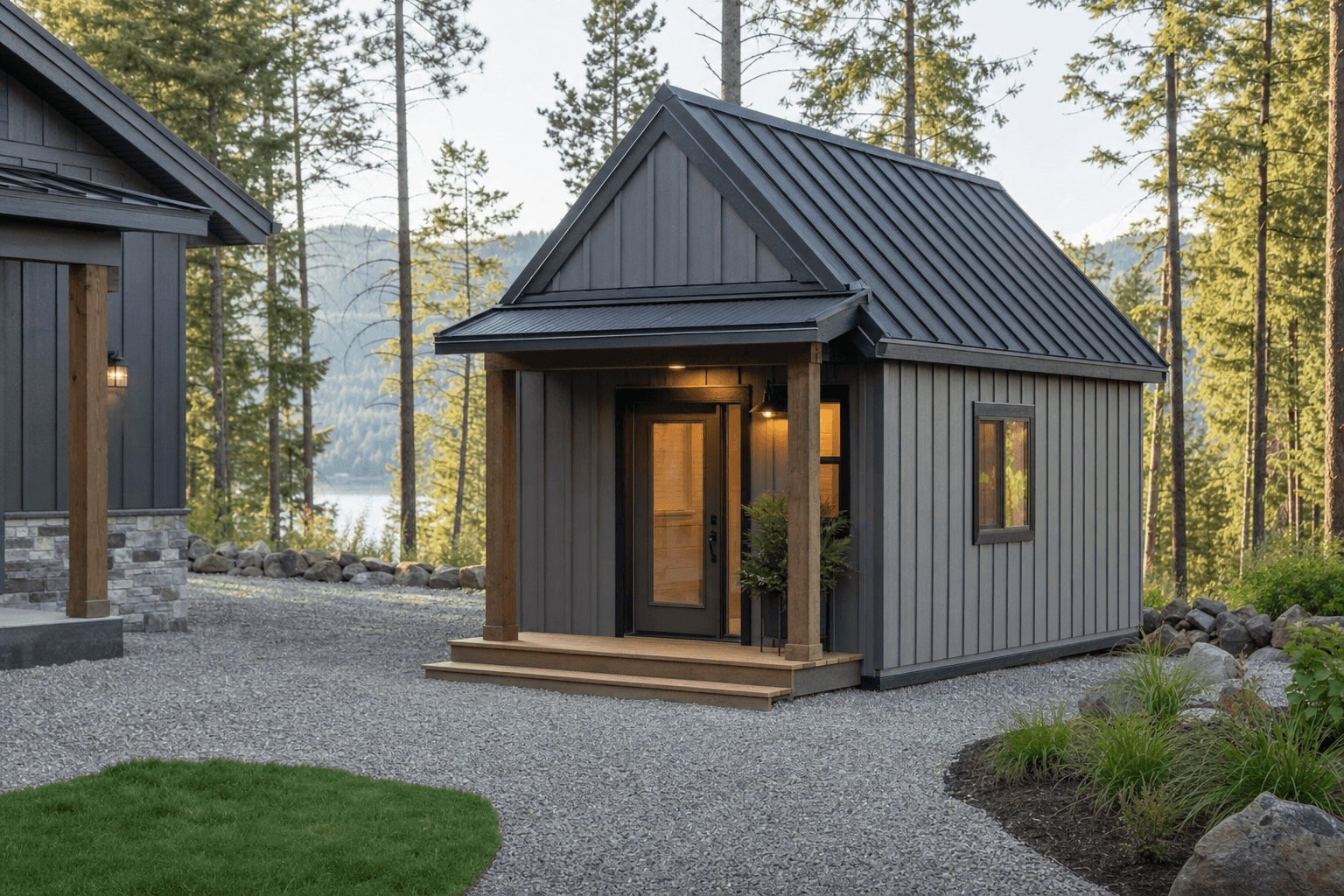
A guest house plan starts with a comfortable bed, a sitting corner, and daylight that makes the room feel like a getaway.
Charm matters more here than in almost any other build, so the roofline does real work. A standard gable is the classic choice for a guest house: the steep, symmetrical roof reads like a little cottage, sheds North Idaho snow cleanly, and gives you a bright, airy ceiling over the bed. Add a covered porch — even a four-foot overhang with room for two chairs — and the building instantly feels like a destination rather than a backyard structure. That porch is the single cheapest upgrade for making guests feel welcomed, and it doubles as a dry spot to shed boots before they track snow inside.
A lofted barn (gambrel) goes further by adding a sleeping loft up top, which is a smart move on a tight footprint: the queen bed climbs into the loft while the main floor stays open for sitting, a kitchenette, and a half-bath. If your taste runs more modern, a lean-to single-slope with one tall wall of glass feels current and frames a view of the trees, though you give up the loft. Where you want the building to feel like a true little home with year-round polish, the plan starts leaning toward a cottage build — more finished trim, a porch, and cottage-style windows. Just stop short of the full kitchen and permitting load of an ADU; that is a different, heavier project.
A queen needs roughly a 10-foot wall with nightstands and walk-around room. Place the bed before anything else; it sets the whole layout.
A guest house that is only a bed feels like a closet. Reserve a corner for two chairs or a loveseat so guests have somewhere to sit that is not the mattress.
A half-bath and a coffee-bar kitchenette each claim a wall. Choose them before you size up, because they change the footprint more than the bed does.
For a comfortable guest room with a queen bed, a sitting corner, and a coffee-bar kitchenette, a 12x16 guest house is the honest starting point — enough for the bed on one wall, two chairs by a window, and a counter with a microwave and mini-fridge, though a bath gets tight. Add a half-bath and you want the extra length of a 12x20: now the bed, the sitting area, the kitchenette, and a small bathroom each have their own zone without crowding each other. This is the size most North Idaho families land on for a true guest house that handles a week-long visit with ease.
If you want the room to breathe — a king bed, a real reading nook, a roomier half-bath, or a kitchenette generous enough to plate a snack — step up to a 14x20. And when the guest house doubles as a long-stay suite for visiting parents or a space that occasionally hosts two guests, a 14x24 gives you room for a bath, a proper sitting area, and even a small dining spot or desk by the window. Past that footprint you are drifting toward ADU territory, where a full kitchen and permitting come into play, so let the length of the stay and the number of guests — not the temptation to keep adding — decide where you stop.
These three look similar from the driveway but solve different problems, and choosing well saves you a lot of cost and paperwork. A guest house is a comfortable place to sleep and relax: a bed, a sitting space, usually a half-bath, and at most a kitchenette for coffee and snacks. It is for hosting, not for housing someone permanently. An accessory dwelling unit is a full, legal second dwelling — a complete kitchen, a full bathroom, permanent utility connections, and the permits and inspections that come with a real residence. If you intend to rent the space, house an adult full-time, or add it to the property's legal value as a dwelling, that is an ADU project, and the planning is genuinely heavier.
A cottage sits between the two in feel: a finished, charming little building with cottage trim, a porch, and year-round comfort, but you decide how far to take the kitchen and bath. Many North Idaho homeowners choose a guest house precisely because it delivers the warmth and privacy guests want without the kitchen plumbing, the permitting timeline, and the cost of a full dwelling. If your plan keeps creeping toward a full kitchen and a permanent occupant, pause and price it as an ADU instead — that is the honest line between the two, and crossing it on purpose is far better than discovering it mid-build.
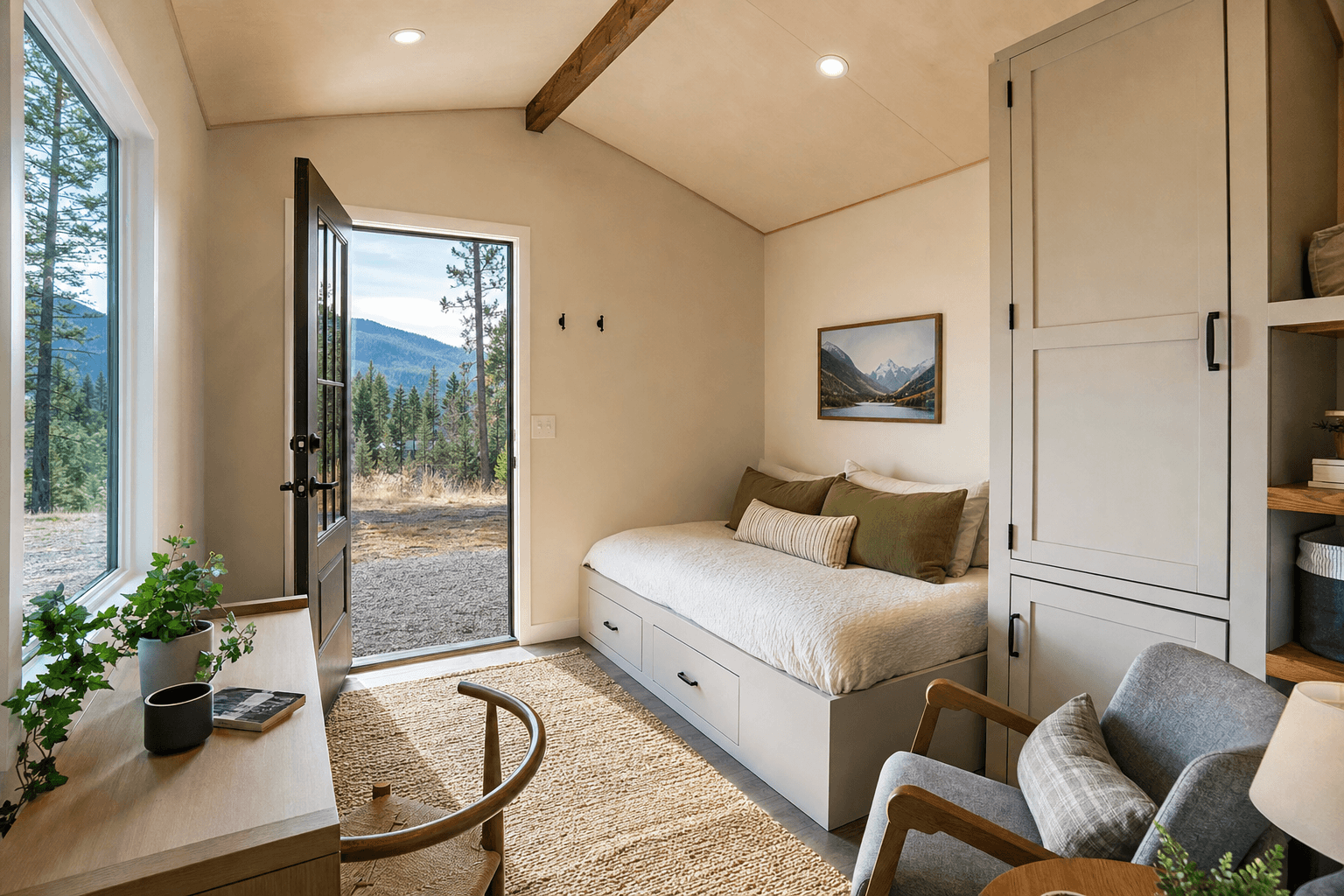
Zoning sleeping, sitting, and a coffee-bar kitchenette keeps a small guest house feeling like a room, not a bedroom crammed with furniture.
A guest house feels generous — even a small one — when sleeping, sitting, and morning routines each get their own corner instead of piling on top of one another. Build it around four zones. The sleep zone is the anchor: place the bed against the most private wall, away from the door and the window a passerby could see into, with a nightstand and a reading lamp on at least one side and ideally both. Give guests a place to set and unpack a suitcase nearby — a low bench, a dresser, or a few open shelves — so living out of a bag feels less like camping.
The sitting zone is what separates a guest house from a glorified bedroom. Reserve a bright corner, usually by a window or the porch door, for two chairs or a loveseat and a small table — somewhere to read, have coffee, or just not be in the main house. The morning zone holds the half-bath and the kitchenette, ideally grouped on one wall so plumbing and the coffee maker share a run and the rest of the room stays restful. Keep the entry zone by the door clear for shoes, coats, and a snowy-boot mat, with a hook or two and a spot to drop keys. Leave a clean path from the door to the bed so a guest arriving late and tired is not navigating furniture in the dark.
Plan the wall for a queen (or a loft for a gambrel) plus nightstands, and add a closet nook or a few shelves so guests have somewhere to hang a coat and stash a suitcase instead of stacking it on the floor.
Two comfortable chairs or a loveseat, a small table, and a lamp by a window. This is the touch guests remember; it turns a sleeping box into a place they want to linger.
Group a half-bath (toilet and sink) and a coffee-bar kitchenette — counter, microwave, mini-fridge, kettle — on a shared plumbing wall so one supply and drain line serves both and the build stays simple.
Warm overhead light plus bedside and reading lamps, a couple of well-placed outlets for phone chargers, and a switch by the bed. Soft, layered light is most of what makes a small room feel cozy.
The small comforts are where a guest house earns its name, so plan for the specific things a visitor reaches for. By the bed: a queen mattress with good bedding, nightstands, reading lamps, a charging outlet within arm's reach, and blackout curtains or blinds for sleeping past a bright North Idaho sunrise. In the sitting corner: two chairs or a loveseat, a side table, a reading lamp, a throw blanket, and a small bookshelf with a few books and board games. Guests notice these things immediately, and they cost very little to get right.
At the coffee-bar kitchenette, plan counter space for a coffee maker or kettle, a microwave, a mini-fridge, a few mugs and glasses, and a small cabinet for snacks and a water carafe — enough to handle breakfast and a late-night cup without a full kitchen. In the half-bath, stock a towel bar, a hook for robes, a mirror, and storage for fresh towels, soap, and the toiletries guests forget. By the door, a boot tray, a coat hook, and a basket for hats and gloves keep North Idaho winters from migrating across the floor. Round it out with the hospitality extras — extra blankets and pillows in a cedar chest, a luggage rack, a clock, a small fan or space heater, and good Wi-Fi reach from the house. A guest house or ADU lives or dies on these details; the building is the easy part, and the welcome is what people remember.
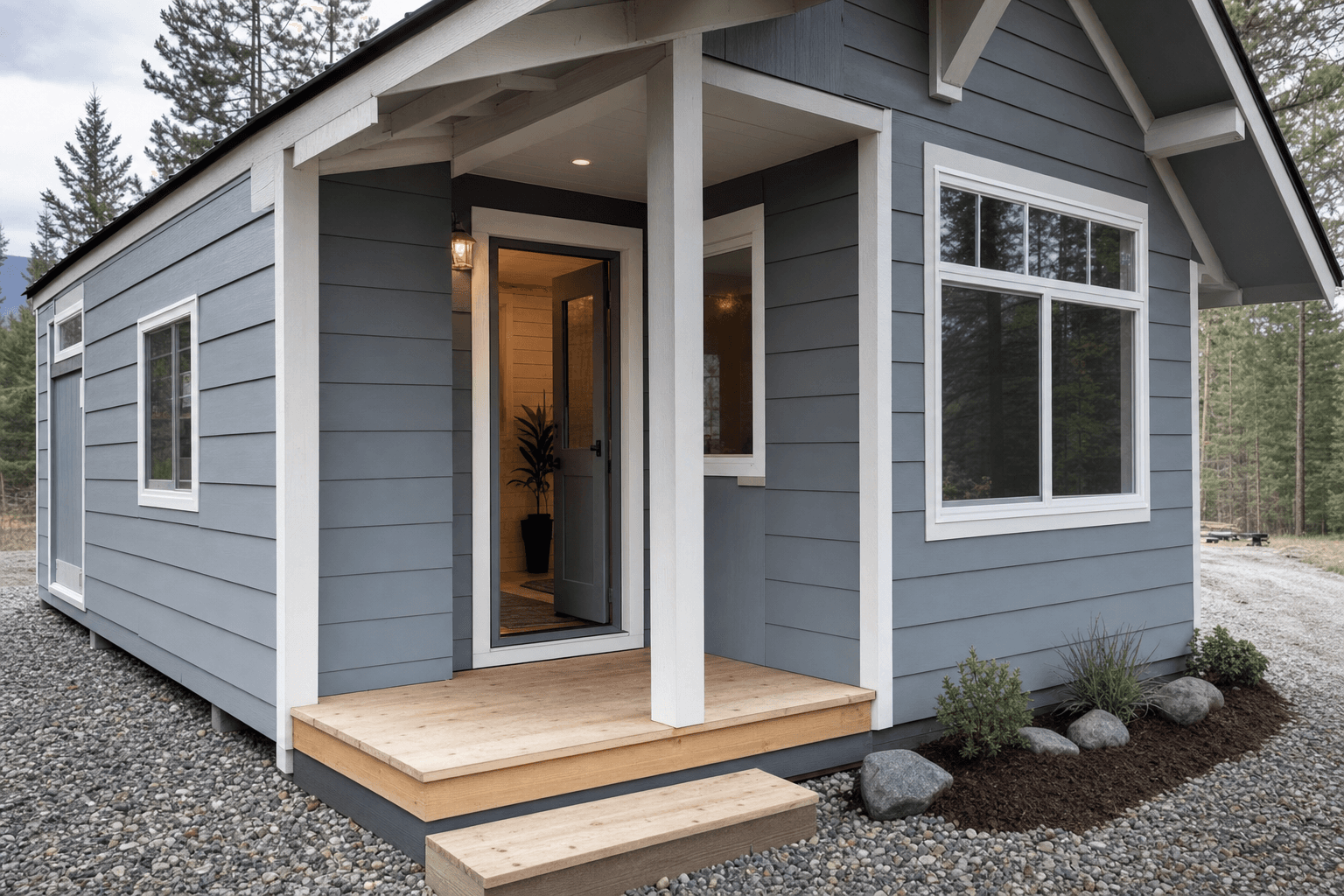
Bedside lamps, a charging outlet, blackout blinds, and a throw blanket are the small touches that make a guest house feel like a getaway.
| Guest house planning checklist | |
|---|---|
| Best all-round size | 12x20 for a queen bed, a sitting corner, a coffee-bar kitchenette, and a half-bath, each with its own zone |
| Sleeping layout | Bed on the most private wall, away from the door; nightstands and reading lamps both sides; or a loft bed in a gambrel to free the floor |
| Bathroom | Half-bath (toilet and sink) is the comfortable baseline; group it with the kitchenette on one plumbing wall |
| Kitchenette | Coffee-bar style: counter, microwave, mini-fridge, kettle, mugs — enough for breakfast, not a full kitchen |
| Heat and insulation | Insulated and a small heat source for seasonal guests; add cooling and a thermostat if family stays through winter |
| Charm factor | A covered porch, real windows for daylight, and warm layered lighting do the most to make guests want to stay |
Comfort in a North Idaho guest house comes down to how you plan heat and insulation, and that depends on when guests will actually use it. For a three-season space — summer visitors, holiday overflow, the occasional shoulder-season weekend — insulate the walls and ceiling and add a single efficient heat source you can switch on the day before a guest arrives: a wall-mounted electric heater, a small mini-split, or an electric fireplace that adds charm as well as warmth. That combination takes the chill off a spring or fall night without the cost of heating an empty building all winter.
If parents winter over, a kid comes home for a snowy month, or you want the room comfortable on demand year-round, plan for it from the start: fuller insulation, a mini-split that both heats and cools so summer afternoons stay pleasant, and a thermostat the guest controls. Run enough power for the heat source, the kitchenette, lighting, and chargers on a circuit sized for the load. Even a three-season guest house benefits from a thermostatically controlled heater left on low in deep cold so any plumbing in the half-bath or kitchenette never freezes. Decide seasonal versus year-round before the walls close up, because insulation and the heat source are far cheaper to get right during the build than to retrofit after guests have already been cold.
Because we build on your property, placement and the pad are part of the plan, and a guest house rewards thinking about both. A level, well-drained gravel pad is the standard base: it keeps the floor framing off wet ground, drains snowmelt away from the building, and gives guests a clean, solid approach to the door. Site the guest house for privacy — angle it so the bed and bathroom windows do not look straight into the main house or the neighbor's yard, and orient the sitting corner and porch toward the trees or the morning sun so the space feels like a retreat. A short gravel path from the driveway or the house keeps guests off the grass when they arrive after dark or in the snow.
North Idaho weather shapes the structure. We build for local snow load, so the roofline and framing carry a heavy winter without strain, and we use treated and pine materials suited to freeze-thaw swings. Place the building so snow sliding off the roof clears the door, the porch, and the windows rather than burying them, and keep it off the lowest, soggiest spot in the yard. Permitting is where the guest house line really matters: a comfortable guest room with a half-bath and a coffee-bar kitchenette is usually a lighter lift than a full accessory dwelling unit, which triggers dwelling permits, inspections, and utility requirements. Sizes, plumbing, and sleeping use all affect how your build is classified, so confirm setbacks, septic capacity, and any HOA rules with Kootenai County or your city before you finalize the plan. When you are ready, get a free estimate or build and price a guest house to see your size, roofline, and porch options come together.
Neither is strictly required, but a half-bath transforms the experience — guests can use the toilet and wash up without trekking to the main house at 2 a.m., and it is the single biggest comfort upgrade. A full bathroom with a shower is nicer still but adds plumbing and footprint. A kitchenette is optional and best kept to coffee-bar scope: a counter, microwave, mini-fridge, and kettle for breakfast and snacks. The moment you add a full kitchen with a range, you are planning an ADU rather than a guest house, which brings permits and inspections, so keep the kitchenette light if you want to stay on the guest-house side of the line.
Place the bed first, against the most private wall and away from the door, then build the room around it. A queen needs about a 10-foot wall with nightstands and walk-around room on at least one side. In a 12x16 or 12x20 that still leaves a corner for two chairs and a kitchenette. If the floor feels tight, a lofted barn (gambrel) lets you put the bed in a sleeping loft and keep the whole main floor open for sitting, a half-bath, and a kitchenette. Keep a clear path from the door to the bed so a guest arriving late and tired is not navigating furniture in the dark.
It depends on when guests actually visit. For a three-season guest house — summer family, holiday overflow, the occasional shoulder-season weekend — insulate the walls and ceiling and add one efficient heat source you switch on the day before arrival, like a wall heater, an electric fireplace, or a small mini-split. For year-round use, when parents winter over or a kid comes home for a snowy month, plan fuller insulation and a mini-split that both heats and cools so summer stays comfortable too. Either way, North Idaho winters argue for keeping a low background heat on in deep cold so any plumbing never freezes.
Yes — a half-bath with a toilet and sink is the most popular comfort feature in a guest house, and it is far simpler than a full bath because there is no shower drain or large hot-water demand. The trick is to group the half-bath and the kitchenette on a single shared plumbing wall so one supply line and one drain run serve both, which keeps the install clean and the cost down. You will need a water source and a drain or septic connection to the property, and in North Idaho that wall and its lines should be insulated and kept above freezing through winter. Septic capacity and local rules can affect what is allowed, so confirm both before finalizing the plan.
Site it so guests and hosts each get some separation. Angle the building so the bed and bathroom windows do not look straight into the main house, the neighbor's yard, or the street, and turn the sitting corner and porch toward the trees, a garden, or the morning sun so the space feels like a retreat. Leave enough distance from the main house that guests do not feel on top of you, but keep a short gravel path so they are not crossing wet grass or snow after dark. Setbacks from property lines are set by your jurisdiction, so check those in Kootenai County or your city, and place the building so roof snow sheds clear of the door and porch.
The line is mostly about a full kitchen and permanent dwelling use. A guest house has a bed, a sitting area, usually a half-bath, and at most a coffee-bar kitchenette, and it is meant for hosting visitors. Once you add a full kitchen with a range, permanent utility connections, and the intent to house someone full-time or rent the space, it is an accessory dwelling unit — a legal second residence that requires dwelling permits, inspections, and utility and septic compliance. It matters because the ADU path is a heavier, costlier, longer project, while a guest house stays comfortable and relatively simple. If your plan keeps drifting toward a full kitchen and a permanent occupant, it is better to commit to an ADU on purpose than to build a guest house that quietly crosses the line.
A guest house that actually gets used year-round in Kootenai County needs the same envelope attention as a primary home. The difference between a finished guest house and a shed with a bed in it is insulation continuity, a vapor barrier done correctly for our climate, and a heat source sized to recover the space from cold after it's sat empty for a week. A guest house built on site in Coeur d'Alene or Post Falls is designed to that standard — not shipped from a factory built for an averaged national climate.
Window placement and natural light are where on-site construction gives guests a noticeably better experience. A delivered unit arrives with windows positioned for the factory floor plan; a built-in-place structure positions them for the actual site — morning light from the east, a view line across the yard, or privacy from the neighboring property. That orientation decision costs nothing extra when it happens at the framing stage and can't be changed economically after the fact.
On lots where a delivered shed physically can't reach — a rear placement on a Coeur d'Alene hillside property, a fenced backyard in Post Falls, or an acreage parcel in Rathdrum accessed by a narrow lane — on-site framing removes the access constraint entirely. The crew works within the space rather than needing a clear path for a truck and crane.
Finishing details like a half-bath rough-in, a dedicated electrical panel, a porch, or trim that matches the primary home are all decisions made during construction, not after. See guest house builds we've completed or price your layout in the configurator to see what a finished guest structure costs with the features your property needs.
Size the bed, the bath, and the sitting corner, then get a free estimate or price it in the configurator.
Keep planning your build with related North Idaho shed guides.