A honey extraction shed is the building that lets you take the stickiest, messiest job in beekeeping out of your kitchen and do it right. Anyone who has run a few frames through an extractor on the kitchen counter knows how it goes: honey on the floor, the cat tracking it down the hall, robber bees finding the open window, and a spouse who never wants to see another sticky cabinet handle. A purpose-built honey extraction shed solves all of that by giving the extractor, the uncapping station, the sink, and the finished jars a dedicated clean room with food-safe washable surfaces, a sealed floor that hoses out, and screening tight enough to keep every last bee outside while you work. For a hobbyist with a handful of hives or a sideliner pulling a few hundred pounds a season, it turns extraction day from a chaotic kitchen takeover into a tidy, repeatable routine in a room built for exactly this.
What separates an extraction shed that stays clean and bee-free from one that turns into a sticky, wasp-filled mess is a short list of decisions you make before the first wall goes up. This is a food-prep clean room, so the surfaces, the floor, the sink, and the screening all have to be planned as a system rather than added later. Get the washable finishes, the floor drainage, the bee-tight envelope, and a way to gently warm the room right, and you have a little extraction kitchen that wipes down in minutes and keeps the bees on the other side of the screen; skip any of them and you get honey worked into the framing, robbing bees in your face, and granulated honey that won't flow. None of it is complicated, but it has to be planned from the start. This guide walks through the styles that suit an extraction building, the footprints that fit an extractor plus storage, how to lay out and finish the inside for food safety, and how we build the shell on your property so it cleans up and stays tight. If you'd rather see options priced first, you can build and price a layout in a few minutes and come back to the details.
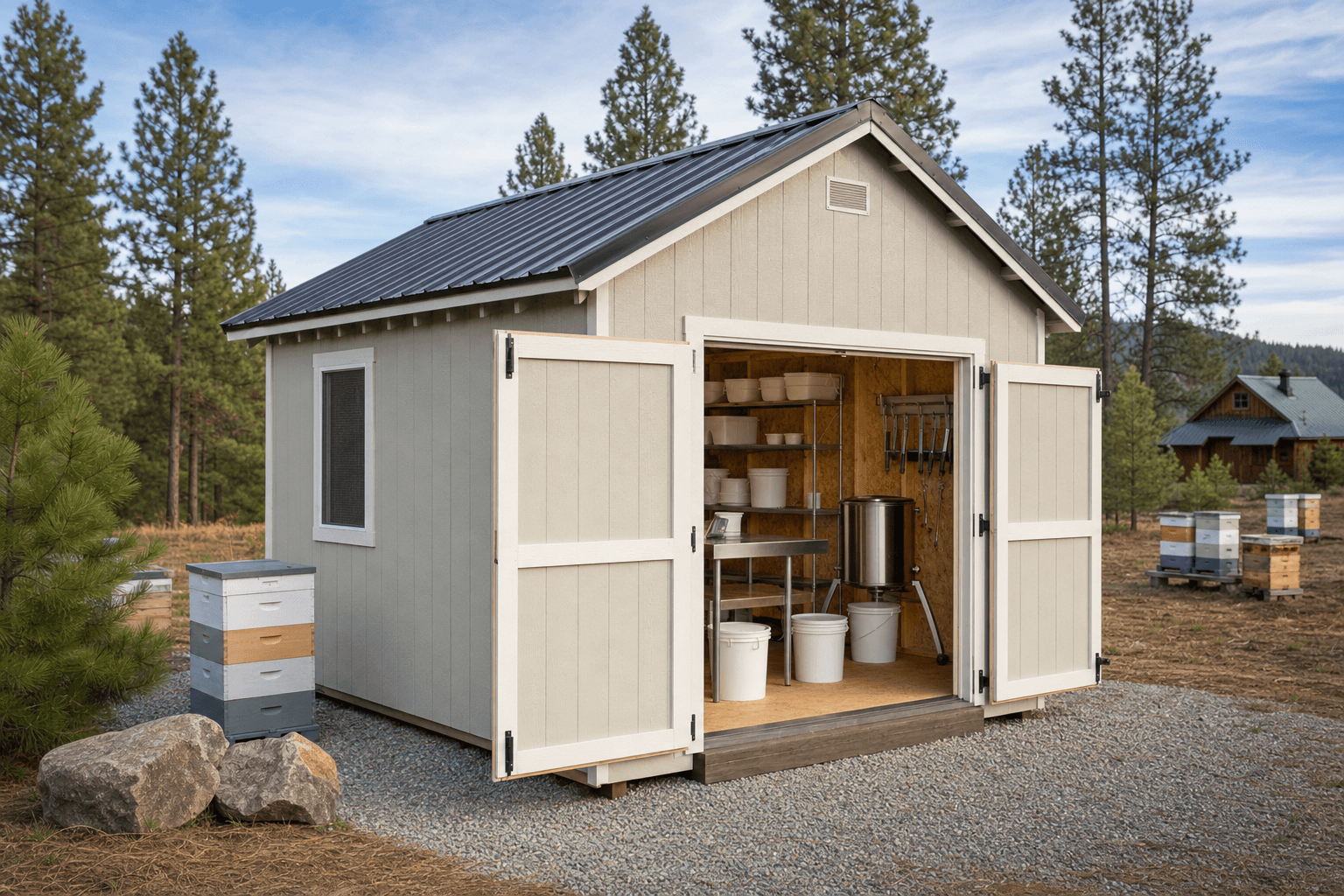
A clean room built for extraction day: an extractor, an uncapping station, a sink, and bee-tight screening, all on a floor that hoses out.
Most honey extraction sheds work best as a standard gable, because the straight walls and simple peaked roof give you full-height space along every wall to line up an uncapping tank, an extractor, a bottling bench, and a sink, and the headroom matters more than you'd think once a tall radial extractor is sitting on a stand. A gable also makes it easy to screen a ridge vent and a couple of windows for the cross-flow you want when the room is warm and humid with honey. If you'd rather the building read as a small honey house, a lean-to or single-slope modern roof pairs well with a wide screened door and a big window over the sink, and the sloped roof sheds Panhandle snow cleanly toward the back. A loft is worth considering too, since it gives you a dry, out-of-the-way spot to stack empty supers and store the extractor and tanks between seasons without crowding the work floor below.
Because so much of the year this building is really a storage and prep space, it has a lot in common with a canning kitchen shed, and many people who keep bees also put up garden produce, so it's worth planning the room so it could double for both: the same washable surfaces, sink, and warm room that serve a honey flow also serve a canning batch. Whatever roofline you choose, plan the building around a sticky job done indoors, with a door wide enough to carry full supers through, a threshold and floor that take spilled honey and a hose-down, and an interior built to be scrubbed rather than babied.
A two- or four-frame extractor, an uncapping tub beside it, and just enough room to spin, drain, and bottle. An 8x10 covers a tidy hobby extraction setup for a handful of hives.
Once you want a wall sink, a bottling bench, and shelving for empty supers and jars, step up to an 8x12 or 10x12 so the wet work and the clean storage stop competing for the same floor.
If you run dozens of hives, want a big radial extractor, a sump and tanks, and room to stage many supers at once, a 10x16 gives every zone room to work through a heavy harvest.
Footprint is the decision everything else rides on, so size for the extractor plus the uncapping station plus somewhere to stack supers, not just the extractor you picture first. An 8x10 shed is a solid starting point for a hobby apiary of a few hives: a small extractor on a stand, an uncapping tub, a narrow bench, and just enough floor to move a super from the stack to the uncapping tank to the spinner, which is plenty if you only pull honey once or twice a year. Move up to an 8x12 shed and the extra length buys you a real bottling bench and a wall sink without crowding the extractor, so the wet uncapping-and-spinning end and the clean bottling end stop overlapping. A 10x12 shed adds enough width for a U-shaped flow around the room, a bigger uncapping table, and floor-to-ceiling shelving for empty supers and finished cases, which is the size many growing beekeepers land on once a hobby turns into a steady side income. The 10x16 shed is the size to choose when you're running a sideline operation: a large radial extractor, a sump and a couple of bottling tanks, a long uncapping table, and room to stage a whole truckload of supers waiting their turn, all under one roof. As a rule, size for the wet end plus the storage end, because an extraction shed that's all extractor and no room to stack supers leaves you working out of the bed of your truck.
These food-handling buildings overlap, and the right one depends on what happens in there most. A honey extraction shed is purpose-built around a seasonal sticky harvest: an extractor, an uncapping station, food-safe washable surfaces, a sink, gentle warmth for flow, and bee-tight screening so the work stays contained and the room scrubs clean. If you put up jars of produce as much as you pull honey, a canning kitchen shed is built around the same cleanable, sink-equipped clean room but centers on a stovetop or burner, a big prep counter, and water for processing, and the two uses pair so naturally that many people build one room to do both. If your real need is keeping bulk staples and harvests cool, dry, and organized year-round, a bulk food storage shed focuses on shelving, pest exclusion, and a stable temperature rather than a work surface to spin honey on. And if the building mostly serves the apiary and the yard the rest of the year, a garden shed handles the tools, the smoker, the hive bodies, and the seasonal gear that surround beekeeping. Many buyers choose a true extraction shed because it does the honey side properly, the washable surfaces, the floor that drains, and the bee-tight envelope an open extractor demands, while leaving the door open to can produce or store harvests in the same room later. If you're torn, build for honey extraction first, since it has the strictest cleanability and bee-exclusion needs, and let the other uses flex around it.
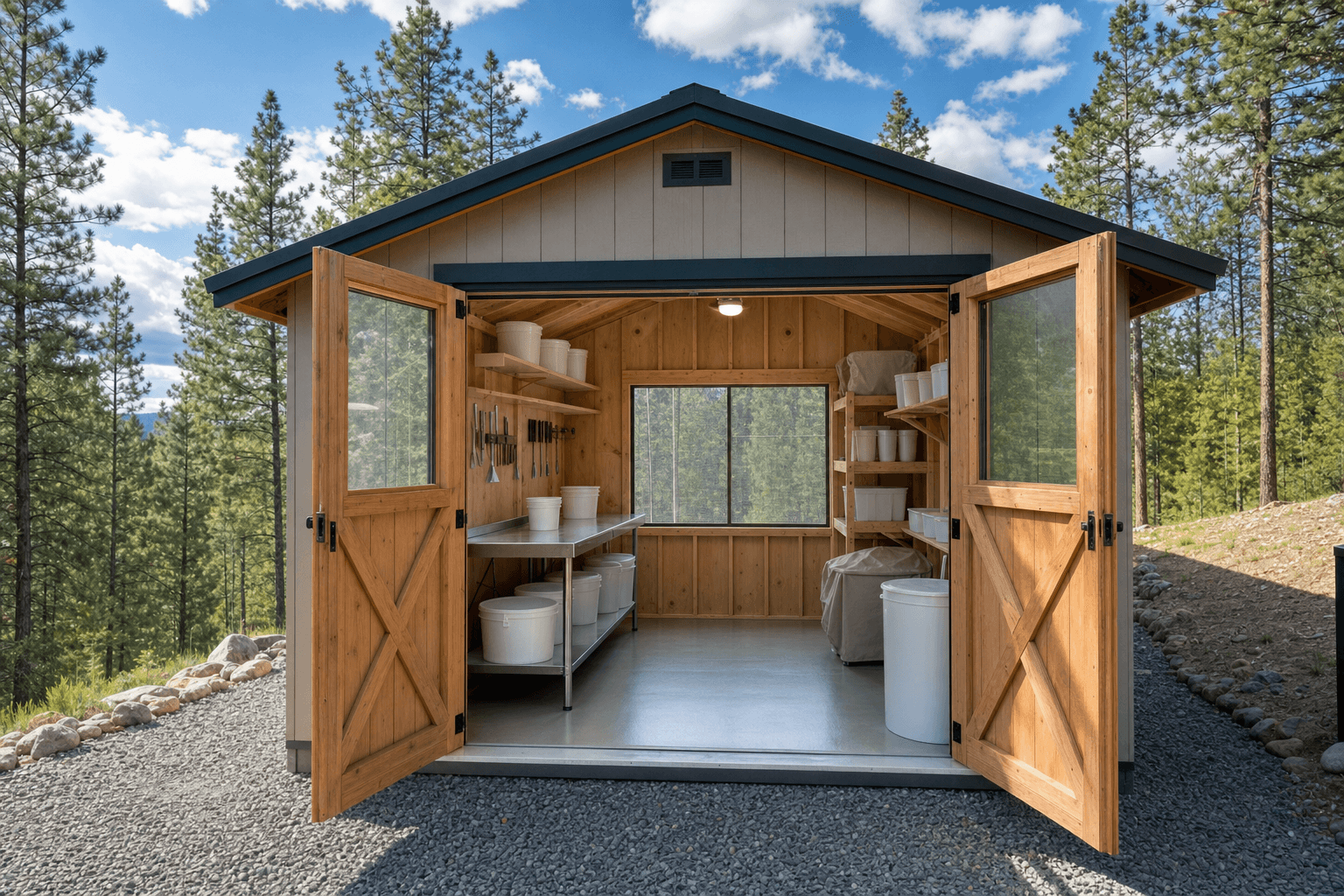
Zoned for a sticky job: the extractor and uncapping tank sit over a sealed, drained floor, with the sink and super storage on their own walls.
A honey extraction shed works far better when you plan it as a flow from dirty to clean instead of one open box, because the whole goal is to move a super of capped frames through uncapping, spinning, and bottling without backtracking or dripping honey across a finished surface. Start with the super staging zone just inside the door, where you set down boxes of full frames as they come off the hives and stack the empties as they come out of the extractor, ideally on a dolly or low bench so you're not bending over a sticky floor all day. Next is the uncapping zone: an uncapping tank or tub with a heated knife or roller, a cappings strainer below, and a board or bench at a comfortable height, set over the part of the floor you most expect to drip, because uncapping is the messiest step. From there frames go into the extractor zone, where the spinner sits on a stable, level stand with room to walk around it and a bucket or sump under the gate to catch the flow. Then comes the bottling and clean zone on its own wall, well away from the dirty work: a settling tank or bottling bucket, a filtered fill station, a bench to cap and label jars, and the sink for rinsing tools and washing up. Finally, reserve the storage zone, shelving or a loft for empty supers, jars, lids, and the extractor itself between seasons. Sketching this dirty-to-clean flow on paper before you settle on a footprint is the fastest way to tell whether an 8x10 will do or whether you'll want the length of a 10x16 so staging, uncapping, spinning, bottling, and storage never compete for the same square foot.
This is the heart of an extraction room. Line the walls with a wipeable panel like FRP or a sealed semi-gloss instead of bare studs or flat-painted drywall, top the benches with stainless or a food-grade sealed surface, and finish everything so a sponge and warm water take spilled honey off in seconds. Sticky residue is the enemy, so every surface you might splash should shed it rather than soak it up.
Honey ends up on the floor no matter how careful you are, so plan a sealed concrete or coated floor that slopes gently to a drain or a low door so you can squeegee and hose it clean at the end of the day. Skip carpet, bare wood, and seams that trap honey, and use a coved or sealed wall-to-floor joint so spills can't work underneath and turn rancid in the framing.
Open honey draws every forager for half a mile, so the building has to be sealed and screened to keep them out. Screen every operable window and the vents with fine mesh, fit the door with a self-closing screen or a vestibule, and seal gaps around the eaves, soffit, and trim so a bee can't find a way in while the extractor is running.
Most of the year this room stores gear, so build in floor-to-ceiling shelving rated for the weight of full supers, a spot for the extractor and tanks, and organized racks for empty jars, lids, and frames. A loft or high shelf keeps seasonal equipment up and out of the way of the work floor when the flow is on.
The keyword for a honey extraction shed is clean room, and the fit-out is everything that handles a sticky harvest cleanly and keeps the bees outside. For the extraction itself: a radial or tangential extractor on a sturdy stand, an uncapping tank or tub, a heated uncapping knife or a roller and a scratcher, a cappings strainer or spinner, and a frame rest to hold uncapped frames. For bottling: a settling or bottling tank, a honey gate, a double sieve or filter, bottling buckets, and jars, lids, and labels. For the room itself: food-safe washable wall panels, stainless or sealed benchtops, a sealed floor that drains, a stainless or deep utility sink with hot water for washing up, and a coved wall-to-floor joint. For keeping bees out: fine screening on every window and vent, a self-closing screen door or a vestibule, and a sealed, gap-free envelope. For warmth and flow: a hot box or warming cabinet, a space heater or a small heat source, and insulation so you can hold the room warm enough that honey runs instead of crawling. For storage: shelving rated for full supers, racks for jars and frames, and a loft for the off-season. Walk through your own version of this list before you settle on a size, because an extraction room fills up fast once you add the extractor, the uncapping tank, a bottling bench, the sink, and somewhere to stack supers, which is exactly why people who run more than a few hives are rarely sorry they sized up from an 8x10 to a 10x12 or a 10x16.
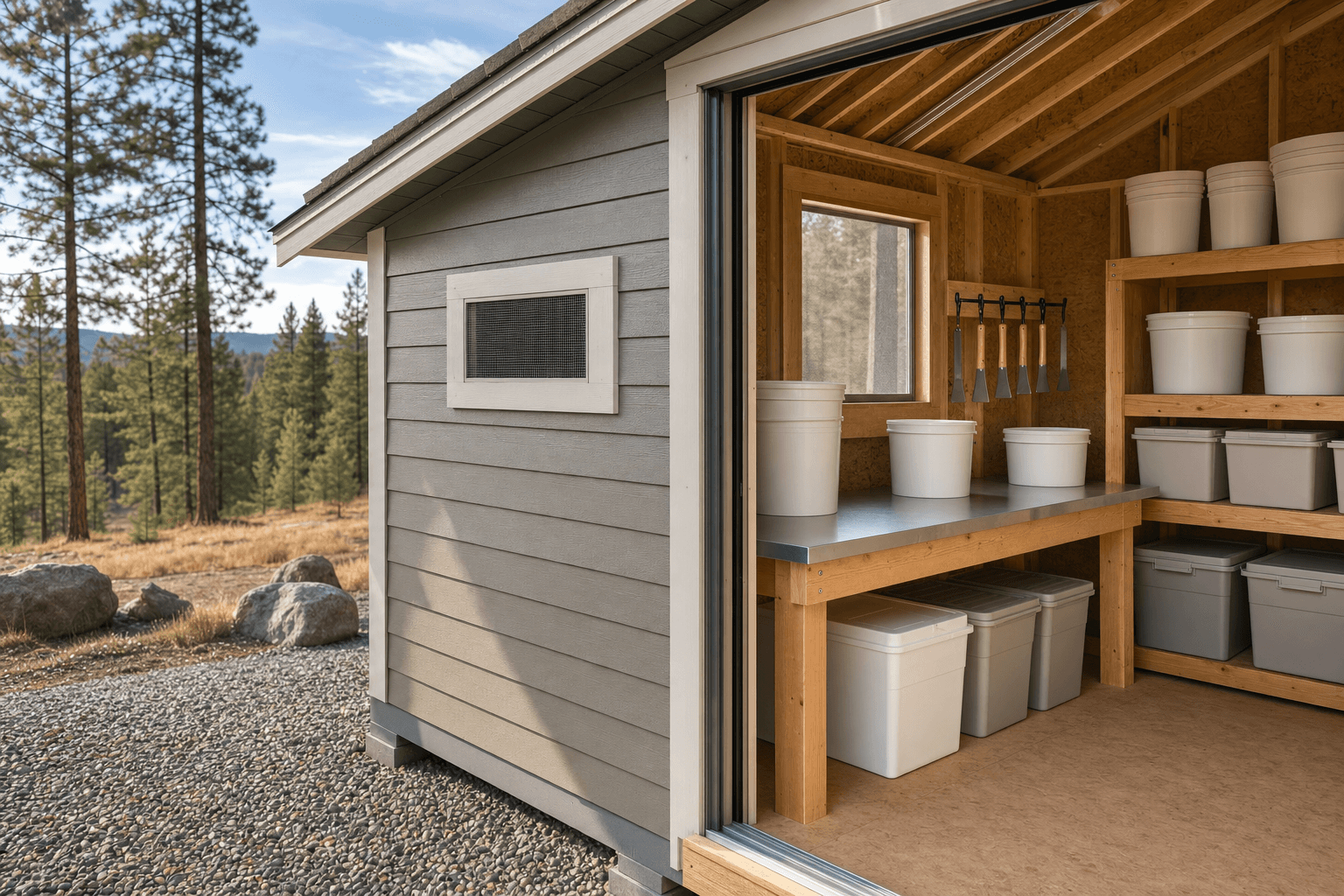
The details that keep an extraction room food-safe: a deep sink, wipeable wall panels, and a coved floor joint that spilled honey can't get under.
| Honey extraction shed planning checklist | |
|---|---|
| Best roofline | Standard gable for full-height walls and a screened ridge vent; single-slope modern for a honey-house look that sheds snow off the back; add a loft for super storage |
| Practical sizes | 8x10 for a hobby extractor, 8x12 to 10x12 to add a sink and bottling bench, 10x16 for a sideline operation with tanks and bulk super staging |
| Surfaces and floor | Food-safe washable wall panels, stainless or sealed benchtops, and a sealed concrete or coated floor sloped to a drain with a coved wall-to-floor joint |
| Bee exclusion | Fine screening on every window and vent, a self-closing screen door or a vestibule, and a sealed, gap-free envelope around eaves and trim |
| Warmth and water | Insulation and a small heat source or hot box to keep honey flowing, plus a sink with hot water for cleanup; freeze-protect the lines for winter |
| Storage | Shelving rated for full supers, racks for jars and frames, and a loft or high shelf for the extractor and tanks in the off-season |
Four things decide whether a honey extraction shed runs smoothly on harvest day or turns into a frustrating fight with crawling honey and bad light. Power matters because a motorized extractor, a heated uncapping knife, a hot box, and a space heater all draw current at once, so plan a dedicated circuit run from your home's panel by a licensed electrician, usually in buried conduit out to the building, with enough outlets along the work walls that you're not running cords across a wet floor. A small subpanel inside makes it easy to add a circuit later if you scale up to a bigger extractor or more warming gear. Light is worth getting right, because checking frames for stray cappings and filling jars to a clean line both need bright, even light, so plan generous overhead fixtures plus a window over the sink and the bottling bench for daylight. Water is the other essential: an extraction room is far easier to keep food-safe with a real sink and hot water for rinsing tools, washing tanks, and scrubbing up, so plan the plumbing and a water heater or an on-demand unit from the start, run by a licensed plumber. Keeping honey flowing ties it together, because honey turns thick and stubborn as the room cools, so an insulated shell, a small heat source, and a hot box or warming cabinet let you hold the room and the supers warm enough that honey runs clean off the frames and through the filter instead of crawling. We frame and build the shell tight, insulated, well-lit, and ready on your property so your electrician and plumber can finish their work.
A food-prep building stays clean, level, and easy to scrub only on a solid base, so most honey extraction sheds sit on a concrete slab, which many people prefer here because a slab can be poured with a gentle slope to a drain and a sealed surface that takes spilled honey and a hose-down cleanly. A compacted gravel pad sized about a foot wider than the building on each side helps water drain away under that slab. North Idaho weather drives the rest of the plan. Design the roof for local snow load so it shrugs off a heavy Panhandle winter, keep the floor up off the ground so spring melt and rain drain away instead of wicking into a building you wash down regularly, and insulate the shell so you can warm the room for a fall honey flow and freeze-protect the sink lines through winter. Since harvest is short and intense, place the building where the gravel driveway or a clear path lets you wheel full supers in by dolly and lets our crew bring materials in to build. We build with weather-rated framing and finishes suited to pine-country freeze-thaw cycles, and we set the structure to drain and breathe so it lasts and stays clean inside year-round. On permits, the deciding factor is usually how the building is used and how it's serviced, not just how big it is. A small detached shed under your jurisdiction's size threshold often needs no permit, but once an extraction shed is wired for an extractor and plumbed for a sink, your county or city may require a building permit, electrical and plumbing permits and inspections, and adherence to setbacks. Selling honey adds its own layer, since Idaho's cottage food and apiary rules can affect how a home extraction space is treated, so confirm both with your local building department and the state before you finalize the size, the power, the plumbing, and where it sits. Once you know what your jurisdiction requires, we plan the build around it so the structure, the rough-in, and the placement all line up.
Open honey draws every forager within range, so a bee-tight envelope is the whole point of doing extraction indoors. Screen every operable window and vent with fine mesh, fit the door with a self-closing screen or, better, a small vestibule or double-door entry so foragers can't slip in while you carry supers through, and seal the gaps a bee can find around the eaves, soffit, trim, and where utilities pass through the wall. The trick is that a bee will exploit any opening, so the building has to be sealed first and screened second, not just screened over a leaky shell. It also helps to bring supers in covered and to clean up spills promptly, since standing honey is what turns a few scouts into a robbing frenzy. We build the shell tight and gap-free and frame the openings so your screening seals cleanly, which is what keeps the bees on the other side of the mesh while the extractor runs.
Because everything in here touches honey you'll eat or sell, the surfaces have to be chosen for cleanability rather than treated like a dry shed. Line the walls with a wipeable, washable panel such as FRP or a sealed semi-gloss finish instead of bare studs or flat-painted drywall, top the work benches with stainless steel or a food-grade sealed surface, and use a sealed concrete or coated floor that sheds honey toward a drain rather than soaking it into bare wood. Add a coved or sealed wall-to-floor joint so spills can't work underneath and go rancid in the framing, and choose stainless or rust-resistant hardware so nothing corrodes from repeated washing. The whole idea is that every surface a drip might land on should let a sponge and warm water take it off in seconds. We build the shell and use a finish package suited to a food-prep room so the interior wipes and hoses clean instead of staining or trapping sticky residue.
Honey gets thick and stubborn as it cools, and a cold extraction room can turn a quick harvest into hours of waiting for honey to crawl off the frames and through the filter, so warmth is part of the plan. Insulate the shell so the room holds heat, add a small heat source such as a space heater or a wall heater to bring the working space up to a comfortable, flowing temperature, and consider a hot box or warming cabinet to pre-warm supers and finished buckets so the honey runs clean. In North Idaho a fall flow can mean cool mornings, so the ability to warm the room a day ahead makes a real difference in how fast extraction goes. The same insulation that warms the room for honey also protects the sink lines from freezing in winter. We build the shell insulated and tight so a modest heat source holds the temperature you need, and your electrician can wire the circuits for whatever warming gear you choose.
You can extract without one, but a real sink and hot water make an extraction room far easier to keep food-safe and far less miserable to clean up, because honey gets on every tool, tank, and surface and the cleanup is most of the work. Plan a deep stainless or utility sink with hot water so you can rinse the extractor, uncapping tank, sieves, and buckets right there instead of hauling sticky gear to the house, and run the plumbing and a water heater or on-demand unit through a licensed plumber from the start, since adding water later means trenching and opening walls. Pair the sink with the sealed, draining floor so wash water and rinse-down both head to the same low point. If you ever sell your honey, a dedicated sink in a cleanable room also helps the space meet the kind of standards a cottage-food or apiary inspection may look for. We frame and rough-in the building so the sink, the water heater, and the drain go in cleanly for your plumber to finish.
Extraction is a short season, so for most of the year this building is really storage, and planning for that is what keeps the work floor clear when the flow is on. Build in floor-to-ceiling shelving rated for the weight of full supers, since stacked honey boxes are heavy, plus organized racks for empty jars, lids, and spare frames, and a dedicated spot for the extractor and tanks so they're not blocking the bench between harvests. A loft or a run of high shelves is ideal for the seasonal gear you only touch a few times a year, keeping it up and out of the way. Storing drawn comb and empty supers in a sealed, screened room also helps protect them from wax moths and rodents compared with an open garage. The size you choose should account for this storage as much as the extraction itself, which is why many beekeepers move up to a 10x12 or 10x16 once they have more than a few hives' worth of equipment to keep. We build in the shelving and loft space so the room stores your gear and still leaves room to work.
It comes down to how many hives you run and how much gear and honey move through the room. For a hobby apiary of a few hives, where you pull honey once or twice a year with a small two- or four-frame extractor, an 8x10 gives you room for the extractor, an uncapping tub, a narrow bench, and a little storage. Once you want a wall sink, a real bottling bench, and shelving for empty supers, step up to an 8x12 or a 10x12 so the wet uncapping-and-spinning end and the clean bottling-and-storage end stop overlapping. If you're running a sideline operation with dozens of hives, a big radial extractor, a sump and bottling tanks, and a need to stage a whole harvest of supers at once, plan on a 10x16 so the dirty-to-clean flow and the bulk storage each get real room. The honest advice is to size for the extractor plus the storage plus a clean place to bottle, because an extraction shed that's all spinner and no room to stack supers leaves you working out of your truck, and most people are glad they sized up once a hobby starts turning into a steady side income.
Backyard beekeeping has grown steadily across Kootenai County, and the extraction season — typically late July through September in the Coeur d'Alene area — concentrates a messy, sticky process into a short window. Running that process in a garage or kitchen works once or twice. A dedicated extraction shed changes the math entirely: a room built to be washed down, with a warm floor and no risk of bees following the supers inside.
The bee-tight requirement is the one that trips people who plan a general-purpose shed first and retrofit later. Windows need screens, door sweeps need to seal, and any wall penetration for wiring or water lines needs to be caulked. When a honey extraction shed is framed on site, every one of those details is built in rather than patched on.
Warmth drives extraction efficiency. Uncapping and spinning honey at 70–80°F runs significantly faster than at 50°F, and North Idaho evenings in late harvest season are genuinely cold. A small electric panel heater run off a dedicated circuit keeps the room in range without the moisture risk of a propane option in a sealed space.
Water access and a deep utility sink — the other non-negotiable — is easiest to plan during framing when drain lines can be run cleanly under the floor before the pad sets. Post Falls and Hayden properties on municipal water can tap a frost-free sill cock near the shed; more rural parcels north toward Athol or Rathdrum need a heat-taped supply line if the shed will be used into early fall.
Super storage outside extraction season rounds out the layout. Shallow supers stack tall, so ceiling height matters — 8 feet lets you store two full seasons of equipment on simple wall racks. Start in the configurator to rough in the footprint, then request a free estimate with plumbing and electrical as line items.
Tell us how many hives you run and we'll help you size, lay out, and price a food-safe clean room with the washable surfaces, sink, warmth, and super storage your North Idaho harvest needs.
Keep planning your build with related North Idaho shed guides.