A hunting cabin is the building that turns a long drive and a cold morning into a real basecamp. It is where your crew sleeps off the ground, dries out wet boots by a warm stove, eats a hot meal, and stores gear safely between trips instead of hauling everything home each time. Out on a North Idaho property — a wooded parcel off a forest road, a back forty bordering public land, a quiet draw where the elk move through at first light — a hunting cabin is the difference between roughing it in a tent and starting each day rested, fed, and ready. This guide walks through how to plan one: the bunk layout that fits your group, the wood stove and insulation that make it usable in the cold, the secure storage for gear and firearms, the off-grid power and water you will need, and how a finished cabin even reaches a remote site.
North Idaho On Site Sheds builds every hunting cabin on your property, so the plan answers to your land, your access road, and the way you actually hunt the place. The goal here is a rugged, low-maintenance basecamp — not a polished guest suite. Finishes are tough and wipeable, the layout favors function over fuss, and every square foot earns its keep between the bunks, the stove, the kitchen corner, and the gear wall. Think of it as a four-season room built to take mud, snowmelt, and a season of hard use, then shrug it off. Start with how many people sleep there and how cold it gets, because those two answers shape almost every decision that follows.
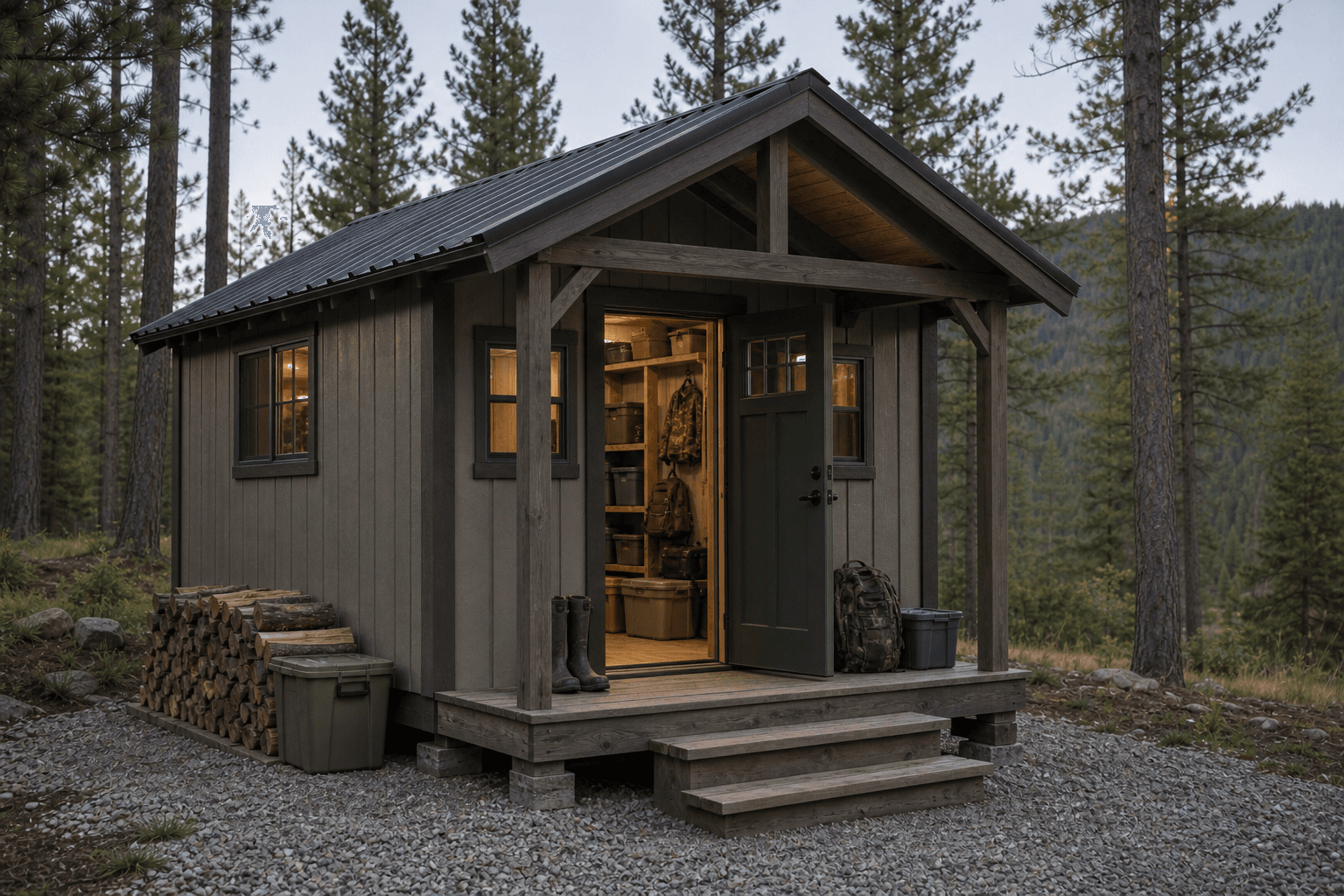
A hunting cabin plan starts with two questions: how many people sleep there, and how cold does it get before you head out at dawn.
Ruggedness and a warm, dry interior matter more here than curb appeal, but the roofline still does real work. A standard gable is the workhorse for a hunting cabin: the steep, symmetrical roof sheds heavy North Idaho snow cleanly, carries a stovepipe straight up through the ridge for a good draft, and gives you headroom for stacked bunks along the walls. Add a covered porch — even a modest overhang — and you gain a dry spot to pull off muddy boots, hang wet outer layers, and stack a little firewood out of the snow before it ever crosses the threshold.
A lofted barn (gambrel) goes a step further by opening a sleeping loft overhead, which is a smart move when you want to sleep more hunters without growing the footprint: bunks or sleeping pads climb into the loft while the main floor stays clear for the stove, a cook corner, and a gear wall. A lean-to single-slope is the simplest, most economical shell and pairs naturally with an attached run for hunting gear storage if you would rather keep packs, decoys, and stands in their own bay. If the cabin doubles as a comfortable retreat your family uses in the off-season too, the plan can borrow from a cottage or a backyard guest house — a little more trim and a few real windows — without losing the tough, basecamp bones that a hunting cabin needs.
Decide how many hunters sleep here on a busy weekend, then size for that. A pair of stacked bunks fits a short wall; sleeping four to six means more wall or a loft. The sleeping count sets the whole footprint.
A wood stove needs clearance to combustibles on every side and a clear path from the door so you can carry wood in without weaving past bunks. Block out that zone before you place anything else.
Packs, optics, ammo, and a lockable firearm cabinet each want dedicated wall space. Decide where the gear wall lives before you size up, because secure storage is easier to build in than to add later.
For a two-to-three-person basecamp with a pair of stacked bunks, a wood stove, a small cook corner, and a gear wall, a 12x16 cabin is the honest starting point — tight but workable, with enough room to sleep, warm up, and store the essentials. Add a third bunk stack or a little elbow room around the stove and table, and the extra length of a 12x20 pays off fast: now the sleeping, cooking, and gear zones each get their own corner instead of overlapping. This is the size many North Idaho hunting parties land on for a comfortable weekend camp that handles three or four people without anyone tripping over a pack.
If your crew runs larger, you cook real meals, or you want a dedicated gear-and-drying bay inside the same walls, step up to a 14x20 — room for more bunks, a proper kitchen counter, a bench by the stove, and a wall for hunting gear storage without crowding the bunks. And when the cabin sleeps a full party of five or six, serves as a season-long basecamp, or doubles as an off-season family retreat, a 14x24 gives you space for stacked bunks, a kitchen, a real eating table, the gear wall, and a lockable storage corner all at once. Let the size of your crew and the length of your stay decide where you stop, not the urge to keep adding room you will only heat a few times a year.
Three buildings get confused here, and choosing the right one saves real money and headaches. A hunting cabin is a four-season basecamp you sleep in: bunks, a wood stove, a cook corner, insulation, and secure storage, built to take hard use in the cold. A standalone hunting gear storage building solves a different problem — it is an unheated or lightly conditioned bay for packs, stands, decoys, blinds, and a lockable cabinet, with no bunks or kitchen. Many hunters build the cabin first and add a gear shed later, or attach a gear bay to the cabin so muddy, scent-heavy equipment stays out of the sleeping space. If you are mainly trying to keep equipment organized and protected, lead with the gear building; if you need a warm place to sleep on the property, lead with the cabin.
A backyard guest house or a cottage, by contrast, is built for comfort and finish — soft furnishings, nicer trim, year-round polish — and it lives near a home rather than out on a hunting parcel. The hunting cabin borrows the bones of those buildings (insulation, a heat source, a tight envelope) but keeps the finishes tough and the layout practical, because it will see wet boots, field dressing gloves, and a wood stove running hard. If your plan keeps drifting toward plush bedding and delicate finishes, you may actually want a cottage-style retreat; if it leans toward bunks, a stove, and a gear wall that can take abuse, you are squarely in hunting-cabin territory, and planning it as one keeps both the cost and the durability right.
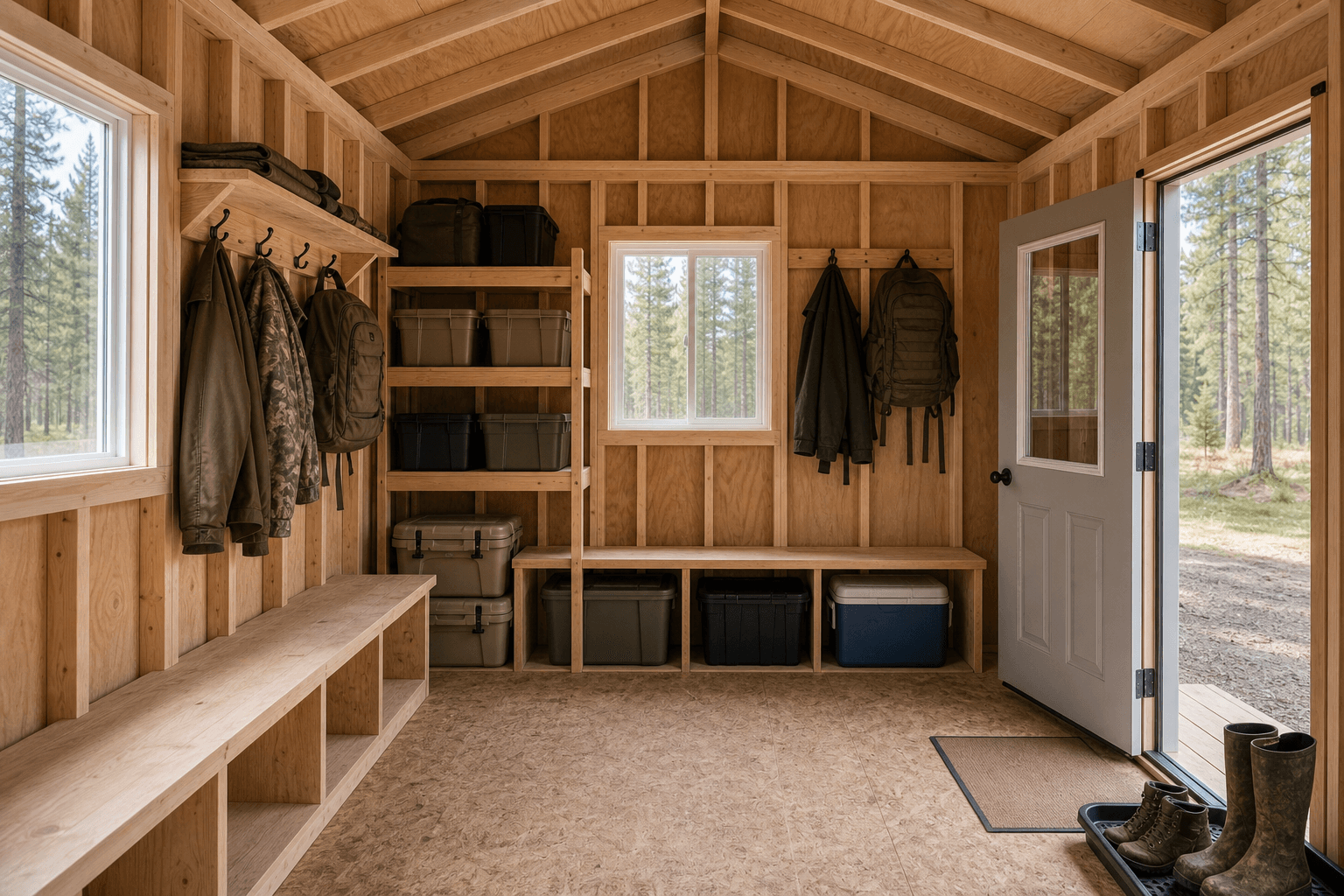
Zoning sleeping, the stove, the cook corner, and the gear wall keeps a small cabin functional when a tired crew comes in after dark.
A hunting cabin works when sleeping, heat, cooking, and gear each get a defined corner instead of piling together — especially when a cold, tired crew files in after dark. Build it around four zones. The sleep zone anchors one or two walls: stacked bunks keep the floor open and sleep the most people per square foot, with a shelf or hook at each bunk for a headlamp, glasses, and a phone. Place bunks away from the door so the worst of the cold draft does not blow straight across them when someone steps out before dawn.
The stove zone is the heart of the cabin and needs the most respect. Center the wood stove where its heat reaches the bunks but its required clearances to combustibles stay clear on every side, with a non-combustible hearth pad beneath it and a straight path from the door so you can carry wood in without brushing past anyone. The cook zone holds a counter, a propane camp stove or cooktop, a basin or sink, and shelves for food and cookware, ideally near the door so cooking smells and propane vent easily. The gear zone runs along the remaining wall: hooks and racks for packs and outer layers, shelves for boots and optics, a bench for sorting equipment, and a lockable cabinet. Keep a clean lane from the door to the stove so the first person in can get a fire going while everyone else stamps the snow off.
Plan walls for stacked bunks sized to your crew, plus a loft in a gambrel if you sleep more. Add a shelf or hook at each bunk and a few open shelves so gear and clothes stay off the floor and out of the walking lane.
Size the stove to the cabin's square footage, set it on a non-combustible hearth pad with proper clearances, and run an insulated stovepipe straight up through the roof. Keep a wood rack and a spot for kindling and matches right beside it.
Build in a sturdy, lockable cabinet for firearms and ammunition, stored separately and out of sight, plus a locking exterior door and shutters or window security so the cabin stays buttoned up between trips. Treat safe, secure storage as a core requirement, not an afterthought.
Plan headlamp-friendly task lighting over bunks and the cook corner, outlets or a 12-volt rail for charging, and a drying rack or boot tray near the stove so wet gear is dry by morning. Keep the wiring simple and matched to your off-grid power source.
A hunting cabin earns its keep by holding the specific things your trips revolve around, so plan storage around real gear. On the gear wall: hooks and racks for daypacks and frame packs, a row for jackets and outer layers, shelves or a boot bench for muck boots and pac boots, cubbies for optics — binoculars, a spotting scope, a rangefinder — and bins for game bags, knives, a saw, calls, scent control, and field-dressing supplies. Add a dedicated spot for decoys, ground blinds, tree stands, climbing sticks, and trail-camera gear if you run them, or move that bulk into an attached hunting gear storage bay so the sleeping space stays clear and scent-free.
Firearms and ammunition deserve their own plan, handled responsibly. Build in a sturdy, lockable gun cabinet or safe sized to your group, store ammunition separately, and keep both out of sight and secured whenever the cabin is unattended — this is about safety and theft prevention as much as organization, so make it a fixed part of the build rather than a loose afterthought. Round out the cabin with the camp essentials: a propane or wood cook setup, a water container and a basin, a cooler or a small fridge if you have power, lanterns and headlamps with spare batteries, a first-aid kit, a fire extinguisher, sleeping bags and pads, a table and a couple of chairs or a bench, and a tote of staples that lives at the cabin so you are not repacking it every trip. The building keeps it all dry, warm, and secure between hunts, which is the whole point of having a basecamp instead of a tailgate.
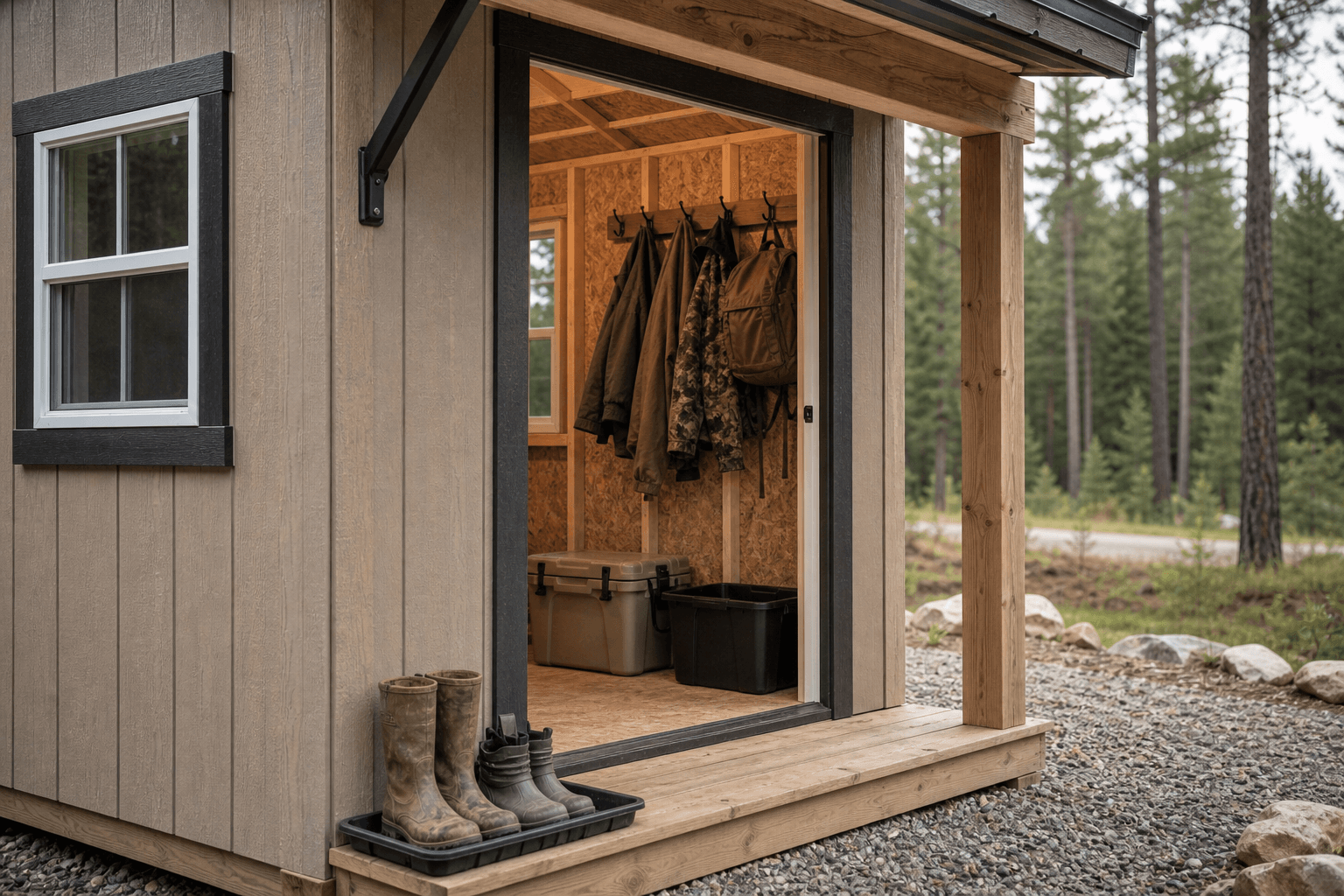
A dedicated gear wall with hooks, a boot bench, and a lockable cabinet keeps optics, packs, and equipment organized, dry, and secured between trips.
| Hunting cabin planning checklist | |
|---|---|
| Best all-round size | 12x20 to 14x20 for two to four hunters with bunks, a wood stove, a cook corner, and a gear wall, each in its own zone |
| Sleeping layout | Stacked bunks along one or two walls away from the door; add a sleeping loft in a gambrel to sleep more without growing the footprint |
| Heat source | Wood stove sized to the square footage on a non-combustible hearth, with an insulated stovepipe through the roof and a wood rack beside it |
| Insulation | Insulated walls, ceiling, and floor for cold-weather use; a tight envelope holds stove heat and cuts condensation and drafts |
| Secure storage | Lockable firearm cabinet with ammunition stored separately, a locking exterior door, and window security for time between trips |
| Off-grid utilities | Solar or generator power, LED or 12-volt lighting, propane for cooking and backup heat, and stored or hauled water with a basin |
Most hunting in North Idaho happens in the cold, so heat and insulation are not optional — they are what make the cabin usable from early-season elk through late-season whitetail. A wood stove is the classic, self-reliant choice: it runs on fuel you can gather on the property, dries wet gear fast, and needs no grid power. Size it to the cabin's square footage so it warms the space without cooking you out, set it on a non-combustible hearth with the manufacturer's clearances to walls and bunks, and run an insulated stovepipe straight up through the roof for a clean draft. Many hunters add a small propane heater as a backup for the middle of the night so the fire does not have to be fed until dawn. Pair any combustion heat with a carbon-monoxide alarm and a fire extinguisher, and crack a window for fresh air — this is basic safety in a tight, heated cabin.
Insulation is what lets that heat hold. Insulate the walls, ceiling, and floor and keep the envelope tight, so the stove warms the cabin quickly, the heat stays in overnight, and you avoid the condensation and drafts that make a cold camp miserable. For off-grid power, a small solar setup with a battery handles LED lights, charging, and a 12-volt fridge for a quiet, fuel-free system, while a portable generator covers heavier loads or recharges the bank on dark winter days — the same thinking behind a dedicated solar and battery shed or a generator shed on a larger property. Water is usually stored or hauled in jugs with a basin or a simple gravity setup, since running water means winterizing against the freeze. Plan power, heat, and water together before the walls close up, because a cabin that is warm, lit, and self-sufficient is the one your crew will actually want to spend the season in.
Because we build on your property, placement, the pad, and access are all part of the plan — and on a remote North Idaho parcel, access deserves real thought up front. A level, well-drained gravel pad is the standard base: it keeps the floor framing off wet ground, drains snowmelt away from the cabin, and gives you a solid, mud-free approach to the door. Site the cabin on high, firm ground rather than the lowest, soggiest spot, orient the door and porch so roof snow sheds clear of the entry, and angle it to catch morning light and shelter from the prevailing wind. Leave room beside it for a firewood stack, and keep the stovepipe and any chimney clear of overhanging branches.
North Idaho weather shapes the structure. We build for local snow load, so the roofline and framing carry a heavy winter without strain, and we use treated and pine materials suited to hard freeze-thaw swings. The big variable on a remote site is the road in: building on your property means the cabin takes shape on the pad itself, but our crew and materials still need to reach it, so a passable gravel driveway or forest road — wide enough, firm enough, and clear of low limbs and tight switchbacks — makes the build go smoothly. If access is rough, talk through it early so we can plan around it. Permitting and setbacks vary by parcel: a sleeping cabin with a wood stove can trigger different requirements than an unheated outbuilding, and rural, forested, or wildland sites may carry defensible-space or fire rules, so confirm setbacks, septic or sanitation, and any local requirements with Kootenai County or your jurisdiction before you finalize the plan. When you are ready, get a free estimate or build and price a hunting cabin to see your size, roofline, and bunk layout come together.
Plan the bunks first, because the sleeping count drives the whole footprint. Stacked bunks are the most efficient way to sleep a crew: a single stack of two fits a short wall, and a pair of stacks along one wall sleeps four. A 12x16 comfortably handles two to three hunters, a 12x20 or 14x20 sleeps three to four with room for a stove and gear, and a 14x24 fits a full party of five or six. Place bunks away from the door so cold drafts do not blow across them, give each bunk a shelf or hook for a headlamp and glasses, and if you want to sleep more without a bigger footprint, a lofted barn (gambrel) adds a sleeping loft overhead while the main floor stays open for the stove and cooking.
A wood stove is the classic choice because it runs on fuel from the property, dries wet gear fast, and needs no grid power. Size it to the cabin's square footage so it warms the space without overheating it, set it on a non-combustible hearth pad with the manufacturer's clearances to walls and bunks, and run an insulated stovepipe straight up through the roof for a clean draft. Many hunters add a small propane heater as overnight backup so no one has to feed the fire at 3 a.m. Always pair combustion heat with a carbon-monoxide alarm and a fire extinguisher, keep a fresh-air source, and insulate the walls, ceiling, and floor so the heat actually holds through a cold night.
Most remote cabins run self-sufficient. For power, a small solar array with a battery bank handles LED lights, device charging, and a 12-volt fridge quietly and fuel-free, while a portable generator covers heavier loads or recharges the bank on dark winter days — the same approach behind a dedicated solar-and-battery shed or generator shed on a larger property. For cooking and backup heat, propane is simple and reliable. Water is usually stored or hauled in jugs with a basin or a gravity-fed setup, since plumbed running water means winterizing every line against the freeze. Plan power, heat, and water together before the build so the wiring, the stove, and the storage all fit the way you actually use the cabin.
Treat secure storage as a core part of the build, handled responsibly. Build in a sturdy, lockable gun cabinet or safe sized to your group, store ammunition separately from firearms, and keep both out of sight and locked whenever the cabin is unattended — this protects against both theft and unauthorized access. Back that up with a solid, locking exterior door and window security such as shutters or locking sashes so the whole cabin buttons up tight between hunts. For packs, optics, and bulkier equipment like decoys and stands, a dedicated gear wall with hooks, shelves, and a boot bench keeps everything organized and dry, and an attached gear-storage bay can keep scent-heavy equipment out of the sleeping space entirely.
A cabin you heat from cold every trip benefits enormously from a tight, insulated envelope. Insulate the walls, ceiling, and floor so the wood stove warms the space quickly and the heat holds overnight instead of leaking out, and seal the envelope well to cut the drafts and condensation that plague an under-insulated camp. Because the cabin sits cold between visits, avoid plumbed water lines that can freeze and burst, or fully winterize and drain them; stored-water setups sidestep the problem. If you ever leave a low background heat on, a thermostatically controlled propane heater keeps the interior from deep-freezing. The combination of good insulation and a right-sized stove is what lets a weekend cabin warm up fast and stay comfortable from early season through late winter.
Yes — because we build on your property, the cabin takes shape right on the gravel pad rather than being trucked in whole, which makes remote and wooded sites very workable. The key variable is the road in: our crew and materials still need to reach the building site, so a passable gravel driveway or forest road that is wide enough, firm enough, and clear of low branches and tight switchbacks makes the build go smoothly. If access is rough, narrow, or steep, talk it through with us early so we can plan around it. We build for North Idaho snow load and freeze-thaw with treated and pine materials, and we set the cabin on a level, well-drained gravel pad on high ground. Confirm setbacks and any rural fire or sanitation requirements with Kootenai County or your jurisdiction before finalizing placement.
A hunting cabin in North Idaho has a site problem that most other structures don't: the best locations are remote. Wooded acreage in Bonner County, ridge-top parcels near Sandpoint, and rural Kootenai County lots outside city limits all share the same challenge — there's no road wide or solid enough to deliver a pre-built unit. Building the cabin on site changes that equation entirely. We build it where it belongs, not where a truck can reach.
Winter performance is the other non-negotiable. A cabin used during rifle or archery season in northern Idaho will face cold mornings, heavy roof loads, and freeze-thaw cycles through the foundation. The framing, insulation, and roof pitch need to be sized for that reality — not for a milder region. A wood stove or propane heater in an insulated shell makes early-morning temperatures tolerable without a full heating system.
Sleeping layout matters as much as square footage. Four to six bunks, a gear wall with hanging hooks, and a small table take priority over ceiling height or window count in a working hunting cabin. Simple, durable finishes hold up better than anything that requires maintenance you won't be there to do.
Kootenai County and Bonner County both have permit requirements that vary by parcel zone and acreage — worth confirming before design is final. See our hunting cabin page for build options, or start pricing your layout in the configurator. Owners anywhere in North Idaho can get a free estimate to understand cost before committing to a design.
Size the bunks, the stove, and the gear wall, then get a free estimate or price it in the configurator.
Keep planning your build with related North Idaho shed guides.