A man cave shed gives you the one thing the basement and the spare room can't: a place that's yours, in your own backyard, where the TV is loud, the game runs late, and nobody's asking you to turn it down. You walk out across the yard, open the door, and the rest of the house stays the rest of the house. That separation is the whole appeal, and it's why a purpose-built man cave beats carving a corner out of the garage. The garage is still half full of the lawnmower and the kids' bikes; a dedicated building is finished, insulated, and wired for one job, which is to be a comfortable backyard hangout for watching the game, having a few buddies over, and unwinding.
The difference between a real year-round retreat and a glorified storage box comes down to a handful of decisions you have to make up front: insulation and a heat-plus-AC plan, wiring sized for a big TV and a sound system, a spot for a bar or a kegerator, enough seating that people aren't sharing a folding chair, and a little attention to sound so the bass doesn't carry to the neighbors. None of it is exotic. It's a tight insulated shell, a couple of dedicated circuits, a wall built for a mounted TV, and a layout that fits a sectional, a screen, and a bar without anyone backing into the dartboard. This guide walks through each of those choices in order, the sizes that actually fit seating and a bar, and how we build the structure on your property so it's solid, dry, and ready for your electrician to finish the wiring. If you'd rather see options priced out first, you can build and price a layout in a few minutes and come back to the details.
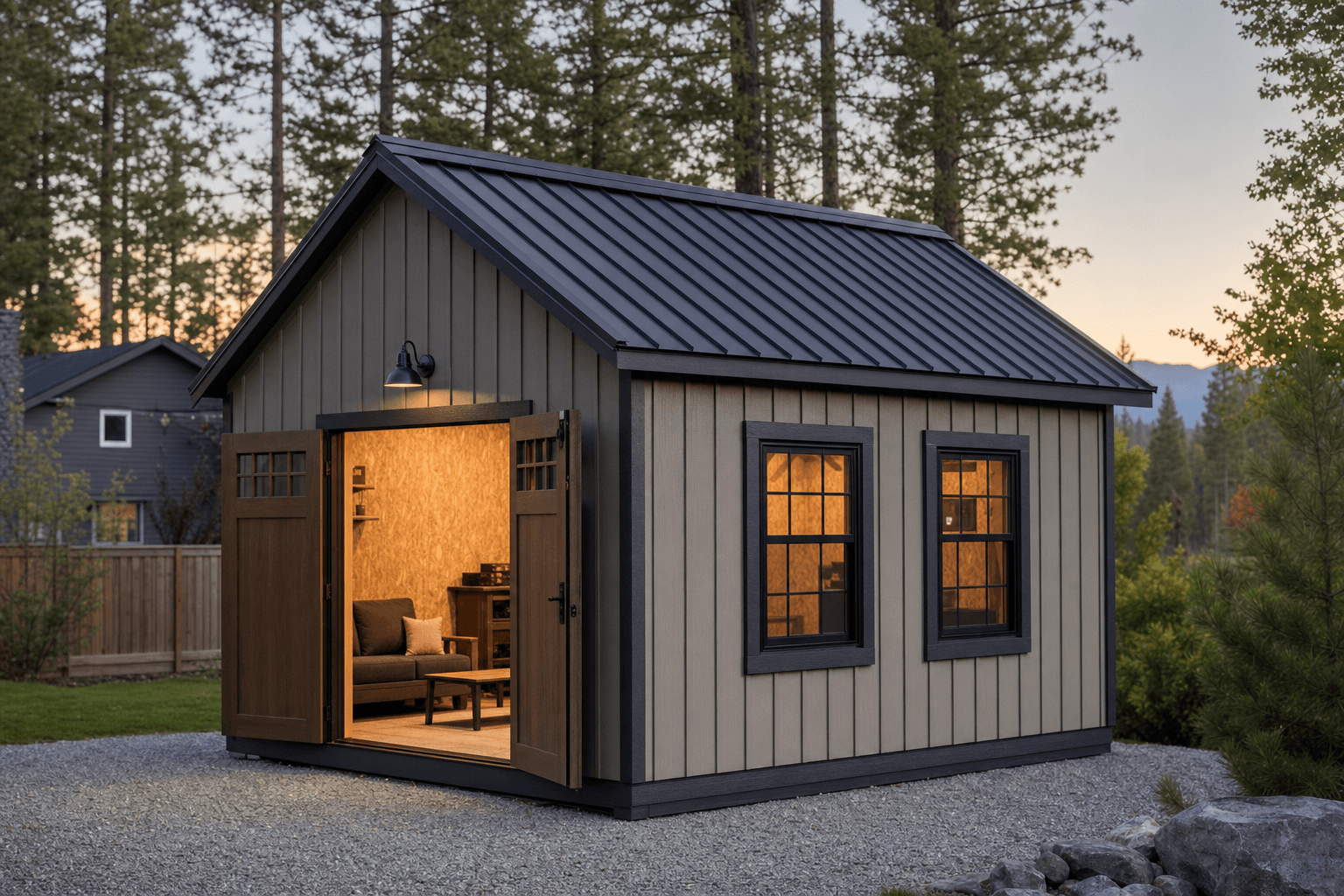
A backyard man cave built for game day: insulated, wired for a big TV and sound, and finished to hang out in year-round.
Most man caves are happiest in a standard gable. The straight walls and simple roofline give you long, flat surfaces for a wall-mounted TV, a bar, shelving, and a sectional, with no roof slope eating into headroom where people sit. It's the easiest style to insulate, the simplest to wire, and the most natural to lay out as a single open hangout room.
If you want the space to feel bigger and a little more like a lodge, a lofted barn (gambrel) roof adds vertical volume and an optional loft you can turn into a second seating tier, a card-table nook, or storage for seasonal gear. A lean-to or modern single-slope roof reads contemporary and pairs well with a tall window wall, which is great if you want daylight and a view between games. A model with a covered porch gives you a sheltered spot to step outside with a drink and run a grill or a smoker just off the door. A man cave shares a lot of its DNA with the other finished hangout builds we do, so it's worth seeing how we handle a she shed when you're weighing rooflines, because the insulated, wired, comfortable-room priorities overlap almost completely.
Whatever the roofline, a man cave is a finished, conditioned room, not a tool shed. That means a continuous insulated envelope, a real door and windows that seal, and an interior you finish to actually live in on a Sunday afternoon.
A big mounted TV, a sofa or loveseat at the right viewing distance, and a side table or two. A 12x16 covers a solo retreat or a tight two-person hangout with no bar.
Add a sectional, a couple of stools, and a real bar along one wall and you want 14x20 so the seating and the bar aren't fighting for the same floor.
If you want a crowd on game day, a poker or pool table, plus a bar and a bathroom, step up to 16x24 so every zone has room to breathe.
Footprint is the decision everything else rides on, so size for the seating plus whatever sits next to it. A 12x16 shed is the sensible floor for a man cave: 192 square feet holds a big TV, a sofa at a comfortable viewing distance, a mini-fridge, and a couple of chairs without feeling boxed in. Move up to a 12x20 shed and the extra length absorbs a real bar along the end wall or a sectional that seats the whole group, while keeping the room narrow enough to feel like a cozy den. A 14x20 shed is the sweet spot for most buyers: 280 square feet gives you a clear TV-and-seating zone on one side and a bar with stools on the other, with floor left over for a dartboard or a small high-top. The 16x24 shed is the full game-day room, with space for a sectional, a bar, a poker or pool table, and even a partitioned corner for a bathroom, and it's the size people wish they'd chosen if they started small and the crew kept growing. Whatever you pick, plan the room around how many people you actually host, not the average Tuesday.
These backyard hangout builds overlap, and the right label depends on how you'll use the space most. A man cave is optimized for the screen and the crowd: a big mounted TV, a sound system, comfortable seating, and a bar or kegerator for game day. A she shed leans toward a personal retreat or a hobby and reading space where the calm and the finish matter as much as the entertainment. If the bar itself is the point, with a built-in kegerator, a back bar, and stools as the centerpiece rather than the TV, that's really an outdoor bar shed, and it's worth seeing how we lay one out before you commit. And if your idea of unwinding is a workout instead of a couch, a gym shed trades the sectional and the bar for rubber flooring, a power rack, and mirrors, with a tougher floor and bigger ventilation. Many buyers land on a man cave because it flexes: it's the room for the game on Sunday, cards on Friday, and a quiet beer with a movie any night of the week. If you're torn, pick the use you'll do most often and build the room around that, then let the bar, the table, and the TV share the rest.
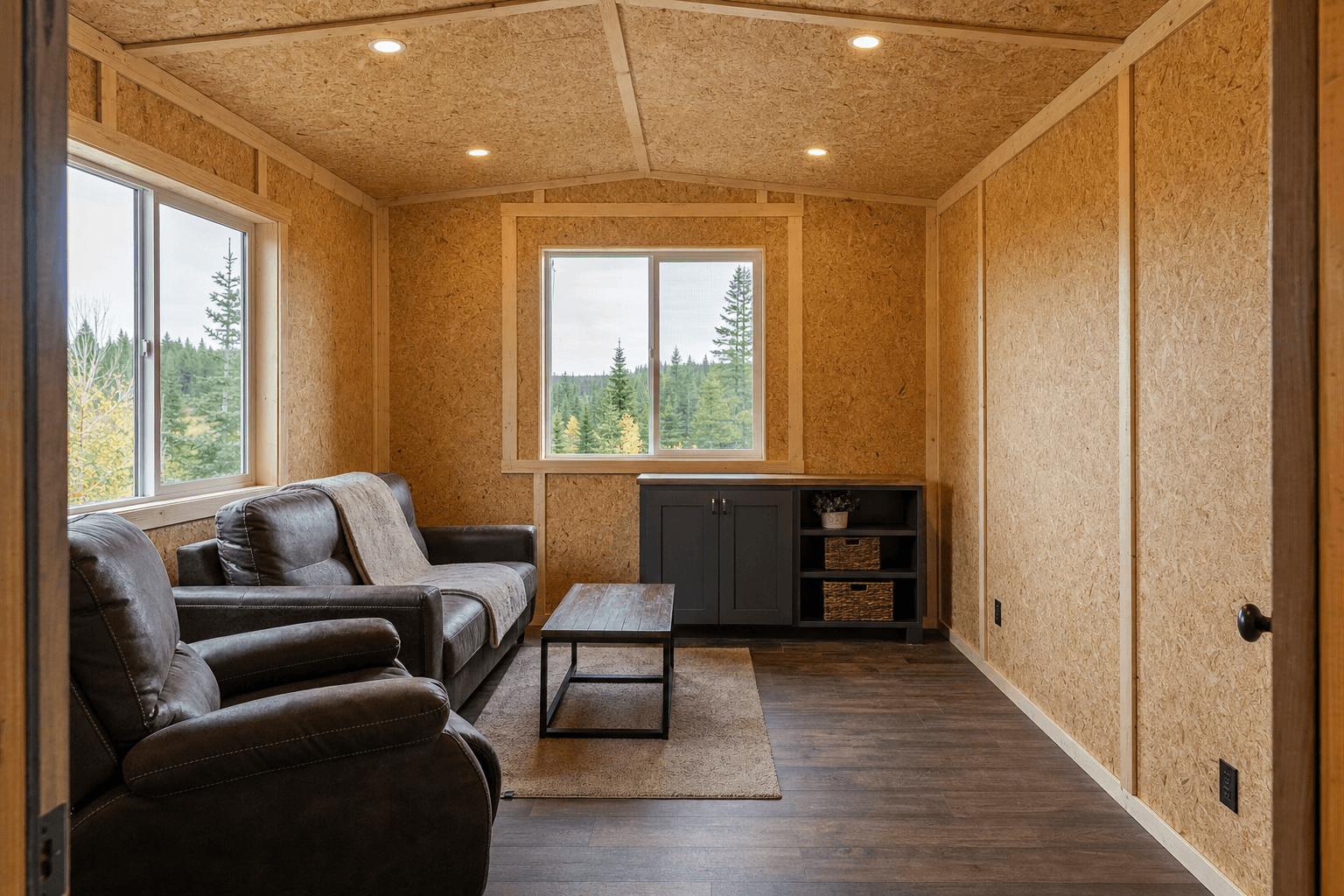
Zoned for hanging out: seating facing the screen, a bar along the back wall, and climate control overhead.
Even a single-room man cave works better when you plan it as zones instead of one open box. The viewing zone is the anchor: mount the TV on the most solid wall, away from direct window glare, and set your main seating at a comfortable distance so nobody's craning their neck or sitting on top of the screen. Give the sofa enough depth behind it to walk past without turning sideways. The bar zone belongs along an end wall or a corner where plumbing and power can land together, so the mini-fridge, the kegerator, the sink, and the back-bar shelving share one short run instead of cords and lines crossing the room. Reserve a climate and power wall for the mini-split head, the subpanel feed, and the main outlet cluster, so the warm, noisy equipment sits away from where people relax and the cords stay short and tidy. Leave a game zone with real clearance if you want darts, a poker table, or a pool table, because a dartboard needs throwing room and a pool table needs cue space on every side. Finally, keep a small transition zone at the door for a coat hook, a boot mat, and a spot to set a case of drinks down. Sketching these zones on paper before you pick a footprint is the fastest way to tell whether you can fit everything in a smaller building or whether you'll want the extra wall length of a larger one.
Plan dedicated circuits with outlets behind the TV, around the bar, and along the seating wall, plus a separate run for the mini-split. A big screen, a receiver, a console, a kegerator, and a mini-fridge add up, so wire for what you'll actually run. Add in-wall conduit behind a solidly blocked TV wall so cables and a power kit hide clean.
Match the TV to the viewing distance and plan for a soundbar or a small surround setup with the receiver and subwoofer placed where the bass won't rattle the bar glass. Pre-wire for speakers in the corners so you're not running cables across the floor later, and pick the wall that keeps the screen out of afternoon glare.
A ductless mini-split heat pump heats and cools the room efficiently and quietly so it's usable in a January cold snap and a July heat wave. Add a ceiling fan for shoulder seasons, a small dehumidifier for damp, and weatherstripped doors so the conditioned air and the game-day noise both stay where you want them.
Build the bar with a back-bar shelf for glasses and bottles, room underneath for a kegerator or a mini-fridge, and a stretch of counter for pouring. Add closed cabinets for cups and gear, a wall rack for cues or darts, and durable flooring or floor mats that shrug off spills and dropped chips.
The keyword for a man cave is game day, and the fit-out is everything that makes a Sunday afternoon out there better than the living room. For the screen: a large mounted TV or a short-throw projector and screen, a receiver, a soundbar or surround speakers and a subwoofer, a streaming box, and a game console or two with a controller charger. For the bar: a kegerator or a beer fridge, a mini-fridge for mixers, an ice maker or a cooler, a bar sink if you run a water line, glassware and a back-bar shelf, and bar stools that tuck under the counter. For seating and the room: a sectional or a couple of recliners, a coffee table, a mini-split for heat and air conditioning, a ceiling fan, and blackout shades to kill glare on the screen during a day game. For the games: a dartboard with a backboard and a throw line, a poker table and a chip set, or a pool table with a cue rack, plus a small high-top for cards and snacks. For finish and durability: luxury vinyl plank or sealed flooring that wipes clean, a rug to warm it up and tame echo, neon or LED accent lighting on a dimmer, and team or bar signage on the walls. Walk through your own list like this before you settle on a size, because a TV, a sectional, a bar, and a pool table claim floor faster than people expect. None of it fits in a 12x16 shed once you add the bar and a table, which is exactly why a full game-day room tends to land at 14x20 or larger.
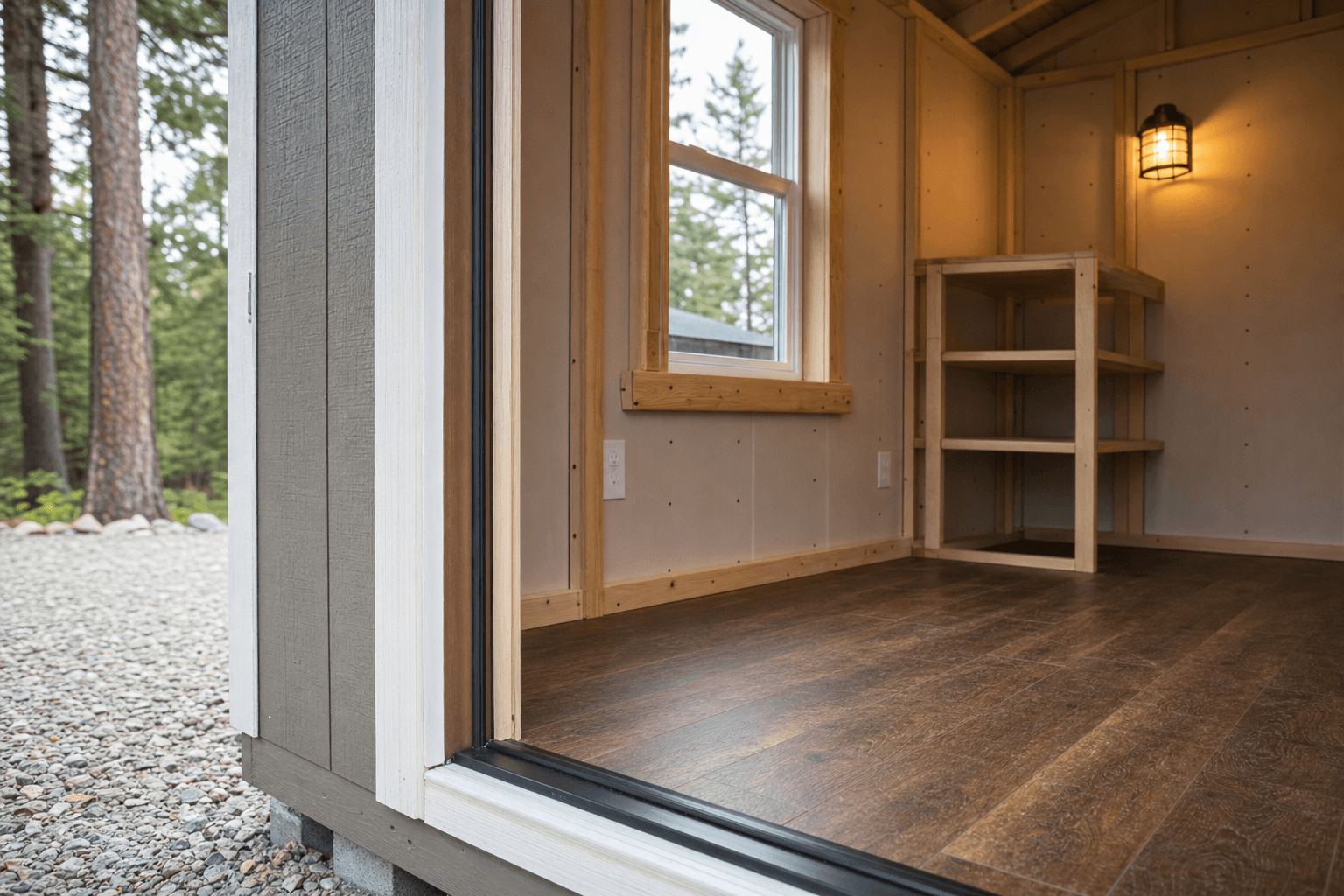
Detail that makes it a real hangout: a bar wall wired for a kegerator, mounted-TV blocking, and lighting on a dimmer.
| Man cave planning checklist | |
|---|---|
| Best roofline | Standard gable for flat TV and bar walls; lofted barn or single-slope for a lodge feel and more height |
| Practical sizes | 12x16 for TV and a couch, 12x20 to 14x20 with a bar, 16x24 for a crowd plus a table and a bathroom |
| Insulation | Continuous insulated walls, ceiling, and floor; sealed door and windows for year-round game day |
| Climate | Ductless mini-split heat pump for quiet heating and cooling; ceiling fan and a dehumidifier for damp |
| Power and AV | Dedicated circuits, outlets behind the TV and at the bar, and in-wall conduit on a blocked TV wall |
| Bar and plumbing | Power for a kegerator and fridge; add a supply and drain line only if you want a wet bar or bathroom |
Three systems decide whether your man cave works in February as well as it does in September. Power comes from dedicated circuits run from your home's panel by a licensed electrician, ideally feeding a small subpanel in the shed so you can add circuits later without re-trenching. Plan a circuit for the TV wall and AV gear, a circuit for the bar so a kegerator and a fridge aren't sharing a breaker with the receiver, and a separate run for the mini-split, because a fridge compressor kicking on shouldn't dim the picture mid-game. Sound is what separates a man cave from a quiet room, and it cuts both ways: you want the bass to hit inside and you want to keep it from carrying to the neighbors. Insulated walls already block a lot, and a solid-core door, soft surfaces like a rug and a sectional, and smart speaker placement do the rest, so pre-wire for corner speakers and a subwoofer while the walls are open. Winter readiness ties it together: a fully insulated envelope, a properly sized mini-split, and weatherstripped openings hold a steady temperature through North Idaho cold snaps so the room is just as good for a December playoff game as a summer one, and the same insulation keeps it cool in July. We frame and build the shell tight and dry on your property so it's ready for your electrician and AV installer to finish the wiring.
A man cave shell stays straight and dry only on a solid, level base, so most sit on a compacted gravel pad sized about a foot wider than the building on each side for drainage, or on a concrete slab if you want a perfectly flat, sealed floor under a pool table or a bar. North Idaho weather drives the rest of the plan: design for local snow load so the roof shrugs off a heavy Panhandle winter, keep the floor up off the ground so spring melt and rain drain away instead of wicking in, and place the building where the gravel driveway or a clear path lets our crew get materials in to build it. We build with weather-rated framing and finishes suited to pine-country freeze-thaw cycles, and we set the structure to drain and breathe so it lasts. On permits, the rule of thumb is the use: a plain storage shed under a size threshold often needs no permit, but the moment a building is conditioned and finished as living space, with power, climate control, and especially plumbing, your county or city may treat it differently and require a permit, an electrical inspection, and a plumbing inspection if you add a wet bar or bathroom, plus adherence to setbacks. Rules vary across Kootenai County and the cities around Coeur d'Alene, so confirm with your local building department before you finalize size, placement, and whether you're running water out there. We can plan the build around whatever your jurisdiction requires once you know the answer.
Treat the man cave as a conditioned room with a continuous insulated envelope: insulated walls, ceiling, and floor, plus a sealed door and windows that don't leak air. For climate, a ductless mini-split heat pump is the go-to because it both heats and cools, runs quietly under the TV, and holds a steady temperature through a Panhandle cold snap, so the room is good for a December playoff game and a July afternoon alike. Add a ceiling fan to move air in the shoulder seasons and a small dehumidifier for damp. With a tight envelope and a properly sized mini-split, the space stays comfortable year-round and your energy bill stays reasonable because you're conditioning one small, well-sealed building rather than fighting an uninsulated box.
Plan it before the walls close up. Run dedicated circuits from a subpanel in the shed with outlets behind the TV, around the bar, and along the seating wall, and keep the mini-split on its own circuit so heavy AV and fridge loads don't trip a breaker mid-game. On the TV wall, add solid blocking for the mount and in-wall conduit so the power and HDMI cables hide clean instead of dangling. For sound, pre-wire for corner speakers and a subwoofer and leave a spot for the receiver near the screen, so you're not stapling speaker wire across the floor later. If you want internet for streaming and online gaming, pull a hardwired Ethernet line in conduit from the house to a mesh node inside rather than relying on Wi-Fi to cross the yard. We build the shell tight and dry so your electrician and AV installer can run and terminate everything cleanly.
Yes, and it's one of the most popular features. The key is to plan the bar wall up front so power, and water if you want it, land in one place. Build the bar along an end wall or a corner with a dedicated circuit and outlets underneath for a kegerator and a mini-fridge, plus a back-bar shelf for glasses and bottles and a stretch of counter for pouring. A kegerator and a beer fridge only need power, so a dry bar is simple and needs no plumbing. If you want a bar sink and running water, that's a wet bar and it crosses into plumbing, with a supply and drain line, which adds cost and may trigger a plumbing inspection. Many buyers start with a dry bar and a kegerator and leave room to add a sink later, which keeps the first build straightforward while keeping the option open.
The same insulated envelope that keeps the room warm also blocks most of the sound, so a tight, fully insulated shell is the foundation. From there, the wins are simple: a solid-core door with weatherstripping seals the biggest leak, soft surfaces inside, a rug, a sectional, and curtains, soak up reflections, and placing the subwoofer away from shared walls and up off a hard floor keeps the bass from traveling. Because the building is detached and sits out in the yard, you already get distance working in your favor, which a basement never gives you. If you host loud and late and want to push it further, we can talk about heavier wall treatment and double doors, but for normal game-day volume, good insulation, a solid door, and a few soft furnishings keep things neighborly.
Size for the crowd plus the bar, not the average Tuesday. A 12x16 fits a big TV and a sofa or a couple of recliners with a mini-fridge, which works for a solo retreat or a tight two-person hangout but leaves no room for a real bar. To add a bar along one wall and seat a small group, step up to a 12x20 or a 14x20 so the seating and the bar aren't competing for the same floor and people can move around the stools. If you want to host a real game-day crowd with a sectional, a bar, and a poker or pool table, plan on a 16x24, which also leaves room to partition off a bathroom. Counting the seats you actually want and the footprint of the bar and any table, rather than just the TV, is how you avoid outgrowing the room the first time the whole group comes over.
You can, but plumbing is the upgrade that changes the project the most, so plan it deliberately. A wet bar with a sink or a half bath needs a water supply line and a drain line run out to the building, which on most North Idaho properties means trenching from the house and tying into supply and waste, and it usually requires a plumbing permit and inspection. Cold-climate runs also need protection from freezing, so lines and any fixtures have to be insulated and planned to drain or stay heated through winter. For that reason many buyers keep the first build dry, a kegerator and a mini-fridge need only power, and add a sink or a bathroom later, or step up to a larger footprint like a 16x24 where a plumbed corner has room to live. Once you decide whether water is in scope, we plan the structure, the slab, and the wall layout around it so the rough-in lines up with your plumber's work.
A backyard man cave shed in North Idaho has to handle both extremes — the 90-degree afternoons in Coeur d'Alene and Post Falls and the sub-zero mornings that show up every January. Insulation and a mini-split or wall unit that handles both heating and cooling is the standard solution for a shed used year-round. Sizing that system to the square footage and insulation R-value is what separates a comfortable space from one that's only usable half the year.
Power is the other early decision. A TV, a sound bar, a kegerator or bar fridge, and a few outlets for charging and lighting add up quickly. Running a dedicated circuit from the main panel during the build — rather than running an extension cord as a stopgap — is the cleaner path and the one that passes electrical inspection in Kootenai County.
Because we build on site, the shed can go where your lot actually has room: behind the detached garage, in a corner of the back yard, or at the edge of a wooded lot in Hayden or Rathdrum. Delivered units can't reach those spots. The on-site build also means wall framing and insulation are engineered for our actual snow loads and freeze-thaw cycles, not generic Pacific Northwest specs.
Acoustic treatment is worth considering if neighbors are close — in city limits in Coeur d'Alene or Post Falls, sound travels. Even basic insulated walls and a solid-core door help significantly. See the full man cave shed overview or configure your layout now to land on a realistic budget.
Tell us how you'll use the space and we'll help you size, lay out, and price an insulated, wired-up man cave shed for your North Idaho property.
Keep planning your build with related North Idaho shed guides.