An outdoor bar shed turns the backyard into a place people actually gather. Instead of running drinks and ice back and forth from the kitchen every time you host, you build one small building that does the pouring, the chilling, and the serving in the spot where the party already is, out by the patio, the fire pit, or the pool. The thing that makes it a bar and not just a finished shed is the serving setup: a pass-through window that opens onto a bar top, a few stools on the outside, and everything you need to mix and pour staged on the inside where it stays clean and dry. That is the whole idea behind a purpose-built outdoor bar shed, and it is why it earns its footprint in a way a cooler on a folding table never will.
A bar shed is a smaller, more focused build than a full hangout room, and that is its appeal: you do not need a big footprint, you need the right one, with the window on the side that faces your guests and the inside laid out so one person can tend bar without tripping over a keg. The decisions that matter come up front, the serving window and bar top, power for a kegerator and a fridge, whether you run water for a sink, how many stools you want to seat, lighting that works after sunset, and weather protection so the bar is usable on a cool North Idaho evening and not just a few warm afternoons. This guide walks each of those in order, points you to the sizes that fit serving plus seating, and explains how we build the structure on your property so it is solid, dry, and ready for your electrician and plumber to finish. If you would rather see options priced first, you can build and price a layout in a few minutes and come back to the details.
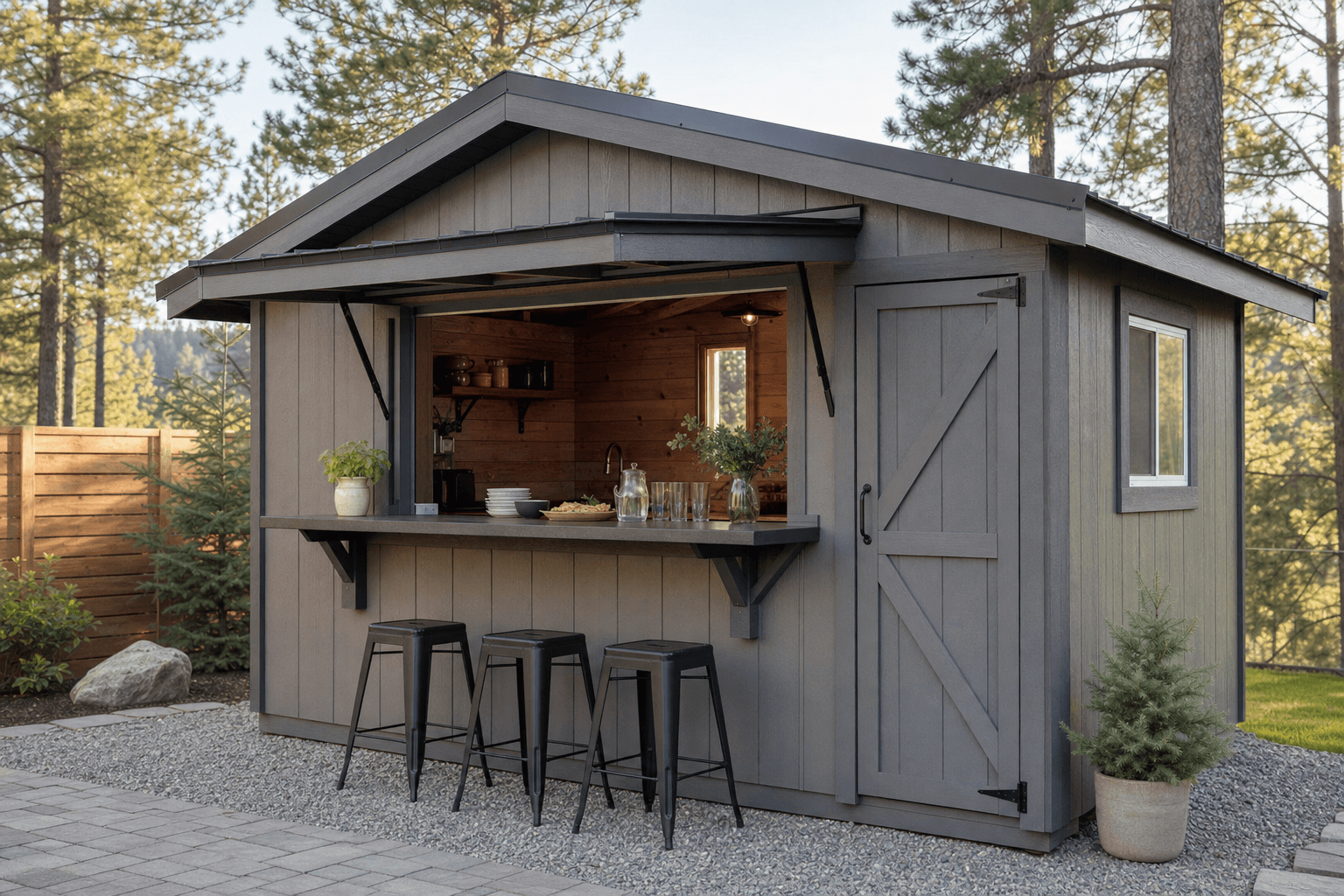
A backyard bar shed built to serve: a pass-through window onto a bar top, stools outside, and the keg, fridge, and pour staged dry on the inside.
Most bar sheds work best with a roofline that gives you a clean, tall wall for the serving window and a generous overhang on the serving side. A standard gable is the natural fit: straight walls make it easy to frame a wide pass-through window and hang a fold-down or fixed bar top under it, and the symmetrical roof sheds snow evenly. If you want the serving side covered so guests can belly up to the bar in light rain or full sun, a model with a covered porch along the front is hard to beat, because the porch roof shelters the stools and the bar top while the enclosed half keeps the keg, the fridge, and the glassware out of the weather.
A lean-to or single-slope roof reads modern and lets you pitch the tall wall toward your guests, which is a great look for a poolside or patio bar and gives you height for a big window and overhead string lights. A lofted barn (gambrel) adds vertical volume and a small loft you can use to stash seasonal coolers, extra stools, and party supplies overhead so the bar floor stays clear. A bar shed shares most of its DNA with the other backyard entertaining builds we do, so it is worth seeing how we handle a man cave shed when you are weighing rooflines, because the wiring, the kegerator, and the comfortable-finish priorities overlap almost completely. Whatever the roofline, the serving window and the overhang over the stools are the two features that make it read as a bar from the yard.
However you roof it, a bar shed is a finished, working serving space, not a storage box. That means a solid bar wall built to carry a counter and a window, durable surfaces that wipe clean, and power and lighting planned in before the walls close up.
A pass-through window, a back counter, a kegerator and a fridge, and room for one bartender to work. An 8x12 is the tidy floor for a serve-out bar with the seating all outside.
Add a sink, more cold storage, and space to stand and mix inside without bumping the keg. A 10x12 or 10x16 gives the bartender real working room behind the counter.
If you want stools at an interior bar as well as the serving window, plus storage and a sink, step up to a 12x16 so seating and the work zone are not fighting for floor.
Footprint is the decision everything else rides on, so size for the serving window plus whatever has to sit behind it. An 8x12 shed is the sensible floor for a serve-out bar: 96 square feet holds a kegerator, a fridge, a back counter, and a bartender, with all the stool seating outside under the window, which is plenty if the bar's job is to pour for the patio. Move up to a 10x12 shed and the extra width gives the person behind the bar room to turn around, add a sink, and keep ice and mixers within reach without backing into the keg. A 10x16 shed is the sweet spot for a serious entertaining bar: 160 square feet absorbs a full back bar, a sink, a kegerator and a separate fridge, glass storage, and a little dry-stock shelving, while still serving out one long window. The 12x16 shed is the build for hosts who want it all, an exterior serving window and stools, plus an interior bar with its own stools so a few people can sit inside on a cold night, room for a sink and a bathroom-adjacent plumbing run, and storage for everything a party needs. Whatever you pick, plan the room around how you actually host, a quick pour for a crowd outside, or a place people sit and stay.
These backyard builds overlap, and the right label depends on where the action is. An outdoor bar shed is optimized for serving: the serving window, the bar top, the kegerator, and the stools are the whole point, and most of the seating lives outside in the yard. A man cave shed is optimized for the screen and the couch, a big mounted TV, a sound system, and seating, with a bar as one feature among several inside a larger conditioned room, so if you picture the group sitting down to watch the game, that is a man cave with a bar, not a bar shed. A pool house is built around the water, with a changing area, a bathroom, and towel and float storage, and a serving bar bolted onto that program, so if the bar is really there to feed swimmers between dips, plan it as a pool house with a bar window. And if your retreat is more about a quiet, finished personal space than serving a crowd, a she shed trades the keg and the pass-through for a calm hobby and lounge room. Many buyers land on a dedicated bar shed precisely because it keeps the serving compact and outdoor-facing, the drinks come out the window, the mess stays in the building, and nobody is crowding the bartender. If you are torn, decide whether people mostly stand and mingle outside or sit and stay inside, and build the bar around that.
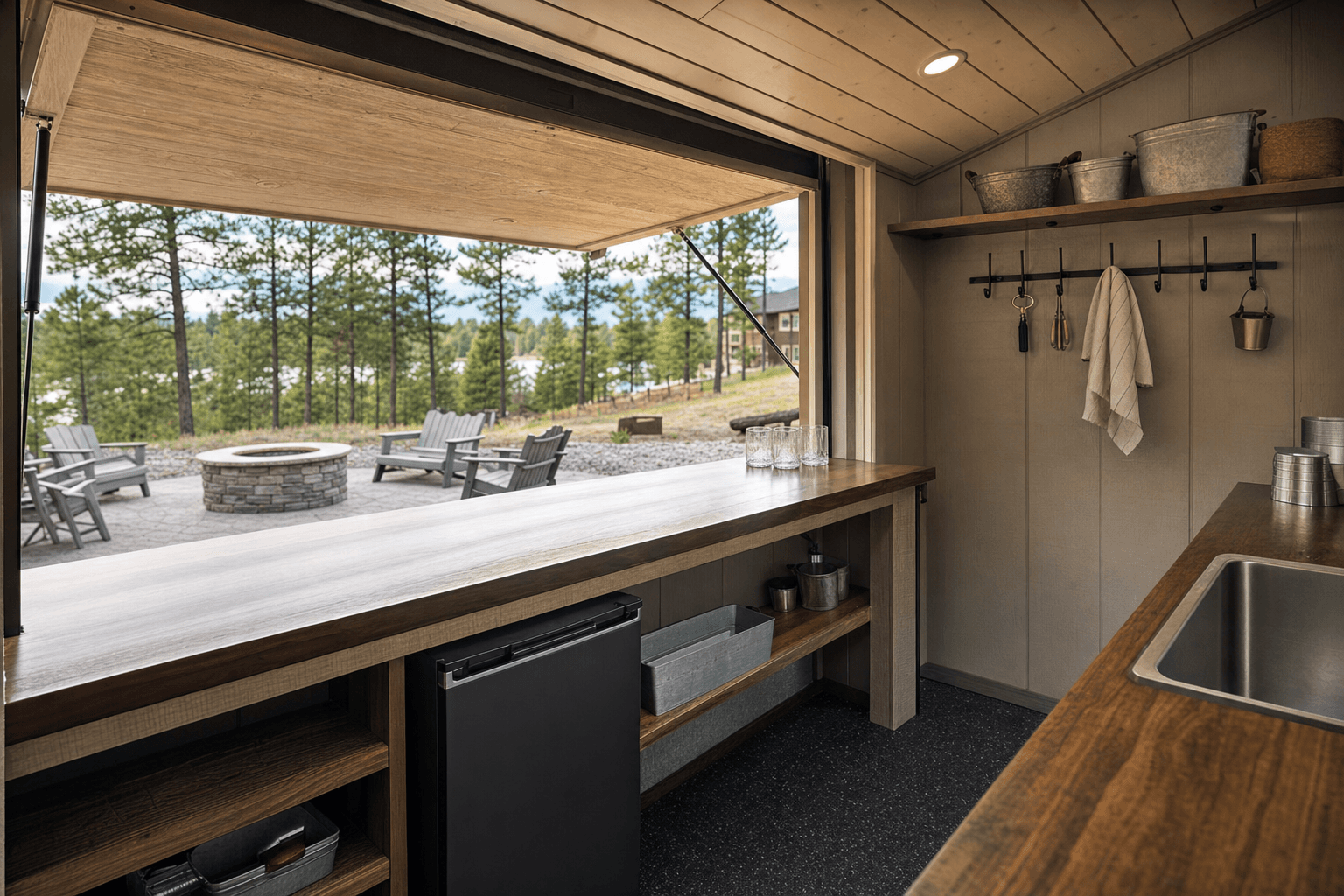
Zoned to pour: cold storage and a sink along the back wall, dry stock and glassware on shelves, and the serving window framing the bar top.
Even a small bar shed works better when you plan it as zones instead of one open box, because a bar is really a tiny kitchen and the flow matters. The serving zone is the anchor: the pass-through window and the bar top under it face your guests, so put the window on the side that looks out at the patio, the pool, or the fire pit, and keep the bar top clear so it is a place to set drinks and lean, not a place to store clutter. The cold zone holds the kegerator and the fridge, and it belongs on the back or end wall on its own dedicated power so the compressors sit away from where the bartender stands and the cords stay short. The wet zone, if you run water, groups the sink, the supply line, and the drain in one corner so plumbing lands together instead of crossing the floor, ideally next to the cold zone so a single short run handles both. Reserve a pour-and-prep zone of open counter between the cold storage and the window, because the bartender needs a clear stretch to mix, garnish, and set drinks up to pass out. Finally, keep a dry-stock zone of shelving for glassware, bottles, napkins, and bar tools, up off the counter and out of the splash. Sketching these zones on paper before you pick a footprint is the fastest way to tell whether one bartender can work the bar comfortably or whether you need a wider building.
Plan dedicated circuits with outlets at the back counter for a kegerator and a fridge, plus outlets at the bar top for a blender, an ice maker, and phone chargers. A kegerator, a beer fridge, and an ice maker running together add up, so wire for what you will actually plug in and keep heavy cold storage off the lighting circuit.
Frame a wide pass-through window on the serving wall and hang a fixed or fold-down bar top under it, built from a sealed, weather-tough surface that wipes clean. Block the wall to carry the counter and a person leaning on it, and pitch any exterior bar top slightly so spills and rain run off instead of pooling.
A bar sink turns a serve-out window into a real working bar, but it needs a supply line, a drain, and protection from freezing in North Idaho. Group it with the cold zone, plan a way to drain or heat the line for winter, and decide up front whether water is in scope, because it is the upgrade that most changes the build.
Add back-bar shelving for glasses and bottles, closed cabinets for tools and napkins, and a stretch of sealed counter for pouring. Finish the floor in luxury vinyl plank or a sealed surface that shrugs off spills and dropped ice, and add a floor mat where the bartender stands.
The keyword for a bar shed is serving, and the fit-out is everything that lets one person pour for a crowd without leaving the building. For cold and draft: a kegerator or a keezer with one or more taps, a beer-and-mixer fridge, an undercounter or countertop ice maker, and an ice well or a speed rail at the pour station. For the serving window: a wide pass-through with a screen and a way to lock it down, a fixed or fold-down bar top, and bar stools sized to tuck under the counter outside. For mixing and pouring: a bar sink with a faucet if you run water, a cutting board and a garnish caddy, a cocktail shaker and jiggers, a blender for frozen drinks, and a bottle rail within arm's reach. For storage and stock: back-bar shelving for glassware, closed cabinets for tools and supplies, a wine or bottle rack, and a small dry-stock area for napkins, straws, and mixers. For comfort and atmosphere: overhead and under-counter lighting on a dimmer, string lights over the serving window, a ceiling fan or a heater for shoulder-season evenings, and a sound setup or a Bluetooth speaker. For durability: a sealed bar top and floor that wipe clean, weatherstripped doors and window, and a mat where ice and spills land. Walk through your own list like this before you settle on a size, because a kegerator, a fridge, a sink, and an ice maker claim the back wall faster than people expect, and that is exactly why a serious entertaining bar tends to land at a 10x16 shed rather than something tighter.
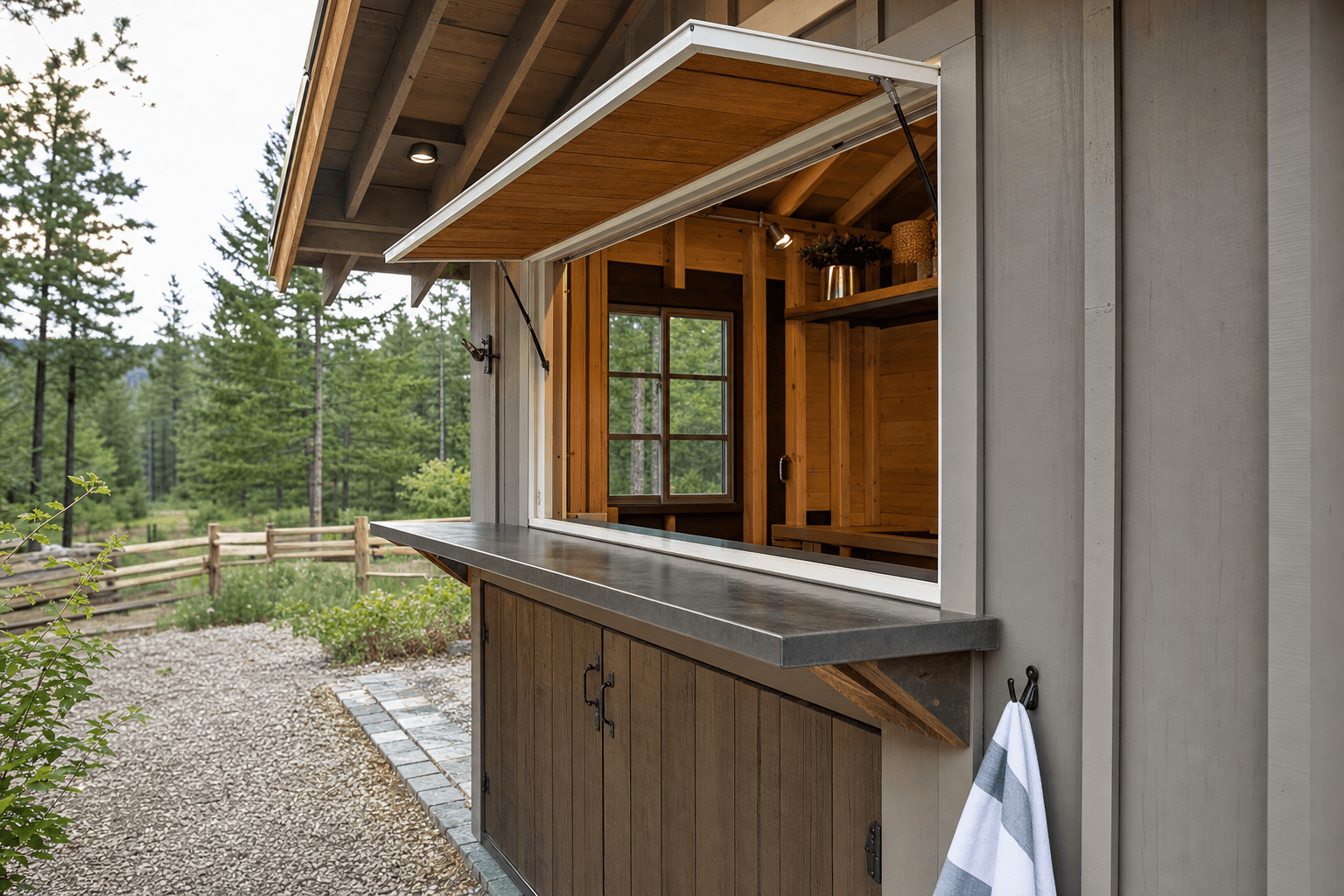
Detail that makes it a bar: a pass-through window over a bar top, taps and a fridge below, and lighting that keeps the pour going after dark.
| Outdoor bar shed planning checklist | |
|---|---|
| Best roofline | Standard gable or single-slope for a tall serving wall; covered porch to shelter the stools and bar top |
| Practical sizes | 8x12 for a serve-out bar, 10x12 to 10x16 with a sink and full cold storage, 12x16 for interior seating too |
| Serving window | Wide pass-through on the guest-facing wall with a fixed or fold-down bar top, blocked to carry the counter |
| Power | Dedicated circuits for the kegerator, the fridge, and an ice maker, plus bar-top outlets, off the lighting circuit |
| Plumbing | Optional bar sink needs a supply and drain line, grouped with cold storage and planned to drain or heat for winter |
| Lighting and weather | Dimmable overhead and under-counter light, an overhang or porch over the stools, sealed surfaces that wipe clean |
Three things decide whether your bar shed is usable on a cool October evening and not just a few warm afternoons. Power comes from dedicated circuits run from your home's panel by a licensed electrician, ideally feeding a small subpanel in the shed so you can add circuits later without re-trenching. Plan a circuit for the cold storage so a kegerator, a fridge, and an ice maker are not sharing a breaker, outlets along the bar top for a blender and chargers, and a separate lighting circuit so a compressor kicking on never dims the bar. Lighting is what keeps the party going after sunset, and a bar wants layers: bright task light over the pour-and-prep counter so the bartender can see, softer under-counter and back-bar lighting on a dimmer for atmosphere, and weatherproof string lights or a sconce over the serving window so guests at the stools are not in the dark. Weather readiness is what makes the bar a three-season space in North Idaho: an overhang or a covered porch over the serving side shelters the stools and the bar top from rain and sun, weatherstripped doors and a window that latches keep wind and weather out of the building when it is closed, and a patio heater or a small mini-split lets you push the season into the cold months. We frame and build the shell tight and dry on your property, with the serving window roughed in and the bar wall blocked, so it is ready for your electrician and plumber to finish.
A bar shed stays straight and dry only on a solid, level base, so most sit on a compacted gravel pad sized about a foot wider than the building on each side for drainage, or on a concrete slab if you want a perfectly flat, sealed floor that handles a sink, dropped ice, and the weight of a loaded keg. Placement matters more than usual for a bar, because the serving window has to face your guests, so set the building so the pass-through looks out at the patio, the pool, or the fire pit, and leave room for the stools and a few people to gather outside it. North Idaho weather drives the rest of the plan: design for local snow load so the roof and any porch overhang shrug off a heavy Panhandle winter, keep the floor up off the ground so spring melt and rain drain away instead of wicking into a building that gets wet use, and place it where the gravel driveway or a clear path lets our crew get materials in to build it. We build with weather-rated framing and finishes suited to pine-country freeze-thaw cycles, and we set the structure to drain and breathe so it lasts. On permits, the rule of thumb is the use: a plain storage shed under a size threshold often needs no permit, but the moment a building is finished and wired, and especially if you run a sink or any plumbing, your county or city may require a permit, an electrical inspection, and a plumbing inspection, plus adherence to setbacks. Rules vary across Kootenai County and the cities around Coeur d'Alene, so confirm with your local building department before you finalize size, placement, and whether you are running water out there. We can plan the build around whatever your jurisdiction requires once you know the answer.
Plan the serving window into the build from the start, because it sets where everything else goes. Pick the wall that faces your guests, the patio, the pool, or the fire pit, and frame a wide pass-through opening there, then hang a bar top under it. You have two common choices: a fixed exterior counter that cantilevers out under a fixed window, which is the cleanest look, or a fold-down bar top hinged to the wall that drops to serve and lifts to close the bar, which is great if you want to lock the building up tight between parties. Either way, the wall has to be blocked to carry the counter and a person leaning on it, the window needs a screen and a secure latch, and any exterior bar top should pitch slightly so rain and spills run off. We frame the opening and block the wall during the build so the window and counter install cleanly and the bar reads as a bar from the yard.
Cold storage is the heaviest electrical load in a bar shed, so wire for it deliberately. A kegerator, a beer-and-mixer fridge, and a countertop or undercounter ice maker each draw a real amount, and their compressors cycle on and off, so put cold storage on a dedicated circuit rather than sharing with the lights or the sound system, which keeps a compressor from dimming the bar when it kicks on. Run the power from a licensed electrician off your home's panel, and feed a small subpanel in the shed so you can add circuits later without trenching again. Place the outlets on the back or end wall right where the kegerator and fridge sit so cords stay short and hidden, and add separate bar-top outlets for a blender, a charger, and small appliances. Plan for what you will actually run at once on a busy night, not the minimum, because a bar that trips a breaker mid-party is the thing you most want to avoid. We build the shell so your electrician can run and terminate everything cleanly before the walls close.
Yes, and a bar sink is what turns a serve-out window into a real working bar, but water is the upgrade that most changes the project, so plan it on purpose. A sink needs a water supply line and a drain line run out to the building, which on most North Idaho properties means trenching from the house and tying into supply and waste, and it usually requires a plumbing permit and inspection. Cold-climate runs also have to handle freezing, so the line and the fixture need to be insulated and planned either to drain down for winter or to stay heated, since a frozen line is a burst line. Group the sink with the cold zone so a single short plumbing run serves the corner, and put it on a slab if you can for a clean, sealed floor under the wet area. Many buyers keep the first build dry, a kegerator and a fridge need only power, and add a sink later, or step up to a larger footprint like a 10x16 where a plumbed corner has room to live. Once you decide whether water is in scope, we plan the structure, the floor, and the wall layout so the rough-in lines up with your plumber's work.
Lay the bar out around the serving window and the bartender's reach. The pass-through bar top faces out, so plan the stools on the outside under the window and the work counter on the inside, with a clear pour-and-prep stretch between the cold storage and the window so one person can mix and pass drinks without backing into the keg. For the stools, allow about 24 inches of bar-top width per seat so people are not bumping elbows, and leave roughly 10 to 12 inches of knee room under the counter, with enough clear ground behind the stools that guests can pull out and stand up without crowding a walkway. Set the bar top at standard bar height, around 42 inches, and match the stool height to it. If you also want seating inside on cold nights, you need a wider building like a 12x16 so an interior bar and its stools do not eat the bartender's working room. Sketch the window, the counter, the cold storage, and the stools to scale before you pick a size, because the seating and the work zone compete for the same few feet.
A bar shed lives or dies on being usable after dark and in cool weather, so plan light in layers and shelter for the serving side. For lighting, put bright task light over the pour-and-prep counter so the bartender can see what they are mixing, add softer under-counter and back-bar lighting on a dimmer for atmosphere, and hang weatherproof string lights or a sconce over the serving window so guests at the stools are not sitting in the dark. Keep lighting on its own circuit so a compressor never dims it. For weather, an overhang or a covered porch over the serving side is the key feature, it shelters the stools and the bar top from rain and afternoon sun so the bar is comfortable across the seasons, while weatherstripped doors and a latching window keep wind and weather out when the bar is closed. To push into the cold North Idaho months, add a patio heater under the overhang or a small mini-split inside. We build the overhang and rough in the window and lighting locations so it is ready to finish and good for a chilly fall evening, not just a July afternoon.
Size for the serving setup plus whatever has to sit behind the bar, and decide whether seating is inside or out. If the bar's job is to pour out a window for a crowd that stands and mingles in the yard, an 8x12 is the tidy floor, it holds a kegerator, a fridge, a back counter, and one bartender, with all the stools outside under the window. To add a sink, more cold storage, and room for the bartender to turn around and mix without bumping the keg, step up to a 10x12 or a 10x16, with the 10x16 giving you space for a full back bar, a sink, separate cold storage, and dry-stock shelving while still serving one long window. If you want stools at an interior bar as well, so a few people can sit inside on a cold night, plus a sink and a bathroom-adjacent plumbing run, plan on a 12x16 so the seating and the work zone are not fighting for floor. Count the cold storage, the sink, the prep space, and the seats you actually want, not just the window, and you will avoid outgrowing the bar the first time you host a real party.
Coeur d'Alene summers run hot and bright, and a backyard outdoor bar shed built on site gives you a permanent entertaining structure that handles the season properly — a serving window that actually faces the patio, a roof pitch that sheds the rare summer downpour, and power routed where you placed it rather than where a factory decided.
The on-site build advantage matters most for orientation and siting. A bar shed that faces the wrong direction or sits too far from the patio becomes a storage shed you ignore. Because we frame and finish on your property in Coeur d'Alene or Post Falls, the opening, the step height, and the connection to your existing patio can all be resolved during the build — not guessed at from a catalog.
Winter performance is worth thinking through even for a structure you plan to use primarily in summer. North Idaho freeze-thaw cycles can heave an undersized slab and crack plumbing supply lines that aren't drained or insulated. A gravel pad foundation, foam-sheathed walls, and properly sloped drain lines make reopening in May straightforward rather than a repair project.
Kootenai County and city-of-Coeur-d'Alene permit requirements for accessory structures are worth checking before you lock in a size — a few feet of footprint difference can move you across a threshold. When you have a layout in mind, price it in the shed builder or request a free estimate. See how other properties turned out in our completed builds gallery.
Tell us how you'll host and we'll help you size, lay out, and price a serving window, a bar top, and cold storage in an outdoor bar shed for your North Idaho property.
Keep planning your build with related North Idaho shed guides.