A pool house is the building that makes a backyard pool actually pleasant to live with. Without one, every swim ends the same way: wet kids tracking through the house, towels piled on patio furniture, floats and noodles scattered across the lawn, and somebody dripping their way to the only bathroom inside. A purpose-built pool house fixes all of that by putting a changing room, a half-bath, towel and float storage, and a shaded place to sit a few steps from the water, so the wet stays outside and the house stays dry. For most families it's the difference between a pool that's a hassle and a pool that feels like a real backyard retreat you use all summer long.
What separates a pool house that holds up from one that's mildewed and warped by its second season is a handful of decisions you make before the first wall goes up. This is a wet building, used by people in swimsuits with dripping hair and bare feet, so moisture control, ventilation, and easy-clean surfaces aren't upgrades, they're the whole brief. Get the finishes, the airflow, and the plumbing right and you have a poolside building that wipes down in minutes and stays fresh through years of chlorine, splashing, and humidity; skip them and you have a damp box that smells musty and shows water stains by fall. None of it is complicated, but it has to be planned from the start, because you can't easily add a floor drain or re-route a vent after the build. This guide walks through the styles that suit a poolside building, the sizes that fit a changing room plus storage plus a lounge, how to lay out and finish the inside for wet use, and how we build the structure on your property so it drains, breathes, and lasts. If you'd rather see options priced first, you can build and price a layout in a few minutes and come back to the details.
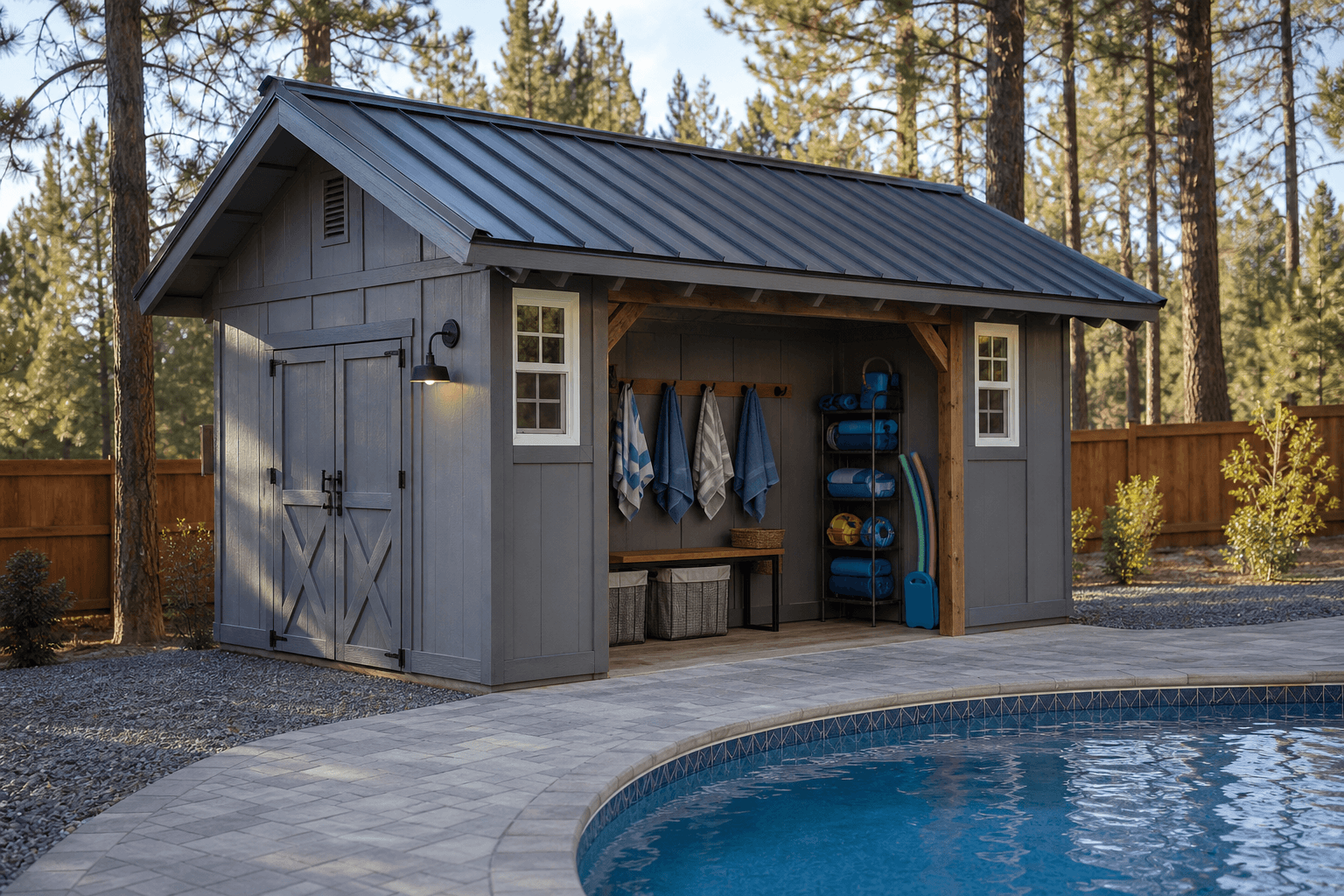
A pool house built for wet feet: changing room, half-bath, storage, and a shaded spot to sit, all a few steps from the water.
Most pool houses look best in a standard gable with a covered porch on the front. The straight walls give you flat surfaces for benches, towel hooks, and shelving inside, while the porch creates the shaded lounge that makes a pool house more than a changing room, somewhere to sit out of the sun, dry off, and watch the water without going indoors. The simple peaked roof also reads as a tidy little cabana rather than a utility box, which matters when the building sits in full view by the pool. If you want a more contemporary, resort feel, a lean-to or modern single-slope roof pairs beautifully with wide sliding or barn doors and a tall window wall, opening the whole building to the deck so the line between inside and poolside disappears. A lofted barn (gambrel) roof adds height and an optional loft if you want overhead storage for off-season floats and cushions tucked above the changing and storage zones.
Because a pool house is a finished, frequently-used room rather than a storage shed, the comfort and layout decisions overlap with the other backyard living buildings we do. It's worth looking at how we approach a she-shed when you're weighing rooflines, windows, and a finished interior, since the priorities, light, comfort, and a room you actually relax in, carry over even though the use is wetter. Whatever roofline you choose, plan the building around water moving through it, with a covered entry, a door wide enough to walk through in a towel, and an interior that's built to get splashed and wiped down rather than babied.
A private spot to change, hooks and a bench, and shelves for towels and floats. A 10x12 covers the essentials without a lounge, ideal when the patio already has seating.
Once you want a toilet, a sink, and a rinse shower alongside the changing area and storage, step up to 10x16 so the wet room and the dry storage each get real space.
If you want a changing room, a half-bath, storage, and an interior lounge or bar all under one roof, a 12x16 or 12x20 gives every zone room to work at once.
Footprint is the decision everything else rides on, so size for everything you want the building to hold, a changing area, storage, plumbing, and seating, not just the changing room you picture first. A 10x12 shed is a solid starting point for a pool house built around the essentials: a private corner to change with a bench and hooks, plus a wall of shelving for towels, floats, and sunscreen, which is plenty when your patio already provides the seating. Move up to a 10x16 shed and the extra length gives you room to add a half-bath and a rinse shower along one end while keeping the changing and storage zones uncrowded, which is the size most families land on once they decide they want a toilet a few steps from the pool. A 12x16 shed opens the building up enough for a genuine interior lounge or a small bar alongside the wet zones, so people can dry off, grab a drink, and sit in the shade without crowding the changing area. The 12x20 shed is the size to choose when the pool house needs to do it all, a private changing room, a full half-bath with a shower, generous storage, and a real lounge or bar, with a covered porch on top, and it's the footprint most people wish they'd picked once the building becomes the hub of every pool day. As a rule, size for the wet zone plus the dry zone plus the seating, because a pool house that's all changing room and no place to sit gets used like a closet instead of a retreat.
These poolside buildings overlap, and the right one depends on what happens in there most. A pool house is the all-rounder: a changing room, storage, usually a half-bath, and a shaded lounge, built to handle wet feet and serve the whole pool day. If the social side is the point, an outdoor bar shed puts the budget into a serving counter, a beverage fridge, and a pass-through window to the deck, with less emphasis on changing and bathing, so it's a cabana bar first and a changing spot second. If your backyard centers on a hot tub rather than a pool, a dedicated hot tub changing shed is sized tighter around quick changes, towel and robe storage, and a rinse, without the larger lounge a pool deck wants. And if you mostly need a comfortable, finished backyard room to relax in and the water is secondary, that's closer to a she-shed, which trades floor drains and wet-area finishes for ambiance. Many buyers choose a true pool house because it flexes, changing room and bathroom on a busy swim afternoon, shaded bar and lounge in the evening, dry storage all winter, without locking into a single use. If you're torn, build for the way the pool gets used four days out of five and let the rest flex around it.
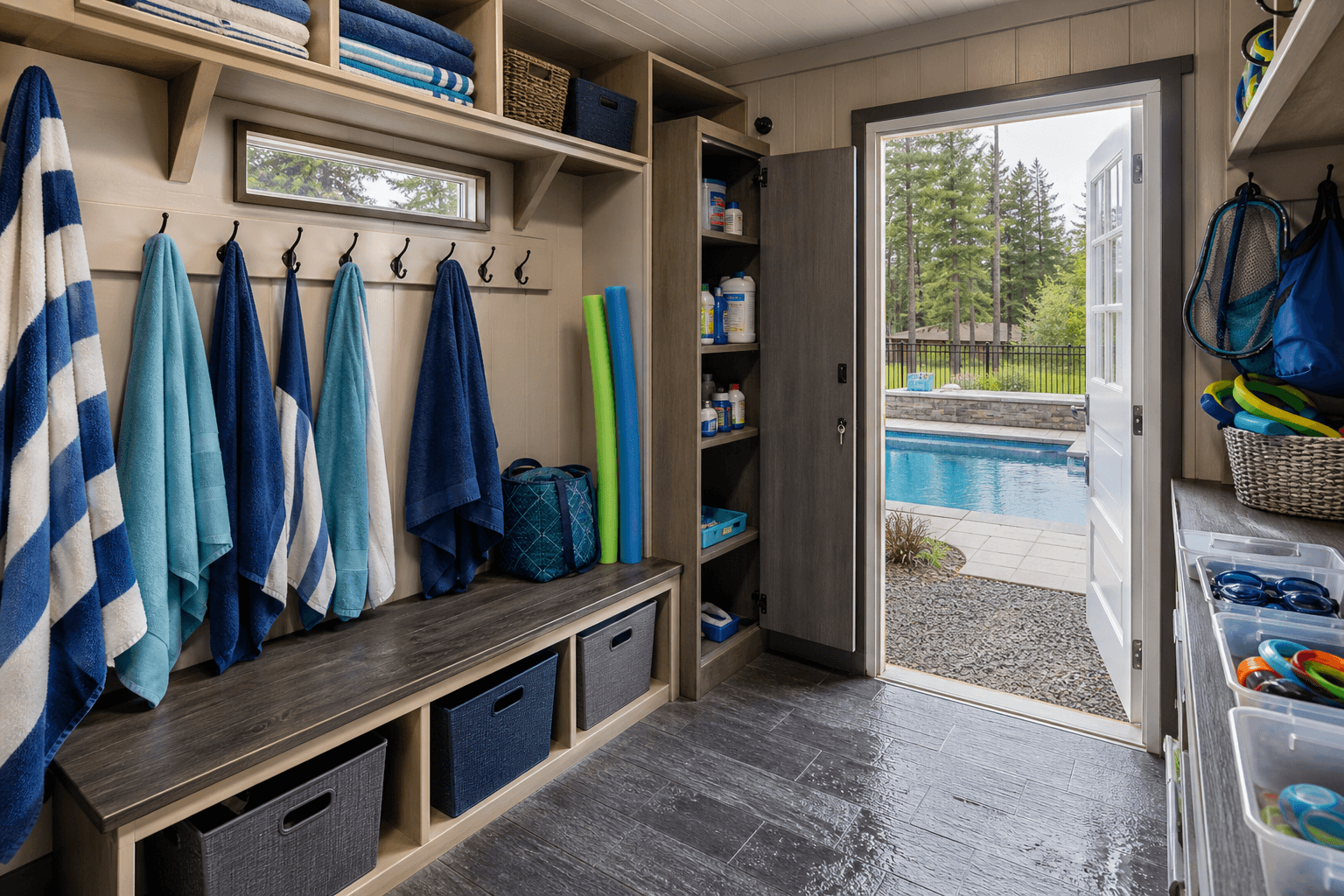
Zoned for wet use: a private changing corner, towel and float storage, and a rinse shower that all wipe down fast.
A pool house works far better when you plan it as distinct wet and dry zones instead of one open box, because the whole goal is to keep water where it belongs. Start with the changing zone, a private corner with a bench to sit on, hooks for wet suits, and ideally a curtain or a partition so more than one person can use the building at once. Keep this near the door so dripping bodies don't have to cross the rest of the room. Next comes the wet zone if you're adding plumbing: group the half-bath and the rinse shower together at one end where the floor slopes to a drain and the surfaces are fully waterproof, so all the splashing stays in one easy-to-clean area instead of spreading. Build the storage zone up the walls and into a dry section away from the shower, with open shelving for towels and sunscreen, deep cubbies or bins for floats and noodles, and hooks for goggles and gear, so everything has a home and nothing lives on the lawn. Reserve the lounge or bar zone for the part of the building that stays driest, often opening onto the covered porch, with a counter, a couple of stools or chairs, and a beverage fridge, so people can dry off and sit without dragging water into it. Sketching these zones on paper before you settle on a footprint is the fastest way to tell whether a 10x16 will do or whether you'll want the extra length of a 12x20 so the wet, dry, and seating areas never compete for the same square foot.
This is the heart of a pool house. Moisture-resistant wall panels, a sealed or tiled floor that sheds water, semi-gloss or marine-grade paint, and rust-resistant hardware stand up to chlorine, humidity, and dripping swimsuits and wipe down in minutes instead of staining or warping.
Plumbing turns a changing room into a real pool house: a compact toilet, a hand sink, and an indoor or exterior rinse shower, all grouped at one end over a floor drain with a waterproof surround, run and connected by a licensed plumber so the wet work is contained and serviceable.
Open shelving and hooks for towels, deep bins or cubbies for floats, noodles, and inflatables, a rack for goggles and pool toys, and a closet or wall space for skimmers, the vacuum, chemicals, and the cover keep the whole pool kit organized and off the deck.
A covered porch, a counter or bar top, a beverage fridge, and a few weather-friendly stools or chairs create the shaded spot to dry off, grab a drink, and watch the water, the feature that turns a changing building into the hub of every pool day.
The keyword for a pool house is wet-and-dry, and the fit-out is everything that keeps those two worlds separated and easy to clean. For changing: a bench, plenty of towel hooks, a curtain or partition, a small mirror, and a mat that drains. For the half-bath: a compact toilet, a hand sink, a paper holder, and a fan to clear humidity. For rinsing: an indoor or wall-mounted exterior shower, a foot-rinse spigot by the door, and a waterproof surround over a floor drain. For storage: open towel shelves, deep bins for floats, noodles, and inflatables, a goggle and toy rack, a hose reel, and a dry cabinet for chlorine, shock, test kits, the skimmer net, the pool vacuum, and the winter cover. For the lounge and bar: a counter, a beverage or mini fridge, a few stools, an ice bucket, a Bluetooth speaker, and a spot for sunscreen and snacks. For comfort: a ceiling fan, shades on the windows, hooks for robes, and a clock. Walk through your own version of this list before you settle on a size, because a real pool house is more than a place to change, and a 10x12 shed fills up fast once you add a half-bath, the pool chemicals, a season's worth of floats, and somewhere to sit. That's exactly why families who add plumbing and a lounge are rarely sorry they sized up to a 10x16 or a 12x20.
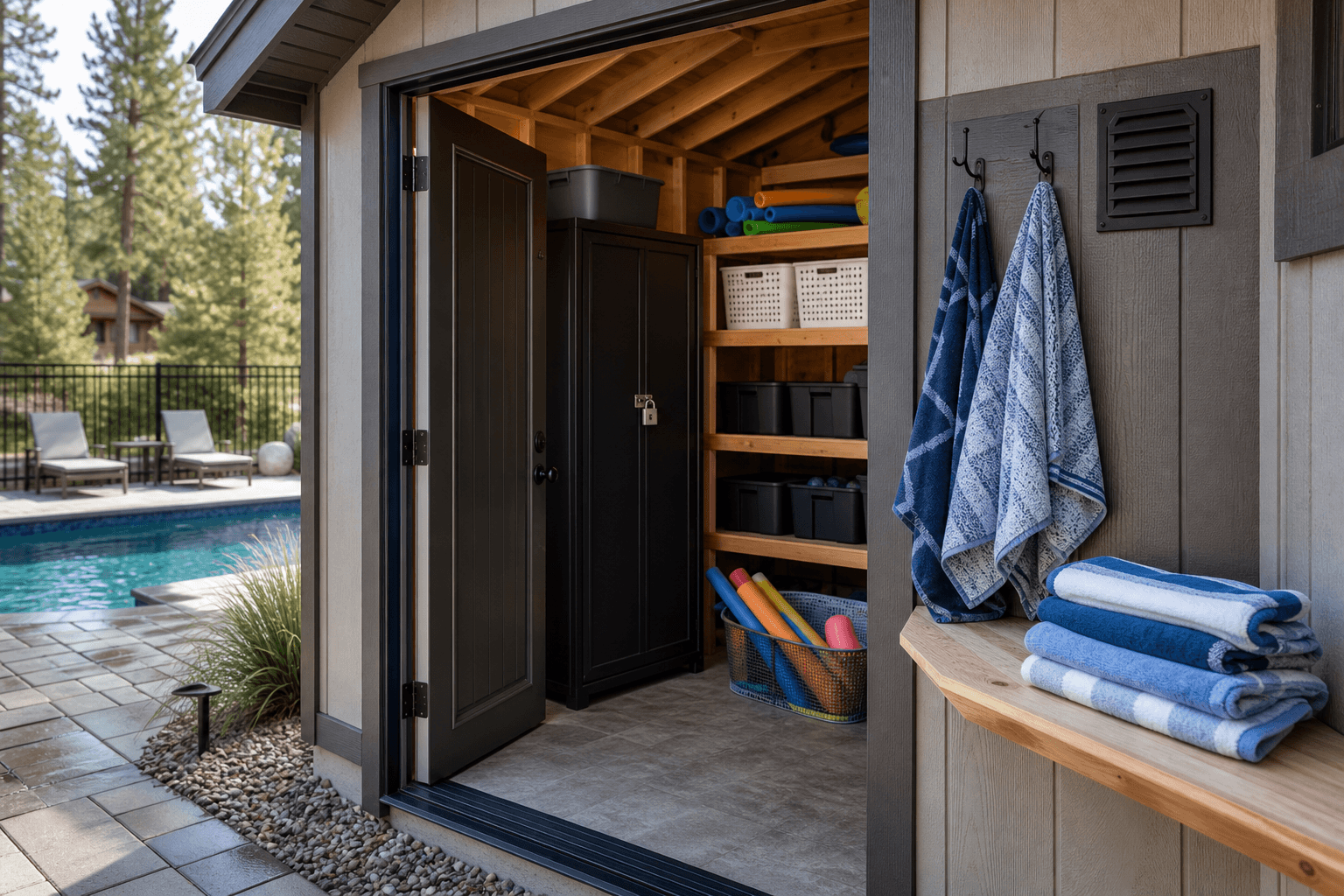
The details that keep a pool day tidy: rust-resistant hooks, dry towel shelves, and bins that corral the floats.
| Pool house planning checklist | |
|---|---|
| Best roofline | Standard gable with a covered porch for a cabana feel; single-slope for a modern, open-to-the-deck look |
| Practical sizes | 10x12 for changing plus storage, 10x16 to add a half-bath and rinse shower, 12x16 to 12x20 for a full lounge and bar |
| Surfaces and finish | Moisture-resistant wall panels, a sealed or tiled water-shedding floor, semi-gloss paint, and rust-resistant hardware throughout |
| Plumbing | Grouped half-bath, hand sink, and rinse shower at one end over a floor drain, run and connected by a licensed plumber |
| Ventilation | An exhaust fan in the bathroom, operable windows or vents for cross-breeze, and a ceiling fan to keep the building dry between swims |
| Storage and lounge | Towel shelves, deep float bins, a dry pool-chemical cabinet, plus a shaded counter or bar for drinks and seating |
Three things decide whether a pool house stays fresh and usable or turns damp and musty. Power comes from a dedicated circuit run from your home's panel by a licensed electrician, usually in buried conduit out to the building, and a small subpanel inside makes it easy to add a circuit later without trenching again. Plan outlets where you'll actually use them, by the bar and the fridge, near the bathroom, and a spot for a fan, and use weather-resistant outdoor-rated covers on anything near the wet zone for safety. Ventilation is what protects a wet building, so plan it deliberately: an exhaust fan in the half-bath to clear shower and toilet humidity, operable windows or wall vents on opposite sides for a cross-breeze that dries the room between swims, and a ceiling fan to keep air moving over damp towels and floors. Moving air is the single best defense against the mildew and musty smell that plague poorly-ventilated poolside buildings. Staying dry ties it together: surfaces that shed water, a floor that drains, ventilation that pulls humidity out, and good airflow so nothing stays wet long. If you want to use the building beyond the swim season, an insulated shell and a small heater keep it comfortable for changing on cool spring and fall days, though many pool houses are happily warm-season buildings. We frame and build the shell tight, vented, and ready on your property so your electrician and plumber can finish their work and you can fit out the rest.
A wet building stays straight, dry, and easy to clean only on a solid, level base, so most pool houses sit on a compacted gravel pad sized about a foot wider than the building on each side so water drains away from the structure, or on a concrete slab if you want a perfectly flat, sealed, sloped floor that handles a floor drain and a shower cleanly, which many people prefer for a plumbed pool house. North Idaho weather drives the rest of the plan. Design the roof for local snow load so it shrugs off a heavy Panhandle winter while the pool sits closed under its cover, keep the floor up off the ground so spring melt and rain drain away instead of wicking into a building that's already managing pool humidity, and place the pool house where the gravel driveway or a clear path lets our crew bring materials in to build, and where it sits a convenient few steps from the water. We build with weather-rated framing and finishes suited to pine-country freeze-thaw cycles, and we set the structure to drain and breathe so it lasts and stays dry inside through the off-season. On permits, the deciding factor is usually how the building is used, not just how big it is. A small detached changing shed under your jurisdiction's size threshold often needs no permit, but once a pool house has plumbing and a bathroom and is wired as a finished, occupied building, your county or city will likely require a building permit, plumbing and electrical permits and inspections, and adherence to setbacks, and pool-area buildings can also interact with barrier and fence rules. Requirements vary across Kootenai County and the cities around Coeur d'Alene, so confirm with your local building department before you finalize the size, the plumbing, and where it sits relative to the pool. Once you know what your jurisdiction requires, we plan the build around it so the structure, the rough-in, and the placement all line up.
Yes, and it's one of the most popular reasons people build one. A changing room is simple, a private corner with a bench, hooks, and a partition or curtain, and it doesn't need plumbing. Adding a half-bath with a toilet, a hand sink, and a rinse shower does, so you'll want to group those fixtures together at one end of the building over a floor drain, with waterproof surfaces around the wet area, and have a licensed plumber run the supply and drain lines and make the connections. Grouping the plumbing keeps the wet work contained, easier to service, and cheaper to run than spreading fixtures across the building. A 10x16 comfortably fits a changing area, storage, and a compact half-bath with a shower; step up to a 12x20 if you also want a lounge or bar in the same building. We frame the structure with the wet zone and rough-in planned from the start so your plumber's work goes in cleanly.
Because a pool house deals with constant humidity, splashing, and chlorine carried in on wet swimsuits, the finishes matter more than in a dry shed. Use moisture-resistant wall panels rather than untreated drywall, a sealed concrete or tiled floor that sheds water toward a drain, and semi-gloss or marine-grade paint that wipes clean and resists mildew instead of a flat finish that holds moisture. Choose rust-resistant or stainless hooks, hinges, and hardware so nothing corrodes, and waterproof the surround anywhere there's a shower. The goal is a building where every surface that gets wet can be wiped down or hosed off and dries quickly, which is what keeps it looking good and smelling fresh after years of pool seasons. We build the shell tight and use a finish package suited to a wet building so your interior stands up to the splashing instead of staining and warping.
Floats and pool gear are bulky and awkward, so plan storage that fits their shape rather than generic shelving. Deep bins, large cubbies, or a tall corner work well for inflatables, noodles, and rafts, while open shelves keep stacks of towels dry and within reach, and a row of hooks handles goggles, pool toys, and swim bags. For the maintenance side, give the chemicals, the skimmer net, the pool vacuum, the test kit, the hose, and the winter cover their own dry cabinet or wall space, ideally away from the changing and lounge areas and out of children's reach. Keeping equipment up off the floor protects it and keeps the building easy to sweep and clean. Because the full pool kit takes more room than people expect, plan storage into the footprint from the start, which is part of why many families size up to a 10x16 or 12x16 once they total up the floats, towels, and gear.
Absolutely, and it's what turns a pool house from a place to change into the hub of every pool day. The simplest version is a covered porch on the front of the building, which gives you shade and a place to dry off and sit without going indoors. Inside, you can add a counter or a bar top, a beverage or mini fridge, a few stools, and a pass-through window to the deck so drinks and snacks move easily between the bar and the poolside. Keep the lounge and bar in the driest part of the building, away from the shower and changing area, so water doesn't track into it. If a bar is a priority, look at how a dedicated outdoor bar shed is laid out for ideas on the counter and serving side. A 12x16 or 12x20 has the room to combine a real lounge or bar with the changing room, half-bath, and storage all under one roof.
Ventilation is essential in a pool house because the building is constantly dealing with humidity from wet swimsuits, towels, and a shower, and trapped moisture is what leads to mildew and a musty smell. Plan an exhaust fan in the half-bath to pull out shower and toilet humidity, and add operable windows or wall vents on opposite sides of the building so you get a cross-breeze that dries the room out between swims. A ceiling fan helps too, keeping air moving over damp towels and floors so nothing stays wet for long. The combination of moisture-resistant surfaces that shed water and good airflow that carries humidity out is what keeps the building fresh season after season. We build the shell with ventilation planned in, so you're not fighting trapped moisture in a closed-up wet building all summer.
It depends on how many of those uses you want under one roof. If you mainly need a changing room and storage for towels and floats and your patio already has seating, a 10x12 covers the essentials. Once you want to add a half-bath and a rinse shower alongside the changing and storage zones, step up to a 10x16 so the wet room and the dry storage each get real space. If you want a full poolside building, a private changing room, a half-bath with a shower, generous storage, and an interior lounge or bar, plan on a 12x16 or a 12x20 so every zone works at once without crowding, usually with a covered porch on top for shade. The honest advice is to size for the wet zone plus the dry storage plus the seating you actually want, because a pool house that's all changing room and no place to sit ends up used like a closet, and most families are glad they sized up once the building becomes the center of every pool day.
North Idaho pool seasons run shorter than most pool owners expect — roughly late May through early September in Coeur d'Alene and Post Falls — which means your pool house needs to earn its keep beyond swim months. A well-built structure with insulated walls, a heated changing room, and year-round storage for chemicals and equipment stays useful through fall and winter, not just July.
Moisture resistance is the defining requirement. Wet feet, chlorine-damp towels, and humid changing-room air punish finish materials that weren't chosen for that environment. Built on site, we select siding, trim, and interior finishes appropriate to a wet-zone building from the start — not an afterthought applied to a stock structure.
Lot access is worth planning around. Many properties in Coeur d'Alene and Post Falls that have pools also have back-yard access constraints: fencing, gates, grade changes, or mature trees that make a delivered building impossible to place. Because we build the pool house in place, it fits the site rather than the other way around.
Pool houses often benefit from Kootenai County permit review before breaking ground — setbacks from the pool edge and from property lines both apply. See our pool house service page for what goes into a full spec, or price it out in the configurator once you know your footprint.
Tell us how you use the pool and we'll help you size, lay out, and price a poolside building with the changing room, half-bath, storage, and shade you want for your North Idaho backyard.
Keep planning your build with related North Idaho shed guides.