If you grow or buy in bulk in North Idaho, you already know the problem a root cellar solves: the garden comes in all at once in September and October, the potato and carrot harvest is more than the kitchen can use, the apples and squash pile up, and the canning shelves fill faster than the pantry can hold. A heated house is the wrong place for most of it — too warm and too dry, so potatoes sprout, carrots go limp, apples soften, and squash shrivels weeks before you get to them. What roots and keeping crops actually want is the opposite of a house: cool, humid, dark, and steady, somewhere just above freezing where produce goes dormant and holds for months. A root cellar shed gives you exactly that — a small, insulated, well-vented building tuned to hold a stable cool temperature and high humidity through a long winter, so the fall harvest keeps until spring instead of spoiling by Thanksgiving.
North Idaho On Site Sheds builds every root cellar shed right on your property, so the insulation, the vents, the floor, and the shelving can be specified around the crops you actually store and the way our winters swing from a wet fall to deep cold and back to a muddy thaw. This guide is built around the three things that make a root cellar work — temperature, humidity, and ventilation — and how to design a shed that holds all three steady when it is 10 degrees outside one week and 45 the next. We will cover which roofline and floor suit a cellar, what footprint fits a season of produce, how to zone the interior so potatoes, carrots, apples, and canned goods each get the conditions they like, how to build the shelving and bins, and how to keep the whole space from freezing, overheating, or rotting your harvest. If you also process and can what you grow, you will see where a canning kitchen shed and a cellar fit together.
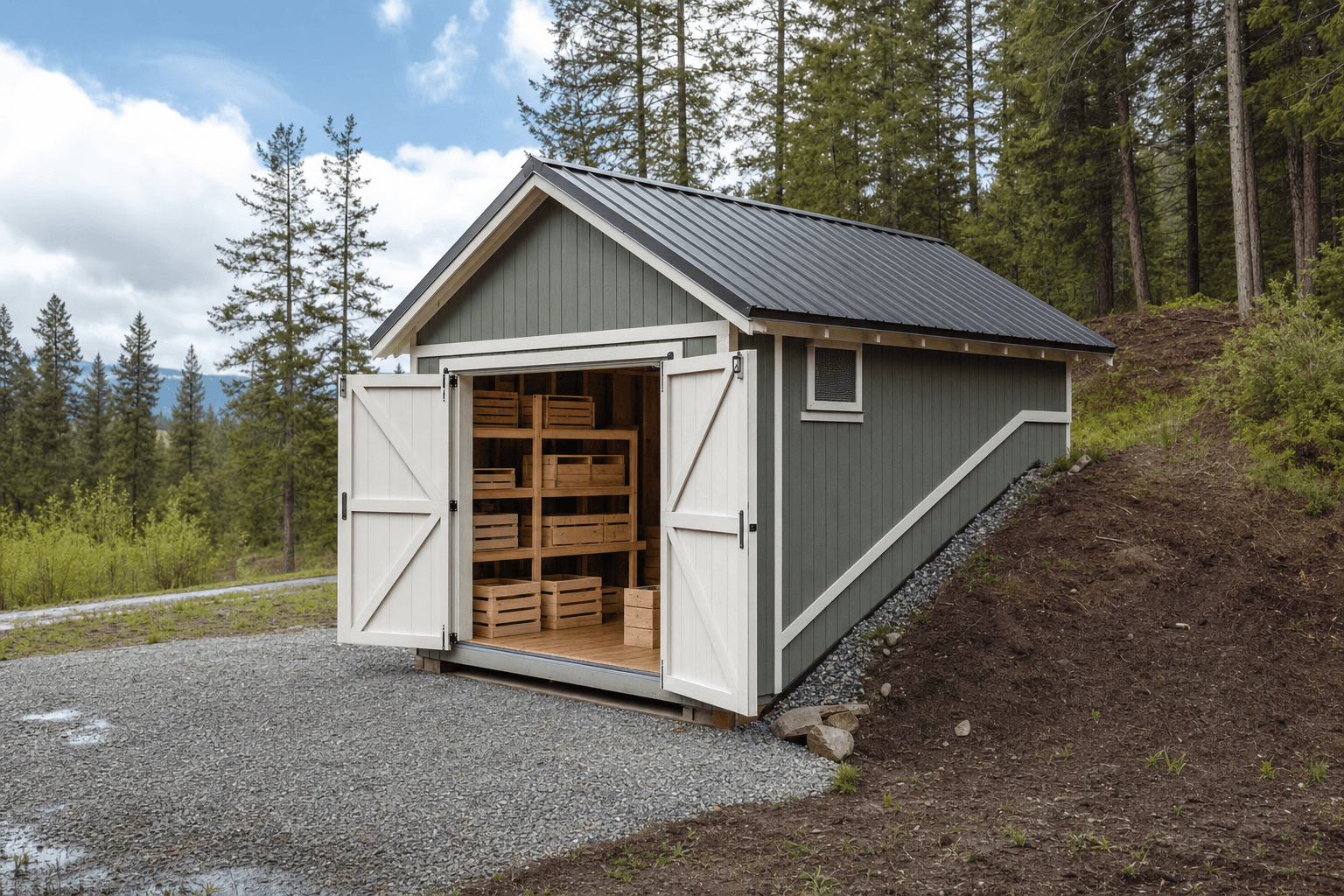
Cool, humid, dark, and steady: an insulated, vented shed that holds just above freezing so roots, squash, apples, and preserves keep through the winter.
A root cellar cares less about headroom than it does about how well the building holds a steady, cool temperature, so the roofline you pick is really a decision about insulation, snow shedding, and a clean run for the vents. A standard gable is the natural starting point: the peaked roof sheds North Idaho snow, gives the warm, stale air a high point to collect and exhaust, and leaves straight sidewalls for floor-to-ceiling shelving and stacked bins. Spec a fully insulated shell — walls, roof, and floor — because a cellar lives or dies on its ability to hold cold without freezing solid, and an uninsulated box swings with every outside temperature change. A lean-to or modern single-slope sheds snow predictably to one side and puts a tall wall where you can run a high exhaust vent and mount your deepest shelving, which suits a cellar built against a hillside or an existing building. A lofted barn (gambrel) adds a small loft overhead, useful for the lighter keeping crops — squash, onions, garlic — that like it a touch warmer and drier than the roots down low.
Whatever the roofline, the parts to spec up are insulation, a low intake vent and a high exhaust vent, a floor that can hold humidity, and a door that seals — a root cellar runs cold, damp, and dark on purpose, so it has to hold temperature and humidity far better than a plain storage box. The floor deserves special thought: many cellars use a gravel or part-earth floor specifically so the ground keeps the room cool and the floor can be dampened to raise humidity, while a sealed framed floor stays cleaner and drier but needs the vents and a humidity source to do more work. A root cellar shed sits right next to a bulk food storage shed when dry goods, flour, grains, and home-canned cases join the harvest, and it overlaps with a garden shed the moment the same building also has to hold tools, seed trays, and the wheelbarrow you haul the harvest in with.
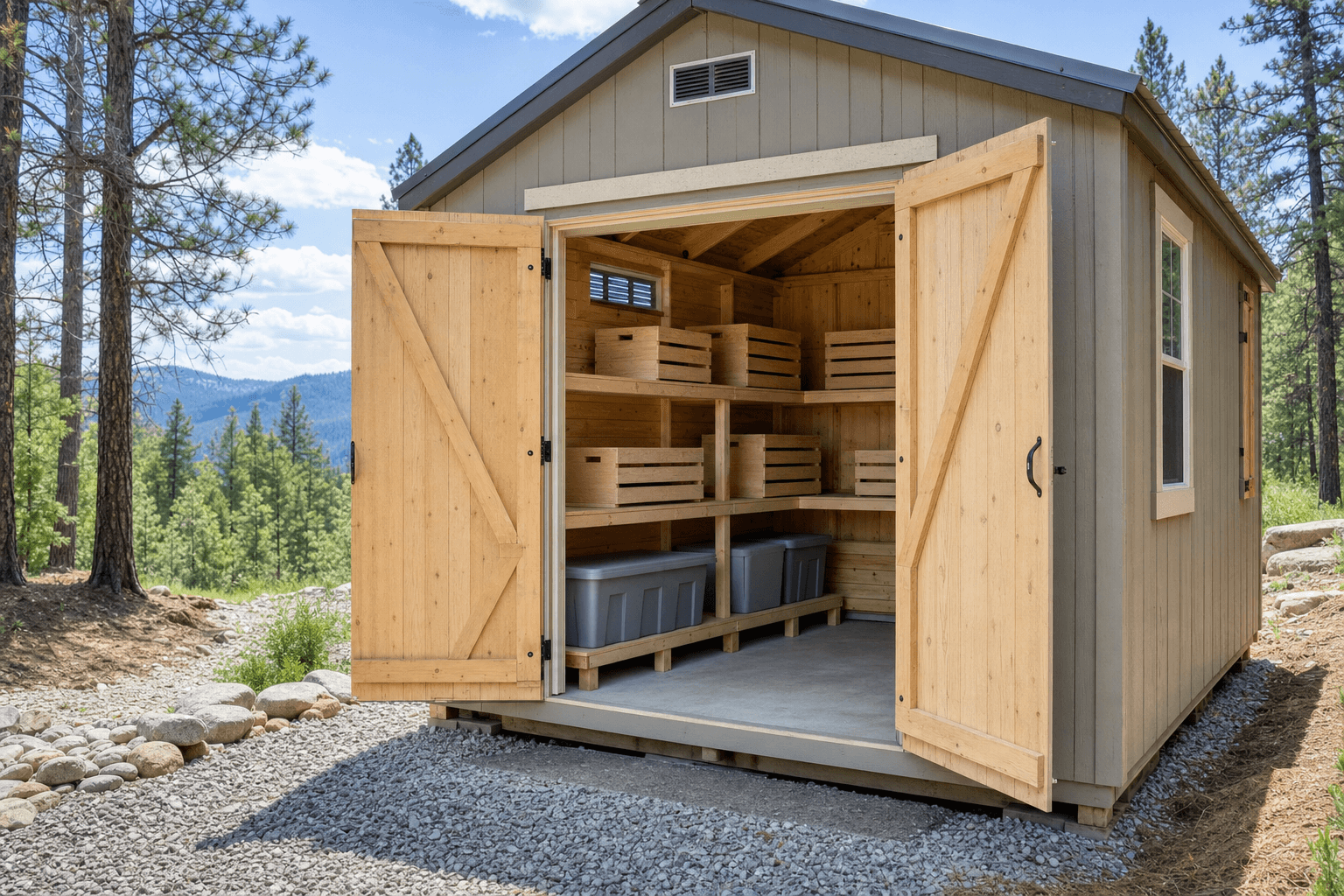
A 6x8 or 8x8 holds a single household's potatoes, carrots, onions, squash, and a wall of home-canned jars — bins down low, shelves up high, and a vent at each end in a compact, easy-to-cool room.
An 8x10 takes a serious garden's worth of roots and keeping crops, with floor bins for potatoes and carrots, shelving for squash and apples, and a long wall of canned goods, plus a clear lane to load it.
An 8x12 stores a homestead's harvest plus bulk and canning overflow at once — separate cool-humid and cooler-dry zones, deep bins, full shelving, and room for the vents to keep the air moving.
Footprint here is about how much produce you put up in a peak fall and how many separate conditions you want to hold, so size to your biggest harvest rather than an average week. A 6x8 is the compact cellar: it handles one household's potatoes, carrots, beets, and onions in floor bins, squash and apples on shelves, and a wall of home-canned jars, with a low intake vent at one end and a high exhaust at the other to keep the cool, damp air moving. An 8x8 gives you a square room with shelving on two or three walls and floor space for several bins, enough to separate the high-humidity roots from the drier onions and garlic without crowding the airflow. An 8x10 is the full-garden workhorse — long enough to line one wall with deep floor bins for potatoes and carrots, dedicate a wall of shelving to squash and apples, run a long span of canned-goods shelving, and still keep a clear lane to carry baskets in and out without brushing the produce. If you grow at homestead scale and want roots, keeping crops, and home-canned cases all in one place, step up to an 8x12 so you can hold a cool-humid zone and a cooler-dry zone separately, fit deep bins and full shelving, and give the intake and exhaust vents enough room to actually turn the air over. Depth matters more than width in a cellar — a longer building lets the vents pull cool air the full length of the room and keeps the dense, humid root zone separate from the drier shelf goods.
These buildings all deal with food you put up, but they hold very different conditions, and naming the lead use keeps you from a building that does two jobs poorly. A root cellar leads with cool, humid, and dark — a steady spot just above freezing with high humidity, built to keep fresh roots, squash, apples, and home-canned jars dormant and unspoiled through winter. A bulk food storage shed leads with cool and dry: it is built around shelving and sealed containers for flour, grains, rice, beans, sugar, dry goods, and cases of canned and dehydrated food, and it wants low humidity and pest exclusion rather than the damp a root cellar runs. The two are close cousins and many people build one shed that does both, with a humid root zone at one end and a dry-goods wall at the other — but if dry bulk is most of your storage, plan for dry and add a small humid corner; if fresh roots are most of it, plan for humid and seal a dry cabinet for the bulk goods.
If you grow and process your own food, the natural neighbor is a canning kitchen shed: it is built around a work sink, counters, a heat source for water-bath and pressure canning, and prep space, so the harvest gets cleaned, cut, cooked, and jarred in one room — and the finished jars then move straight into the cool, dark cellar to keep. The two pair naturally: process in the canning shed, store in the root cellar, and the workflow runs short. The same harvest also touches a garden shed, which holds the tools, baskets, and seed trays that bring the crop in and start next year's. Decide which condition you most need to hold — cool-humid for fresh roots, cool-dry for bulk goods, or a working space to process — and build the room around that condition first, then fit the neighboring use into the same shed. That order locks in your insulation, your vents, your floor, and your humidity plan before the framing is set.
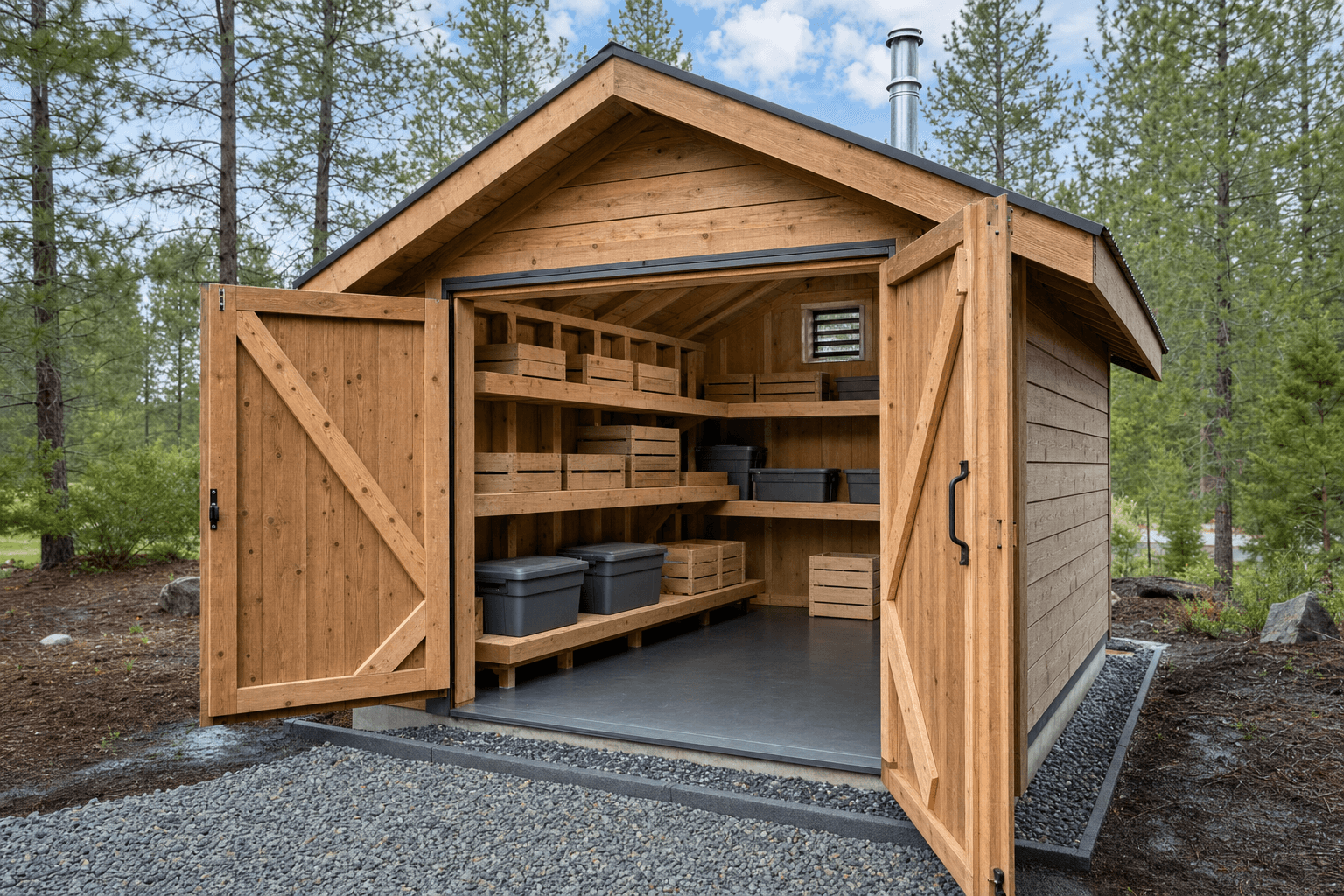
Zone by condition: dense roots in floor bins down low where it is coolest and dampest, squash and apples on airy shelves, canned goods on the dry wall.
Think of a root cellar as a set of microclimates inside one room — coolest and dampest near the floor, a touch warmer and drier up high — and lay it out so each crop lands where it keeps best. A root zone anchors the floor along the coolest wall: open bins and slatted boxes for potatoes, carrots, beets, turnips, and parsnips, the crops that want it cold and humid, set low where the temperature is steadiest and the air is dampest. A keeping-crop zone runs on the shelves above and toward the warmer end: squash, pumpkins, onions, and garlic like it cool but a little drier and warmer than the roots, so they go up off the floor on airy, slatted shelving where air moves around them. A preserves zone takes a dry, dark wall for the home-canned jars, dehydrated goods, and crocks — they want cool and dark to hold color and flavor, but they do not need the damp, so keep them off the most humid floor corner.
The airflow itself is a zone you design, not an afterthought: place a low intake vent on the cool side near the floor and a high exhaust vent on the opposite wall or at the ridge, so cold night air sweeps in low, moves across the produce, and the warmer, staler, ethylene-laden air rises and leaves at the top. That low-in, high-out path is what keeps a cellar both cool and fresh — it lets you pull in cold outside air on a freezing night to drop the room temperature, and it carries off the ripening gas that fruit gives off and that would otherwise spoil everything around it. Keep apples and other heavy ethylene producers in their own corner near the exhaust, away from the potatoes and carrots that ripen and sprout faster in that gas. Leave a clear lane down the middle so you can carry baskets to the back without climbing over bins, and put what you will eat first nearest the door. Slatted shelves and raised bins everywhere let air reach every surface, top and bottom, so nothing sits in a still, damp pocket and rots.
Open, slatted wood shelves and ventilated floor bins for potatoes, carrots, squash, and apples, raised off the floor and spaced so cool, humid air reaches every surface and nothing sits in a still pocket where it would rot.
A low intake vent on the cool side and a high exhaust vent on the far wall or ridge, often baffled or damper-controlled, so you can pull in cold night air to drop the temperature and push out warm, ethylene-heavy air.
A min-max thermometer and a hygrometer so you can read temperature and humidity at a glance, plus a way to add moisture — a damp gravel floor, a pan of water, or dampened sand bins — to hold the high humidity roots need.
A weather-sealed, insulated door and few or shaded windows, so the room holds its cool temperature, blocks the daylight that greens potatoes and sprouts onions, and keeps the cellar dark, stable, and steady.
This is where an insulated shell becomes a working cellar, and it is worth naming exactly what goes in it so you size the bins, the shelving, and the zones around real produce. The root crops come first because they fill the floor and set the humidity: potatoes in slatted bins or paper bags kept dark, carrots and beets packed in boxes of damp sand or sawdust to hold their moisture, plus parsnips, turnips, rutabagas, and celeriac that all want it cold and humid. The keeping crops take the shelves above: winter squash and pumpkins cured and spaced so they do not touch, onions and garlic braided or netted in the cooler, drier air, and apples and pears in single layers or shallow trays, kept apart from the roots because the ethylene they give off sprouts potatoes and softens carrots. Cabbages, leeks, and a crock of carrots in sand round out the fresh stores. Each of these wants a slightly different spot, which is why zoning the room by temperature and humidity matters more here than in any other shed.
Along the dry wall go the preserves and bulk: home-canned jars of tomatoes, pickles, jams, and sauces; dehydrated fruit and vegetables in sealed jars; crocks of sauerkraut and fermented vegetables; and overflow from the canning kitchen waiting to be eaten. Many cellars also hold a sealed cabinet or a corner of bulk food storage — flour, grains, beans, and rice in rodent-proof bins — kept dry and separate from the humid root corner. The hardware that makes it all keep is simple but specific: damp sand or sawdust for packing roots, slatted crates and bushel baskets, paper bags and mesh netting, a min-max thermometer and a hygrometer to watch the conditions, and a stable cool floor that you can dampen to raise humidity on dry stretches. Get the bins, the shelving, the zones, and the moisture right and a cold shed turns into a cellar that hands you crisp carrots and firm potatoes in March.
Carrots and beets packed in damp sand hold their moisture for months — the detail that keeps roots crisp deep into a North Idaho winter.
| Root cellar shed planning checklist | |
|---|---|
| Temperature | An insulated shell and vents tuned to hold the room cold but above freezing through winter, so roots and apples go dormant and keep for months instead of freezing solid or warming and sprouting |
| Humidity | A way to hold high humidity — a damp gravel or earth floor, pans of water, or roots packed in damp sand — so carrots, potatoes, and beets stay crisp instead of going limp and shriveled |
| Ventilation | A low intake vent and a high exhaust vent, dampered so you can open them on a cold night to drop the temperature and to carry off the ethylene gas that ripening fruit gives off |
| Insulation & freeze protection | Insulated walls, roof, floor, and a sealing door so the room rides out a deep cold snap without freezing the produce, plus a plan for the coldest nights of a North Idaho winter |
| Shelving & bins | Slatted shelves and raised, ventilated floor bins so cool air reaches every surface, with a damp-sand zone for roots and a dry, dark wall for canned and dehydrated goods |
| Darkness & layout | Few or shaded windows and zoned storage — cool-humid roots low, keeping crops up high, preserves on the dry wall, apples apart from the potatoes — so each crop keeps where it is happiest |
A root cellar lives by its numbers, so the first job is to hold a steady cool temperature and high humidity through a North Idaho winter that swings hard. Insulate the walls, roof, and floor so the room holds cold without dropping below freezing in a deep snap, and use the vents as your thermostat: on a cold night you open the low intake and high exhaust to flush in cold outside air and pull the room temperature down, and on a bitter night you close them down so the insulated shell holds the cold you banked without letting it freeze the produce. A min-max thermometer tells you whether you are holding the cool, just-above-freezing band that roots want, and a hygrometer tells you whether the humidity is high enough — if it reads dry, dampen the gravel floor, set out pans of water, or pack more roots in damp sand, because dry air is what turns crisp carrots limp. The whole point is a stable cool environment: produce that stays at a steady cold temperature keeps far longer than produce that warms and cools as the weather bounces around.
Winter readiness is mostly about riding out the extremes without electricity if you can. A well-insulated, vented cellar holds itself for most of the season on the vents alone, but plan for the coldest weeks — a small amount of stored thermal mass like the earth or gravel floor, jugs of water, or the sealed door holding heat from the ground will buffer a cold snap, and in a hard winter a thermostat-controlled trickle of heat or a single bulb can keep the room from freezing on the worst nights. Keep a shoveled path to the door so the cellar stays reachable after a storm, and locate it where the produce comes in — near the garden gate, the canning kitchen, or the driveway you unload at — so a full basket of potatoes is a short carry, not a trek across an icy yard. Check the thermometer and hygrometer through the season and adjust the vents, and your harvest will hold its temperature and moisture from fall right through to spring planting.
A root cellar shed is small, but where and how it sits drives how easily it holds temperature and humidity, so the base and the location matter more here than in a dry storage shed. A compacted gravel pad drains well and keeps the framed floor dry from below, and a gravel or part-earth floor inside is often a feature rather than a flaw, because it keeps the room cool from the ground and gives you a surface you can dampen to raise humidity. Tucking the cellar where it gets afternoon shade, or siting it against a north wall, a slope, or a stand of pine, helps the building stay cool through a warm fall and an early spring, which are the hardest seasons for a cellar to hold its temperature. Set it close to where you bring the harvest in and where you process it, so the workflow from garden to canning kitchen to cellar stays short. Read how to prep a shed site before delivery day so the pad, the drainage, and the access are squared away before the building arrives.
North Idaho's four seasons set the rest of the spec. The roof and anchoring need to be rated for local snow load; the shell wants real insulation in walls, roof, and floor so it holds cold without freezing solid in January or warming through in a March thaw; the vents need to be sized and dampered to manage both the deep cold and the muddy shoulder seasons; and a shoveled path keeps the door reachable after a storm. Plan the dampness in too — a cellar runs humid on purpose, so the framing, the shelving, and any metal hardware should be specified to live in that moisture without rusting or rotting. Most small sheds skip a building permit, but any added electrical for a light, a thermostat, or freeze protection can need one, and setback or HOA rules may apply — confirm what your town and county require on the service areas pages, and factor any permit into the plan before you finalize the size and where the cellar will sit.
Most root crops keep best in a cold but above-freezing band with very high humidity, and the goal is to hold that steadily rather than let it bounce with the weather. You manage temperature with insulation and vents working together: an insulated shell holds the cold you bank, and a low intake and high exhaust vent let you flush in cold night air to pull the room down or close up to hold it on a bitter night. You manage humidity with a moisture source — a damp gravel or earth floor, pans of water, or roots packed in damp sand — and you watch both numbers with a min-max thermometer and a hygrometer. Stability is the real key: produce that sits at a steady cold, damp temperature stays dormant and keeps for months, while produce that warms and cools repeatedly sprouts, softens, and spoils. In North Idaho, the hard seasons to hold are a warm fall and an early spring, so siting the shed in shade and insulating it well matter as much as the vents.
Insulation is what lets a small above-ground shed behave like a buried cellar — it slows how fast the inside follows the outside, so the room holds a steady cool temperature instead of swinging with every cold snap and warm spell. Without insulation, a North Idaho cellar would freeze solid in a January cold snap and warm through in a March thaw, and that swing is exactly what spoils produce. With insulated walls, roof, and floor plus a sealing door, the shell holds the cold you let in on cold nights and rides out the worst of a deep freeze without dropping below freezing inside. The vents are the other half: you open them to bank cold air when you need to drop the temperature, and close them to hold it. For the coldest nights, a bit of stored thermal mass like the gravel or earth floor and jugs of water buffers the room, and a thermostat-controlled trickle of heat can keep it from freezing in a hard winter. The combination of insulation, vents, and a little thermal mass is what holds the stable cool environment roots need.
A root cellar needs two vents working as a pair — a low intake on the cool side and a high exhaust on the far wall or at the ridge — and they do two jobs that nothing else can. First, they are your temperature control: on a cold night you open them so cold outside air sweeps in low and warm air leaves high, pulling the room temperature down to where it should be, then you close them to hold it. Second, and just as important, they carry off the ethylene gas that ripening fruit and some vegetables give off. That gas builds up in a closed room and accelerates sprouting and softening in everything around it, so moving air out is what keeps the whole cellar fresh, not just cool. Size the vents so they can actually turn the room's air over, fit dampers so you can open and close them with the weather, and route the exhaust high where the warm, gas-laden air collects. Keep apples and other strong ethylene producers near the exhaust and away from potatoes and carrots, and the airflow will keep your produce dormant and firm for months.
Different crops want different conditions, so the shelving and bins are really how you build microclimates into one room. Put the dense, high-humidity roots — potatoes, carrots, beets, turnips, parsnips — in raised, slatted floor bins along the coolest, dampest wall, and pack carrots and beets in boxes of damp sand or sawdust to hold their moisture. Put the keeping crops that want it a touch warmer and drier — winter squash, pumpkins, onions, garlic — up on airy, slatted shelves where air moves freely around them, with onions and garlic braided or netted. Give apples and pears their own shallow trays or single-layer shelves apart from the roots, because the ethylene they give off sprouts potatoes and softens carrots. Reserve a dry, dark wall for home-canned jars, dehydrated goods, and crocks. The rule throughout is slatted and raised — open shelves and ventilated bins off the floor so cool, humid air reaches every surface and nothing sits in a still, damp pocket where it rots. Zoning by temperature and humidity like this is what lets one cellar keep a dozen different crops well at once.
An on-site shed gives you a true above-ground cellar, and with the right build it holds produce as well as a dug-in one without the cost, drainage headaches, and water-table risk of going underground in our soils. A buried or bermed cellar borrows the ground's stable cool temperature, but it is expensive to dig and waterproof, can flood or stay damp, and is hard to add to an existing property. An above-ground shed gets to that same stable cool environment a different way: heavy insulation in the walls, roof, and floor to slow temperature swings, a gravel or part-earth floor to draw coolness and humidity from the ground, paired vents to bank cold night air and exhaust warm air, and a shaded, north-facing site so it stays cool through the warm shoulder seasons. The trade-off is that an above-ground cellar leans harder on insulation and vents where a buried one leans on the earth, but it is far simpler to build, site, and access on your property — and you can walk in standing up, in the dry, instead of climbing down into a damp hole.
Spoilage in a cellar comes from a few specific causes, and the build heads off each one. Rot and mold come from still, wet air, so the slatted shelves, raised bins, and paired vents that keep cool, humid air moving around every surface are your first defense — produce that breathes does not mold the way produce packed tight in a still corner does. Sprouting and softening come from too much warmth and from ethylene gas, so holding the room cold and venting off that gas, plus keeping apples away from potatoes and carrots, keeps crops dormant. Greening and sprouting in potatoes and onions come from light, so keep the cellar dark with few or shaded windows. Drying out comes from low humidity, so a damp floor and roots packed in sand hold the moisture that keeps them crisp. Pests are kept out by sealing the building — a tight, weather-stripped door, screened vents, and rodent-proof bins for anything dry — and by checking the stores regularly and pulling anything that starts to go before it spreads. A cool, humid, dark, well-vented, sealed room simply does not spoil a harvest the way a warm, dry, stale shed does.
A root cellar shed in North Idaho works with the climate rather than against it — but only if it's built correctly for the site. Kootenai County winters deliver sustained cold rather than extreme freeze, which is actually ideal for root storage: temperatures that hover between 32°F and 40°F are harder to maintain in a poorly insulated box than most guides acknowledge. An on-site build lets us dial in wall thickness, ceiling insulation depth, and vapor management to the specific microclimate on your property in Coeur d'Alene or Post Falls rather than delivering a standard shed and hoping the ambient temperature cooperates.
Ground contact and frost depth matter here more than almost any other shed type. Kootenai County's frost line typically runs 18 to 24 inches, and a root cellar shed that sits on shallow skids will see significant temperature swings at floor level through a hard winter. NIOS builds on compacted gravel pads or concrete piers set below frost depth, keeping the floor stable and your stored produce away from the worst temperature cycling.
Ventilation is the mechanical heart of a root cellar — two separate vent paths, one low and one high, drive the convective exchange that manages humidity and keeps ethylene gas from accelerating spoilage. Framing these in as part of the shell design in Rathdrum or Sandpoint is straightforward; retrofitting them into a finished wall later is not. That's an argument for getting the design right before framing starts.
Work through size and insulation options in the shed builder, or get a free estimate to start a real conversation. The Coeur d'Alene service area page covers how we handle permitting and site prep across the region.
Tell us what you put up each fall — potatoes, carrots, squash, apples, and home-canned cases — and we will help spec the insulation, the vents, the floor, the humidity, and the shelving around your property, then you can build and price it online.
Keep planning your build with related North Idaho shed guides.