Around Coeur d'Alene, a household's fun gear runs on a calendar. In June the garage fills with pool floats, paddleboards, lawn games, and patio cushions; by November those are buried behind sleds, snowboards, ski bags, and the tubs of holiday decor that come down from the attic. A seasonal toy storage shed is built for exactly that swap — a single dry building where the gear you are not using right now waits its turn, and the gear you reach for every weekend stays up front and easy to grab. It is not a static storage box you fill once and forget; it is a building you re-stage three or four times a year, so the whole plan is about rotation and reach, not just raw capacity.
North Idaho On Site Sheds builds every seasonal storage building right on your property, so the door placement, the shelving runs, and the loft can be specified around how your family actually cycles gear in and out. The plan that pays off is the one you make before delivery: a season-by-season inventory of the bulky stuff, a footprint that holds peak load with a clear aisle, and a wall-and-overhead system that lets you pull the kayaks down in May and the sleds down in December without moving everything else twice. Get the rotation wrong and the shed quietly turns back into the cluttered garage you were trying to escape — the in-season gear ends up walled off behind the off-season pile, and every swap becomes an afternoon of unstacking. Get it right and the building does the organizing for you. Start with what comes out in each season, and the right size, door width, and shelving fall into place.
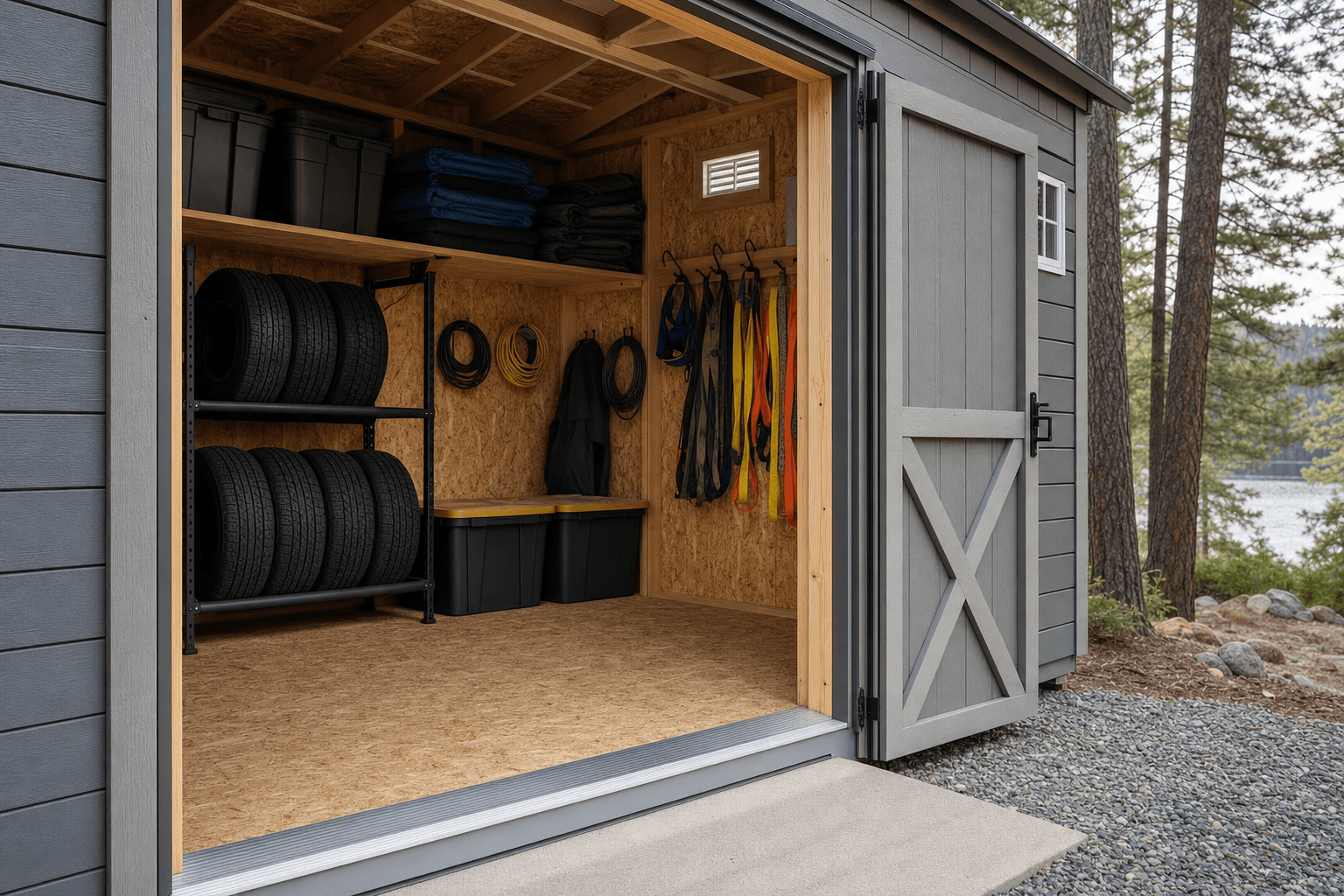
One building for the whole year of gear: wide doors, deep shelving, and overhead room so each season rotates without a pile-up.
Seasonal gear is bulky and oddly shaped, so the shell you pick is really about two things: height for the long stuff and a wide door for the awkward stuff. A standard gable is the honest starting point — affordable, tall at the ridge, and easy to line with plywood walls you can hang anything from. The most useful upgrade for this use, though, is a lofted barn (gambrel): the gambrel roof builds in a full-width loft that swallows the light, bulky things that only come out once a year — pool floats, beach toys, holiday tubs, sleeping bags, and the spare canopy — so the floor stays clear for whatever season is in play. A lean-to or modern single-slope tucks against a fence and sheds North Idaho snow predictably to one side, which keeps the door clear when you need the sleds in January.
Whatever roofline you choose, spec the walls and the door up. Plywood-lined walls hold hooks and racks anywhere, and a wide double door (or a tall one) lets a paddleboard, a kid's kayak, or a folded patio table go straight in without a wrestling match. Pair this guide with the seasonal toy storage service page to see rooflines and door options, and if a chunk of what you rotate is watercraft — kayaks, paddleboards, a canoe, life jackets, and paddles — look at a dedicated boat and gear shed, which is laid out around hull racks and a wider opening.
A 10x12 holds a wall of shelving for totes, a few bikes on hooks, sleds, and patio cushions for a smaller household that swaps gear a couple times a year.
A 10x16 or 12x16 gives each season its own zone — summer water toys, winter snow gear, holiday tubs, and bikes — with a clear aisle to rotate them.
A 12x20 adds room for paddleboards, a kid's kayak, lawn games, and the off-season grill alongside the totes, with deep shelving on both long walls.
Seasonal gear runs bigger than people guess, because you are storing two opposite seasons at once — the snow gear is in storage all summer while the pool floats are out, and vice versa. Size for peak load, not average. For a smaller household that rotates a couple of times a year, start at 10x12: a full wall of shelving, a few bikes on hooks, and floor room for sleds and cushions. When a family runs the full four-season cycle — water toys, snow gear, holiday tubs, lawn games, and bikes — step up to 10x16 or 12x16 so each season gets its own zone and you keep an open lane to swap them. If the bulky toys are real — paddleboards, a kayak, a canoe, the patio set, and the off-season grill — jump to 12x20 for a true walk-down aisle and deep shelving on both walls. The rule here: the more seasons you store at once, the more a few extra feet of length pays you back every time you rotate.
These overlap, and naming the lead job keeps you from buying a building that does none of them well. A general storage shed is about steady capacity — overflow furniture, boxes, and gear you reach for a few times a month — so it favors fixed shelving and a generous loft, and most of what goes in stays put. A seasonal toy storage shed is the same idea turned active: the contents cycle out completely twice a year, so it favors a wide door, a clear aisle, and shelving you can re-stage fast, with off-season gear pushed up and back while in-season gear sits by the door. Same building family, different rhythm — one is a warehouse, the other is a staging area.
If the rotation includes a machine — a quad you ride in summer and store in winter, a snowmobile that flips the other way, or a trailer — that pushes you toward a garage or a powered-machine building with a roll-in floor and a taller, wider door instead of a gear-only shed. Decide which job leads. If the priority is cycling the family's recreational gear by season with the occasional bike or sled, build the seasonal toy shed and keep it gear-first. If a powered toy lives inside year-round, build to that machine first and treat the seasonal gear as the easy part it shares the floor with.
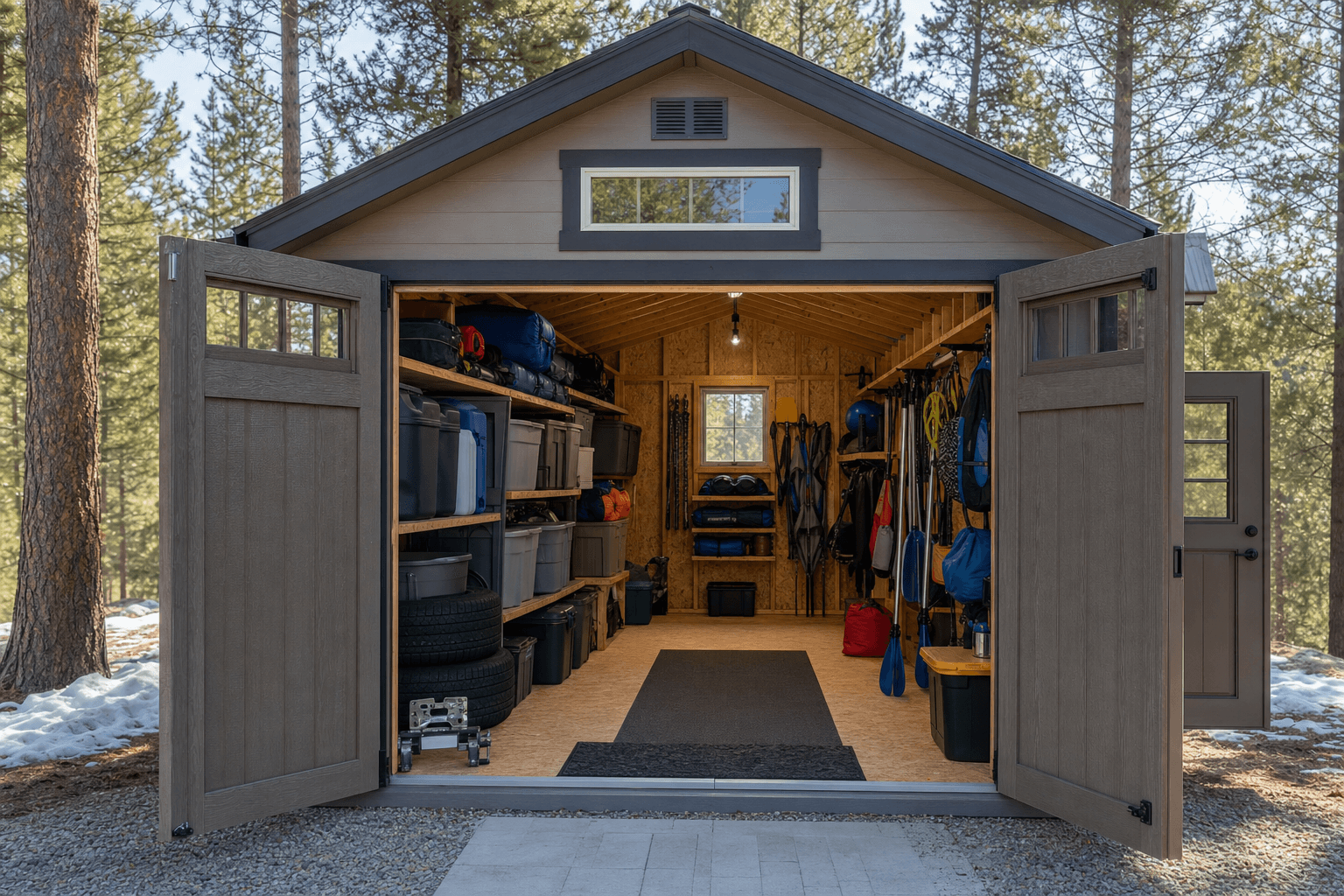
In-season gear by the door, off-season totes up in the loft: the layout is built to re-stage in minutes, not an afternoon.
Think of a seasonal toy shed as a rotation system, not one open box. The trick is that what counts as 'reachable' changes with the calendar, so build zones you can re-stage rather than fixed homes for everything. Keep an active zone near the door for whatever season is in play — pool floats and lawn games in July, sleds and snowboards in January — so the gear you grab weekly is always a step inside. Run a deep-storage zone along the back wall and up on shelves for the opposite season, sorted in labeled tubs so the snow gear sits quietly behind the summer toys until the swap. Reserve an overhead zone in the loft or on ceiling racks for the light, bulky once-a-year items — holiday decor, the spare canopy, beach toys, and sleeping bags.
The habit that makes this work is grouping by season first, then by activity. Give summer its own bay and winter its own bay, and leave a center aisle wide enough to carry a tub with both hands so the spring and fall swaps take an hour, not a weekend. When the calendar turns, you slide the new season's gear forward to the active zone and push the old season back — nothing gets unstacked three deep to reach a fourth. That single discipline is the difference between a shed you dread re-staging and one you re-stage on a Saturday morning.
Heavy-duty adjustable shelves on the long walls let you re-space for tall snow gear one season and flat pool floats the next, so the same wall flexes all year.
A gambrel loft or ceiling-mounted racks swallow the off-season's light, bulky items — floats, decor, canopies, sleeping bags — keeping the floor clear for in-season gear.
A plywood wall lined with heavy hooks and a track lifts bikes, sleds, paddles, chairs, and lawn games off the floor so the aisle stays open through every swap.
Stackable clear bins, color-coded or labeled by season, keep contents visible and sealed against dust and pests so a rotation is a slide-and-swap, not a treasure hunt.
This is the long list that decides your size, door, and shelving, so walk it season by season. Summer is the bulky-and-soft pile: pool floats and inflatables, beach toys and sand toys, paddleboards or a kids' kayak with paddles and life jackets, lawn games like cornhole and spikeball, patio furniture and cushions, the umbrella, coolers, and the camping bins with the tent and sleeping bags. Fall brings the swap-in tubs: Halloween decor, rakes and yard tools, and the off-season grill once the patio set goes inside. Winter is the long, hard gear: sleds and toboggans, snowboards and ski bags with poles, snowshoes, ice skates, and the bins of snow clothing the kids cycle through.
Then there is the year-round middle that just moves around as the seasons shift: bikes on wall hooks, scooters, the wagon, sports balls in a bin, and the holiday decor that owns the loft from January to November. Be honest about every piece of it, because seasonal gear is where households underestimate volume — the snow stuff and the pool stuff are both in the building at once, just on opposite ends. If watercraft dominate the list, a dedicated boat and gear shed is built around hulls and paddles, and if the pile keeps growing past gear into general household overflow, a larger storage shed gives you the steady capacity to absorb it.
Color-coded totes and a wall of hooks turn the spring and fall swap into a quick slide-and-stage.
| Seasonal toy storage planning checklist | |
|---|---|
| Doors | Wide double doors sited for a straight roll-in of paddleboards, the patio set, and bikes |
| Shelving | Deep adjustable shelves on both long walls, re-spaced each season for tall or flat gear |
| Loft | A gambrel loft or ceiling racks for the off-season's light, bulky, once-a-year items |
| Aisle | A clear center lane wide enough to carry a tub with both hands during swaps |
| Ventilation | Eave or gable vents to keep cushions, floats, and gear from trapping damp |
| Security | Quality hasp and lock, plus concealed hinges on out-swing doors |
A seasonal toy shed rarely needs heat the way a workshop does — most recreational gear is happy unheated as long as it stays dry and sealed. What it does need is enough light to find things in the short North Idaho winter afternoons, since the December swap happens in the dark. A single circuit for an LED light or two and a couple of outlets covers it: you can charge a battery for the e-bike or the kids' ride-ons, run a fan to dry gear after a wet day, and see what you are reaching for at 5 p.m. in January.
Two cold-weather items are worth planning. If you store anything that should not freeze — certain inflatables' pumps, latex paint, batteries, or aerosols — a small thermostatic heater on that one circuit keeps a corner above freezing without heating the whole building. And think about the swap itself: ventilation matters more than insulation here, because pool floats, wetsuits, and tents that go in even slightly damp will mildew over a sealed-up off-season. Good eave or gable venting lets that moisture escape so the gear comes out fresh next season instead of musty.
A seasonal toy shed is only as good as the pad under it, and the rotation makes the approach matter even more than usual. A compacted gravel pad keeps the floor dry and lets snowmelt drain, which is ideal for a building full of cushions, totes, and gear; a concrete pad makes sense if you will roll a heavy kayak cart or a loaded wagon in and out often. Place the doors where a straight, level path from the gravel driveway makes the spring and fall swaps easy — you do not want to haul wet pool gear or a stack of sleds uphill through mud twice a year.
North Idaho winters drive several choices: a roof and anchoring rated for local snow load, vents that keep the off-season gear dry, and a door sited so it still opens after a storm when you need the sleds. Many small sheds do not need a permit, but setbacks, HOA covenants, and larger footprints often do — confirm the rules for your town on the service areas pages before you finalize size and placement, and read how to prep a shed site before delivery day so the pad is ready when the building goes up.
Build the shed as a staging area, not a fixed warehouse. Keep an active zone by the door for whatever season is in play, a deep-storage zone along the back wall and shelves for the opposite season, and an overhead loft for once-a-year items. Group everything by season first, then by activity, and leave a center aisle wide enough to carry a tub with both hands. When the calendar turns, you slide the new season forward and push the old season back instead of unstacking the whole building.
Heavy-duty adjustable shelving on both long walls is the backbone, because adjustable brackets let you re-space for tall snow gear one season and flat pool floats the next. Pair it with a gambrel loft or ceiling racks for the light, bulky off-season items — floats, holiday tubs, canopies, and sleeping bags — and a plywood wall lined with hooks and a track for bikes, sleds, paddles, and lawn games. Getting the long and bulky stuff off the floor is what keeps the aisle open for the swap.
Most recreational gear stores fine unheated, so the real enemy is moisture, not cold. Start with a dry, well-drained pad and good eave or gable ventilation so any damp escapes instead of condensing on cushions and floats. Let wetsuits, tents, and pool floats dry fully before they go in for the off-season, store soft goods in sealed totes rather than open bags, and keep anything that should not freeze — pump motors, paint, batteries — in one corner you can warm with a small thermostatic heater on a single circuit.
Reachability changes with the calendar, so plan for re-staging rather than permanent spots. Put the season you are not using up in the loft and along the back and top shelves, and keep that gear in clearly labeled or color-coded tubs so you can spot the right one without digging. Keep a clear aisle to the back so you can pull an off-season item if you need it mid-season, and label by season and contents both, so a December sled or a July float is a two-minute grab instead of a full unstack.
Size for peak load, because you store two opposite seasons at once — snow gear sits all summer while the pool gear is out, and vice versa. A 10x12 suits a smaller household that swaps a couple of times a year. Most families running the full four-season cycle of water toys, snow gear, holiday tubs, bikes, and lawn games are happier in a 10x16 or 12x16, where each season gets its own zone. If you store paddleboards, a kayak, the patio set, and the off-season grill too, a 12x20 gives a true aisle and deep shelving on both walls.
Cushions, sleeping bags, and life jackets are exactly what mice want to nest in, so the defense is sealing the building and the gear. Choose a tightly built shed and seal any gaps, since mice slip through surprisingly small openings. Store all soft goods in hard-plastic totes with tight lids rather than fabric bags or cardboard, keep those totes up on shelves and out of the loft corners where rodents travel, and avoid leaving food, birdseed, or pet items in the shed that would draw them in. Sealed bins plus a sealed building keeps the soft gear fresh for next season.
North Idaho gear runs on a hard seasonal cycle. Snowmobiles, sleds, and skis own the garage from November through March; come spring it's kayaks, paddleboards, bikes, and lawn equipment fighting for the same floor. Around Coeur d'Alene and Post Falls, where lots are filling in and garages are already crowded, a dedicated seasonal toy storage shed is what finally gets a vehicle back inside.
Building it on site means the shed is sized and placed for how you actually load it — wide doors for a trailer or a row of bikes, headroom for a loft, and a footprint that fits the side yard rather than whatever a delivered shed happens to come in. We frame it where it will stand, so a sloped or wooded lot in Hayden or Rathdrum isn't a problem.
Plan for the weather the gear lives through. A roof framed for real snow load keeps the building sound through January, and tight construction keeps wind-driven snow and spring rain off everything inside. If you store anything that shouldn't freeze, add insulation as an option.
Vertical storage is where these buildings earn their keep — shelving, lofts, and ramps turn a modest footprint into serious capacity. Design your storage shed in the builder to compare sizes and door layouts, then get a free estimate.
Tell us what your family cycles in and out by season and where the shed should sit. We will help size the building, door layout, and shelving around your rotation — then you can build and price it online.
Keep planning your build with related North Idaho shed guides.