A paint booth shed is a small building set up for one thing: laying down a clean finish on furniture, parts, or projects without the overspray, dust, and fumes that make spraying in a garage miserable and dangerous. The whole point is moving air. Filtered air comes in one end, washes across the work and the spray, and pulls the fumes and overspray out the other end through a filtered exhaust, so you breathe clean air while you work and the cloud of paint solids leaves the building instead of settling on everything you own. Spray in an open garage and you fight all of it at once: fumes you can smell for hours, a fog of overspray that drifts onto the car and the tool chest, bugs and dust landing in wet clear coat, and a real fire risk from flammable vapor pooling near a water-heater pilot or an ordinary light switch. A purpose-built paint booth shed puts the finishing work in its own controlled room where the airflow, the lighting, and the fixtures are all built for solvent and dust, not against them.
What separates a real finishing booth from a shed you happen to spray in is the safety and the air, in that order. Flammable finish vapor is the thing to respect: it is heavier than air, it travels, and it ignites from a spark you would never think twice about, so the building wants explosion-resistant fixtures, sealed wiring, and enough airflow to keep vapor from ever reaching a flammable concentration. Get the ventilation, the filtration, and the fire-safe fixtures right and you have a room that finishes furniture glass-smooth, keeps overspray out of your lungs and off your yard, and stays safe shot after shot. Get them wrong and you have a fume-filled box that drops dust into every panel and quietly stores a fire hazard. This guide walks the planning in that order: airflow and exhaust first, then fire-safe fixtures, then the dust-free finish room, the lighting, the sizes that fit your work, and how we build the shell tight and dry on your property so it is ready to fit out. If you would rather price a layout first, you can build and price a shed in a few minutes.
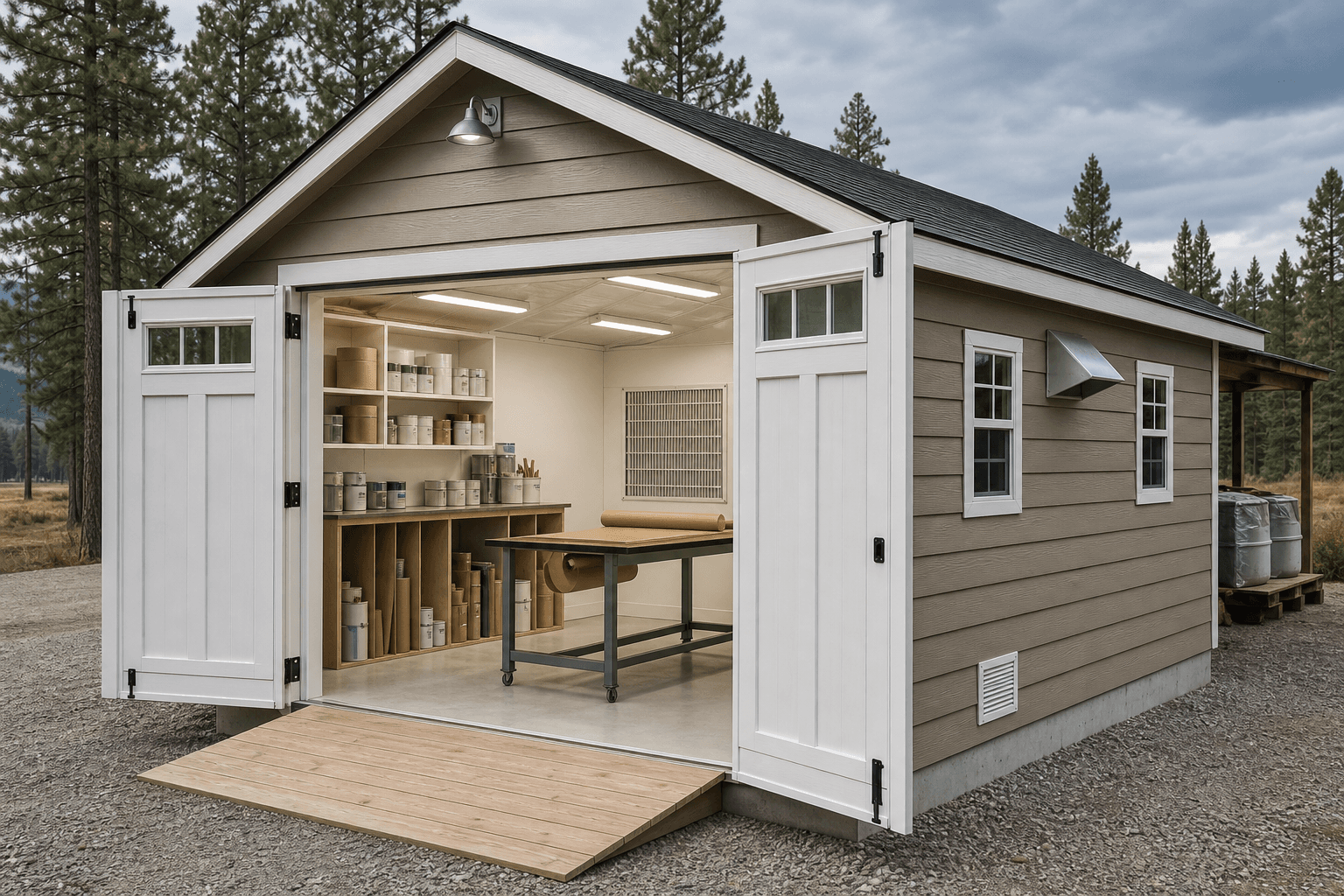
A finishing booth built around airflow: filtered air in one end, overspray and fumes out the other.
A paint booth wants a simple, open shell that you can run air straight through, so the rooflines that work are the ones that give you clear wall ends and a clean interior. A standard gable is the easiest to set up as a cross-draft or down-and-out booth: straight walls, a plain roof, and two clear ends so you can mount a filtered intake on one wall and a filtered exhaust fan on the opposite wall, with the air sweeping the work in between. It is the style we steer most finishing booths toward because a clear, boxy room is exactly what a controlled airflow path needs.
If you spray tall pieces, hang doors and cabinet parts to dry, or want headroom for a down-draft style where air moves from a ceiling intake toward low exhaust, a lofted barn (gambrel) roof buys vertical space and a loft you can use for filter stock and finished-and-curing parts away from the spray. A stick-built shop style suits a serious, permanent booth where you want a heavier wall, a sealed concrete floor, and room to combine finishing with prep and assembly, much like a full backyard workshop but dedicated to coating. A small lean-to or single-slope works for a compact, contemporary booth when you mostly finish smaller parts and want a clerestory window for daylight without a lot of openings to seal. Whatever the roofline, treat the building as a controlled box: a tight shell with two planned, filtered openings for airflow, not a vented shed with random gaps that let unfiltered, dusty air sneak in around the work.
Chairs, cabinet doors, drawers, small tables, and bike or auto parts on a stand. A 10x16 gives you a spray zone, room to walk all the way around the piece, and wall space for intake and exhaust filters.
Dressers, doors, hoods, fenders, and larger builds you want to walk around with a gun. Step up to 12x16 or 12x20 so air sweeps fully past the work and overspray clears before it can settle.
Long trim, bed rails, a full set of cabinet doors, or finishing plus a separate cure area in one room. A 14x20 gives you length for airflow and room to stage wet parts away from the spray.
Footprint matters more in a booth than in an ordinary shed because the size of the room sets how well air can sweep the work and how far overspray travels before the exhaust catches it. The rule is to leave clear floor on every side of what you finish, so you can walk a spray gun all the way around the piece and the air has room to carry overspray past it to the exhaust instead of swirling back onto a wet surface. A 10x16 shed is a sensible floor for furniture, cabinet doors, and small parts: it holds a spray stand with walkaround clearance and leaves a wall for the intake filter and a wall for the exhaust. Move up to a 12x16 shed and the extra width lets bigger furniture and project panels sit in a true cross-draft with air sweeping the full face of the work. A 12x20 shed adds length so you can keep a prep-and-mask area separate from the spray zone, which keeps sanding dust out of the wet-paint end of the room. The 14x20 shed is the call when you finish long pieces, hang a full set of doors, or want a dedicated curing corner where fresh work can flash off while you mask the next piece. Build for the largest thing you realistically finish plus walkaround room, because a booth that is too tight traps overspray and fumes against the work no matter how strong the fan is.
These builds look similar from the driveway but they are tuned for different jobs, so match the room to the work you do most. A paint booth shed is optimized for applying a finish: strong filtered airflow, fire-safe fixtures, dust control, and color-true light so coatings go on clean and the fumes leave the room. A backyard workshop is built around building and repair, with heavy power, dust collection for woodworking, and bench space, so if most of your time goes to cutting, joining, and assembly and only some to finishing, a shop with a small dedicated spray corner may suit you better than a full booth. An auto detailing shed shares the clean-air and good-light goals but tilts toward washing, polishing, and protecting a vehicle rather than spraying solvent finishes, so it leans on water, drainage, and lighting more than on explosion-rated exhaust. A maker space shed overlaps when your finishing is part of a broader build habit, since both rooms care a lot about fume extraction and tidy benches, but a maker space spreads its air handling across many tasks while a booth concentrates everything on the spray. If you are torn, decide whether the room exists to make a finish or to make a thing, build the air and fixtures for that, and let the other tasks borrow the space.
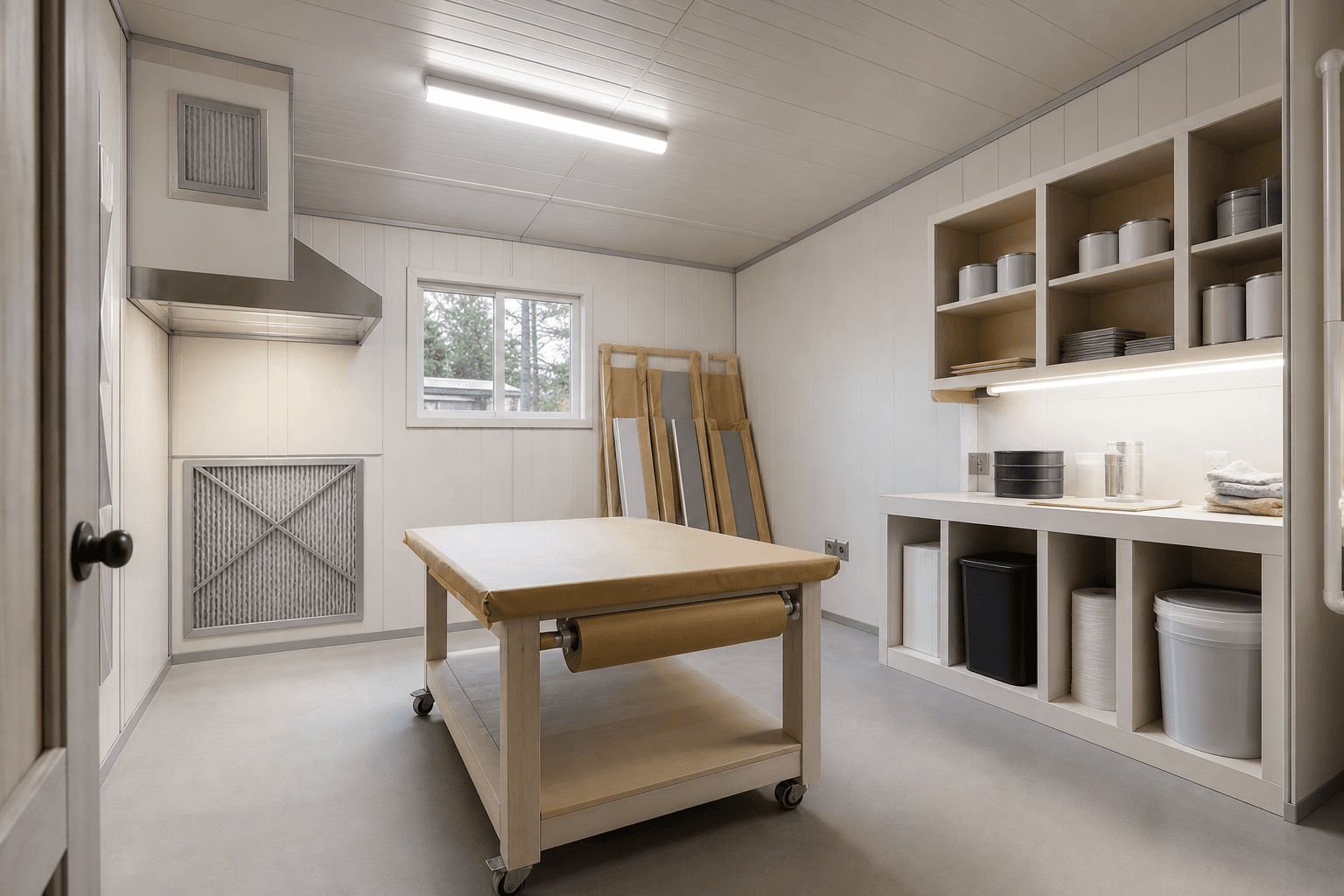
Zoned for finishing: filtered intake on one wall, filtered exhaust on the other, and clean light over the work.
Even a small booth works far better planned as zones than as one open room, because finishing has stages and dust travels. The airflow zone is the anchor and you plan it first: pick the intake wall and the exhaust wall so air moves in a straight, sweeping path across the work, and keep that path clear of shelving and clutter that would make the air swirl and drop overspray. The spray zone is the clear floor in that airflow where the piece sits on a stand or turntable with room to walk all the way around it, lit evenly so you can see the wet edge. The prep and masking zone is where you sand, fill, tape, and wipe down, kept at the intake end or partitioned off so the dust you raise there does not drift into wet finish, because sanding dust is the single most common thing that ruins a coat. A small mix-and-supply zone holds your paint, reducers, and cups on a fire-safe shelf or in a flammables cabinet, ideally near the door so deliveries and cleanup stay out of the spray path. Finally, leave a cure and staging zone where finished parts flash off and harden without anyone brushing past them, on a rack or hung from a rail. Sketch these zones before you choose a footprint and you will see fast whether a compact booth handles your work or whether you want the extra length of a larger one.
A booth needs air moving through it, not just out of it. Pair a filtered fresh-air intake with a properly sized exhaust fan so air sweeps the work in a steady cross-draft or down-and-out path. Intake filters keep incoming dust and bugs off your wet finish; exhaust filters catch the overspray solids before air leaves the building. Size the fan to the booth's cross-section so vapor never builds toward a flammable level and overspray clears fast.
Flammable finish vapor is heavier than air and ignites from an ordinary spark, so the electrical has to be built for it. Plan sealed, explosion-resistant or vapor-tight light fixtures, switches and outlets located outside the spray area or rated for the duty, an exhaust fan with a non-sparking motor kept out of the airstream, and bonding and grounding so static off the spray gun has somewhere safe to go. This is the part you do not improvise.
The enemy of a glass-smooth finish is the dust that lands while the paint is wet. A tight, sealed shell with smooth, wipe-down walls, a sealed floor you can wet down or sweep clean, and filtered intake air keeps airborne dust out, while keeping sanding and the spray in separate zones keeps the dust you make from reaching the wet coat. A clean booth is what lets a modest gun lay a finish that looks sprayed in a shop.
You cannot finish what you cannot see, so light the booth bright and even with high-CRI, daylight-balanced fixtures placed to wash the work from the sides and overhead without hot spots or shadows. Good color rendering lets you read the true color and catch runs, dry spots, and orange peel while the paint is still wet and fixable. Sealed, vapor-rated fixtures keep the lighting safe in a solvent room.
The keyword for this room is controlled airflow over a clean, well-lit surface, and the fit-out is everything that delivers it and keeps it safe. For airflow and filtration: an exhaust fan sized to the booth with a non-sparking motor, a filtered intake plenum or filtered intake wall, intake filters to stop incoming dust and bugs, exhaust or overspray filters to catch paint solids, and spare filter media stocked so you change them on schedule rather than spraying through clogged ones. For spraying: an HVLP or airless spray gun, an air compressor and a water-and-oil separator if you spray with air, paint, primer, clear coat, reducers and hardeners, mixing cups and stir sticks, strainers, masking film and tape, tack cloths, and a respirator rated for organic vapor plus eye protection. For safe storage and cleanup: a flammables cabinet or a fire-safe shelf for solvents and finishes, an oily-rag can with a self-closing lid because solvent-soaked rags can self-heat, a properly rated fire extinguisher by the door, and a sealed floor you can wet down and squeegee. For staging the work: a spray stand or turntable, a parts rack, and a drying or curing rail for finished pieces. Walk your own list like this before you settle on a size, because the fan, the filter walls, the flammables cabinet, the compressor, and a clear spray zone with walkaround room all need floor and wall space. None of it fits in a 6x8 shed used as a booth, which is why a real finishing room starts around ten by sixteen and most people are happier with extra length once the prep zone, the spray zone, and a cure area all want their own corner.
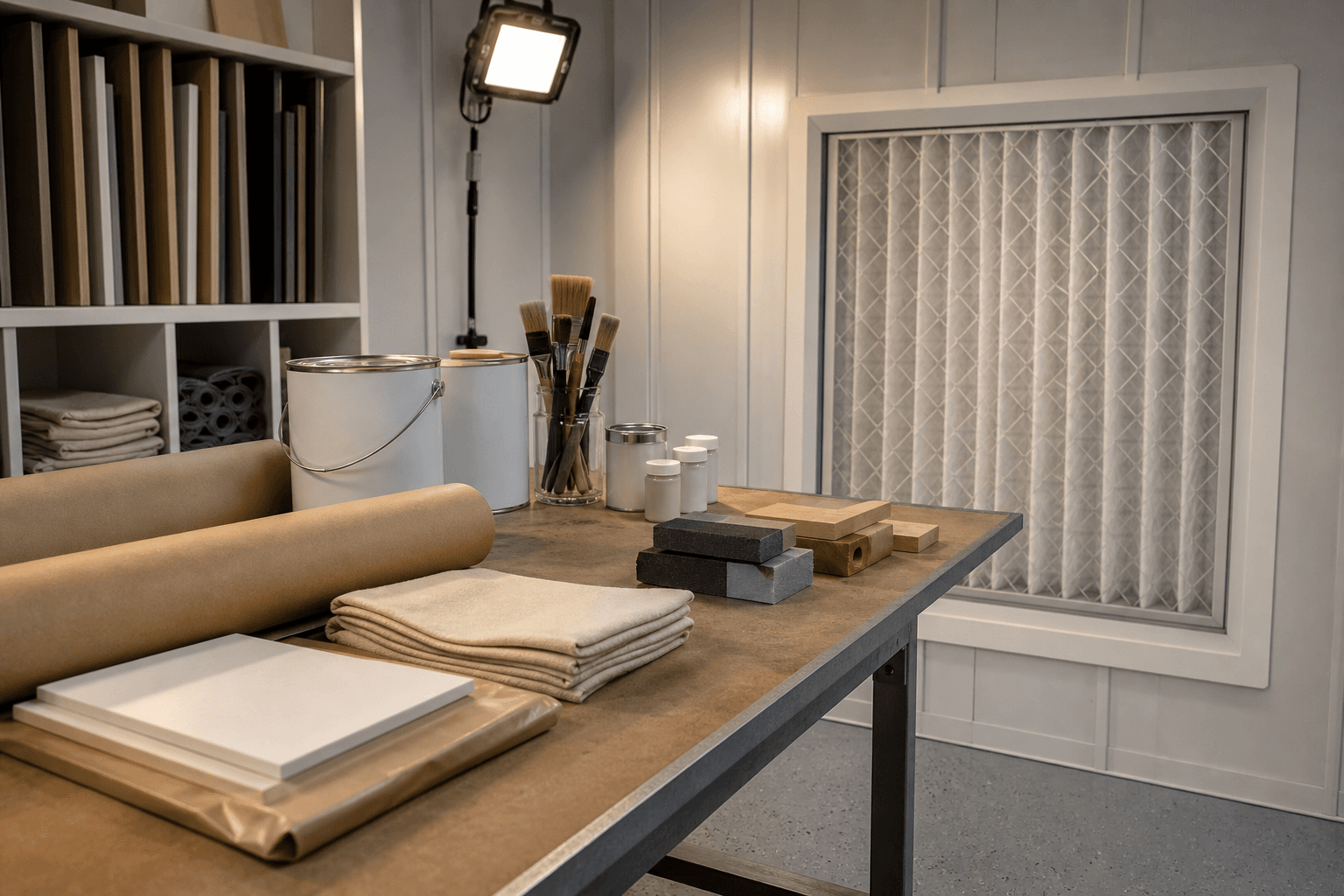
Detail that makes it a booth: filtered exhaust, a sealed vapor-rated light, and fire-safe storage for solvents.
| Paint booth shed planning checklist | |
|---|---|
| Best roofline | Standard gable for a clean cross-draft; gambrel or stick-built shop for headroom and a sealed-floor booth |
| Practical sizes | 10x16 furniture and parts, 12x16 to 12x20 big pieces plus prep, 14x20 for long work and a cure zone |
| Ventilation | Balanced filtered intake plus a properly sized exhaust fan with a non-sparking motor for a steady sweep |
| Filtration | Intake filters to stop incoming dust and bugs, exhaust filters to catch overspray solids, spares on hand |
| Fire safety | Vapor-tight fixtures, sealed or relocated switches and outlets, bonding and grounding, flammables cabinet, extinguisher |
| Light and floor | High-CRI daylight-balanced lighting placed to kill shadows, plus a smooth sealed floor you can wet down and clean |
Three systems decide whether the booth sprays clean and stays safe through a North Idaho year. Power comes from a dedicated circuit run from your home's panel by a licensed electrician, and a small subpanel in the shed makes it easy to feed the exhaust fan, the compressor, the lighting, and any heat without tripping. In a solvent room the electrician's layout matters as much as the capacity: switches and outlets belong outside the spray area or in rated enclosures, fixtures should be sealed and vapor-tight, the fan motor should be non-sparking and kept out of the airstream, and the spray setup should be bonded and grounded so static has a safe path. This is the system you build to code and do not shortcut. Lighting is what lets you actually finish: bright, even, high-CRI, daylight-balanced fixtures placed to wash the work from overhead and the sides with no hot spots, so you read true color and catch runs and dry spots while the coat is still wet. Winter readiness is real here, because most finishes will not flash, level, or cure right when the room is cold, and you cannot just open a door to warm up a booth full of vapor. Plan safe, sealed heat that keeps no open flame or hot element in the spray air, insulate the shell so the heat holds and the temperature stays steady through a cold Panhandle night, and remember that the exhaust pulls conditioned air out while you spray, so size the heat to keep up. We frame and insulate the shell tight and dry on your property so it is ready for your electrician and your heat to finish.
A booth needs a solid, level, easy-to-clean base, so most paint booth sheds sit on a compacted gravel pad sized about a foot wider than the building on each side for drainage, or on a concrete slab when you want a perfectly flat, sealed floor you can wet down, squeegee, and keep dust-free, which is the better choice for a serious finishing room. North Idaho weather shapes the rest: design the roof for local snow load so it carries a heavy Panhandle winter, keep the floor up off the ground so spring melt and rain drain away rather than wicking in, and place the booth where the gravel driveway or a clear path lets our crew get materials in to build and lets you move large pieces in and out. Where the exhaust discharges matters too, so plan the fan outlet away from the house, from windows and intakes, and from where neighbors and your own outdoor living sit, with prevailing wind in mind so overspray and fumes blow clear. We build with weather-rated framing and finishes suited to pine-country freeze-thaw cycles and set the structure to drain and shed water so the shell stays sound. On permits, the use drives the answer: a plain storage shed under a size threshold often needs no permit, but a building wired for power, mechanical exhaust, and finishing with flammable materials may trigger a permit, an electrical inspection, fire-code requirements for spray application and flammable storage, and setbacks. Rules vary across Kootenai County and the cities around Coeur d'Alene, so confirm with your local building department and fire authority before you finalize size and placement, and we will plan the build around whatever your jurisdiction requires.
Plan air that moves through the booth, not just out of it. The cleanest setups are a cross-draft, where a filtered intake on one wall feeds air that sweeps the work and leaves through an exhaust fan on the opposite wall, or a down-and-out path where intake air enters high and leaves low. Both put filters on the way in to stop incoming dust and bugs and filters on the way out to catch overspray solids before the air discharges. The goal is a steady sweep across the piece so overspray clears fast and finish vapor never builds toward a flammable concentration, which means sizing the exhaust fan to the booth's cross-section rather than guessing, and using a non-sparking fan motor kept out of the airstream. Keep the airflow path clear of shelves and clutter that make the air swirl and drop overspray, and change the filters on schedule, because a clogged intake starves the booth and a clogged exhaust lets solids past. When in doubt, size up the fan and the filter area; a booth almost never suffers from too much clean airflow.
The thing to respect is that finish vapor is flammable, heavier than air, and ignites from a spark you would never think twice about, so the electrical is built around keeping ignition sources away from where vapor can collect. That means sealed, vapor-tight or explosion-resistant light fixtures so a bulb or a switch arc can't reach the vapor, switches and outlets located outside the spray area or in rated enclosures rather than loose on the spray wall, an exhaust fan with a non-sparking motor mounted out of the airstream, and bonding and grounding so static electricity off the spray gun and the work has a safe path instead of jumping as a spark. You also keep open flames and hot elements out of the spray air entirely, which is why a booth never has a water-heater pilot, an unsealed space heater, or a standard furnace inside it. A licensed electrician builds this to code, and because finishing with flammable materials often falls under fire-code rules, it is worth confirming the requirements with your local fire authority. This is the one part of a booth you plan carefully and never improvise.
A gritty, bumpy finish almost always comes from dust landing while the paint is still wet, so a booth fights dust on three fronts. First, the shell: a tight, sealed building with smooth, wipe-down walls and a sealed floor you can wet down and squeegee keeps the room from generating and holding dust, unlike an open garage with dusty rafters and a porous slab. Second, the air: a filtered intake means the fresh air feeding the booth is clean rather than carrying yard dust and bugs onto your wet coat, and positive, filtered airflow helps push settling particles toward the exhaust. Third, your workflow: keep sanding, grinding, and masking in a separate prep zone or at the intake end, away from the spray zone, because the dust you raise prepping a piece is the dust most likely to ruin the next coat. Wipe the piece down with a tack cloth right before you spray, let the booth run a minute to clear the air before you pull the trigger, and avoid stirring up the floor while finishing. Do those things and a modest gun can lay a coat that looks like it came out of a body shop.
You can only finish what you can clearly see, so a booth is lit bright, even, and color-true. Use high-CRI fixtures, ideally 90 CRI or better, in a daylight-balanced color temperature so the color you see on the work matches what it will look like in natural light, which matters a lot when you are matching a stain or a paint color. Place the lights to wash the piece from overhead and from the sides so there are no hot spots and no deep shadows, because shadows hide runs, dry spots, thin coverage, and orange peel until it is too late to fix them. Even, glare-free light lets you watch the wet edge as you spray and catch problems while the coat is still workable. In a solvent room the fixtures themselves have to be sealed and vapor-rated for safety, so plan the lighting and the fire-safe electrical together rather than treating light as an afterthought. Good light is the difference between guessing at coverage and actually seeing your finish go down.
Overspray is the fine cloud of paint solids that doesn't land on the work, and a booth manages it instead of letting it settle everywhere. Inside, the answer is airflow plus filtration: a steady sweep of air carries the overspray off the piece and into exhaust or overspray filters that trap the solids before the air leaves the building, so it lands in a filter you replace rather than on your walls, your tools, and your last project. Keeping the spray zone clear and the airflow path unobstructed helps the air actually carry overspray to the filters rather than swirling it back onto the work. Outside, two things matter: the exhaust filters keep most of the solids in the booth, and where you point the discharge keeps the rest from being a nuisance, so plan the fan outlet away from the house, windows, and neighbors and with the prevailing wind so anything that escapes blows clear. Spraying technique helps too, since correct gun distance, pressure, and overlap put more paint on the work and less in the air. Change the overspray filters before they load up, because a clogged filter lets solids through and chokes the airflow that controls the cloud in the first place.
Size the booth around the largest thing you realistically finish plus room to walk all the way around it with a spray gun, because the airflow needs clear space on every side of the work to carry overspray to the exhaust instead of swirling it back onto a wet surface. For furniture, cabinet doors, drawers, and small auto or bike parts, a 10x16 gives you a spray stand with walkaround clearance and walls for the intake and exhaust filters. For bigger furniture, doors, hoods, and project panels you want to spray in a full cross-draft, step up to a 12x16 or a 12x20, where the extra width and length let air sweep the whole face of the piece and let you keep a prep-and-masking area separate from the spray zone so sanding dust stays away from wet finish. For long pieces like trim and bed rails, a full set of doors, or finishing plus a dedicated cure corner where parts flash off undisturbed, a 14x20 gives you the length and staging room. The common mistake is building too tight to save money, which traps fumes and overspray against the work no matter how strong the fan is, so when you are between sizes, go up; the clear floor and airflow room pay off on every piece you finish.
A paint booth shed has stricter construction requirements than almost any other shed type — non-sparking fixtures, sealed penetrations, filtered intake that controls dust before it reaches your work, and exhaust volume that moves enough air to keep solvent concentrations below ignition threshold. These requirements aren't afterthoughts you can add to a generic building; they need to be part of the framing and rough-in from the start. An on-site build makes that coordination straightforward.
North Idaho's climate introduces a finishing challenge that painters in warmer climates don't face: temperature swings between morning and afternoon in Coeur d'Alene and Post Falls can be significant in spring and fall, which is exactly when many people want to spray — not too hot, not freezing. A well-insulated booth with a clean heat source holds temperature stable through those fluctuations, which directly affects how coatings flow and cure.
Humidity is the other North Idaho variable. Late fall and winter bring high ambient humidity to the Rathdrum Prairie and the lake areas alike. A booth with a controlled environment and adequate exhaust volume lets you keep working through conditions that would ruin a finish in an open garage.
Browse our completed builds to see shop-style structures, design a footprint in the configurator, or get a free estimate for your property.
Tell us what you finish and how you work, and we'll help you size, ventilate, and price a fire-safe, dust-controlled paint booth shed for your North Idaho property.
Keep planning your build with related North Idaho shed guides.