If you paddle Lake Coeur d'Alene, Hayden, Pend Oreille, or the Spokane River, your boats spend most of the year out of the water — and where they live the other ten months decides how long they last and how fast you get on the lake. Kayaks, canoes, and paddleboards are long, awkward, and easy to ruin: lean a sit-on-top against the garage wall all winter and the hull warps, stack a couple of SUPs flat on the concrete and the bottom one dents, hang a paddle from a nail and the shaft bows. A dedicated kayak and paddleboard shed fixes all of it by getting the fleet up off the floor and onto racks, keeping one long clear bay so the boats slide in straight, and giving wet paddles, PFDs, and dripping gear somewhere to dry that is not the back of the truck.
North Idaho On Site Sheds builds every paddle craft storage shed right on your property, so the wall framing, the door, and most of all the length can be specified for the longest boat you own instead of a generic box that fights a 12-foot kayak the moment you carry it in. Start by measuring your longest hull — a tandem canoe or a touring kayak can run 14 to 17 feet — because that number drives the footprint, the door placement, and how the racks lay out far more than the number of boats does. This guide covers which roofline gives you the height for vertical and ceiling racks, what size fits the boats plus paddles and gear, how to zone the interior so nothing rubs, and how to dry wet kit and protect hulls through a long North Idaho off-season.
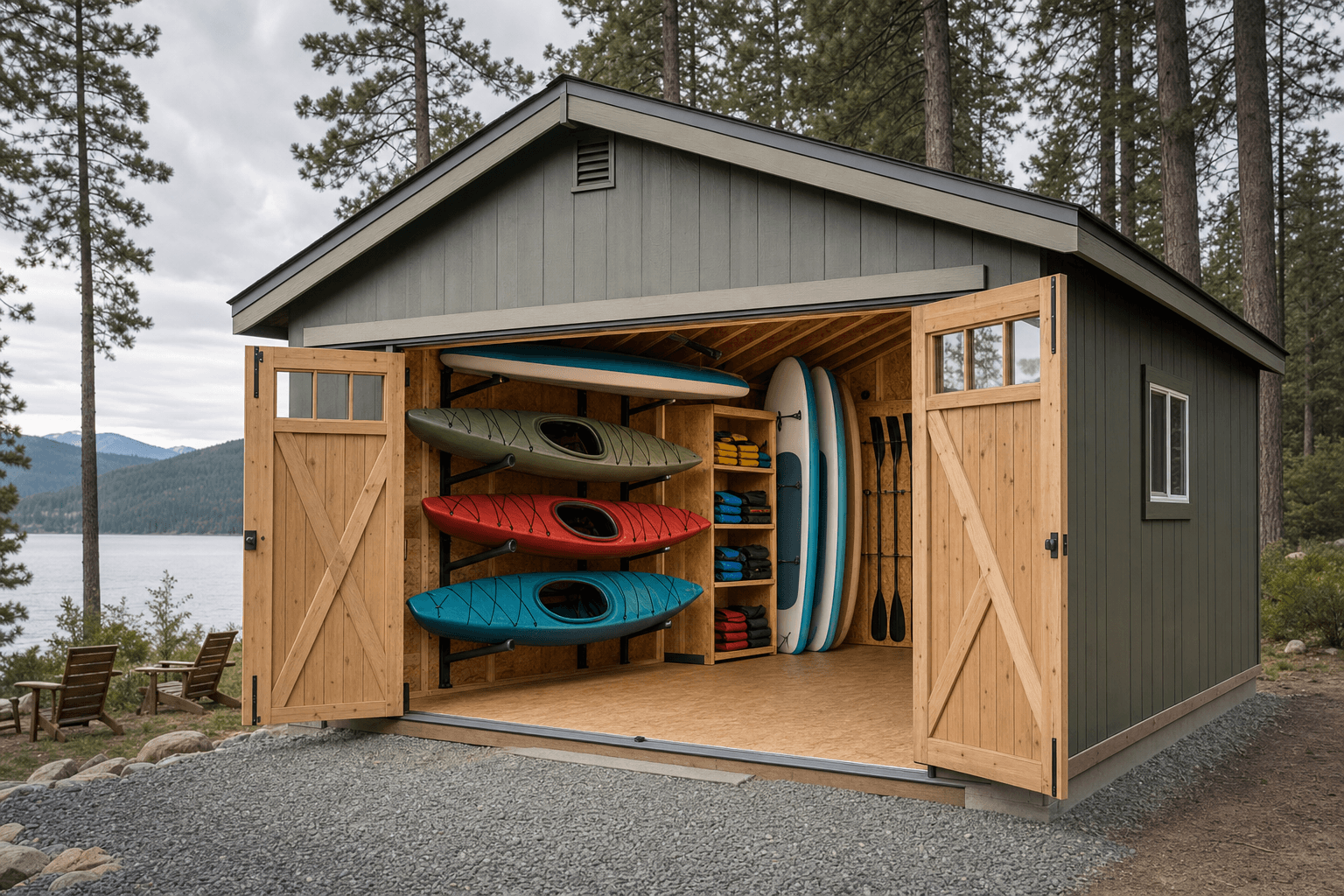
Get the fleet off the floor: wall and ceiling racks free up a long clear bay and give paddles, PFDs, and wet gear somewhere to dry.
A paddle-craft shed asks two things of its shell that a normal storage shed never has to: length to swallow a long boat, and wall height to rack several hulls vertically. That makes a standard gable the honest starting point — it gives the most usable headroom for the money, lines easily with plywood walls you can bolt a rack into anywhere, and leaves clean, tall sidewalls for vertical kayak and SUP racks. The number that matters most here is interior length, closely followed by sidewall height: taller walls (8-foot-plus) let a 12-foot kayak stand on its tail in a vertical rack with the bow still clear of the ceiling, which is the single biggest floor-saver in the whole building. A lofted barn (gambrel) raises the center ridge and adds a loft that is ideal for the off-season overflow — spare paddles, dry bags, coolers, and the inflatable SUPs you only break out for guests — while the long floor below stays open for the hard boats you launch most.
If you carry long tandem hulls, a lean-to or modern single-slope is worth a look: it sheds North Idaho snow predictably to one side and gives you one tall, square wall you can fill top to bottom with horizontal rack tiers. Whatever the roofline, the door and the clear interior run are the parts to spec up — a door placed on the gable end, not the long side, lets you carry a 14-foot canoe straight in along the length of the building instead of pivoting it sideways through a too-narrow opening. A kayak and paddleboard shed overlaps closely with a boat and gear shed when there is a trailered fishing boat or motor in the mix, and with a gear drying shed the moment drying wetsuits, PFDs, and dripping gear becomes half the reason you want the building.
An 8x16 takes two or three kayaks or SUPs on wall and ceiling racks with the length for a 14-foot hull, plus a paddle wall and a PFD hook by the door.
A 10x16 or 10x20 racks the whole fleet on both walls, adds a real drying corner and a gear bench, and keeps a clear lane to slide boats in and out.
A 12x20 fits long tandem canoes and touring kayaks, the SUPs, a paddle and PFD wall, a drying rack, and an open bay to load up before a launch.
Footprint decides whether the shed feels like a clean boathouse or a jammed closet, and with paddle craft the length is what makes or breaks it — a couple of feet is the difference between sliding a 14-foot kayak straight onto its rack and wrestling it diagonally past every other boat. An 8x16 is the smart entry point because the 16-foot length swallows most recreational kayaks and SUPs end to end while two or three hang on the walls; it suits a one- or two-paddler household with a paddle wall and a PFD hook by the door. A 10x16 opens up the second wall for the rest of the fleet plus a proper drying corner and a gear bench, and the extra width lets two people gear up at once without bumping. Step to a 10x20 when you run longer touring kayaks or a canoe, because the 20-foot run gives you length to rack the longest hulls horizontally and still keep a clear walking lane down one side. If you want long tandem boats, the full SUP quiver, a paddle-and-PFD wall, and an open bay to stage everything before a launch, a 12x20 keeps the floor usable with all of it racked at once. Remember that boats are long before they are heavy — a long, narrow building almost always beats a square one of the same area here, because you carry a kayak in a straight line, not around a corner.
These three overlap, and the right call comes down to what you actually haul to the water. A pure kayak and paddleboard shed leads with rack storage and length: human-powered hulls that hang on walls and ceilings, a paddle wall, PFD and wetsuit drying, and a clear bay to load up — no trailer, no motor, no fuel to plan around. The build changes the moment a powered or trailered boat enters the picture: a boat and gear shed is sized around a hull on a trailer, with a wide drive-in door, room to walk around the trailer, and storage for a motor, fuel, batteries, and life jackets, so if a fishing boat or a runabout shares the space, build to the trailer first and treat the kayaks as the easy add-on along one wall.
The other natural neighbor is gear. If drying wetsuits, PFDs, paddling jackets, and booties — airing out everything that comes off the lake soaked — is half of why you want the building, a gear drying shed shares the exact same heat, airflow, and hanging hardware, and it is worth borrowing that playbook for your drying corner. And if you fish from the kayak, a fishing tackle shed handles the part the paddle racks do not: rod racks, a tackle wall, and dry storage for reels and electronics, so a paddle-angler often wants a shed that does both. Naming the lead use up front keeps you from a building that stores boats poorly and dries gear poorly both, and it locks in your length, your door, and your ventilation before the framing is ordered.
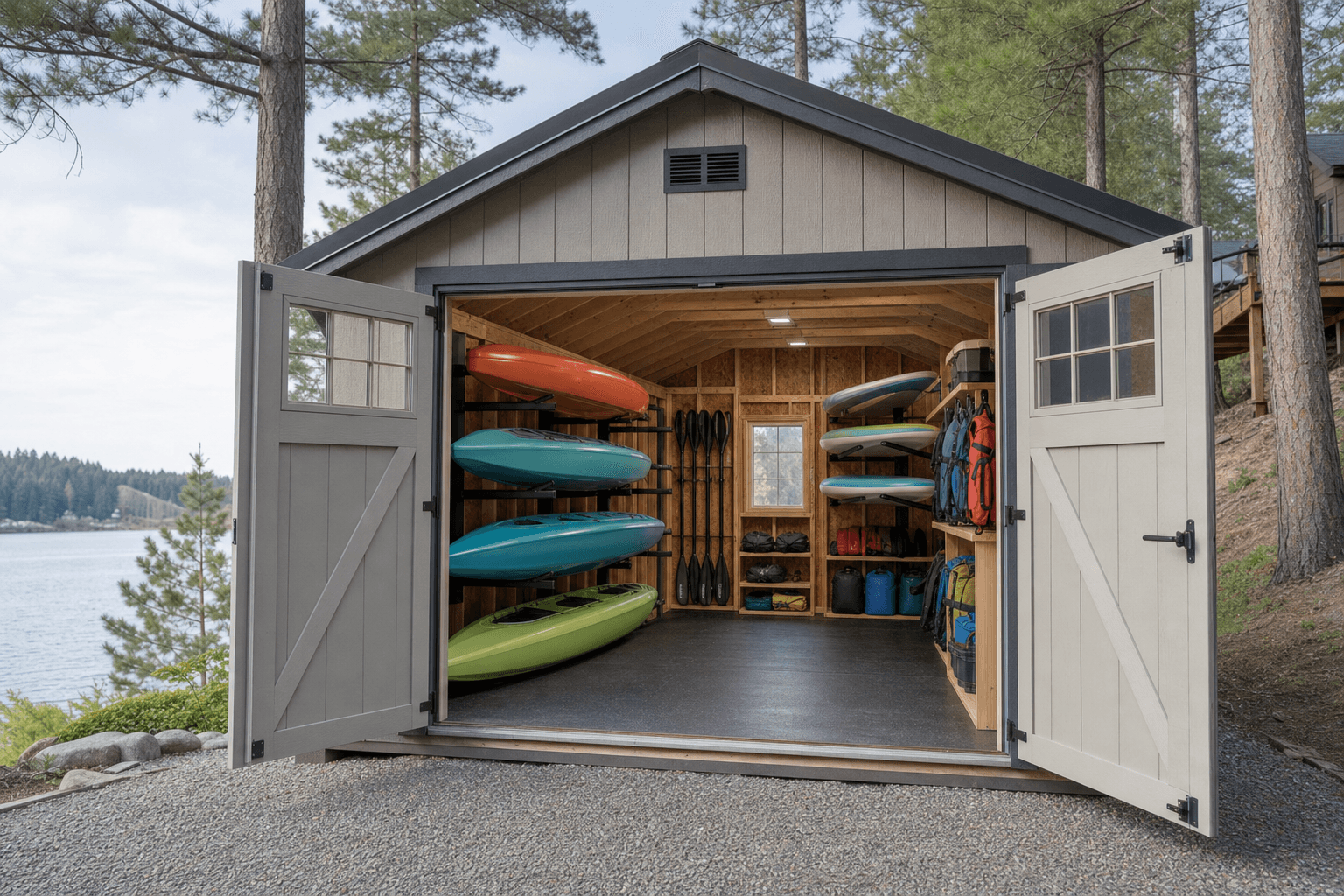
Zone the shed: a vertical rack wall for the boats, ceiling racks for the SUPs, a paddle and PFD wall, and a drying corner by the door.
Think of a paddle-craft shed as four zones instead of one open box, and lay them out so nothing has to move when you grab a boat. A boat rack zone anchors on one or both plywood-lined long walls: vertical J-cradles or rack uprights for kayaks stood on their tails, padded horizontal arms for the hulls you keep level, and overhead ceiling racks or a hoist for the paddleboards and the boats you launch least. This is the wall you protect first, because getting every hull off the floor and cradled at the right points is the whole reason the shed exists. A clear bay runs down the open side — the straight, unobstructed lane you carry a long boat in along, wax a SUP on, or stage everything you are loading before a launch. A paddle and accessory zone lives on one end wall: vertical paddle holders so shafts hang straight and never bow, hooks for spare blades, and shelves or bins for the small kit.
A drying and gear zone sits by the door, where wet PFDs, wetsuits, paddling jackets, spray skirts, and booties hang and drip without soaking the rest of the floor — this is the wettest corner, so it belongs nearest the entrance where water stays by the door instead of tracking across the shed. Good zoning means you never have to lift one boat down to reach another, and the lane stays clear so carrying a 14-foot kayak in is a straight slide, not a three-point turn. Cradle the boats you paddle most at an easy waist-to-shoulder reach and send the off-season hulls, the guest inflatables, and the spare paddles up high or into the loft. Keep the drying corner downstream of airflow from any vent so the damp, lake-smelling air moves out the door rather than across your dry boats.
Vertical J-cradles or rack uprights for kayaks stood on their tails, plus padded horizontal arms bolted into plywood-lined walls that support each hull at the bulkheads so it never sags, warps, or dents under its own weight over a long off-season.
Suspended ceiling racks or a pulley hoist to lift paddleboards and the boats you launch least up out of the way, freeing the walls and the floor for the kayaks and canoes you carry to the water most weekends.
Vertical paddle holders so shafts hang straight and never take a set, hooks for spare blades and dry bags, a ventilated row for PFDs and wetsuits, and labeled bins for bilge pumps, leashes, fins, and the small kit.
Hooks and a drying rack by the door for PFDs, wetsuits, jackets, spray skirts, and booties, a boot tray, good airflow, and a heat source so soaked gear dries overnight instead of staying damp, mildewed, and musty.
This is where a bare shell becomes a boathouse, and it is worth naming exactly what lives inside so you size the walls, the length, and the airflow around it. The boat storage hardware comes first: vertical kayak racks and J-cradles for hulls stood on end, padded horizontal wall arms set to carry each boat at its bulkheads, freestanding floor racks or a multi-boat tree for renters who would rather not drill, ceiling-suspended SUP racks, and a pulley hoist for the canoe you launch least. The paddle and accessory storage is the part most garages get wrong — vertical paddle holders so shafts hang straight, hooks for spare and breakdown paddles, a wall row for dry bags, and labeled bins for bilge pumps, sponges, paddle and SUP leashes, fins, and a repair kit with hull patch and marine sealant. The safety and apparel storage wants its own ventilated zone: PFDs and wetsuits on wide hangers or a drying rack, paddling jackets and spray skirts on hooks, helmets on a shelf, and booties and gloves in an airy tray, all off the floor and out of the sun.
Around the boats and paddles you fit out for getting on the water fast and keeping the gear alive between trips. Add a low gear bench for waxing a board or re-rigging a fishing kayak; a hose bib or wash bucket near the door to rinse lake water and milfoil off hulls; and a bin to clean and dry so you can knock invasive weeds off the boat — a real concern on North Idaho lakes — before it leaves the water and before it goes away. For the drying corner, borrow the heat-and-airflow setup that dries soaked kit overnight, and if you paddle to fish, give the rods and tackle their own home along the lines of a fishing tackle shed so the angling gear is not crammed in among the paddles. The right cradles, a straight paddle wall, and a real drying setup are what turn a storage shed into the boathouse you load out of in five minutes flat.
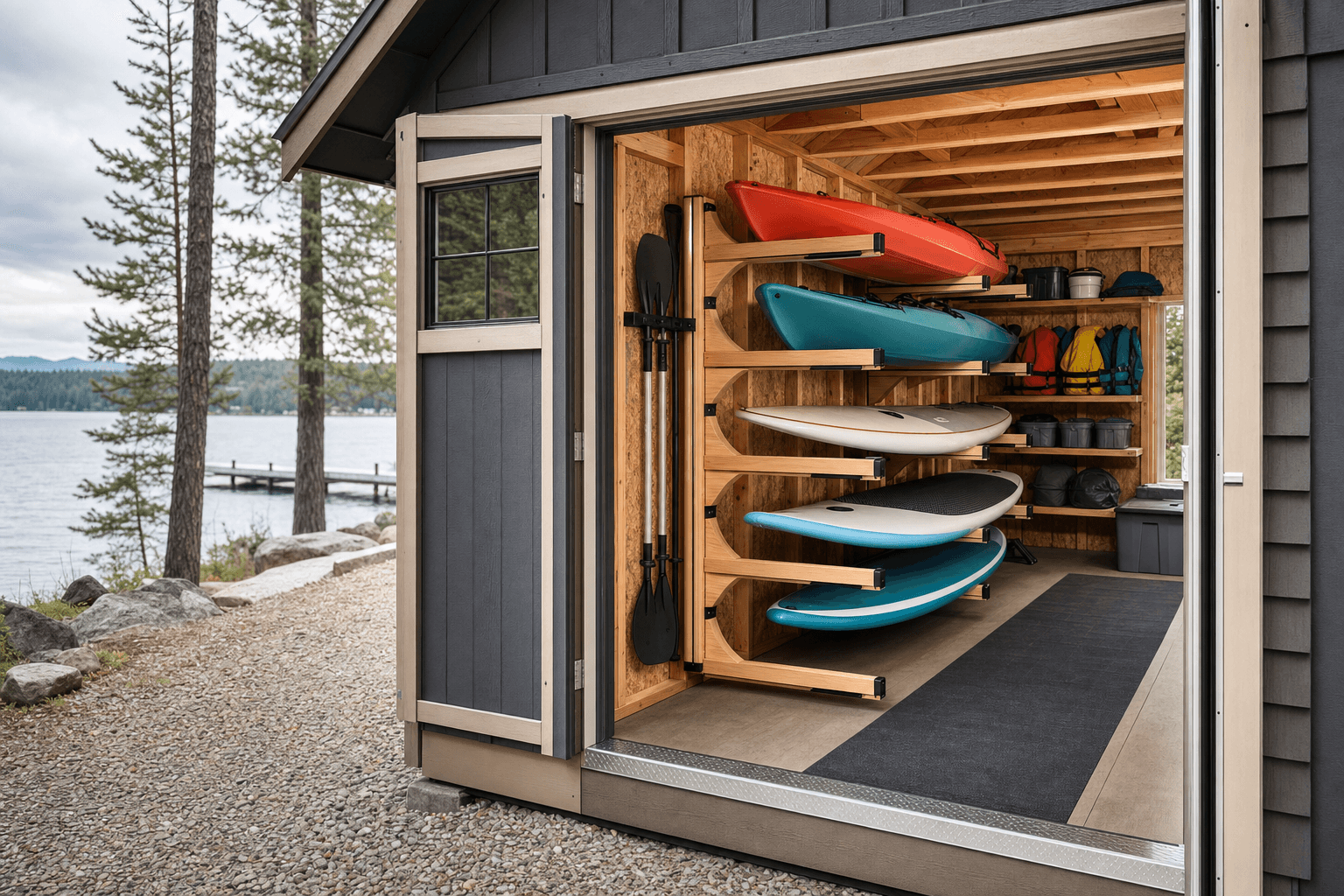
Padded cradles at the bulkheads, paddles hung straight, and PFDs drying in the open — the details that keep hulls true and gear fresh.
| Kayak and paddleboard shed planning checklist | |
|---|---|
| Interior length | Built to your longest hull plus working room, so a 14-to-17-foot canoe or touring kayak slides in straight along the building instead of pivoting in |
| Wall framing | Plywood-lined walls so vertical racks, J-cradles, padded arms, and a paddle wall bolt in anywhere and carry a loaded hull without pulling loose |
| Wall & ceiling height | Tall sidewalls (8 ft+) so a 12-foot kayak stands vertically with the bow clear, and ceiling racks or a hoist lift SUPs and spare boats overhead |
| Door & access | A wide door, ideally on the gable end, so you carry a long boat straight in down the length of the shed without turning it sideways |
| Drying & airflow | A vented drying corner by the door with a heat source so PFDs, wetsuits, and wet gear dry overnight instead of sitting damp and mildewing |
| Rinse & weed-clean | A hose bib or wash bucket and a clean-drain spot near the door to rinse lake water and milfoil off hulls before they go back on the rack |
A paddle-craft shed does not need a workshop's worth of power, but a little electrical makes it far more usable for ten months of the year. Plan a few dedicated 120V outlets run from the house — one at the gear bench for charging a fish finder, a headlamp, or a SUP pump inflator, one for a small heater in the drying corner, and one by the door for a shop vac to clear sand and lake debris. Place them where the work happens so no extension cord crosses the floor where you carry boats. For light, run bright, even LED fixtures down the length of the ceiling so there are no shadows between the racks when you load out before dawn, and add a task light at the gear bench. Good light matters more than people expect in a long, narrow building where the racked boats themselves throw shadows.
Heat and airflow are what keep the gear alive through a long North Idaho off-season. You are not heating the shed to be comfortable — you are keeping wet kit from mildewing and the building from sweating. A soaked PFD, a wetsuit, and a dripping spray skirt left in an unheated, unventilated box all winter come out musty and stiff; the same trapped damp condenses and drips onto your hulls and rack hardware. Insulate at least the drying end, add a small heater to take the chill off the wet corner, and pair it with a vent or a fan so the damp, lake-smelling air moves out and fresh air comes in. You do not have to climate-control the whole building — even a modest heat-and-vent setup in the drying zone is the difference between gear that is dry and ready in the spring and a closet full of mildew. Hard hulls store fine cold; it is the apparel, the foam PFDs, and any inflatable SUPs that reward a dry, ventilated corner.
A paddle shed is not heavy, but its length and the way you use it earn a proper base and a smart approach. A compacted gravel pad drains well, keeps the floor dry under a framed floor, and matters in a building where you will rinse hulls and track in lake water and wet gear. Size the pad and plan the approach for the long boats — leave room at the gable-end door to swing a 16-foot hull in line with the building, and keep the path from the shed toward where you load the truck or trailer clear and roughly level so carrying a long kayak is not an uphill fight over rough ground. If you cart-haul to a dock, plan a smooth run for the kayak cart, too. Read how to prep a shed site before delivery day so the pad, the drainage, and the door-end clearance are sorted in advance.
North Idaho winters set the rest of the requirements. The roof and the building need to be rated for local snow load, and the long, low rooflines common on paddle sheds shed snow well when oriented right. Keep a plowed path to the door so you can reach the boats for a winter outing or get to stored gear, and remember that the off-season here is long — the drying and ventilation you plan now is what protects the gear through it. Most small paddle sheds skip a building permit, but bigger buildings, any added electrical, and setback, shoreline, or HOA rules near the lake sometimes do not — lakefront and near-shore lots in particular can carry extra rules — so confirm what your town, your county, and any homeowners association require on the service areas pages, and factor any electrical permit in before you finalize the length and where the shed will sit.
Mix the rack types to the boats. Stand kayaks on their tails in vertical J-cradles or rack uprights bolted into plywood-lined walls — that packs the most hulls into the least floor and is the single biggest space-saver in the shed. Lay canoes and longer touring kayaks on padded horizontal arms set to carry the hull at its bulkheads. Send the paddleboards and the boats you launch least up onto suspended ceiling racks or a pulley hoist overhead, which clears both the walls and the floor for the boats you paddle most. A freestanding floor rack or a multi-boat tree is the move for renters who would rather not drill into the structure. Spacing matters: leave enough gap that hulls never press against each other, and cradle the boats you launch most at an easy waist-to-shoulder reach so you are not lifting one boat down to grab another.
Size the building to your longest hull first, because boat length drives the footprint far more than the number of boats does. A 16-foot-long shed swallows most recreational kayaks and SUPs end to end, while longer touring kayaks and tandem canoes that run 16 or 17 feet are happiest in a 20-foot building like a 10x20 or 12x20 where they rack horizontally with a clear lane still down one side. The door is just as important as the length: put a wide door on the gable end, not the long side, so you carry a long boat straight in along the length of the shed instead of trying to pivot a 16-foot hull sideways through a too-narrow opening. Plan the approach outside the door for the same straight-line carry, and you can load a long boat onto its rack solo without a wrestling match.
Set up a dedicated drying corner by the door, away from the racked boats, so the dripping happens near the entrance and water stays off the rest of the floor. Hang PFDs and wetsuits on wide hangers or a drying rack so air gets all the way around them, put paddling jackets, spray skirts, and booties on hooks and in an airy tray, and keep everything off the floor. Then make the corner actually work with heat and airflow: a small heater takes the damp chill off and a vent or fan moves the wet, lake-smelling air out and brings fresh air in, so gear dries overnight instead of sitting musty for days. Drying matters more for paddling kit than almost any other shed because foam PFDs and neoprene mildew fast when they stay damp, and a stiff, mildewed PFD is one you stop trusting on the water.
Plan for both, because the same building does each job if you zone it right. For daily summer launching, the priorities are a clear bay you can stage gear in, racks at an easy reach for the boats you grab every weekend, a paddle wall by the door, and a rinse spot so hulls get cleaned before they go back up. For the long off-season, the priorities shift to protecting the boats and the gear: cradle hulls so they do not warp or dent over months of sitting, send the boats you will not touch until spring up high or into a loft, and lean on the heated, ventilated drying corner to keep PFDs, wetsuits, and inflatables from mildewing. Build the racks and the bay for easy summer access, add the loft or overhead racks for winter overflow, and put the drying-and-ventilation in the off-season corner, and one shed covers the whole year.
The cause of warped hulls is point loading — a boat left resting its full weight on one narrow spot, or stacked flat under the weight of another, slowly deforms there, and heat and time make it worse. Store boats on their side or on edge in padded cradles that support the hull at its strongest points, the bulkheads, rather than flat on a single bar or leaned on a rail. Never stack hard boats directly on top of each other on the floor; rack them separately so nothing bears another boat's weight. Keep the boats out of direct sun and off a hot surface, since heat is what lets a stressed hull take a permanent set. Inflatable SUPs are the opposite case — they store best rolled or only lightly inflated and kept somewhere dry so the material does not mildew. Cradled at the bulkheads, off the floor, and out of the sun, a hull holds its shape for many seasons.
Give the paddles, the safety gear, and the small kit their own wall so they are not scattered among the boats. Store paddles in vertical holders so the shafts hang straight and never bow or take a set, with hooks alongside for spare blades and breakdown paddles. Keep PFDs and wetsuits in their own ventilated row on wide hangers or a rack so they dry and air out rather than getting crushed in a bin. For the rest of the kit, use labeled bins and shelves sorted by type: bilge pumps and sponges together, paddle leashes and SUP leashes together, fins and fin keys together, dry bags and deck bags on hooks, and a small repair kit with hull patch and marine sealant where you can find it. A row of clearly labeled bins and a straight paddle wall is what lets you grab everything for a trip in one pass instead of hunting through a pile on the floor.
Coeur d'Alene Lake, Hayden Lake, and the smaller water bodies across Kootenai County mean a lot of households are managing long, awkward boats in yards that weren't designed for them. A kayak and paddleboard shed built on site solves the storage problem without the compromises of a delivered box — the door opening, the interior bay length, and the wall-mounted rack positions are all framed to fit your actual boats.
Kayaks and paddleboards need horizontal or angled wall storage, not floor stacking. A long clear bay of at least fourteen feet handles most touring kayaks, and ceiling joists sized correctly during framing can take overhead slings for a second boat without needing a retrofit. Because NIOS builds on your lot in Coeur d'Alene or Post Falls, we can position the shed so the door faces the yard rather than a fence, which makes pulling a boat in and out a single-person job.
UV and moisture are the real threats to composite hulls left in North Idaho storage. A shed with ventilated walls keeps interior humidity low, and a north- or east-facing orientation reduces direct summer sun exposure on stored boats. Wader and PFD drying space is easily incorporated as a hanging wall near the door — often just vertical cleats and a few inches of airspace.
On sloped lots common around Hayden and Rathdrum, a gravel pad gives you a level, frost-stable foundation without a poured slab. See sizes and options in the shed builder, compare materials on our pricing page, or get a free estimate to start a real number for your property.
Tell us your longest hull and how many boats and boards you paddle, and we will help spec the racks, the clear bay, the paddle wall, and the drying corner around your property — then you can build and price it online.
Keep planning your build with related North Idaho shed guides.