A backyard home gym is the building you walk to in your training shoes before the coffee is even cold — no drive across town, no waiting for a rack, no sharing a bench with a stranger. The gyms people actually keep using are not the flashy ones. They are the ones planned around the three things that make or break a training space: a floor strong enough to take a loaded barbell dropped from lockout, ceiling height tall enough to press and pull overhead, and enough fresh air and heat that a January session does not feel like working out in a freezer. Get those right and a 12-by-something shed becomes a real gym you train in year-round. This guide walks through how to plan a backyard gym shed for a North Idaho property: which roofline buys you the height, what size fits a rack plus cardio plus floor work, how to build the floor and ventilation, and how to wire and heat it so it works in the dead of winter.
North Idaho On Site Sheds builds every home gym right on your property, so the floor and the framing can be specified for the load you actually plan to lift instead of a generic storage shed that happens to have a door. Start with the heaviest thing you will do — deadlifts and dropped Olympic lifts, a rack with pull-ups, a rower or bike going at 6 a.m. — and size, floor, vent, and heat the building around that. A gym that flows is one you use five days a week; a cramped one with a bouncy floor and no airflow becomes an expensive shed full of laundry.
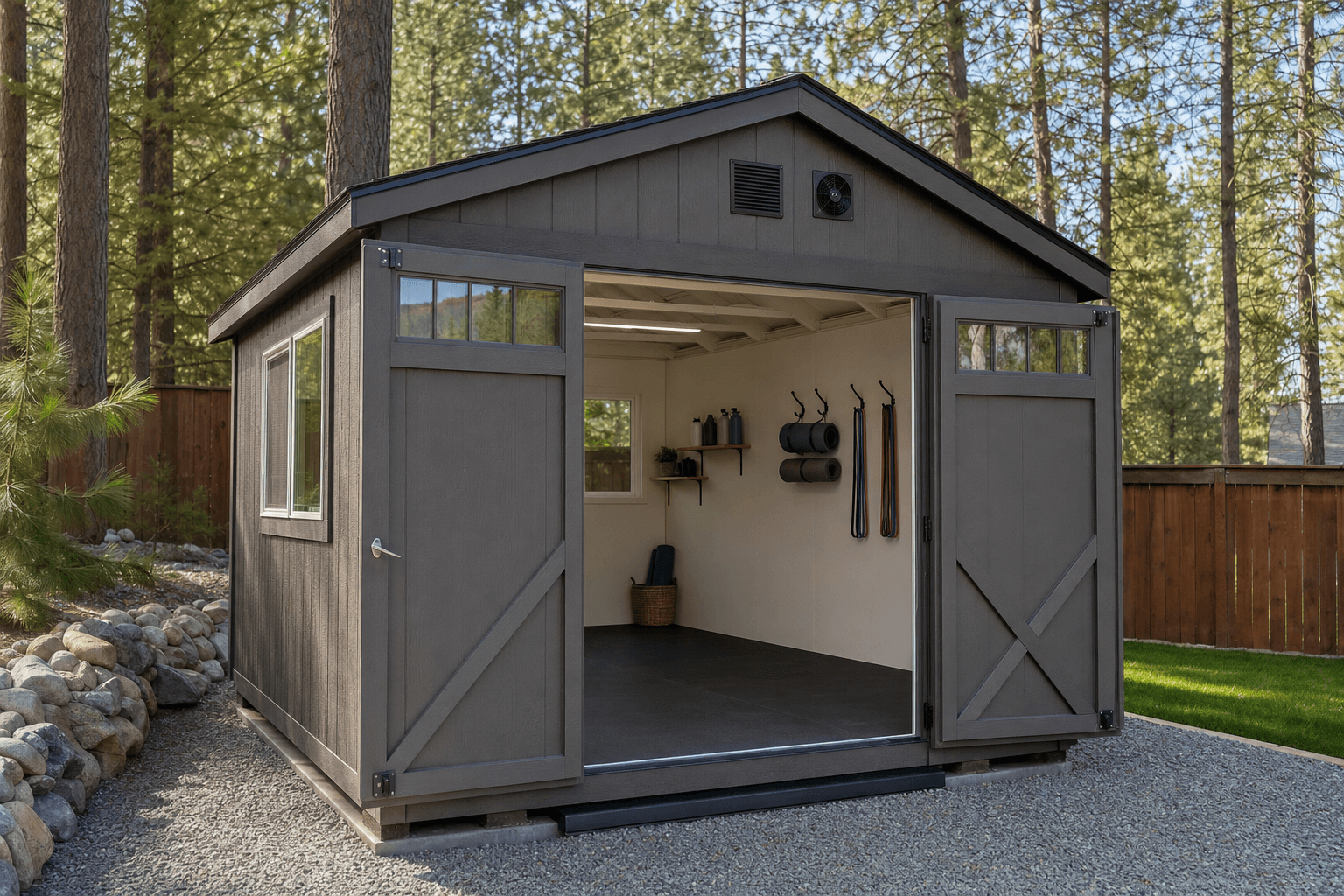
A real gym starts with the bones: a strong floor, the height to press overhead, and air that moves before the first set.
A gym wants two things from its shell above all else: floor strength and vertical clearance. That makes the standard gable the honest starting point — it is the most headroom for the money, easy to insulate, and simple to line with plywood walls you can bolt a rack or hang a pull-up bar into anywhere. The number that matters most is sidewall height: order taller walls (think 8-foot-plus sidewalls) so a 7-to-8-foot power rack stands clear of the ceiling and you have room to press a barbell or do strict pull-ups without ducking. A lofted barn (gambrel) raises the center ridge even higher and can give you a small loft for foam rollers, bands, and off-season gear while keeping the training floor open. A lean-to or modern single-slope sheds North Idaho snow predictably to one side and gives you a tall front wall to fill with windows, a fan, and a wall of mirrors.
Whatever the roofline, the floor and the framing are the parts to spec up, not down — a gym lives or dies on whether the floor takes a dropped barbell without flexing and whether the room is tall enough to lift. A home gym sits closer to a finished, conditioned room than to a plain storage shed, which is why it overlaps with a she-shed retreat or a man cave hangout when the space pulls double duty for recovery and downtime. If cold-water recovery is part of the plan, a gym shares a lot of its build — drainage, power, ventilation — with a cold plunge setup. Decide early whether heavy barbell work leads or lighter cardio-and-mobility leads, because that one call drives the floor build, the ceiling height, and how hard the ventilation has to work.
A 10x16 fits a power rack, a bench, a barbell with bumpers, and a lane of rubber floor for stretching or a folding bike against the wall.
A 12x16 or 12x20 gives a rack, a bench, dumbbells, and a dedicated zone for a rower, treadmill, or bike with open floor for mat work.
A 14x20 or 16x20 fits a rack or rig, multiple cardio pieces, a full dumbbell set, and an open turf or mat lane for sleds, jumps, and conditioning.
Footprint decides whether the gym feels like a studio or a closet, so compare the real dimensions before you commit — a few feet is the difference between swinging a barbell freely and clipping the wall on every overhead press. A 10x16 is a comfortable rack-and-bench gym with a lane of floor for mobility work; a 12x16 or 12x20 opens up a true cardio zone next to the lifting platform without the rower crowding the rack; and a 14x20 gives you length for a rig, several cardio machines, and an open floor for sleds, kettlebell swings, and box jumps. The extra width on a 12-to-14-foot building is what lets you do walking lunges or push a sled without rearranging furniture first, and it leaves room to drop into a stretch on the floor while someone else is on the bike. If you want a rack or rig plus multiple cardio pieces and a genuine open lane for conditioning, step up to a 16x20 so the floor stays usable with everything set up at once. Length matters as much as width in a gym — a long, narrow lane is what lets a barbell, a sled, or a jump-rope arc move in a straight line instead of pivoting around equipment.
These overlap more than you would think, and the right call comes down to what leads. A she-shed is built around calm and comfort — soft light, a reading or craft corner, a place to decompress — so it favors finish and coziness over a floor rated for dropped iron. A man cave leads with hangout: a TV, seating, a bar or a game table, and gear for downtime. A purpose-built home gym puts the training first — the reinforced floor, the ceiling height, the rubber and the airflow — and lets the comfort follow, not the other way around.
Plenty of buyers want one building that does double duty, and that works as long as you build to the heaviest job. A gym that also serves as a recovery and hangout space still needs the gym floor and the gym ceiling height first, because you cannot retrofit a stronger floor or a taller wall after the fact — but you can always add a screen, a mini-fridge, and a comfortable chair. If recovery is central, a cold plunge or sauna room shares the gym's drainage, power, and ventilation planning and can sit alongside it. Naming the lead use up front keeps you from a building that trains poorly and relaxes poorly both — and it locks in your floor spec, your wall height, and your ventilation before the framing is ordered.
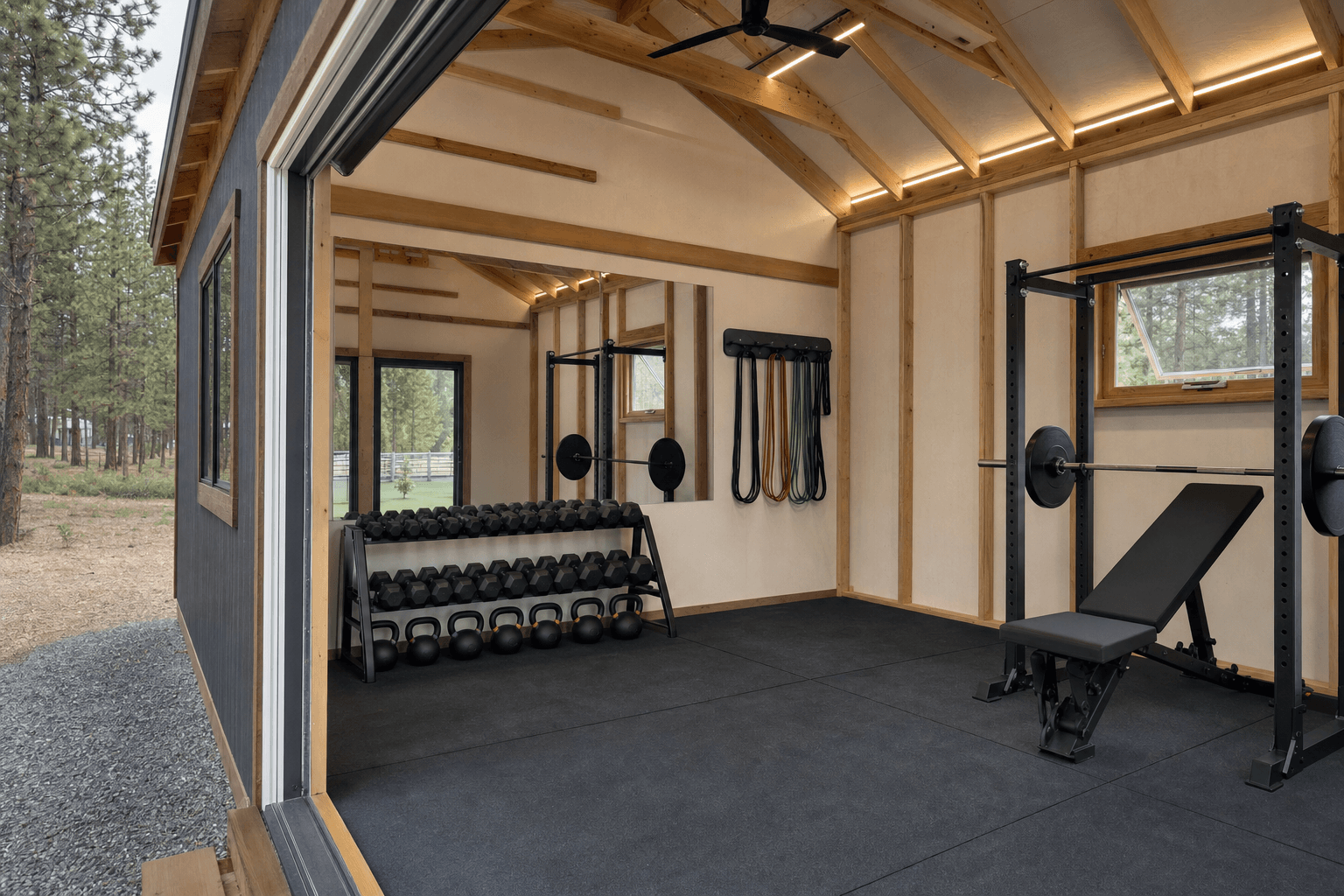
Zone the gym: a lifting platform under the rack, a cardio corner, an open mat lane, and mirrors on the work wall.
Think of the gym as three or four working zones instead of one open box, and lay them out so nothing has to move between sessions. A lifting zone anchors on the rack along one solid wall, with the bench and a loaded barbell in front of it and the strongest part of the floor underneath — this is the space you protect first, because the rack and the dropped weights need both the wall backing and the reinforced floor. A cardio zone holds the rower, treadmill, or bike, ideally near a window and a fan where the airflow is best, since that is where you generate the most heat and humidity. An open floor lane stays deliberately clear for stretching, core work, kettlebell swings, sled pushes, and jump rope. If the building pulls double duty, a small recovery or hangout corner tucks in a chair, a foam roller, and a screen.
Good zoning means you never have to shove a treadmill aside to deadlift, and you never trip over a dumbbell to reach the rower. Put the mirrors on the wall you face while lifting so you can check your bar path and depth, and keep at least the length of a barbell plus a couple of feet of clearance on each end of the rack so you can rack and unrack without hitting anything. Leave a clear, open lane down the middle so a sled, a jump rope, or walking lunges have a straight run. Set the cardio machines where the cross-breeze hits them, because a rower at full effort in a sealed corner turns the room into a sauna fast. A gym that flows is one where the next exercise is a step away, not a furniture-moving project.
A strong, stiff floor system carries a loaded rack and absorbs dropped bumpers, topped with thick rubber tiles or a horse-stall mat where the bar lands to protect the deck and quiet the building.
A power rack lagged into reinforced wall framing or a heavy freestanding rig with a pull-up bar, plus a bench, so heavy presses and pull-ups have a solid, wobble-free anchor.
A wall of mirrors on the lifting side for form checks, plus a vertical barbell holder, a dumbbell rack, a plate tree, and hooks for bands and jump ropes so the floor stays clear.
An exhaust or ceiling fan and an operable window to clear heat and humidity, a heater sized for North Idaho winters, and shadow-free LED lighting over the platform and the mirrors.
This is where a bare shell becomes a gym, and it is worth naming exactly what lives inside so you size the floor, the power, and the airflow around it. The anchors are the big pieces: a power rack or a rig with a pull-up bar, an adjustable or flat bench, an Olympic barbell with bumper plates, and a set of adjustable or fixed dumbbells on a rack. Add the cardio you will actually use — a rower, an air bike or spin bike, a treadmill, or a ski erg — and place it where the air moves. Underneath all of it goes the flooring system: thick interlocking rubber tiles or rolled rubber across the platform, horse-stall mats or extra-dense rubber under the rack where bumpers land, and a strip of artificial turf if you push a sled or do crawls.
Around the anchors you fit out for the daily work: a vertical or horizontal barbell holder, a plate tree, a kettlebell set, a medicine ball or two, resistance bands and a band rack, a jump rope hook, and a chalk bowl or block with a small tray to keep dust down. A wall of mirrors on the working side lets you watch your form, and a clock or interval timer up high keeps your rest honest. Round it out with a Bluetooth speaker, a water-bottle and towel hook, a small fan you can aim at the rower, and a foam roller and stretching mat for the recovery corner — the kind of touches that turn a workout room into a place you want to be at dawn.
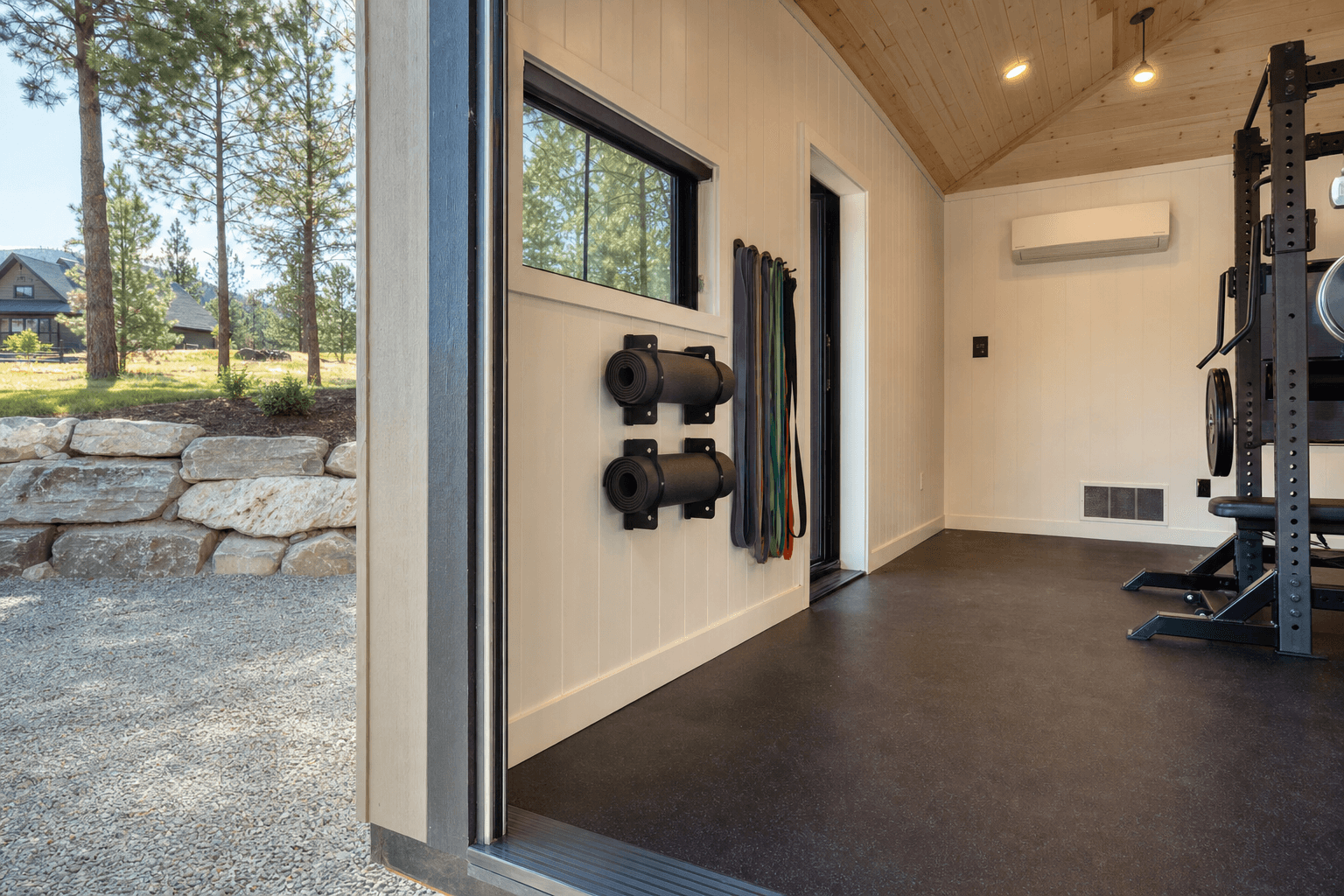
Thick rubber where the bar lands, weights racked off the floor, and a clear platform — the details that protect the building and keep sessions moving.
| Home gym planning checklist | |
|---|---|
| Floor strength | A reinforced, stiff floor system rated for a loaded rack and dropped Olympic lifts, with thick rubber over the landing zone |
| Ceiling height | Taller sidewalls (8 ft+) so a rack clears the ceiling and you can press a barbell and do pull-ups overhead |
| Ventilation | An exhaust or ceiling fan plus an operable window to clear body heat, humidity, and rubber off-gassing during hard sessions |
| Heat & insulation | Insulated walls and ceiling with a heater so the gym is usable through a North Idaho winter and stays dry |
| Power | Several dedicated 120V circuits for a treadmill, fans, lighting, sound, and chargers so a machine and a fan never share one breaker |
| Mirrors & lighting | A mirror wall on the lifting side and bright, even, shadow-free LED light over the platform and cardio zone |
The floor is the single most important thing in a gym shed, and it is the one part you cannot upgrade later, so spec it up front. A loaded power rack, a stack of bumper plates, and the force of a deadlift dropped from lockout put real, repeated load through the deck — a generic storage-shed floor will flex, bounce, and eventually fail under that. Plan a reinforced floor system with tighter joist spacing and a stiff, rated deck so the platform stays dead solid under a loaded rack and shrugs off dropped weights. Over the top of that goes the rubber: thick interlocking tiles or rolled rubber across the training area, with horse-stall mats or extra-dense rubber stacked where the bar actually lands, both to protect the building and to quiet the boom of a dropped barbell so the whole shed does not ring. A concrete slab is the strongest base if you want a permanent platform; a properly reinforced framed floor on a solid pad also handles a home gym well when it is built for the load.
Power and heat decide whether the gym gets used in January. Cardio machines are hungry — a treadmill, a fan, the lights, and a speaker can easily overload a single 120V circuit and trip it mid-run — so plan several dedicated 120V circuits from the house, with the treadmill or air bike on its own breaker and outlets placed where the machines and fans live so no extension cord crosses the floor. Then make it warm: insulate the walls and ceiling and add a heater — a mini-split, an electric heater, or in-floor heat on a slab — sized to take the chill off fast, because nobody trains hard in a 30-degree box and a cold building grows condensation that rusts your bar and plates. Insulation also keeps the morning cold off your equipment and deadens the noise of a rower or dropped weights so the gym stays neighborly.
A home gym is heavy and it earns a real base. A compacted gravel pad drains well and works under a properly reinforced framed floor, but if you want a permanent lifting platform and the strongest possible deck, a concrete slab is the move — it carries a loaded rack without flex, gives a dead-flat surface, and takes anchor bolts for a rack or rig. Either way, plan the approach so a 700-pound rack, a treadmill, and pallets of bumper plates can come straight off the truck and through the doors without a muddy uphill fight. Read how to prep a shed site before delivery day so the pad, drainage, and access are ready for the weight.
North Idaho winters drive several choices: a roof and anchoring rated for local snow load, insulation that keeps the gym workable through a long freeze, and a clear, plowed path so you can get to your morning session after a storm. Ventilation matters in winter too — a sealed, heated room full of a hard cardio session builds humidity fast, so plan an exhaust path or an operable window even when it is cold out. Home gyms also tend toward the larger footprints and added power that can trigger local rules: many small sheds skip a permit, but bigger buildings, electrical work, and setback or HOA requirements often do not. Confirm what your town and county require on the service areas pages, and factor any electrical permit into the plan before you finalize the size and where the gym will sit.
Stronger than a standard storage-shed floor. A loaded rack plus a barbell dropped from lockout puts heavy, repeated force through the deck, so plan a reinforced floor system with tighter joist spacing and a stiff, rated deck, or build on a concrete slab for a permanent platform. Then lay thick rubber tiles or rolled rubber over the training area, and stack horse-stall mats or extra-dense rubber where the bar lands. That combination protects the building and absorbs the impact instead of cracking the floor or rattling the whole shed.
Rubber does two jobs: it protects the floor and your equipment from dropped iron, and it deadens the boom so a dropped barbell does not echo through the building and the neighborhood. Across the general training area, three-quarter-inch interlocking tiles or rolled rubber are plenty. Under the rack and platform where bumper plates actually land, double up or set down horse-stall mats so the landing zone is the thickest, densest part of the floor. The denser and thicker the rubber under the bar, the quieter and more forgiving the drop.
Taller than a basic shed. Order taller sidewalls, around 8 feet or more, so a 7-to-8-foot power rack stands clear of the ceiling and you can do strict pull-ups on the rack's top bar without hitting your head. You also need overhead room to press a barbell at lockout and to do snatches or push presses if those are in your program. A gambrel or lofted roof raises the center ridge for even more clearance. Measure your tallest planned movement, standing on a platform, and add headroom on top of that before you set the wall height.
Plan airflow as carefully as heat, because a hard session in a sealed room builds heat and humidity fast and new rubber flooring off-gasses at first. Put in an operable window and an exhaust or ceiling fan to pull warm, damp air out and bring fresh air in, and place your cardio machines near that airflow since the rower or bike is where you generate the most heat. In winter you still need a vent path even though it is cold out, or condensation will collect and rust your bar and plates. Good cross-ventilation keeps the room breathable and the equipment dry year-round.
More than a single outlet. A treadmill, an air bike's display, fans, lights, a speaker, and phone chargers can easily overload one 120V circuit and trip it in the middle of a run, so plan several dedicated 120V circuits run from the house. Put a treadmill or any high-draw machine on its own breaker, and place outlets where the machines and fans actually live so you never stretch an extension cord across the floor. Detached-building wiring usually needs a permit, so plan the circuits before the walls are insulated and closed up.
Put a wall of mirrors on the side you face while you lift, so you can watch your bar path, depth, and form on squats, presses, and deadlifts. Mount them low enough to see your feet and high enough to catch a full overhead press. For lighting, layer bright, even LED fixtures across the whole ceiling so there are no shadows on the platform, then make sure the mirror wall is well lit and glare-free so the reflection is clear. Good light over the cardio zone matters too, since a dim corner makes a dawn or evening session feel like a chore.
The floor is the first thing to get right in a home gym shed, and it's a decision that has to happen before the slab is poured or the subfloor is framed. A dead-flat, level surface is what lets a power rack sit without shimming and a barbell roll true. On the sloped and graded lots common across Coeur d'Alene's hillside neighborhoods and Post Falls properties backing onto fields, an on-site build lets the foundation be set properly for the site — a delivered unit arrives assuming flat, open ground that may not exist.
Ceiling height is the spec most home gym buyers underestimate. Standing overhead press, pull-ups, and Olympic lifts all need genuine clearance — a standard 8-foot ceiling feels confining fast once a rack is inside. On-site framing makes 9 or 10-foot walls a straightforward decision rather than a special-order premium, and the roof pitch can be chosen to maximize the usable center height while still handling North Idaho's winter snow load on the structure.
Ventilation and heat together are the year-round comfort equation. The Coeur d'Alene and Post Falls area delivers both: summers where an unventilated metal-sided shed becomes unworkable by 10 a.m., and winters cold enough that starting a workout in an unheated space discourages use entirely. A mini-split mounted during construction — with dedicated electrical run while the walls are open — solves both seasons cleanly and doesn't eat floor space the way a freestanding heater does.
Rubber flooring, mirror backing, and wall-mounted storage are all easier to plan when the walls are being framed than when you're trying to attach them to a finished interior. See gym shed builds in our portfolio or price your layout in the shed builder to find the right footprint for your equipment list.
Tell us what you lift and the cardio you run, and we will help spec the floor, ceiling height, ventilation, power, and site prep around your property — then you can build and price it online.
Keep planning your build with related North Idaho shed guides.