A backup generator is supposed to be the thing that keeps your North Idaho home running when an ice storm or a downed line takes the power out — but a generator that is sheltered the wrong way can kill you. Every gas, propane, or diesel generator burns fuel and produces carbon monoxide, an odorless, colorless exhaust gas that has poisoned families running a generator in a garage, under a deck, or in a poorly vented shed during the exact storm the generator was bought for. The two non-negotiable jobs of a generator shed are therefore safety jobs: route the exhaust fully outside and away from every door, window, and vent so carbon monoxide can never collect or drift back into the building or your home, and feed the engine enough combustion and cooling air that it neither starves nor overheats. Get those wrong and the building is dangerous; get them right and a generator shed turns a noisy, exposed, fume-producing machine into a quiet, weatherproof, safely vented part of your property.
North Idaho On Site Sheds builds every generator shed right on your property, so the exhaust outlet, the air openings, the door, and the footprint can be set around your exact generator, your fuel type, and where the building sits relative to the house. This guide leads with the three things that actually keep a generator shed safe and useful — carbon monoxide and exhaust routing, ventilation and cooling airflow, and safe fuel storage — and then covers sound dampening, weatherproofing, service access, and how to size the building around the unit and its clearances. If your backup plan is batteries rather than an engine, you will see where a solar battery shed fits instead, and if the generator exists to keep a well pump or your emergency supplies running, you will see how it ties into a well house shed and an emergency preparedness shed.
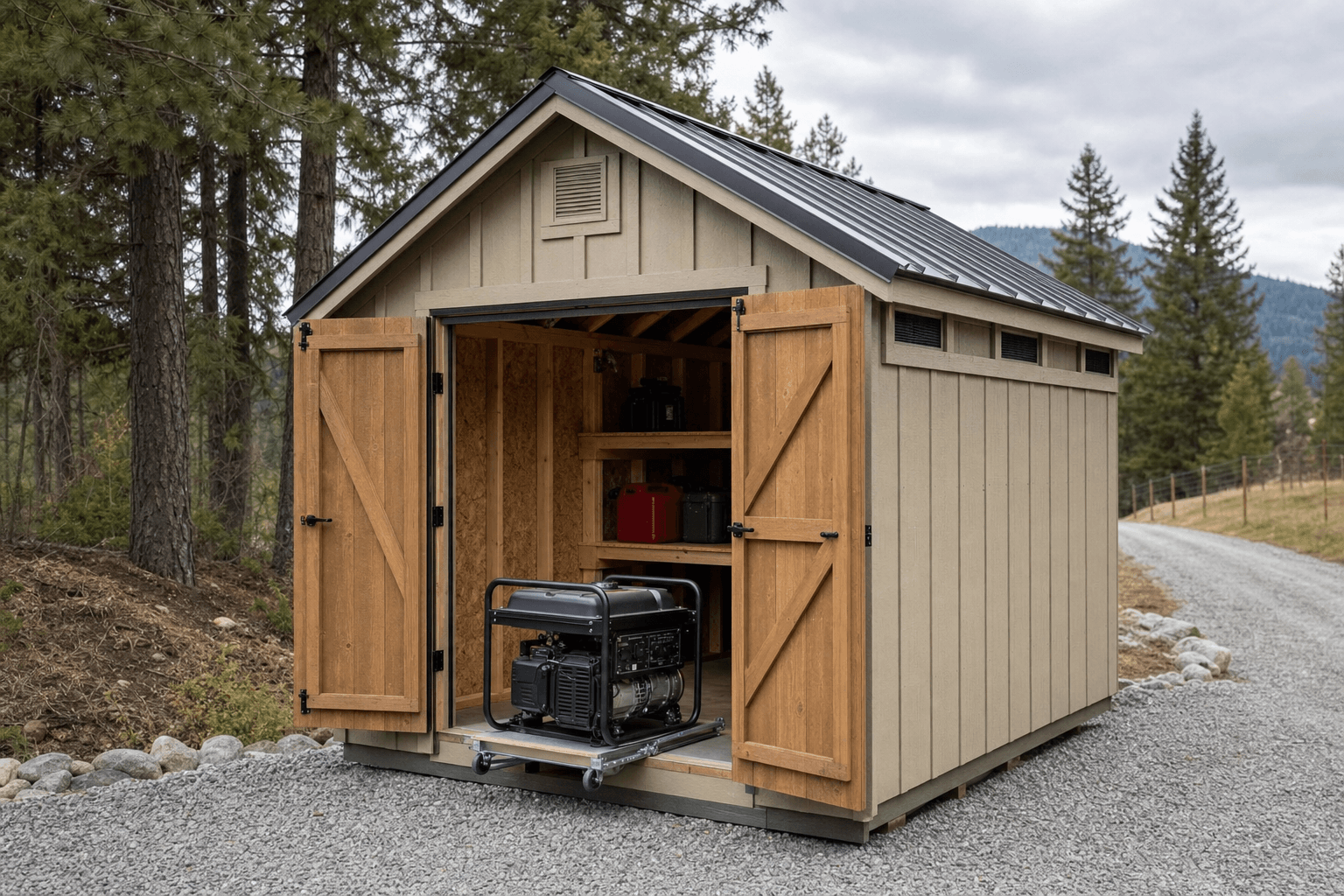
A quiet, weatherproof box around a backup generator — exhaust routed fully outside and away from the house, with low intake and high exhaust air openings sized for cooling.
A generator shed does not need a loft or headroom — it needs straight walls for air openings and an exhaust penetration, a roof that sheds snow, and a door wide enough to roll a unit in and out, so the roofline is really a decision about ventilation, snow shedding, and access. A standard gable is the natural starting point: the peaked roof sheds North Idaho snow off the air vents and the exhaust outlet, the high point gives hot engine air a place to rise and leave, and the straight sidewalls give you clean spots to place a low intake vent, a high exhaust vent, and a sealed exhaust penetration at the right height. A lean-to or modern single-slope sheds snow predictably to one side and keeps the profile low and tight, which suits a generator shed tucked against a garage wall or a fence line — just keep the exhaust outlet and the air openings on the downhill, away-from-the-house side so nothing sheds snow or drifts fumes back toward a door or window.
Whatever the roofline, the parts to spec up are the air openings, the exhaust penetration, sound-dampening in the walls and roof, and a wide, weather-sealed door to roll the generator in for service — a generator shed has to breathe hard, stay quiet, and vent its exhaust safely, which is a very different problem from a sealed, heated utility box. Where a well house shed wants to trap heat and stay nearly closed up, a generator shed has to move a large volume of air while it runs, so the wall build, the vent placement, and the exhaust routing all serve airflow and safety first. If your backup power is batteries instead of an engine, a solar battery shed is the better-suited building — it wants a controlled, ventilated, climate-managed space with no combustion and no exhaust at all, the opposite of the breathe-and-exhaust setup a generator demands.
A 6x8 wraps a portable or small standby generator with room for air openings on two walls, a clear path to the controls and oil fill, and a door wide enough to roll the unit out — the compact, well-ventilated box for a typical home backup.
An 8x8 takes a whole-home standby generator with working clearance on the service sides, wall room for a transfer switch, and a separated, vented corner or lean-to for fuel cans away from the engine and exhaust.
An 8x10 or 8x12 holds a larger standby generator, the transfer switch, and a fuel and tool zone with a real service aisle all the way around, so an oil change, a filter swap, or a load test is a step-in job, not a contortion.
Footprint here is set by the generator's own clearances plus the air it needs and the room to service it, so size to the unit plus a working perimeter rather than to the bare machine. A 6x8 is the compact generator shed: it wraps a portable or small standby unit, leaves wall space for a low intake and a high exhaust vent, keeps a clear path to the control panel and the oil fill, and lets the door open wide enough to roll the generator out for service — the right call for a typical home backup. An 8x8 gives a whole-home standby unit a square room with working clearance on the sides the manufacturer wants kept open, plus a wall for the transfer switch and a separated corner for fuel. An 8x10 is the workhorse when you want a real service aisle around a larger unit, room for the transfer switch and a small tool zone, and a clean separation between the engine, the fuel, and the controls. If you are running a sizeable diesel or a generator plus a fuel supply and a tool bench, step up to an 8x12 so the engine, the fuel, and the service space each get their own area with airflow between them. Respect the generator maker's minimum clearances above all — most units specify open space on the intake, exhaust, and service sides, and crowding those starves the airflow and makes the engine run hot, so the box has to be the unit plus its clearances plus a person, not the unit alone.
These are all small utility buildings that protect critical gear, but they hold completely different equipment under completely different conditions, and naming the lead use keeps you from a building that fights its own contents. A generator shed leads with safe combustion power: it houses an engine that burns fuel, so it is built around exhaust routing, carbon monoxide control, combustion and cooling air, fuel, sound, and the clearances an engine needs — a building designed to breathe hard and vent its exhaust outside while it runs. A solar battery shed leads with stored power: it houses an inverter, charge controller, and a battery bank with no combustion and no exhaust, and it wants a controlled, often climate-managed space to keep the batteries in their happy temperature range — almost the inverse of a generator shed's wide-open, exhaust-venting setup. Decide first whether your backup is an engine or a battery bank, because that single choice flips the entire building from breathe-and-exhaust to seal-and-condition.
A generator shed also pairs naturally with the buildings it keeps running. A well house shed is the classic partner: when the power drops, the generator is what keeps the well pump and the well house heater alive, so many properties build both and wire the well house to the generator's backup circuit. An emergency preparedness shed is the other natural neighbor — the generator is the power half of a readiness plan, while the prep shed holds the water, food, fuel, and supplies, and together they form the backbone of riding out a long North Idaho outage. Decide which job each building leads with — safe engine power, stored battery power, protected water, or stocked supplies — and build each around its own condition first, then wire and plumb them together so the lights, the heat, the water, and the supplies all hold when the grid does not. That order locks in your exhaust plan, your airflow, your fuel storage, and your transfer wiring before the framing is set.
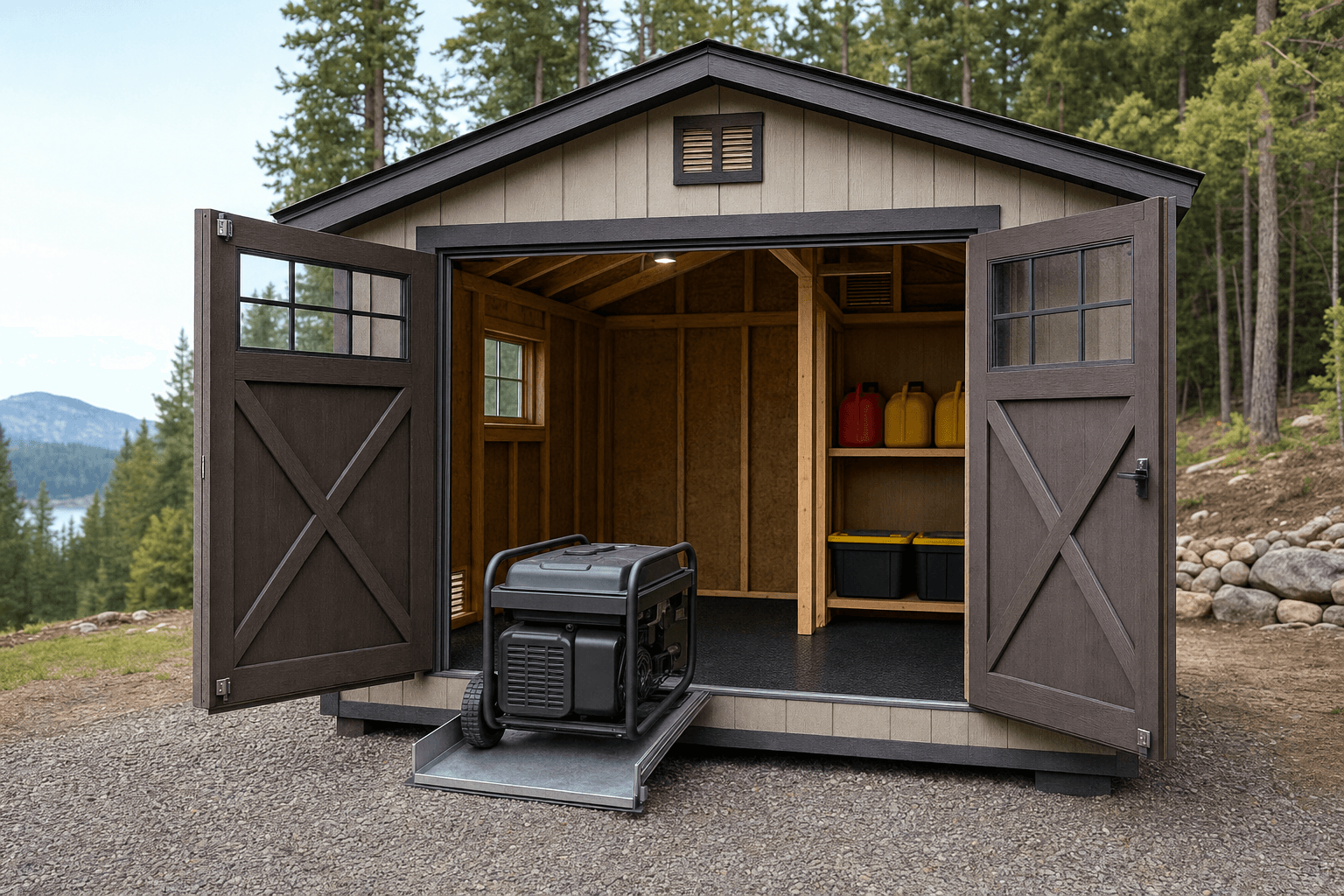
Lay out the engine, the air openings, the exhaust outlet, and a service aisle so the unit breathes and vents safely and every service point stays reachable.
Think of a generator shed as one well-ventilated room with the engine, the air path, the fuel, and the controls laid out so the unit runs cool, vents its exhaust safely, and stays easy to service. An engine zone anchors the building: the generator centered or set so the manufacturer's required clearances stay open on the intake, exhaust, and service sides, with nothing crowding the air openings or the cooling fan. The air path is a zone you design, not an afterthought — a low intake vent that pulls cool combustion and cooling air in, a high exhaust vent that lets hot air rise and leave, and the engine positioned so air flows across it rather than dead-ending in a corner. The exhaust route runs from the engine straight out through a sealed, insulated penetration in the wall, away from every door, window, and air vent, so the carbon monoxide it carries goes outside and stays outside.
A fuel zone gets its own separated, ventilated area — a corner, a partition, or an external lean-to locker — kept away from the engine's heat and exhaust and from any ignition source, so propane, gas cans, or a diesel supply are stored and refueled safely. A controls and power zone takes a dry stretch of wall: the transfer switch, a battery for the starter, a light, an outlet, and the wiring that ties the generator to the home's backup circuits or to a well house shed live here, kept clear of the fuel and the hot exhaust. Leave a service aisle wide enough to reach the oil fill, the filters, the battery, and the control panel without moving anything, and mount a carbon monoxide alarm high on the wall as a final backstop. Crowding is the enemy on every front here: an engine jammed against a wall starves for air and overheats, a fuel can set by the muffler is a fire waiting to happen, and a unit boxed in tight is one you cannot service — so plan the room as zones with airflow and clearance between them.
The engine exhaust piped fully outside through a sealed, insulated wall penetration, aimed away from every door, window, and vent so carbon monoxide never collects or drifts back, plus a battery carbon monoxide alarm mounted high as a backstop.
A large low vent that feeds cool combustion and cooling air in and a high vent that lets hot engine air rise and leave, sized to the unit's airflow so it never starves or overheats, with screens to keep snow, debris, and rodents out.
A door wide enough to roll the generator in and out and an open aisle around it, so an oil change, a filter swap, a battery service, or a load test is a step-in job and a failed unit can come out without disassembly.
A partitioned or external locker for propane, gas cans, or a diesel supply kept away from the engine's heat, exhaust, and ignition, ventilated for vapors, with a drip-tolerant floor so refueling and storage stay safe.
This is where a ventilated shell becomes a working generator shed, and it is worth naming exactly what goes inside so you size the airflow, the exhaust, the fuel storage, and the access around real equipment. The power side comes first because it sets the layout, the air demand, and the exhaust route: the generator itself — a portable inverter unit, a whole-home standby, or a diesel set — with its engine, alternator, cooling fan, muffler, control panel, and starter battery, plus the transfer switch or interlock that ties it to the home's backup circuits and the conduit and feeders that carry the power out. Around those run the exhaust pipe and sealed penetration, the low intake and high exhaust vents, and the carbon monoxide alarm — the safety hardware that turns a fume-producing engine into a building you can stand near, which is exactly why the air path and the exhaust route matter more here than in any other shed.
The fuel side is the other half of the inventory and the other half of the safety story: propane tanks or a propane feed, gasoline cans with stabilizer, or a diesel tank, plus the fuel-stable storage, a spill tray, a funnel, and a fire extinguisher that keep refueling and storage safe. Add the service gear — oil and oil filter, air and fuel filters, spark plugs, a battery charger or tender, a load-test tool, fuel stabilizer, gloves, and a log of run hours and maintenance — and the controls — the transfer switch, a light, an outlet, and the backup feed to a well house shed or the supplies in an emergency preparedness shed — and you have the full set a generator shed has to house and keep safely separated. The hardware that makes it all maintainable is simple but specific: shelving for filters and fluids, a wall hook for the funnel and gloves, a charger to keep the starter battery topped, a carbon monoxide alarm overhead, and clearance around the unit so a winter service or a fuel swap is a short, safe job. Get the airflow, the exhaust, the fuel separation, and the access right and a small box turns into the building that keeps the power on through a North Idaho outage without ever putting anyone in reach of the exhaust.
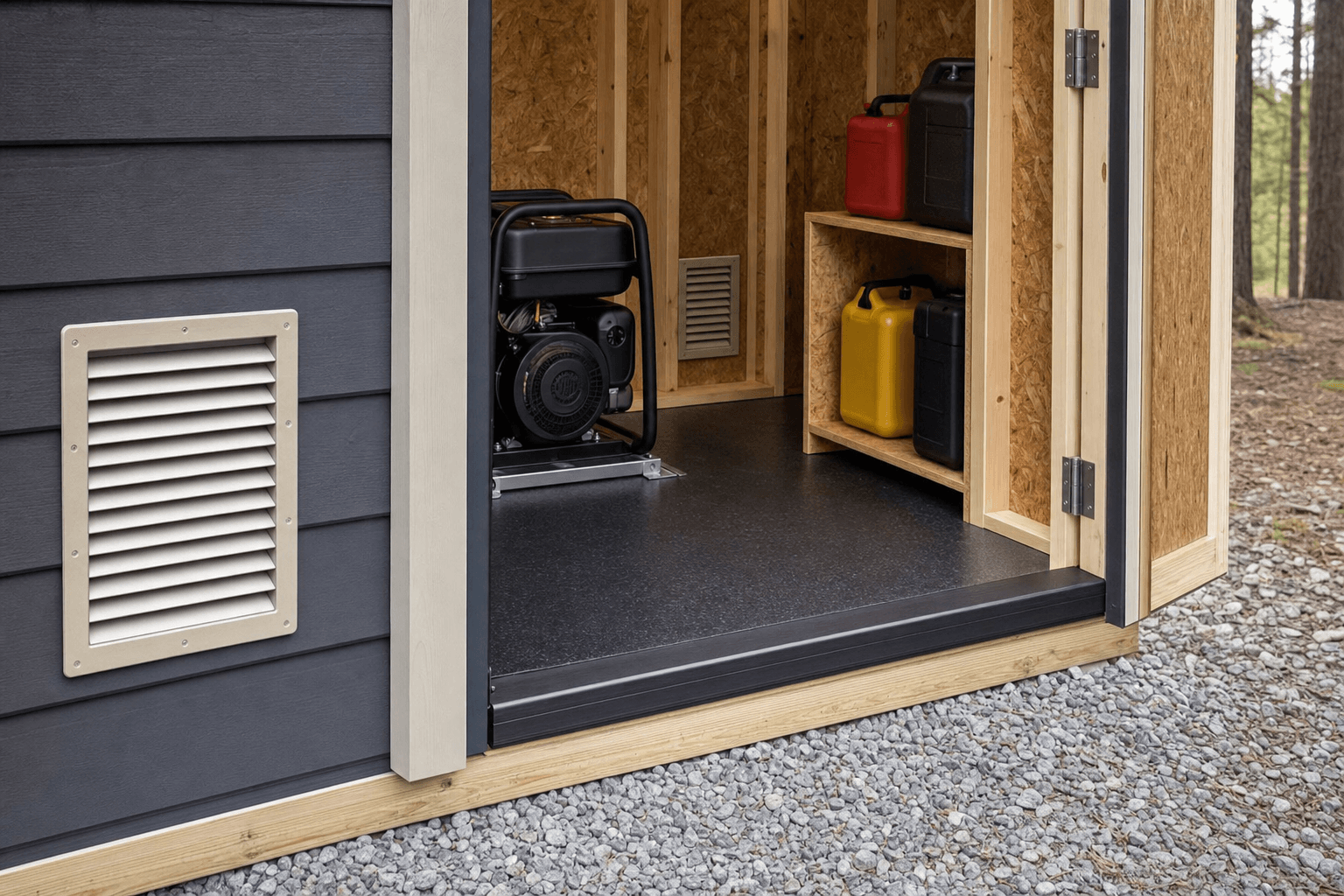
Control panel, starter battery, filters and fluids, and a carbon monoxide alarm — the service points and the safety backstop kept reachable and clear of the fuel and exhaust.
| Generator shed planning checklist | |
|---|---|
| Exhaust & carbon monoxide | Engine exhaust piped fully outside through a sealed, insulated wall penetration aimed away from every door, window, and air vent, so carbon monoxide goes outside and stays outside, backed by a carbon monoxide alarm mounted high inside |
| Ventilation & cooling | A large low intake vent and a high exhaust vent sized to the generator's airflow so it never starves for combustion air or overheats, with screens against snow, debris, and rodents and clear space around the cooling fan |
| Sound dampening | Insulated, sound-absorbing walls and roof, a solid weather-sealed door, and vents and exhaust placed to baffle noise, so the unit runs far quieter for you and the neighbors without choking off the airflow it needs |
| Fuel storage & refueling | A separated, ventilated fuel zone or external locker for propane, gas cans, or a diesel supply, kept away from the engine's heat, exhaust, and ignition, with a spill tray and a fire extinguisher for safe storage and refueling |
| Service access | A door wide enough to roll the generator in and out and a clear aisle around the unit, so an oil change, a filter swap, a battery service, or a load test is reachable and a failed unit comes out without disassembly |
| Sizing & clearances | The footprint set to the generator plus the manufacturer's required intake, exhaust, and service clearances plus a working aisle, with the fuel and the controls in their own zones away from the hot engine and exhaust |
A generator shed exists to deliver power safely when the grid fails, so the controls and the wiring deserve as much planning as the engine itself. The heart of it is the transfer switch or interlock that connects the generator to your home's backup circuits — it keeps generator power from back-feeding the utility line and lets you bring chosen circuits onto generator power cleanly, and it lives on a dry section of wall away from the fuel and the hot exhaust. A starter battery on a charger or tender keeps the unit ready to start on the coldest morning, a light and an outlet let you service the engine after dark, and the conduit and feeders carry the power out to the house and, often, to a well house shed so the pump and the heater keep running through an outage. Mount a carbon monoxide alarm high on the wall as a final backstop behind the exhaust routing, and keep a fire extinguisher by the door near the fuel — the two safety items a generator shed should never be without.
Winter readiness is where a North Idaho generator shed earns its keep, because the outages that matter most arrive in the cold and the snow. Keep the air vents and the exhaust outlet clear of drifting snow — a vent buried by a storm starves the engine and an exhaust outlet packed with snow forces fumes back, so place them high and on the protected, downhill side and clear them after a storm. A cold engine is hard on a generator, so a battery tender and, on a diesel, a block heater keep it ready to start when you need it, and an insulated shell both quiets the unit and keeps the engine bay from getting brutally cold. Store fresh, stabilized fuel and rotate it, because stale gas and a dead starter battery are the two things that most often keep a generator from starting in the storm it was bought for. Run the unit under load on a schedule, log the hours, and keep a shoveled path to the door, and the generator shed will deliver power — safely vented and quietly housed — through the worst of a North Idaho winter.
A generator shed is small, but where it sits drives both its safety and how well it rides out winter, so the base and the location matter as much as the box. The single most important siting rule is distance and direction from the house: set the building and aim its exhaust outlet and air vents so carbon monoxide and engine noise blow away from your home's doors, windows, and fresh-air intakes, never toward them, and keep it off any path where fumes could pool against the house. Bring a compacted gravel pad or a footing right up to the building so the floor stays dry, the unit sits level, and any fuel drip drains away rather than pooling under the engine; a level base also keeps a heavy standby unit from settling and stressing its connections. Set the door on the side with the most working room and the clearest path, so a service call or a roll-out is a short, shoveled walk. Read how to prep a shed site before the build so the pad, the drainage, the exhaust direction, and the access are squared away first.
North Idaho's winters and the nature of the contents set the rest of the spec. The roof and anchoring need to be rated for local snow load; the air vents and exhaust outlet must sit high and clear so a storm cannot bury them and choke the engine or trap its fumes; the shell should be insulated for both sound and a warmer engine bay; and a shoveled path keeps the door reachable. Because a generator shed combines an engine, fuel, exhaust, and electrical wiring, it is far more likely than a plain storage shed to involve permits and inspections — the electrical hookup and transfer switch, any propane or fuel storage, the exhaust and combustion-air provisions, and the setback from the house and the property line can all come into play, and an HOA may have rules about noise and outbuildings. Confirm what your town and county require on the service areas pages, plan the electrical and any fuel connection with a licensed pro, and factor the permits and the hookups into the plan before you finalize the size and where the generator shed will sit.
This is the most important decision in the whole build, because a generator's exhaust carries carbon monoxide — an odorless, colorless gas that is deadly in an enclosed or poorly vented space. The rule is simple and absolute: the exhaust must go fully outside and stay outside. Pipe the engine exhaust straight out through a sealed, insulated penetration in the wall, aimed away from every door, window, and air vent on both the shed and the house, and never let it dump into the room or under the eaves where it can collect or drift back. Site the whole building so the exhaust outlet faces away from your home's doors, windows, and fresh-air intakes, and keep it off any path where fumes could pool against the house. Because the exhaust pipe and muffler get extremely hot, the penetration has to be insulated and kept clear of anything flammable. Then add a carbon monoxide alarm mounted high on the wall inside as a final backstop — not a substitute for routing the exhaust outside, but a warning if anything ever goes wrong. In a North Idaho winter, also keep the exhaust outlet clear of drifting snow, because a packed-in outlet can force fumes back. Done right, the engine breathes out into the open air and the carbon monoxide never reaches a space anyone occupies.
A running generator needs a large, steady flow of air for two reasons at once: the engine burns air as part of combustion, and the unit relies on airflow over the engine and a cooling fan to shed heat. Box it in too tight and it starves for combustion air, runs hot, loses power, and can shut down or damage itself. The fix is a deliberate air path: a large low intake vent that pulls cool air in near the floor and a high exhaust vent that lets the hot engine air rise and leave, with the generator positioned so air flows across it rather than dead-ending in a corner. Size the openings generously to the unit's airflow — a small grille is not enough for a generator that breathes hard under load — and keep them screened against snow, debris, and rodents without choking the flow. Respect the manufacturer's minimum clearances around the intake, exhaust, and cooling-fan sides; those numbers exist precisely so the airflow works. Insulating the shell for sound is fine as long as you do not seal up the air path — the vents stay open and generously sized. In short, a generator shed has to breathe hard while it runs, so plan the intake and exhaust vents and the clearances around the unit as carefully as you plan the exhaust routing, because a hot, air-starved engine is both unreliable and short-lived.
Generators are loud, and an enclosure is one of the best ways to quiet one — the trick is dampening the sound without starving the engine of air. Start with the shell: insulated, sound-absorbing walls and roof and a solid, weather-sealed door absorb and block a large share of the noise that an open generator throws in every direction. The hard part is the vents, because the openings the engine needs for air are also the main path for sound to escape. The answer is to baffle them rather than shrink them: place the low intake and high exhaust vents so they do not point straight at the house or the property line, use lined or louvered vent boxes that let air through while breaking up the sound path, and route the exhaust so its outlet faces away from where people are. Keeping the vents generously sized but baffled lets you cut the noise sharply while the engine still gets all the air it needs. Position the whole building so its quieter sides face your living areas and the neighbors, and the gravel pad and the surrounding ground help absorb the rest. The goal is a unit you can run through an outage without it dominating the yard or carrying to the neighbors — quieter, but never at the cost of the airflow and exhaust routing that keep it safe.
Fuel is the other major safety concern in a generator shed, and it comes down to separation, ventilation, and keeping ignition sources away. Give fuel its own zone — a partitioned corner, or better, an external lean-to locker — kept away from the engine's heat, the hot exhaust, and any electrical that could spark, because storing gas cans or propane right next to a running engine is a fire risk. Ventilate the fuel area so vapors do not build up; gasoline and propane vapors are heavier than air and need somewhere to dissipate. Store gasoline in approved cans with fuel stabilizer and rotate it so it stays fresh, keep propane tanks upright and outside or in a vented locker per the tank's rules, and a diesel supply in a proper tank with a spill tray under it. Refuel with the engine off and cooled, never while it is running or hot, and keep a funnel and a fire extinguisher right there for spills and emergencies. A drip-tolerant floor and a spill tray keep any overflow from spreading. Because fuel storage near a structure is often regulated, check the local rules on quantities and distances for propane and fuel storage before you build. Handled this way — separated, ventilated, stabilized, and refueled cold — the fuel stays a safe, ready supply rather than a hazard sitting next to a hot engine.
A generator shed has to keep snow, rain, and runoff off the unit while staying open enough to service the engine, and the two goals work together if you plan them. For weatherproofing, a snow-load-rated roof and good overhangs shed North Idaho winters, an insulated shell keeps the engine bay from getting brutally cold and quiets the unit, and a compacted gravel pad keeps the floor dry and drains any fuel drip or meltwater away from the engine. Keep the air vents and exhaust outlet high and on the protected side so a storm cannot bury them, and screen them against driven snow and debris. For service access, plan a door wide enough to roll the generator in and out — not just to step through — so a failed unit can come out and a new one go in without disassembly, and leave a clear aisle around the engine so the oil fill, the filters, the starter battery, and the control panel are all reachable without moving anything. Mount a light and an outlet so you can work after dark, and keep the fuel and the hot exhaust clear of the service aisle. A battery tender keeps the unit ready to start through the cold. The result is a building that shrugs off the weather and still lets you do an oil change, a filter swap, or a load test as a short, comfortable job rather than a contortion in the snow.
Size a generator shed to the unit plus the manufacturer's required clearances plus a working aisle, never to the bare machine, because the open space around a generator is what keeps it breathing, cooling, and serviceable. Start with the generator's footprint and its spec sheet: most units list minimum clearances that must stay open on the intake, exhaust, and service sides so the airflow works and the engine does not overheat — those numbers are non-negotiable. Add a service aisle wide enough to reach the oil fill, the filters, the battery, and the control panel without moving anything, plus separate room for the fuel zone away from the engine and a dry wall for the transfer switch and controls. For a portable or small standby unit, a 6x8 wraps the generator with room for the vents, a clear path to the controls, and a roll-out door. A whole-home standby unit usually wants an 8x8 for the clearances and the transfer switch, and a larger unit or a generator plus a real fuel supply and tool zone is better in an 8x10 or 8x12 so the engine, the fuel, and the service space each get their own area with airflow between them. When in doubt, size up one footprint — the extra room costs little and pays off every time you service the unit, refuel it, or need the airflow under a heavy load. A crowded generator is a hot, hard-to-service, and less-safe generator, so build the box around the unit and its clearances, not just the unit.
Power outages in Kootenai County tend to cluster around the seasons that already demand the most from a generator — heavy snowfall in January, ice storms in November, and the occasional summer wildfire that knocks out transmission lines. A generator shed built on your property means the machine is protected and ready to start, not buried in drift or sitting in a wet corner of the garage.
Exhaust routing is the first thing to get right. A well-framed generator shed positions the machine so exhaust exits the building directly — never back toward the house — with clearance sized to your model's specifications. The shed walls are framed with enough ventilation to prevent carbon monoxide accumulation and enough airflow to keep the engine cool under load, even in summer.
Fuel storage near Coeur d'Alene and Post Falls comes with freeze considerations that don't apply in milder climates. Diesel gels at low temperatures; propane feed lines need protected runs. The shed can be spec'd with a small insulated fuel bay or conduit routing for a remote propane feed, so the system is actually usable at 10°F.
Sound attenuation matters more than most buyers expect until they quote their neighbors. A shed with mass-loaded walls and an air gap absorbs a meaningful portion of generator noise — without restricting the airflow a combustion engine requires. Design your shed in the builder and add wall insulation as an option to compare the difference.
On-site framing means the structure is built to the load specifications of your property — not trucked in and dropped on whatever ground is level. For wooded lots in Rathdrum or Hayden where a delivery truck can't access the build site, that's the practical path. Get a free estimate and include your generator's make and output to spec the right footprint.
Tell us your generator, your fuel type, and whether it needs to back up a well pump or your emergency supplies, and we will help spec the exhaust routing, the cooling airflow, the fuel storage, the sound control, and the service access around your property, then you can build and price it online.
Keep planning your build with related North Idaho shed guides.