A tack room shed is the building that finally gives your saddles, bridles, blankets, and grooming gear a clean, dry, organized home instead of a corner of the barn aisle, a leaky lean-to, or the back seat of the truck. Anyone who has watched a good saddle bloom with mold over a damp Panhandle spring, or dug through a tangled pile of halters and lead ropes in the dark before a ride, knows the problem a real tack room solves. A purpose-built tack room shed gives every piece of leather its own rack at the right height, keeps blankets off the floor and out of the rodents, holds the humidity steady enough that bridles stay supple instead of cracking, and locks up thousands of dollars of saddles and bits behind a real door. Whether you keep one trail horse or run a small boarding string, it turns the daily scramble of grabbing gear into a tidy routine in a room built for exactly this.
What separates a tack room that protects your leather and stays organized from one that turns into a musty, cluttered catch-all is a short list of decisions you make before the first wall goes up. This is really a climate-controlled leather room, so the insulation, the ventilation, the racks, and the security all have to be planned as a system rather than bolted on later. Get the moisture control, the rack layout, the grooming setup, and a lockable, well-built envelope right, and you have a tack room that keeps saddles supple, blankets dry, and valuable gear secure year-round; skip any of them and you get mildewed leather, mouse-chewed blankets, and gear you can't find. None of it is complicated, but it has to be planned from the start. This guide walks through the styles that suit a tack building, the footprints that fit a one-horse setup or a barn's worth of gear, how to lay out and finish the inside, and how we build the shell on your property so it stays dry and secure. If you'd rather see options priced first, you can build and price a layout in a few minutes and come back to the details.
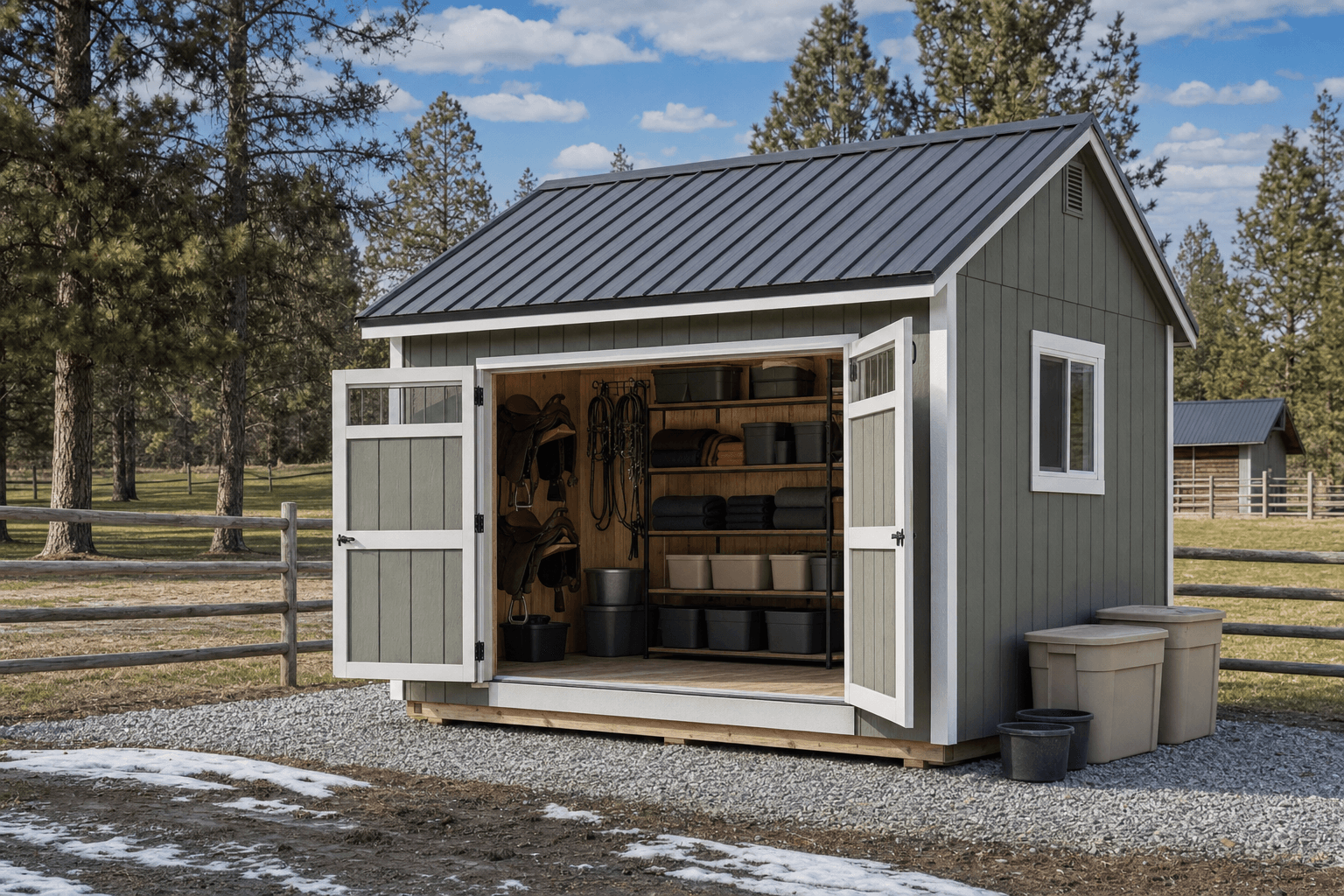
A dedicated leather room: saddle racks, bridle hooks, blanket storage, and a grooming area, all kept dry and locked up tight.
Most tack room sheds work best as a standard gable, because the straight, full-height walls are exactly what you need to line up swinging saddle racks, rows of bridle and halter hooks, and blanket bars without fighting a sloped ceiling, and the simple peaked roof leaves room for a ridge vent that helps carry damp air out. A gable also gives you the headroom to stack saddles two or three high on a rack tree and still walk under them. If you'd rather the building tuck neatly against a barn or run along a fence line, a lean-to or single-slope modern roof pairs well with a wide door and sheds Panhandle snow cleanly toward the back, which keeps the entry clear on feeding mornings. A lofted barn or gambrel roof is worth a look if you want a loft overhead for seasonal blankets, fly sheets, and show gear you only touch a few times a year, keeping the work floor below clear for saddles and grooming.
Because a tack room so often sits next to the place you keep grain and hay, it has a lot in common with a feed storage shed, and many horse owners build the two needs into one well-divided building or a matched pair so leather and feed each get the conditions they want. Whatever roofline you choose, plan the building around dry, secure leather storage, with a solid lockable door, a floor that stays off the damp ground, and an interior laid out so saddles, bridles, blankets, and grooming gear each have a dedicated spot.
A couple of saddle racks, a wall of bridle and halter hooks, a blanket bar, and a grooming tote shelf. An 8x10 covers a tidy single-horse or two-horse tack room with room to tack up out of the weather.
Once you want a real grooming or wash corner, a trunk for each horse, and shelving for supplements and first-aid, step up to an 8x12 or 10x12 so the gear walls and the grooming area stop competing for floor.
If you run a lesson barn or a boarding string with many saddles, blanket racks, and a wash bay, a 10x16 gives every rider a locker, a full grooming station, and room for bulk blanket and show-gear storage.
Footprint is the decision everything else rides on, so size for the saddles plus the bridles plus the blankets plus a place to groom, not just the two saddles you own today. An 8x10 shed is a solid starting point for one or two horses: two or three swinging saddle racks on one wall, a run of bridle and halter hooks, a blanket bar, a shelf for grooming totes, and just enough open floor to set a saddle on a stand and tack up out of the rain. Move up to an 8x12 shed and the extra length buys you a dedicated grooming corner with cross-ties or a grooming hook, a tack trunk per horse, and shelving for fly spray, supplements, and a first-aid kit without crowding the saddle wall. A 10x12 shed adds enough width for a U-shaped layout, a small wash or rinse station, and floor-to-ceiling cubbies for several horses' worth of gear, which is the size many one- and two-horse owners land on once they account for blankets, boots, and seasonal sheets. The 10x16 shed is the size to choose for a barn or boarding operation: a locker or saddle rack for every rider, a full grooming and wash bay, blanket racks for the whole string, and room to store show gear, spare pads, and bulk supplies under one roof. As a rule, size for the gear walls plus the grooming space, because a tack room that's all saddle rack and no room to groom or store blankets pushes the overflow right back out into the weather.
These horse-property buildings overlap, and the right one depends on what you most need to protect and where. A tack room shed is purpose-built around saddles, bridles, blankets, and grooming gear: swinging racks and hooks at the right heights, climate control to keep leather supple and mold-free, ventilation to carry off the damp, and a lockable envelope to secure thousands of dollars of equipment. If your bigger headache is keeping grain dry and rodent-proof and hay out of the weather, a feed storage shed is built around sealed bins, metal-lined walls, pest exclusion, and bulk shelving rather than leather racks, and many owners build feed and tack as a divided pair so mice drawn to grain never reach the saddles. If you mainly need to dry out soaked saddle pads, blankets, wraps, and turnout sheets between rides, a gear drying shed centers on hanging space, airflow, and gentle heat to pull moisture out fast. And if the building has to handle the broader sweep of a horse property, the wheelbarrows, the muck forks, the arena drags, and the seasonal equipment, a farm storage building gives you the open, tall space that bulky implements need. Many buyers choose a true tack room because it does the leather side properly, the steady humidity, the ventilation, and the security that valuable saddles demand, while leaving the door open to add a feed corner or a drying rack later. If you're torn, build for the tack first, since leather has the strictest climate and security needs, and let feed, drying, and general storage flex around it.
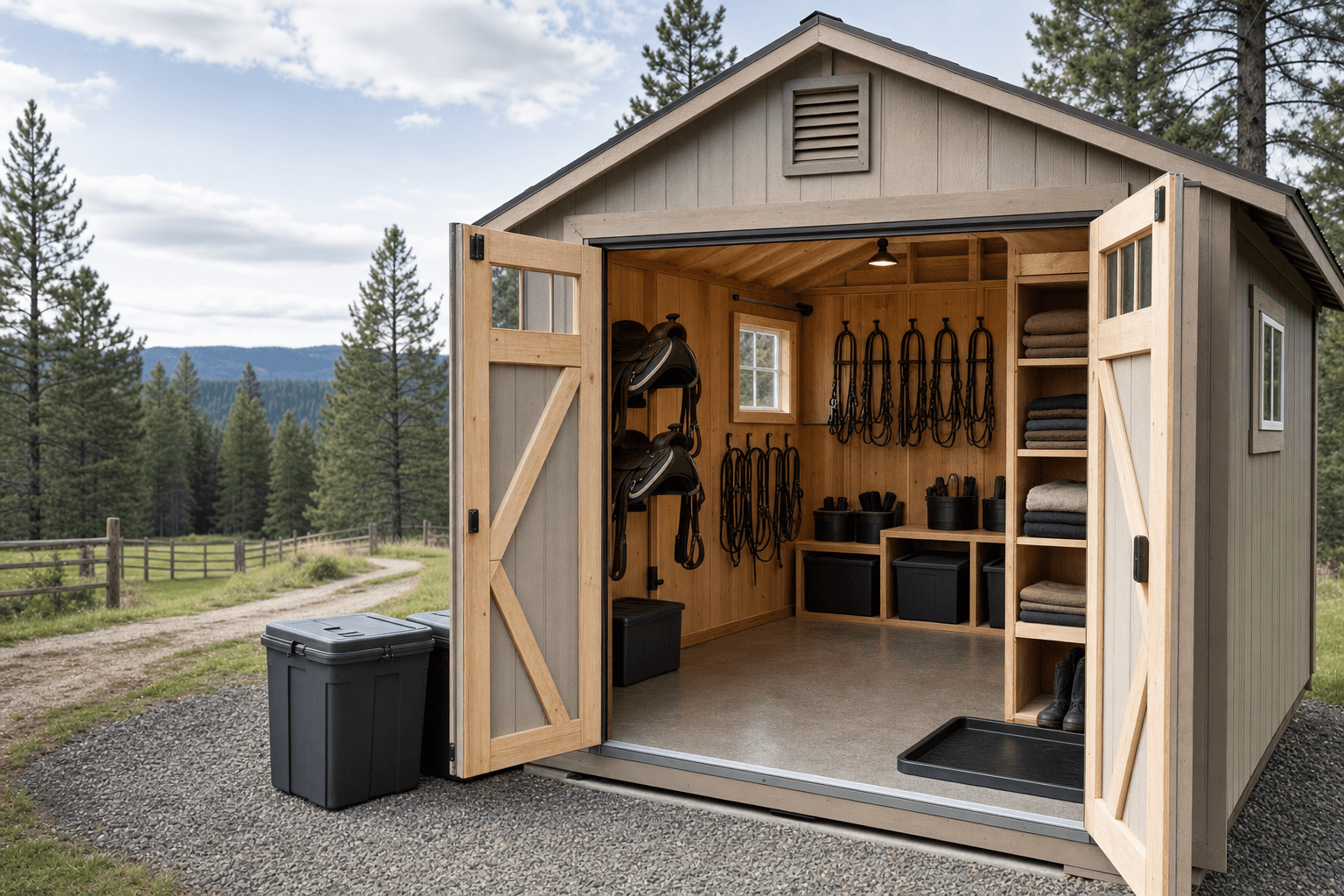
Zoned for daily use: saddles and bridles on their own walls, blankets on bars off the floor, and an open grooming corner in the middle.
A tack room shed works far better when you plan it as a set of zones than as one open box, because saddles, bridles, blankets, grooming kit, and supplies each want a different spot at a different height, and a daily routine flows much faster when everything has a home. Start with the saddle wall, where swinging or fixed saddle racks line up at a height you can lift a heavy western or dressage saddle onto without straining, ideally with a saddle pad rack or shelf right above or below each tree so pads air out beside the saddle they belong to. Next is the bridle and halter zone: a run of cleat-style bridle hooks and halter racks set so headstalls hang straight without kinking the crownpiece, plus a hook or two for spare reins, martingales, and lunge lines. Then plan the blanket and sheet zone, with blanket bars or a rolling rack that keep turnout sheets, coolers, and fly sheets up off the floor where damp and rodents can't get them, and a high shelf or loft for the out-of-season layers. Give the grooming and wash zone real space in the middle or along one wall: a grooming tote shelf or caddy, a hook or cross-tie to clip a horse, a mat underfoot, and, if you have water, a rinse or wash spot with a drain. Finally, reserve the supply and trunk zone for a lockable tack trunk per horse, shelving for fly spray, fly masks, supplements, hoof care, and a first-aid kit, and a spot for boots and helmets. Sketching this layout on paper before you settle on a footprint is the fastest way to tell whether an 8x10 will do or whether you'll want the width of a 10x12 or 10x16 so the gear walls and the grooming space never crowd each other.
This is the backbone of the room. Mount swinging or fixed saddle racks rated for the weight of a loaded western saddle, run cleat-style bridle and halter hooks that hold a crownpiece in its natural shape, and add blanket bars or a rolling rack so sheets and coolers hang off the floor. Place each rack at a working height and leave aisle room to swing a saddle off without banging the wall behind you.
Leather is the whole reason for the room, and it hates both damp and wild temperature swings. Insulate the shell so the interior holds a steadier temperature, and pair it with the ventilation and, where it makes sense, a small dehumidifier or a low-watt heat source to keep humidity in a range that stops mold without drying tack out and cracking it. Steady and moderate beats hot, cold, or muggy every time for keeping saddles and bridles supple.
Stale, trapped air is what grows mildew on a saddle, so plan real airflow: a ridge or gable vent up high, an intake low, and an operable window for cross-flow on milder days. Keep the floor up off the damp ground with a sealed or sweepable surface and rubber mats where you groom, so moisture drains and dries instead of wicking up into your leather and blankets.
A tack room can hold tens of thousands of dollars in saddles and bits, and it's a known target, so build it to lock. Plan a solid, well-framed door with a real deadbolt or padlock hasp, secured windows, and lockable tack trunks or a saddle cabinet for the highest-value pieces. A tight, strong envelope keeps both thieves and weather out of your gear.
The keyword for a tack room shed is the gear, and the fit-out is everything that holds, protects, and secures a barn's worth of equipment. For the saddles: swinging or fixed saddle racks, a portable saddle stand for cleaning and tacking up, saddle pad and blanket racks, and a saddle cover or two. For the bridles and headgear: cleat-style bridle hooks, halter racks, bit racks, and hooks for reins, martingales, breastplates, and lunge lines. For blankets and sheets: blanket bars, a rolling blanket rack, and a high shelf or loft for turnout sheets, coolers, fly sheets, and coolers out of season. For grooming: a grooming tote or caddy, brushes, curry combs, hoof picks, clippers, a cross-tie or grooming hook, rubber mats, and a rinse or wash station if you have water. For supplies and health: shelving and lockable trunks for fly spray, fly masks, fly boots, supplements, hoof care, wound care, wraps, and a first-aid kit, plus a spot for boots, chaps, and helmets. For the room itself: insulation, ventilation, a dehumidifier or small heater, good light, and a lockable door. Walk through your own version of this list before you settle on a size, because a tack room fills up fast once you add a rack for every saddle, a hook for every bridle, bars for the blankets, a grooming corner, and a trunk per horse, which is exactly why owners who run more than one or two horses are rarely sorry they sized up from an 8x10 to a 10x12 or a 10x16.
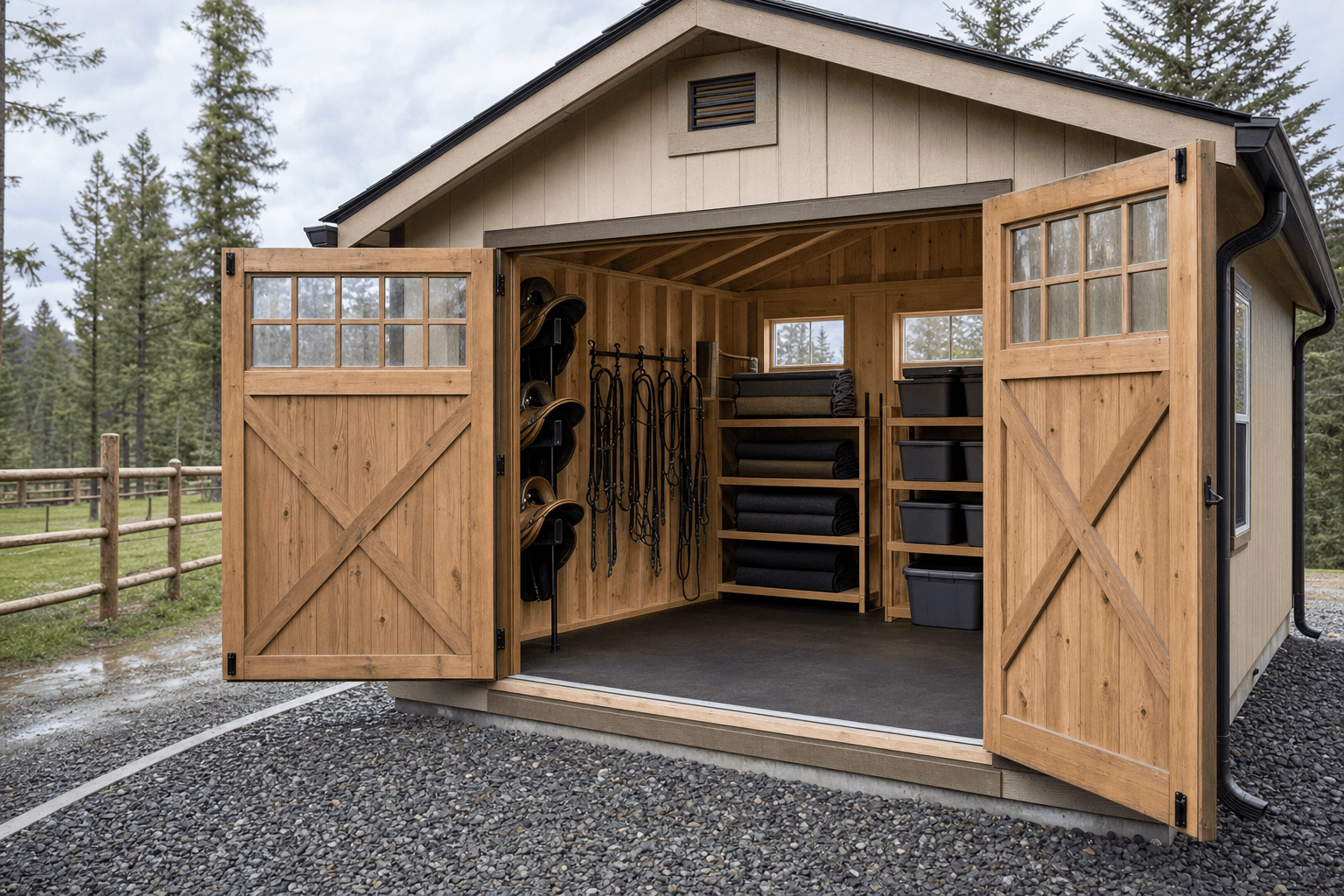
The details that protect leather: saddles on weight-rated racks, bridles hung to hold their shape, and an insulated, ventilated wall behind them.
| Tack room shed planning checklist | |
|---|---|
| Best roofline | Standard gable for full-height rack walls and a ridge vent; single-slope modern to tuck against a barn and shed snow off the back; add a loft for seasonal blankets and show gear |
| Practical sizes | 8x10 for one or two horses, 8x12 to 10x12 to add a grooming corner and trunks, 10x16 for a boarding string with lockers and a wash bay |
| Climate control | Insulated shell plus ventilation and, where needed, a small dehumidifier or low-watt heat source to hold humidity steady so leather stays supple and mold-free |
| Ventilation and floor | Ridge or gable vent high, intake low, an operable window for cross-flow, and a sealed floor kept off the damp ground with rubber mats in the grooming area |
| Security | Solid lockable door with a deadbolt or padlock hasp, secured windows, and lockable tack trunks or a saddle cabinet for high-value gear |
| Storage | Saddle racks, bridle and halter hooks, blanket bars, a grooming station, shelving for supplements and first-aid, and a loft or high shelf for the off-season |
Four things decide whether a tack room shed protects your gear through a North Idaho year or quietly lets it mildew and freeze. Power matters because a dehumidifier, a small heater, clippers, a fan, and good lighting all want current, so plan a dedicated circuit run from your home's or barn's panel by a licensed electrician, usually in buried conduit out to the building, with outlets along the work walls and near the grooming area so you're not stringing cords. A small subpanel inside makes it easy to add a circuit later. Light is worth getting right, because checking a girth for cracks, picking a hoof, or matching a bridle in a dim room is a daily frustration, so plan bright, even overhead fixtures plus a window or two for daylight at the saddle and grooming zones. Climate is the heart of it: insulation to even out the temperature swings, ventilation to carry off damp, and a dehumidifier or low-watt heat source to hold humidity in the range that keeps leather supple and stops mold, all working together so saddles and bridles come through a wet spring and a hard winter in good shape. Winter readiness ties it together, because a Panhandle winter brings deep cold and snow, so an insulated, sealed shell keeps the room from freezing solid, lets a small heater hold it tempered, and protects any water line at a wash station from bursting. If a rinse or wash spot is in the plan, freeze-protect the lines and slope the floor to a drain. We frame and build the shell tight, insulated, well-lit, and ready on your property so your electrician, and your plumber if you add water, can finish their work.
A tack room stays dry, level, and mold-free only on a solid, well-drained base, so most sit on a compacted gravel pad with a treated skid foundation or, where you want a grooming and wash area with a drain, a concrete slab. Size the gravel pad about a foot wider than the building on each side so spring melt and rain drain away under it instead of pooling against the floor, which is the first defense against the damp that ruins leather. North Idaho weather drives the rest of the plan. Design the roof for local snow load so it shrugs off a heavy winter, keep the floor up off the ground so snowmelt and rain drain away rather than wicking into saddles and blankets, and insulate the shell so you can hold humidity steady through a wet spring and freeze-protect any water line in a wash bay. Set the building where the gravel driveway or a clear path lets you carry saddles and haul blanket loads in easily and lets our crew bring materials in to build, and place it near the barn or paddock so the daily walk with an armful of tack is short. We build with weather-rated framing and finishes suited to pine-country freeze-thaw cycles, and we set the structure to drain and breathe so it lasts and keeps your gear dry inside year-round. On permits, the deciding factor is usually how big the building is and whether you run power and water to it, not just that it stores tack. A small detached shed under your jurisdiction's size threshold often needs no permit, but once a tack room is wired and plumbed, or once it crosses that threshold, your county or city may require a building permit, electrical and plumbing permits and inspections, and adherence to setbacks, so confirm with your local building department before you finalize the size, the power, the water, and where it sits. Once you know what your jurisdiction requires, we plan the build around it so the structure, the rough-in, and the placement all line up.
Plan the racks by what each piece of gear needs, then build around a working height. Mount swinging or fixed saddle racks on one main wall at a height you can lift a loaded saddle onto without straining, with enough aisle behind you to swing it clear, and put a saddle pad rack or shelf near each tree so pads air out beside their saddle. Run cleat-style bridle and halter hooks along another wall, sized and spaced so a headstall hangs straight without kinking the crownpiece, and add hooks for reins, martingales, and lunge lines nearby. Keep blankets and sheets on blanket bars or a rolling rack up off the floor where damp and rodents can't reach them, with a high shelf or loft for the out-of-season layers. The trick is to give every category its own zone at its own height so the daily routine flows and nothing ends up piled on the floor. We build the shell with solid, full-height walls and the blocking your racks need, so saddle racks and blanket bars mount securely wherever your layout calls for them.
Mold on a saddle comes from trapped moisture and stale air, so the fix is steady climate plus real ventilation, not just wiping tack down. Insulate the shell so the interior holds a more even temperature and doesn't swing from cold and condensing to warm and muggy, which is what feeds mildew, and pair that with airflow and, where it makes sense, a small dehumidifier or a low-watt heat source to hold humidity in a range that protects leather. You want it dry enough to stop mold but not so dry that bridles and saddles crack, so steady and moderate is the goal rather than aggressively dry. Keep the floor up off the damp ground, store saddles on racks rather than against a wall, and let pads and blankets air out instead of stacking them wet. In a wet Panhandle spring this combination is what keeps a good saddle supple instead of fuzzy with mold. We build the shell insulated and tight and frame in the vents so your climate gear can hold the conditions leather needs.
A tack room needs enough airflow to carry off the moisture that horses, damp pads, and a wet climate bring in, because still, trapped air is exactly what grows mildew on leather and blankets. Plan a high exhaust point such as a ridge vent or a gable vent to let warm, damp air rise and escape, a low intake so fresh air can replace it, and at least one operable window so you can open the room up for cross-flow on milder days. A small fan helps move air on still, humid mornings, and the same insulation that steadies the temperature also cuts the condensation that forms when a cold wall meets warm, moist air. The aim is gentle, continuous air exchange rather than a sealed box, balanced against your climate control so you're not venting away the steady humidity you want. Drying gear out before it goes back on the rack also keeps the moisture load down. We build the shell with the vents framed in and the envelope tight so airflow and climate control work together instead of against each other.
Yes, and many owners do, though how far you take it depends on your space and whether you can run water to the building. At the simplest end, a grooming station is just an open spot with a cross-tie or grooming hook to clip a horse, rubber mats underfoot, and a grooming tote shelf within reach, which fits even a modest tack room once you allow for the floor space. If you want a true rinse or wash spot, plan a slab floor that slopes to a drain, a hose bib or a sink fed by a licensed plumber, and freeze-protected lines for winter, and give that wet zone enough room that splashing and runoff stay away from your saddles and blankets. The key is to keep the grooming and wash area separated from the dry leather storage so moisture from a wet horse never reaches the tack. Stepping up to a 10x12 or 10x16 is usually what makes a comfortable grooming or wash bay fit alongside the gear walls. We frame and rough-in the building so the grooming area, and the plumbing if you add water, go in cleanly for your trades to finish.
A tack room is a known target because saddles, bits, and bridles are valuable, portable, and easy to resell, so plan the building to lock from the start rather than adding security later. Start with a solid, well-framed door fitted with a real deadbolt or a heavy padlock hasp, since a flimsy door and a cheap latch are the weak point most break-ins exploit, and make sure windows are secured or limited in how they open. For the highest-value pieces, add lockable tack trunks or a saddle cabinet inside so even someone who gets through the door can't simply walk off with your best saddle. Good lighting around the entry, placing the building where it's visible from the house, and keeping it tight and strong all help, and a tight envelope keeps weather out as well as people. Recording serial numbers and marking your gear makes recovery more likely if the worst happens. We build the shell solid and well-framed so a strong door and real locks have something sturdy to anchor to, which is the foundation of a secure tack room.
It comes down to how many horses you keep and how much gear and grooming happen in the room. For one or two horses, where you have a couple of saddles, a handful of bridles and halters, a few blankets, and a grooming kit, an 8x10 gives you room for the saddle racks, a wall of hooks, a blanket bar, a grooming shelf, and space to tack up out of the weather. Once you want a dedicated grooming corner, a tack trunk per horse, and shelving for supplements and first-aid, step up to an 8x12 or a 10x12 so the gear walls and the grooming area stop competing for the same floor. If you run a lesson barn or a boarding string, plan on a 10x16 so every rider gets a locker or saddle rack, the blankets for the whole string have racks, and a full grooming and wash bay has its own space. The honest advice is to size for the saddles plus the bridles plus the blankets plus a place to groom, because a tack room that's all rack and no room to work pushes the overflow back out into the weather, and most owners are glad they sized up once they count the blankets, boots, and seasonal gear that come with horses.
Leather gear and North Idaho winters are a poor combination when the storage isn't right. Saddles, bridles, and blankets absorb moisture in a poorly ventilated tack room and dry out in an over-heated one. Properties around Coeur d'Alene and in the rural corridors of Kootenai County — where horse properties are common — benefit from a tack room shed built directly on site near the barn or pasture, positioned and sized for how that specific property actually works.
On-site framing means the tack room can be attached to an existing barn wall or run as a freestanding structure tucked into a corner of the property that a crane-delivered building couldn't reach. Steep driveways, wooded fence lines, and irregular grades are normal on rural Kootenai and Bonner County parcels. A crew that frames on site works around those conditions instead of requiring you to clear them.
Insulation in the walls and a well-placed vent — not a drafty gap, but a controlled cross-vent — keeps the interior from swinging between extremes. A mini-split or a small propane wall unit handles the shoulder seasons in Post Falls and Hayden well; full heating through a North Idaho January keeps leather supple and metal hardware from rusting.
Practical additions worth framing in during construction: a saddle rack wall with blocking pre-installed, a blanket bar, a secure locker for medications, and a single 20A circuit for a fan or heated water bucket. These details cost far less when they are part of the original build than when added later. See examples of finished outbuildings or design your layout before requesting a free estimate.
Tell us how many horses you keep and we'll help you size, lay out, and price a dry, secure tack room with the racks, climate control, grooming space, and storage your North Idaho gear needs.
Keep planning your build with related North Idaho shed guides.