If your water comes from a well in North Idaho, the most expensive thing on your property may be the least protected: a well head, a pressure tank, and a pump sitting out where a January cold snap can find them. Water freezes, pipes split, the pressure tank cracks, and a pump that should last fifteen years dies in one bad night — and then you have no water until a well company can dig out, thaw, and replace the damage in the dead of winter. A bare well casing with a heat-tape cord run to the nearest outlet is a gamble every time the power flickers or the temperature drops to single digits. A purpose-built well house shed ends that gamble: it is a small, insulated, heated building wrapped around the well head and pressure tank, sized to hold heat through the coldest nights, vented to stay dry, and laid out so a plumber can actually reach the fittings when something needs service.
North Idaho On Site Sheds builds every well house right on your property, so the insulation, the heat source, the access door, and the footprint can be set around your exact well head height, your pressure tank, and the way the pipes come out of the ground. This guide is built around the one job a well house has to do — keep the water side above freezing through a hard winter — and the second job that makes it livable to maintain: service access. We will cover which roofline suits a tight, heated utility box, what footprint fits around a standard pressure tank, how to lay out the interior so the pump and fittings stay reachable, which freeze-safe heat sources work and which to avoid, how to vent the space so condensation does not rust everything, and how to protect the well head itself. If you also want backup power so the heat and pump keep running in an outage, you will see where a generator shed and a well house fit together.
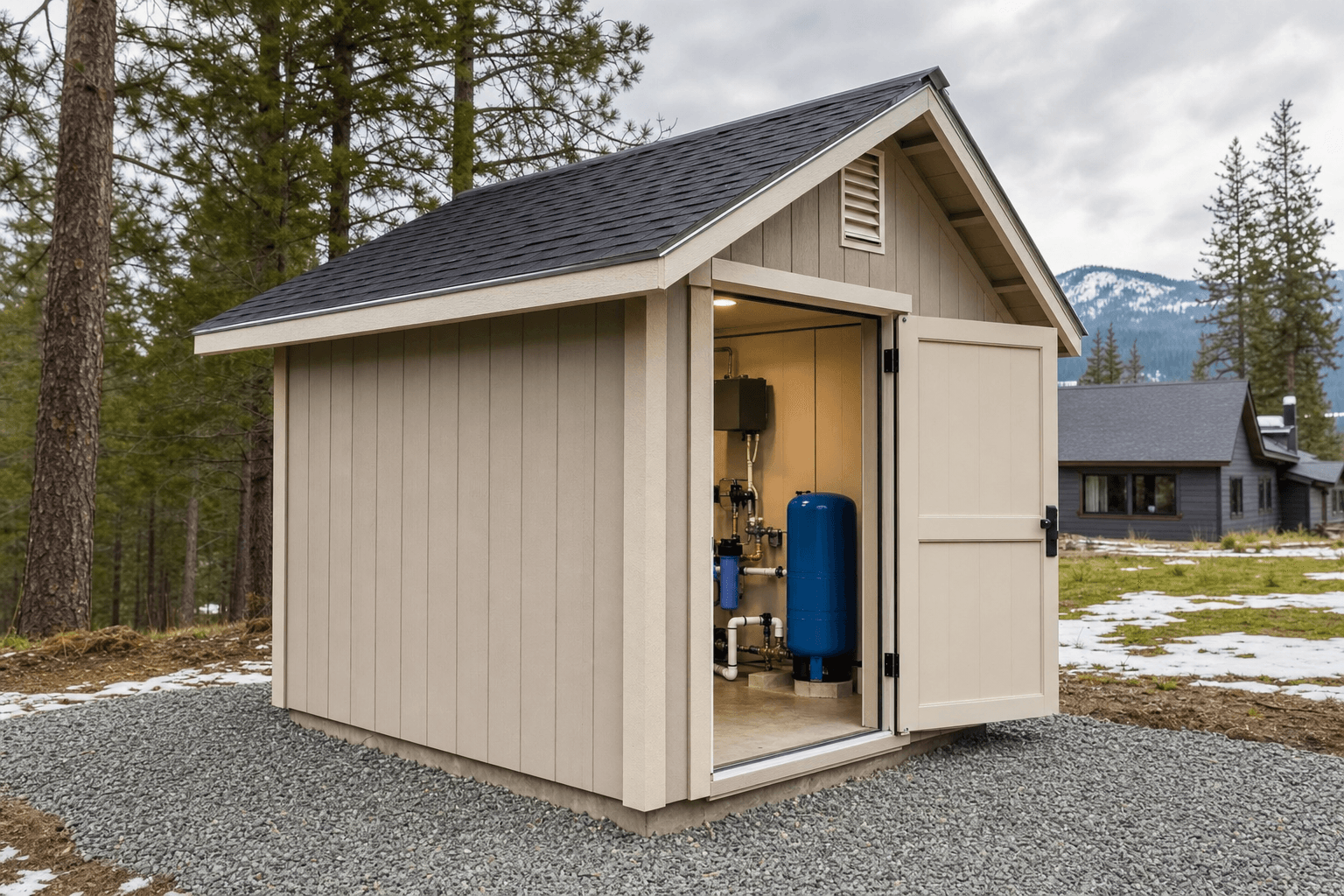
A small, insulated, heated box around the well head and pressure tank — sized to hold heat through a North Idaho cold snap and to open wide for service.
A well house does not need headroom or a loft — it needs to be small, tight, well insulated, and easy to open up, so the roofline is really a decision about insulation, snow shedding, and how the door reaches the equipment. A standard gable is the natural starting point: the peaked roof sheds North Idaho snow, gives any rising warm air a high point to vent from, and leaves straight sidewalls so the pressure tank and fittings sit close to a full-height wall where you can mount a light and a shelf. Spec a fully insulated shell — walls, roof, and floor or skirt — because a well house lives or dies on its ability to hold a heater's warmth through a deep freeze, and an uninsulated box leaks heat as fast as you add it. A lean-to or modern single-slope sheds snow predictably to one side and keeps the profile low and compact, which suits a well house tucked against a hillside, a garage wall, or a fence line where you want it out of the way but still reachable.
Whatever the roofline, the parts to spec up are insulation, a freeze-safe heat source, a low vent for makeup air, and a door wide enough to pull the pressure tank or pump straight out — a well house runs warm and slightly humid on purpose, so it has to hold heat and shed moisture far better than a plain storage box. The floor deserves thought too: many well houses leave the well head coming up through a gravel or open floor so the earth's warmth helps, while the framed portion stays dry for the tank and any electrical. A well house sits right next to a generator shed when you want backup power for the pump and heater in an outage, and it overlaps with a solar battery shed the moment an off-grid or backup power system feeds the same water supply — both are utility buildings that keep critical gear protected and running through a North Idaho winter.
A 6x8 wraps a well head and a standard pressure tank with room to kneel beside the fittings, mount a heater and light, and open the door for service — the compact, easy-to-heat box for a typical home well.
An 8x8 takes the pressure tank, a pump or control box, and a water softener or filter together, with a clear lane to reach every connection and wall space for a shelf of fittings and spare parts.
An 8x10 or 8x12 holds the full water system — tank, pump, softener, filtration — plus a corner for a backup power transfer or a small generator, with room to work without crowding the heat.
Footprint here is about what sits on the water side and how much room a plumber needs to reach it, so size to the equipment plus a working aisle rather than to the well head alone. A 6x8 is the compact well house: it wraps the well head and a standard pressure tank, leaves enough floor to kneel beside the fittings and pull a part, and gives a small heater an easy room to keep above freezing — the right call when all you are protecting is the well and tank. An 8x8 gives you a square room that takes the pressure tank, a pump or control box, and a water softener or filter housing together, with a clear lane to reach every valve and union and a wall for a shelf of fittings, fuses, and spare parts. An 8x10 is the workhorse for a full water system: tank, pump, softener, and filtration all fit with a real aisle between them, so service is a matter of stepping in and turning a wrench, not wrestling past crowded gear. If you also want backup power for the pump and heat, step up to an 8x12 so a transfer switch, a battery bank, or a small generator gets its own corner away from the water and the heater. Reach matters more than raw size in a well house — leave clearance around the tank and pump so a freeze repair or a pump swap is a short job, because the day you need it is the day it is below zero outside.
These are all small utility buildings that protect critical gear, but they hold very different equipment and conditions, and naming the lead use keeps you from a building that does two jobs poorly. A well house leads with freeze protection for water — a tight, insulated, heated box that holds the well head, pressure tank, and pump above freezing through winter, vented to stay dry. A generator shed leads with safe backup power: it houses a standby or portable generator and is built around exhaust routing, combustion-air ventilation, fuel, and the clearances and sound control an engine needs — a very different ventilation problem from a sealed, heated well house. The two pair naturally, because the generator is often what keeps the well pump and the well house heater running when the power goes out, so many properties build both and wire the well house to the generator's backup circuit.
If your backup power is batteries rather than an engine, the natural neighbor is a solar battery shed: it houses an inverter, charge controller, and a battery bank, and it wants a controlled, ventilated, often climate-managed space to keep the batteries in their happy temperature range — again different from a well house, but again a building that can feed power to the pump and the heater in an outage. And on a working property, a well house often sits near farm storage and other outbuildings as part of the cluster of utility buildings that keep a place running. Decide which job each building leads with — freeze protection for water, safe backup power from an engine, or stored power from batteries — and build each around its own condition first, then wire them together so the water keeps flowing and the heat keeps running when winter does its worst. That order locks in your insulation, your heat source, your ventilation, and your power plan before the framing is set.
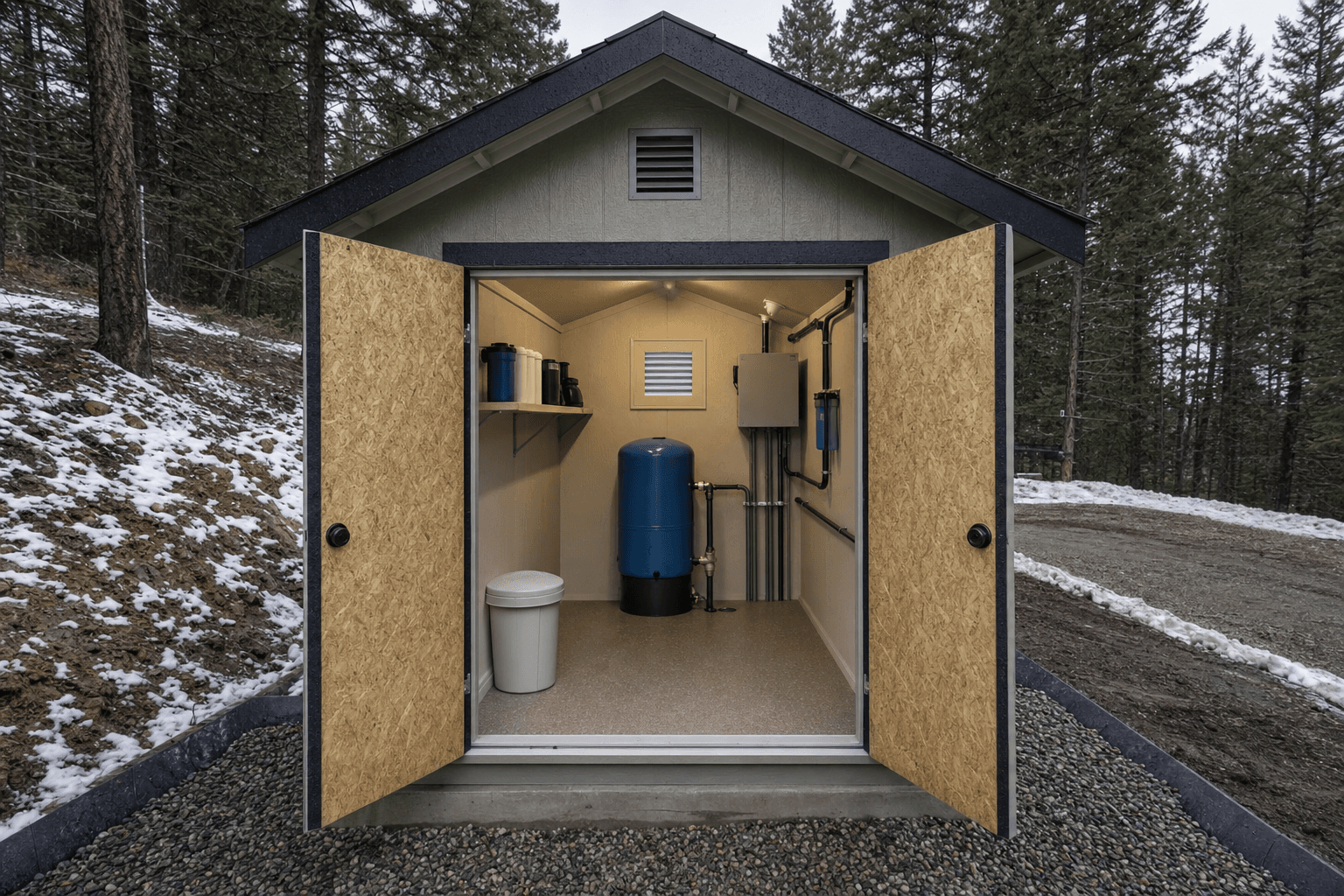
Lay out the water side along the walls and keep a service aisle clear — every valve, union, and the pump itself reachable without moving gear.
Think of a well house as one warm room with the equipment lined up so it stays both protected and reachable, and lay it out so the heat reaches the vulnerable parts and a plumber reaches everything. A water zone anchors the building: the well head, the pressure tank, and the supply and pressure fittings along one wall, set so the heater's warmth wraps the pipes and the tank rather than leaving a cold corner where a line can freeze. A service aisle runs in front of that gear — a clear lane wide enough to stand, kneel, and swing a wrench, so the pressure switch, the unions, and the pump are all reachable without moving anything. Crowding is the enemy here: a tank jammed in a corner against the well head is a freeze repair you cannot get to, so leave clearance on the working sides of the tank and pump.
A power and controls zone takes a dry section of wall, up off the floor and away from any drip: the pressure switch, a light, an outlet, and — if you have backup power — a transfer switch or a feed from the generator shed live here, kept clear of the water side. If a softener, filter, or treatment system shares the building, give it its own short run of wall with room to change cartridges and add salt, and set it where a leak drains away from the electrical rather than toward it. The heat source itself is a zone you plan around, not an afterthought — mount or place it where it warms the tank and the most freeze-prone pipes directly, keep it clear of anything that could be pushed against it, and run its thermostat where you can read and set it from the door. Leave the floor under the well head open or graveled if that suits your well, keep the framed floor dry for the tank and electrical, and put a shelf within reach for the fittings, fuses, and spare pressure switch you will be glad to have on hand at midnight in February.
Insulated walls, roof, and floor or skirt plus a weather-stripped door, so a small heater's warmth stays in and a deep cold snap stays out — the difference between holding above freezing and losing the tank on a single bad night.
A thermostatically controlled electric heater sized to the insulated room and set just above freezing, mounted clear of anything flammable and aimed to warm the tank and the most freeze-prone pipes, with heat tape on the riser as a backup.
A door wide enough to pull the pressure tank or pump straight out and an open aisle in front of the gear, so a freeze repair, a pump swap, or a softener service is a short job instead of a wrestling match in the cold.
A small, screened low vent for makeup air to manage condensation, a light and outlet on the dry wall, and a min-max thermometer by the door so you can confirm the room is holding above freezing at a glance all winter.
This is where an insulated shell becomes a working well house, and it is worth naming exactly what goes inside so you size the footprint, the heat, and the access around real equipment. The water side comes first because it sets the layout and the freeze risk: the well head and casing where the pipe comes out of the ground, the pressure tank that buffers the system, the pressure switch and gauge that cycle the pump, the pitless adapter and riser below frost line, and on many systems a submersible pump's control box or a jet pump sitting right in the building. Around those run the supply line, the unions and shutoff valves, the hose bib, and the pressure-relief fitting — every one of them a place water can freeze and split if the room drops below freezing, which is exactly why the heat and insulation matter more here than in any other shed.
Many well houses also hold the water treatment that makes the supply usable: a water softener with its salt brine tank, a sediment or iron filter, a carbon or UV treatment stage, and the cartridges and salt you keep on hand to service them. Add the electrical — the pump circuit, the heater circuit, a light, an outlet, and any backup-power feed from a generator shed or solar battery shed — and you have the full inventory a well house has to protect and keep reachable. The hardware that makes it all maintainable is simple but specific: a shelf for spare fittings, a backup pressure switch, fuses, pipe dope, and salt, heat tape on the exposed riser, a min-max thermometer to watch the room, and clearance around the tank and pump so a winter repair is a short job. Get the footprint, the heat, the ventilation, and the access right and a small box turns into the building that keeps water flowing through a North Idaho winter.
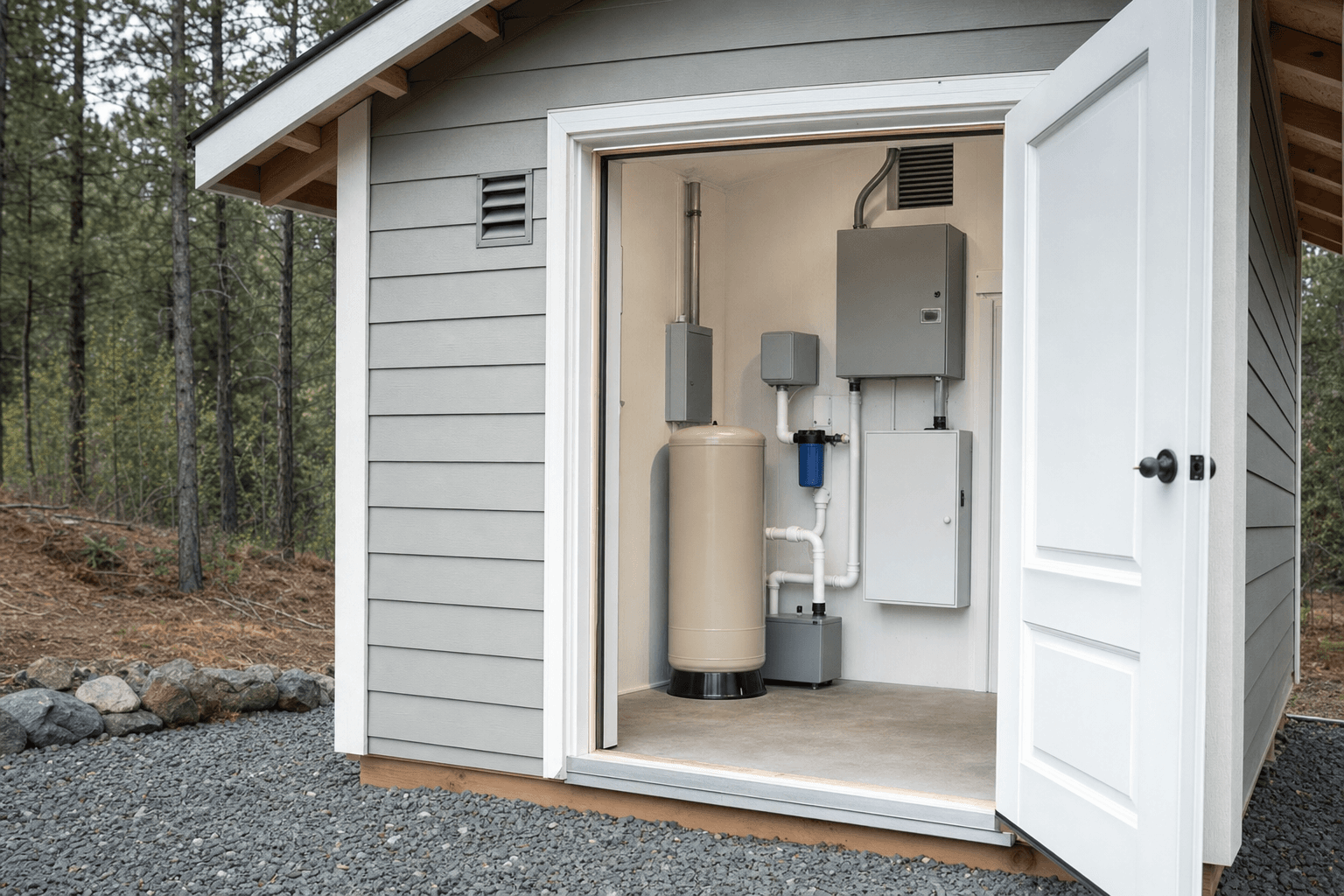
Pressure switch, gauge, unions, and the exposed riser — the fittings that split in a freeze, kept warm by the heater and a wrap of heat tape.
| Well house shed planning checklist | |
|---|---|
| Freeze protection | An insulated shell plus a thermostat-controlled heater set just above freezing, sized so the room holds the water side above 32 degrees through the coldest North Idaho nights instead of letting a pipe or tank split |
| Insulation | Insulated walls, roof, and floor or skirt and a weather-stripped door, so a small heater's warmth stays in and the deep cold stays out, keeping heating cost and freeze risk both low all winter |
| Heat source | A freeze-safe, thermostatically controlled electric heater mounted clear of anything flammable, aimed at the tank and the most freeze-prone pipes, with heat tape on the riser as a backup layer of protection |
| Service access | A door wide enough to pull the pressure tank or pump out and a clear aisle in front of the gear, so a freeze repair, a pump swap, or a softener service is reachable without moving equipment |
| Ventilation & condensation | A small, screened low vent for makeup air so the warm, humid room sheds moisture instead of rusting fittings and growing mold, balanced so it does not bleed off the heat you are paying for |
| Well head & power | The well head sealed and protected with the riser kept warm, the framed floor dry for the tank and electrical, and a clean feed for the heater, pump, and any backup power from a generator or battery shed |
A well house lives by one number — staying above freezing — so the first job is a heat source that holds the room there through a North Idaho winter without burning the building down. The workhorse is a thermostatically controlled electric heater sized to the insulated space and set just above freezing, mounted clear of anything flammable and aimed so its warmth wraps the pressure tank and the most freeze-prone pipes rather than heating dead air. Back it up with heat tape on the exposed riser and any vulnerable run, so even if the heater hiccups the most likely freeze point stays protected. Insulation does half the work: a well-insulated shell lets a small heater hold the room with little run time and little cost, while an uninsulated box runs the heater constantly and still loses the tank in a deep snap. A min-max thermometer by the door tells you at a glance whether the room is holding above freezing all winter, and a freeze alarm or a smart sensor that pings your phone if the temperature falls is cheap insurance for a building you do not visit daily.
Winter readiness is mostly about what happens when the power goes out, because the moment it does, both the pump and the heater stop and the freeze clock starts. This is why a well house and a generator shed pair so naturally: wire the well house heater and the pump to a backup circuit so a standby generator keeps the water flowing and the room warm through an outage, or feed it from a solar battery shed if your backup is batteries. Even without a generator, a well-insulated, sealed well house buys you hours of held heat after the power drops, and heat tape on a small UPS or battery can carry the riser through a short outage. Keep a shoveled path to the door so the building stays reachable after a storm, and locate it where the supply line runs short and the power feed is easy. Check the thermometer through the season, confirm the heater cycles and the vent is clear, and the well, tank, and pump will ride out the worst of winter without a midnight repair.
A well house is small, but where and how it sits drives how well it holds heat and how easily a plumber reaches the gear, so the base and the location matter as much as the box. The building has to go over the existing well head, so site it true to where the casing and the supply line come up, and bring a compacted gravel pad or footing right up to it so the framed floor stays dry and drains well — many well houses keep the floor open or graveled directly under the well head so the earth's warmth helps and any minor seep drains away, while the rest of the floor stays dry for the tank and electrical. Set the door on the side with the most working room and the clearest path from the house, so a winter service call is a short, shoveled walk rather than a trek through a drift. Read how to prep a shed site before the build so the pad, the drainage, and the access to the well head are squared away first.
North Idaho's winters set the rest of the spec. The roof and anchoring need to be rated for local snow load; the shell wants real insulation in walls, roof, and floor or skirt so a small heater holds the room above freezing in a January cold snap; the vent needs to be sized to shed the room's moisture without bleeding off the heat; and a shoveled path keeps the door reachable after a storm. Plan the humidity in too — a heated well house runs slightly damp, so the framing, the shelf, and any metal hardware should be specified to live in that moist warmth without rusting. A well house almost always involves electrical for the pump, the heater, and the light, and that wiring — plus the well head itself — commonly triggers a permit and an inspection where a plain storage shed would not, and setback, well-protection, or HOA rules may apply. Confirm what your town and county require, and what the state asks around the well head, on the service areas pages, and factor any permit and the electrical hookup into the plan before you finalize the size and where the well house will sit.
Freeze protection is the whole point of a well house, and it comes from insulation and heat working together. Start with a fully insulated shell — walls, roof, and floor or skirt — and a weather-stripped door, so the building holds warmth instead of leaking it; an uninsulated box runs a heater constantly and still freezes in a deep snap. Then add a thermostatically controlled electric heater sized to the insulated room and set just above freezing, mounted clear of anything flammable and aimed so its warmth wraps the pressure tank and the most freeze-prone pipes rather than heating dead air. Back that up with heat tape on the exposed riser and any vulnerable run, so the single most likely freeze point stays protected even if the heater hiccups. In North Idaho, where a cold snap can sit in single digits for days, the combination matters: a well-insulated shell lets a small heater hold the room with little run time, the heater holds the air above freezing, and the heat tape covers the riser. Put a min-max thermometer or a freeze alarm by the door so you can confirm the room is holding above 32 degrees all winter.
Size a well house to the equipment plus a working aisle, not to the well head alone, because the room you leave for service is what makes a freeze repair quick. A 6x8 wraps a well head and a standard pressure tank with enough floor to kneel beside the fittings, mount a heater and a light, and open the door to work — the right call when all you are protecting is the well and tank. An 8x8 takes the tank, a pump or control box, and a water softener or filter together with a clear lane to reach every valve. An 8x10 fits a full water system — tank, pump, softener, filtration — with a real aisle between the gear, and an 8x12 adds a corner for backup power. The key is clearance: leave room on the working sides of the tank and pump so a freeze repair or a pump swap is a short job, because a tank jammed against the well head in a tight box is exactly what you cannot reach when it is below zero. Size up one footprint if you are unsure — the extra working room costs little and pays off the first time something needs service in the cold.
A well house has to be easy to open and work in, because the day it needs service is almost always a cold one. Plan a door wide enough to pull the pressure tank or the pump straight out, not just to step through, so replacing a failed tank or swapping a pump does not mean disassembling the gear in place. Inside, keep a clear aisle in front of the equipment — wide enough to stand, kneel, and swing a wrench — so the pressure switch, the unions, the shutoff valves, and the pump are all reachable without moving anything. Set the door on the side with the most working room and the clearest, shortest path from the house, so a winter service call is a shoveled walk rather than a trek through a drift. Mount the light and an outlet on a dry wall so you can see and power a tool, and leave clearance on the working sides of the tank and pump rather than jamming them in a corner. Good access is not a luxury in a well house — it is the difference between a thirty-minute repair and an all-day ordeal in the cold.
The safest and most reliable heat for a well house is a thermostatically controlled electric heater sized to the insulated room and set just above freezing — it has no combustion, no exhaust, and no fuel to manage, and the thermostat keeps it from running any more than it needs to. Mount or place it clear of anything flammable, keep the area around it open so nothing can be pushed against it, and aim its warmth at the pressure tank and the most freeze-prone pipes. Avoid open-flame or fuel-burning heaters in a small, sealed well house: they introduce combustion-air and exhaust problems and a fire risk that an enclosed utility box should not carry. Add heat tape on the exposed riser as a second, independent layer so the most likely freeze point is covered even if the heater fails, and consider a freeze alarm that pings your phone if the room drops. Because the heater depends on power, pair it with backup — a feed from a generator shed or a solar battery shed — so an outage during a cold snap does not stop both the pump and the heat at once. Insulation does the rest: a tight, insulated shell lets a modest, safe heater hold the room with very little run time.
A heated well house runs warm over a cold, damp slab and a well head, so without a little airflow that moist warmth condenses on the walls and fittings and rusts hardware, corrodes the pump, and grows mold. The fix is a small, screened low vent for makeup air that lets the room breathe just enough to shed moisture, balanced so it does not bleed off the heat you are paying for — you want a slow exchange, not a draft. Keep the framed floor dry and let any seep around the well head drain to gravel or earth rather than pooling under the tank and electrical. Specify the framing, the shelf, and any metal hardware to live in that moist warmth without rusting, and keep the electrical up off the floor and away from drips. Watch for condensation in the first cold weeks after the build and open or adjust the vent if the walls sweat; a min-max thermometer plus a quick look for moisture tells you whether the balance is right. The goal is a room that is warm and dry, not warm and dripping — dry warmth protects both the water side and the building, while a sealed, sweating box quietly destroys the gear it was meant to protect.
The well head and the casing are where the water system meets the ground, and a well house protects them on several fronts at once. First, it shelters the well head from the weather, the snow, and the cold, keeping the casing and the seal out of the elements and out of reach of debris and animals. Second, it keeps the riser and the fittings above the well head warm — the pipe that comes up out of the ground is a prime freeze point, so the heater's warmth and a wrap of heat tape on that riser keep it from splitting in a deep snap. Third, it keeps the well-head area dry and clean: a sealed, protected head with the floor draining away from it stays in better shape than a bare casing exposed to runoff, ice, and mud. Many well houses leave the floor open or graveled directly under the well head so the earth's warmth helps and any minor seep drains away, while the framed floor stays dry for the tank and electrical. Because the well head is regulated, confirm the local and state well-protection and setback rules before you build, and keep the head accessible inside the building so it can be inspected and serviced. A well house turns an exposed, freeze-prone well head into a sheltered, warm, reachable part of a protected water system.
A well house is one of the few outbuildings where failure has immediate, serious consequences. In Coeur d'Alene and the rural areas of Kootenai County surrounding it, ground temperatures drop well below freezing by December and stay there. A pressure tank that freezes cracks. A pump house that lets cold air infiltrate around the well casing can freeze the casing itself, and thawing that situation is expensive. The well house shed built on site gets framed tight around your existing well head and equipment — no pre-cut kit that may not account for your casing location, pipe runs, or frost depth.
Insulation value is the primary variable. In Bonner County around Sandpoint and in the higher elevations near Athol and Rathdrum, a well house needs to stay above 32°F on the coldest nights without constant heat. That typically means at least R-15 in the walls and a sealed, insulated floor — values that are practical to achieve in a stick-framed on-site build but difficult to hit with a thin-walled delivered shed.
Heat source selection matters here. A thermostatically controlled electric heat tape on the pipe plus a small wall heater sized for the cubic footage is a common and reliable combination in Kootenai County. The well house should also be sized generously enough that a person can get inside to service the tank and pump without crouching — a tight fit leads to deferred maintenance.
Because most well heads sit in specific spots on rural lots, an on-site build adapts to the location rather than the other way around. Get a free estimate once you have rough dimensions, or configure the shell in the builder to see how insulation and door placement affect the footprint.
Tell us your well head, your pressure tank, and whether you want backup power for the pump and heat, and we will help spec the insulation, the heat source, the ventilation, and the service access around your property, then you can build and price it online.
Keep planning your build with related North Idaho shed guides.